Muhlenberg College was named to commemorate Henry Melchoir Muhlenberg (1711-1787), German immigrant and patriarch of Lutheranism in the United States. The choice linked the College to the Lutheran faith and to a political dynasty exemplifying the promise — and responsibility — of democratic engagement. This is revealed in oft-repeated stories of college lore that I share with my students at the start of each new semester.
The first takes us back to the American Revolution before Muhlenberg College existed to Henry’s son and Virginia Lutheran minister, John Peter Gabriel Muhlenberg (1746-1807), who reportedly openly struggled with the question of revolution. Standing before his congregation in January of 1776 and drawing inspiration from Ecclesiastes, General Muhlenberg is said to have ripped off his clerical robes to reveal his officer’s uniform, shouting: “There is a time to preach and a time to pray. But there is also a time to fight, and that time has come now!” Legend has it that more than 150 men kissed their families, left the church with Muhlenberg leading the way, and joined the Revolutionary cause, becoming the core of Virginia’s 8th regiment.
Historians doubt the veracity of the account of “General Pete’s” famous 1776 speech, but his legacy nonetheless lives on — a copy of the original marble statue of General Muhlenberg found in Statutory Hall in the U.S. Capitol sits at the center of our campus green and it is in his honor that one of our eateries — the “General’s Quarters,” or “GQ” — is named. After the war, General Muhlenberg resettled in Pennsylvania, where he was elected to the first U.S. Congress. His brother, Frederick Augustus Conrad Muhlenberg (1750-1801), was also elected from Pennsylvania, becoming the first Speaker of the House of Representatives and the first to sign the Bill of Rights.
This is the history — itself a lesson about civic engagement and the nation’s founding–that Frederick Augustis Muhlenberg (1818-1901) (Henry’s great-grandson and General Pete’s great-nephew) inherited and transmitted to Muhlenberg College when he became our first president. Although less dramatic than General Pete’s call to fellow patriots, President Muhlenberg’s inaugural address continues to inspire teaching and learning at the College. He said: “No education is complete unless it prepares a man to discharge all his duties properly in this world…this kind of education contemplates the education of his conscience and the cultivation of his heart.” If they are observant, students will find references to the “education of conscience” and “cultivation of heart” on our website and note familiarity with phrases like “ethical and civic values” and “lives of leadership and service” in the College’s mission statement.
Whether or not my students themselves are Lutheran, I seek to convince them that they are part of the community forged by our namesakes.
I share these stories with my students not only because I hope to clue them into the statues they encounter on campus–although seeing the history around us is a useful goal. Most of my students are unfamiliar with the Muhlenbergs; many are surprised to learn of the College’s links to the ELCA (we certainly do not hide this connection, but it is evidently not something we emphasize in admissions). Whether or not my students themselves are Lutheran, I seek to convince them that they are part of the community forged by our namesakes. We are part of Muhlenberg civic history. We can — and should — lean-in to the Muhlenbergs. Their shared values, sense of civic duty, and willingness to lead when it is “time to fight” offer inspiration for our own education and democratic engagement today.
Work Cited
Susan Clemens Bruder, “Connecting the Past, Present, and Future: Muhlenberg College,” The Periodical 57, no. 1A2 (1013-2014): 3-44.
-
 Editorial
From the Publisher & Editor
Colleen Windham-Hughes, Lamont Anthony Wells
6 min audio
Wells and Windham-Hughes frame vocation as “ground game” — the practical, public living-out of faith through civic engagement — and introduce the issue’s focus on how Lutheran higher education equips students to repair the world.
-
Reflection
I am a Treaty Partner
Kyrie Fairbairn
7 min audio
A recent California Lutheran graduate reflects on how a course on Indigenous Rights and Practices, and a conversation with a former Chairman of the Lummi Nation, led her to claim a “treaty partner” identity and to challenge readers to learn the treaties that shape the lands they call home.
-
Article
Civic Engagement and Faith Perspectives
William O'Brochta
15 min audio
Guest editor William O’Brochta introduces the section by overviewing the ELCA’s call to civic engagement, recapping the Fall 2025 Civic Engagement and Faith Perspectives conference at Texas Lutheran University, and previewing the participant essays that follow.
-
Article
Teaching and Mentoring in Service of Civic Engagement
Haco Hoang
6 min audio
Hoang describes how her teaching, mentoring, and research at California Lutheran University — including a multi-year collaboration with the Lutheran Office of Public Policy on Lutheran Lobby Day — cultivate civic skills grounded in ELCA social statements and the Lutheran tradition of faith and reason.
-
Article
Community-Based Research as Engaged Citizenship
James Paul Old
6 min audio
Old argues that genuine citizenship requires more than charitable gestures — it demands long-term, reciprocal community partnerships — and describes how Valparaiso’s Community Research and Service Center embodies that vision even amid the financial pressures threatening such programs.
-
Article
An Ecosystem of Democracy
David Thomason
6 min audio
Thomason argues that faith-based institutions should equip students not to dominate the public sphere with their convictions but to cultivate an “ecosystem of democracy” — pursuing universal values with virtue and tolerance while acknowledging humanity’s incomplete grasp of truth.
-
Article
Bringing Core Values to Life through Civic Engagement
Austin Trantham
5 min audio
Trantham shows how Saint Leo University’s Benedictine Core Values shape his civic engagement work — from advising a “Why Vote?” campaign and Constitution Day panels to engaging students in the Unify Challenge for respectful cross-institutional discourse.
-
Article
Civic Engagement, "Baylor In Deeds," and Engaged Learning
Rebecca Flavin
6 min audio
Flavin describes how Baylor’s strategic plan “Baylor in Deeds” and its Office of Engaged Learning are building civic engagement into the Arts & Sciences core curriculum, with early Global Engagement Survey data showing gains in civic efficacy and global civic responsibility.
-
Article
Fragmented in Faith: The Concerns and Hopes Found in Student Spirituality and Civic Engagement
Emma Bohmann, Monica Sitachitta
11 min audio
Two Texas Lutheran University students reflect on the cyclical pattern of low spiritual and civic engagement on their campus and argue that distinguishing Lutheran values from Lutheran practice could open space for civic engagement to become a non-optional expression of neighbor-justice for all students.
-
 Editorial
From the Editor
Jason A. Mahn
No. 48 · Fall 2018
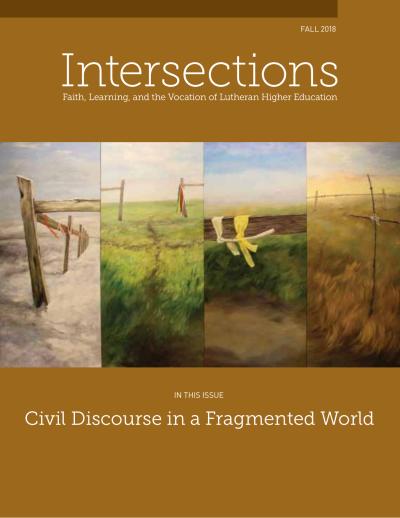
Mahn recounts how a participant’s probing questions at the 2018 Vocation of a Lutheran College Conference turned “civil discourse” from an innocuous theme into a contested one — and previews essays that variously urge listening and common ground, or speaking truthfully even when those words sound angry.
-
 Article
Hope in a Period of Economic Decline
Rebecca Judge
No. 32 · Spring 2010
Judge reads the 2008-2009 recession against the panic-free 1982 downturn and argues that this panic comes from the genuine surprise of a generation that had been told—by George Will and others—that business cycles had been tamed by deregulation, globalization, and Greenspan. Drawing on Luther’s “Trade and Usury” and Large Catechism, Paul Tillich, Stephen Marglin, Karl Polanyi, and Larry Summers, she critiques the “crude utilitarianism” of Homo economicus and benefit-cost analysis, finding hope in the possibility that this recession will renew a national conversation about moral obligation to neighbor in a market whose “raging bull” has broken out of its squeeze chute.
-
 Reflection
Why All This Talk About Vocation?
Madyson Ray
No. 56 · Fall 2022
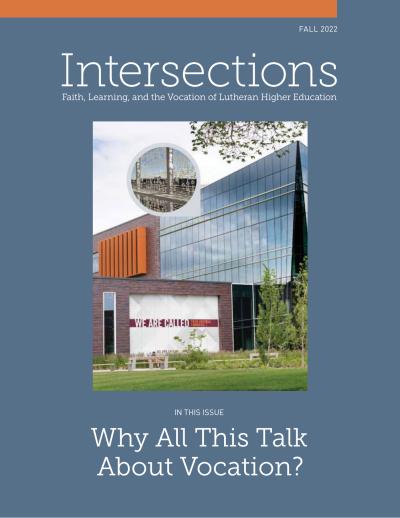
Ray, a junior at Midland University and the only student attendee at the 2022 conference, reflects on four workshops — on teaching womanist thought, on supporting student-athletes, on resistance to the word “vocation,” and on vocational reflection — and brings home concrete ideas including a women’s-history scavenger hunt and semester-long vocational reflections.
-
 Article
Journey Conversations
Amy Zalik Larson, Sheila Radford-Hill
No. 40 · Fall 2014
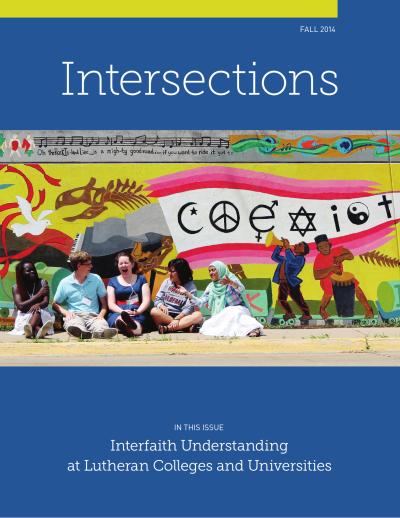
Larson and Radford-Hill describe Luther College’s Journey Conversations Project, a four-phase contemplative practice — quiet, listen, speak, respond — rooted in the Lutheran call to be true to one’s own faith while welcoming all faiths or none, and illustrate its fruit through faith journey stories from Luther students Sukeji Mikaya (South Sudan), Habibullah Rezai (Afghanistan), and Gifty Arthur (Ghana).
-
 Editorial
The Vocation of a Lutheran College: Some Transitional Thoughts
James M. Unglaube
No. 4 · Winter 1998
Unglaube offers final reflections on thirty years in Lutheran higher education as he leaves the ELCA Division for Higher Education and Schools to join Carthage College, his alma mater. He recalls colleague Richard Solberg’s influence, the closing of Upsala College in 1995, the Higher Education and Namibia program shared with Naomi Linnell, the growth of endowments from $70 million to $1 billion in 25 years, and the Vocation of a Lutheran College project he credits Paul Dovre with inspiring. He likens the twenty-eight ELCA colleges to flowers on a rose bush—same Lutheran tradition, each blossom different—requiring constant nurture if the partnership between church and college is to thrive.
-
 Article
Affirming, Entrusting, and Acting: A Baptismal Grounding of Affirmative Action in Lutheran Higher Education
Peter Carlson Schattauer
No. 60 · Fall 2024
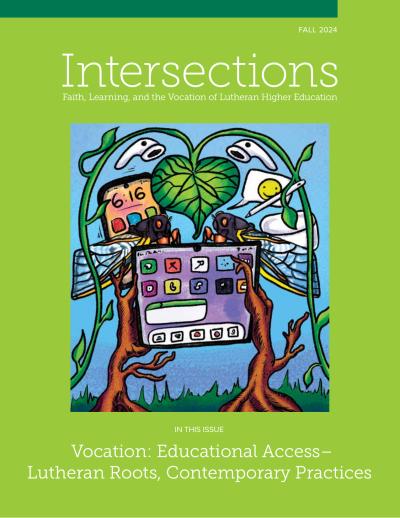
Schattauer draws on the Lutheran baptism liturgy — where the gathered assembly publicly affirms what it is for and is entrusted with responsibilities for justice and peace — to argue that NECU institutions create truly inclusive communities by affirming commitments, naming responsibilities, and acting in ways that embody both.