“It’s a beautiful day in the neighborhood, a beautiful day for a neighbor.
Would you be mine? Could you be mine?
…I have always wanted to have a neighbor just like you,
I’ve always wanted to live in a neighborhood with you.
So let’s make the most of this beautiful day; since we’re together we might as well say,
Would you be mine? Could you be mine? Won’t you be my neighbor?”1
The lyrics of the theme song to Mister Rogers’ Neighborhood shaped my worldview and have served as a sort of walk-up song for my work in higher education. I resonate with the language of neighbor and the effort to find beauty and belonging in each neighbor and neighborhood. Mister Rogers seemed to know everyone in his neighborhood, and he was genuinely interested in them. He asked about their work and their lives, their hobbies and skills, what brought them joy and how they worked through difficulties they faced.
To me Fred Rogers’ show is an example–a living embodiment in televisual form–of a Lutheran understanding of vocation: to see dignity, beauty, and worth in each person you encounter; to offer your gifts generously, and with as much confidence, joy, and humility as you can muster; and to believe that the well-being of the neighborhood is intrinsically connected to the well-being of all of the neighbors.
Mister Rogers knew people my parents did not know and was willing to talk about experiences that adults often dismiss, either because they do not think children can handle it or because they think children should just get over it. In Mister Rogers I encountered an adult who was honest about the realities of death, sadness, anger, and fear. He also showed curiosity and wonder, which first required him to say something like, “I don’t know; let’s find out together.” Hopeful, humble, connected, and brave, Fred Rogers insisted that children need a place of belonging, where they can feel loved and practice loving others across all kinds of differences.
As I child I experienced a lot of firsts through Mister Rogers’ Neighborhood: my first tour through a factory, my first conversation about racism, my first explanation of the postal service, my first honest conversation about death, my first encounter with a child who used a wheelchair, my first interaction with a police officer, and many others. My mom did not like Mister Rogers’ Neighborhood; it moved too slowly for her. My dad liked the Land of Make-Believe, which was never my favorite. Both parents, however, witnessed my intense focus when Mister Rogers addressed the children, and they trusted his efforts to describe what it’s like to be human in the world.
Right now we are the ones who are trusted to describe what it’s like to be human in the world and to offer ourselves generously, with as much confidence, joy, and humility we can muster to the students we serve. It is our vocation to draw deeply on our values to offer our gifts in support collective flourishing.
Endnote
1. https://misterrogers.org/videos/wont-you-be-my-neighbor/
-
 Editorial
From the Publisher
Lamont Anthony Wells
5 min audio
Wells introduces So That All May Belong: Lutheran Roots for Diversity, Equity, Inclusion, and Justice as a theological and institutional articulation of NECU’s commitments, and previews four accompanying essays that frame vocation as a societal responsibility rooted in justice and not solely an individual pursuit.
-
Institutional Focus
So That All May Belong: Lutheran Roots for Diversity, Equity, Inclusion, and Justice
Altheia Richardson, Angie Hambrick, Caryn Riswold, Colleen Windham-Hughes, Deanna Thompson, Marcia Bunge, Robert Clay
22 min audio
The full NECU statement grounds DEIJ work in Luther’s 16th-century reforms and Lutheran theological claims about the image of God, equal dignity, and the limits of human knowing — offering definitions, Lutheran roots, and calls to action for diversity, equity, inclusion, and justice, with belonging as the outcome of DEIJ at work.
-
Institutional Focus
Scriptures That Inspire Work for Diversity, Equity, Inclusion, and Justice
Altheia Richardson, Angie Hambrick, Caryn Riswold, Colleen Windham-Hughes, Deanna Thompson, Marcia Bunge, Robert Clay
9 min audio
A companion list of biblical verses — from Genesis 1:27 and Galatians 3:28 to Micah 6:8 and Luke 4:18-19 — that grounded NECU’s drafting of So That All May Belong, organized by the four DEIJ commitments and offered as an invitation to share other texts that ground and sustain the work.
-
Institutional Focus
So That All May Belong: Lutheran Roots for Diversity, Equity, Inclusion, and Justice [abridged]
Altheia Richardson, Angie Hambrick, Caryn Riswold, Colleen Windham-Hughes, Deanna Thompson, Marcia Bunge, Robert Clay
8 min audio
A condensed version of the NECU statement that consolidates Lutheran theological grounding for DEIJ and a single combined call to action for Lutheran colleges and universities — offered as a shareable summary alongside the complete document.
-
Article
Vocation at Full Stretch: Reflections on Follow Your Bliss and Other Lies about Calling and its Use among College Students
Jason A. Mahn
43 min audio
Mahn engages Bonnie Miller-McLemore’s Follow Your Bliss and Other Lies about Calling as required reading in a sophomore religion course, showing how her categories of missed, blocked, conflicted, fractured, unexpected, and relinquished callings empower young adults to perceive embodied, unplanned, and often painful dimensions of life as essential parts of vocation — and help close the gap between mission-driven and tuition-driven realities.
-
Article
How Mister Rogers’ Neighborhood Reminds Us About Work
Than Oo
5 min audio
Drawing on a Season 15 arc of Mister Rogers’ Neighborhood in which residents redirect pool funds to fix a plumbing problem, Oo finds in Fred Rogers’ vocation-honoring storytelling a reminder that limited resources are an invitation to creativity, perseverance, and optimism in higher education.
-
Reflection
Ecotones of Faith
Tracy Paschke-Johannes
7 min audio
Paschke-Johannes draws on the ecological metaphor of the ecotone — the life-teeming transitional space between two ecosystems — to claim that we are not called to minister in the world of the past or one fifty years hence, but to nurture the kairos moments God is creating in the freshwater-to-saltwater present.
-
Article
Finding the Miracle in the Intersection of Mission and Limitations: Lessons from Latin America
Kat Peters
14 min audio
Peters draws on her time interning with Lutheran World Relief and leading a study abroad program in Central America — including a Costa Rican women’s farm cooperative whose ecotourism project was “unprofitable” but life-giving — to argue that the intersection of God’s preference for struggle and God’s desire for abundant life is itself the miracle higher education can claim amid scarcity.
-
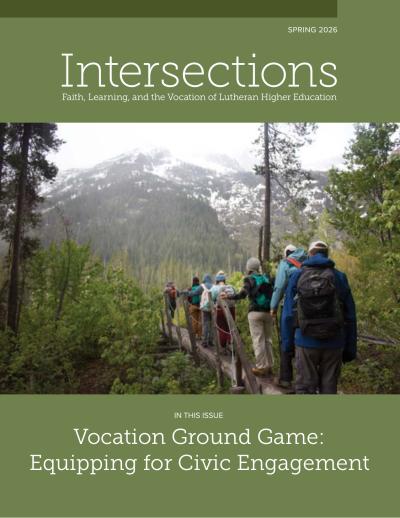 Editorial
From the Publisher & Editor
Colleen Windham-Hughes, Lamont Anthony Wells
No. 63 · Spring 2026
6 min audio
Wells and Windham-Hughes frame vocation as “ground game” — the practical, public living-out of faith through civic engagement — and introduce the issue’s focus on how Lutheran higher education equips students to repair the world.
-
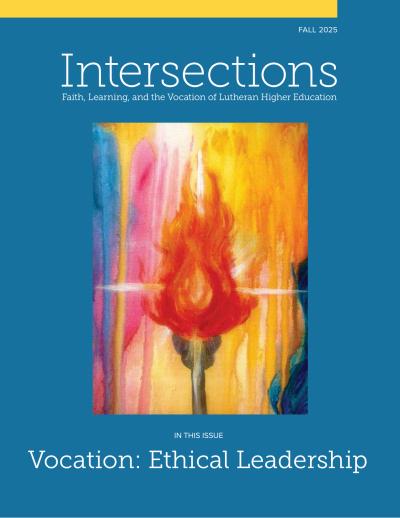 Editorial
From the Editor
Colleen Windham-Hughes
No. 62 · Fall 2025
5 min audio
Windham-Hughes plays on the shared Latin root of “education” and “seduction” (ducere, to lead) to warn against the No-saying seductions of giving up or condemnation, and to call educators to the riskier Yes of showing up to build third-space communities of truth-telling and hope.
-
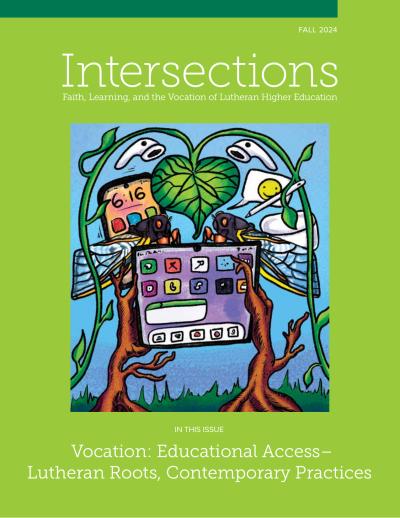 Editorial
From the Editor
Colleen Windham-Hughes
No. 60 · Fall 2024
Windham-Hughes welcomes newcomers and seasoned colleagues to the conversation, lifts up Mary Elise Lowe’s three Lutheran “whys” for educational access, and commends Rev. Jen Rude’s “Sacred Pause” practice as a way to humanize one another and make opening access both easier and more joyful.
-
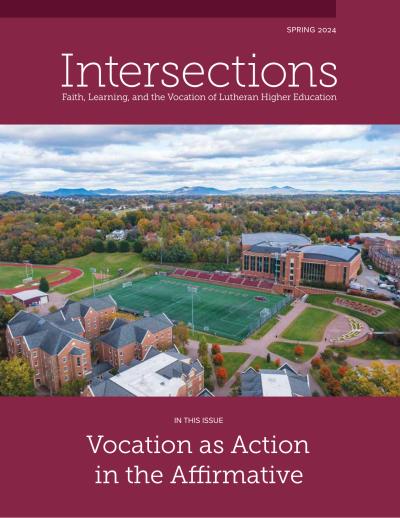 Editorial
From the Editor: Vocation as Action in the Affirmative
Colleen Windham-Hughes
No. 59 · Spring 2024
Windham-Hughes frames vocation as practicing “at the borders of our incompetence” — every small yes to the callings we experience, every effort made in the direction of life, is action in the affirmative — and previews the issue’s essays on diversity, transformation, AI, championship team culture, and dreaming big within and beyond our limitations.
-
Article
Team Culture is Key to Success: Learning from Student-Athletes
Colleen Windham-Hughes
No. 59 · Spring 2024
On a December weekend in “Championship City” Salem, Virginia, both California Lutheran’s Women’s Soccer Team and St. Olaf College’s Men’s Soccer Team won NCAA Division III national titles. Windham-Hughes talks with coaches, faculty mentors, and student-athletes about how off-the-field team culture — built on trust, relationships, and shared why — translates onto the pitch and into liberal arts and sciences education.
-
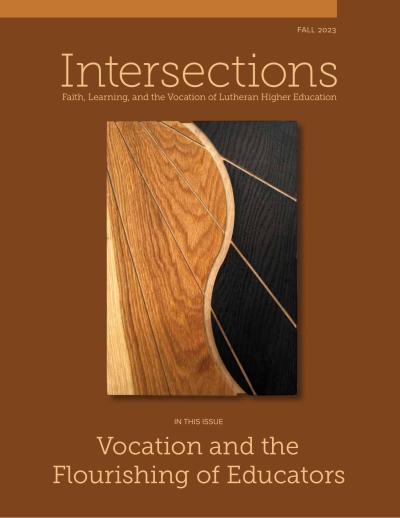 Editorial
From the Editor: So That We, Too, May Flourish
Colleen Windham-Hughes
No. 58 · Fall 2023
Windham-Hughes introduces the 2023 VLHE conference theme of educator flourishing, drawing on Dr. Monica Smith’s plenary challenge — “How can we flourish if only some are centered and others are at the margins?” — and invites readers to ground themselves in Us/We, the cover art by Augustana graduate William Hatchet, and join the conversation.
-
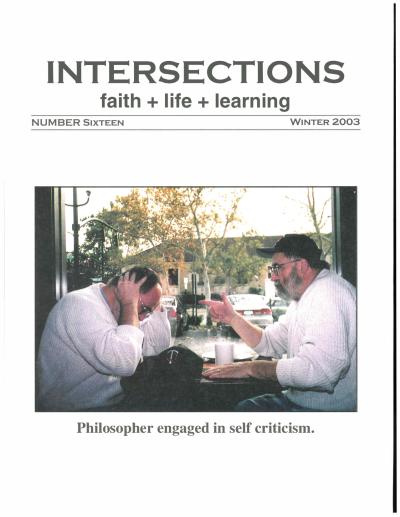 Article
The Impropriety of Jesus' Teaching: The Woman at the Well and The Vagina Monologues
Susan M. O'Shaughnessy
No. 16 · Winter 2003
O’Shaughnessy Poppe dedicates her message to those who worked to put on Eve Ensler’s The Vagina Monologues against administrative resistance and reads the Samaritan woman at Jacob’s well alongside the testimony of a Bosnian rape survivor whose story Ensler asked to tell, arguing that the “impropriety” of Jesus—his scandalous recognition of those silenced by sexism, racism, war, custom, and the church—is the model for the mission of a college of the church to defend academic freedom and to break the chains of oppression by inflicting discomfort on the proper and pure.
-
 Article
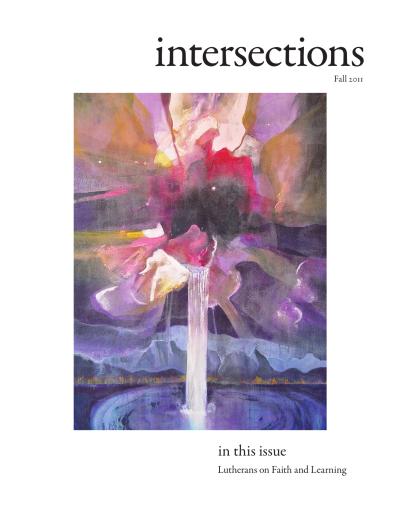
Gift and Calling: A Lutheran Perspective on Higher Education
Darrell Jodock
No. 34 · Fall 2011
Jodock argues that a Lutheran perspective on higher education rests on three underlying ideas—that we are gifted (a giftedness that calls forth wonder, awe, gratitude, a sense of humor, and vocation as response to neighbor); that the Lutheran tradition affirms a particular kind of God who is down-to-earth and at work in the world for justice and human wholeness; and that a Lutheran “third path” can be both rooted in the tradition and inclusive of others. He draws out ten implications for higher education, from wonder as the heart of religion through liberal learning oriented toward the freedom of its members.
-
 Article
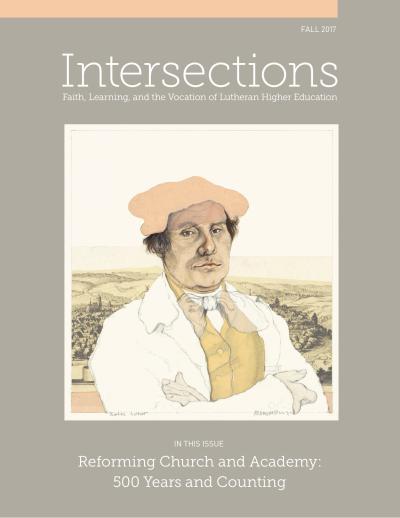
Luther's Sutra: An Indian, Subaltern (Dalit) Perspective
Surekha Nelavala
No. 46 · Fall 2017
Nelavala traces how Luther’s “sutra” — grace alone, faith alone, scripture alone, Christ alone — reached the mud hut of her Dalit grandparents in rural India, transforming three generations, and then reads the parable of the vineyard laborers from a subaltern perspective in which grace for all is the heart of God’s alternative kingdom.
-
 Book Review
Reviews
Matthew J. Marohl
No. 26 · Fall 2007
Marohl reviews two 2006 Lutheran University Press volumes from Grand View College (Des Moines, IA). Mark C. Mattes and Ronald R. Darge’s Imaging the Journey … of Contemplation, Meditation, Reflection, and Adventure pairs Mattes’s Lutheran meditations on seven themes (from a spirituality of communication to Alpha and Omega) with Darge’s photographs and Ronald Taylor’s short prayers, with Mattes’s writing on vocation singled out as the volume’s finest. The Grand View College Reader, edited by Mattes, Evan A. Thomas, Kathryn Pohlman Duffy, and Ronald Taylor, surveys the college’s Foundations, Creativity, and Vocation through chapters by Thorvald Hanson, Kenneth Sundet Jones, Kevin Gannon, Ammertte C. Deibert, Steven Snyder, and President Kent Henning, tracing Grand View’s Grundtvigian and Danish Lutheran roots.
-
 Article
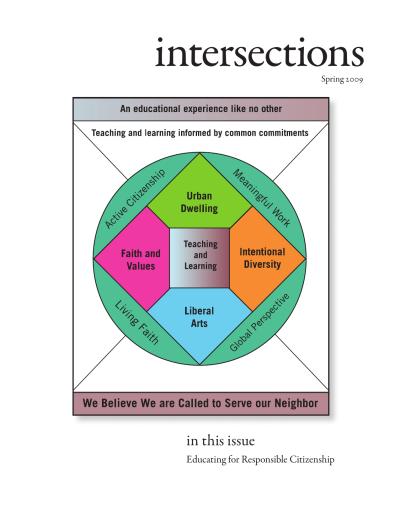
Dual Citizenship: Reflections on Educating Citizens at Augsburg College
Paul C. Pribbenow
No. 29 · Spring 2009
Pribbenow argues that the vocation of Augsburg College is to educate “dual citizens”—those able to live within the messiness of common work rather than resolve every tension once and for all. Drawing on John Courtney Murray on democracy as “the intersection of conspiracies,” Bill Moyers, Jean Bethke Elshtain, Stephen Carter, and the Augsburg vision statement “We believe we are called to serve our neighbor,” he names four common commitments and five principles of civic education that ground Augsburg’s incarnational mission in its city neighborhood.
-
 Article
From Pietism to Paradox: The Development of a Lutheran Philosophy of Education
Philip Nordquist
No. 8 · Winter 2000
Nordquist traces a four-decade personal and institutional journey from the “Protestant triumphalism” and aggressive moralism of S. C. Eastvold’s 1950s Pacific Lutheran through the 1960 Ditmanson–Hong–Quanbeck volume The Christian Faith and the Liberal Arts, Gordon Lathrop’s 1972 PLU donor address grounding the university in two-kingdoms theology, the ALC’s 1975 Concordia workshop with Bill Narum, Bob Bertram, Harris Kaasa, and Sydney Ahlstrom’s case for the “critical” tradition over the scholastic and pietistic, the 1976 LCA statement distinguishing “Christian” from “church-related” education, and Richard Hughes’s 1997 Carthage address. He concludes that dialectical (two kingdoms) theology, Christian humanism alongside professional studies (the New American College model), Luther’s commitment to universal compulsory education, environmental and civic responsibility, and academic freedom together constitute the bequest of the Reformation—“Christ and culture in paradox” remains the best approach to education he knows.