Mark Schwehn begins his address with Otto Paul Kretzmann’s statement, given in October 1940, on Lutheran higher education: “We are committed to the principle that the destiny of a Christian University lies in the quality of the men and women who are graduated from its halls rather than in quantitative production.” This commitment is the present commitment. How we define the quality we wish to promote varies over time and statement. Augustana College has been debating its present mission statement; what has triggered the debate this time is its length: too unwieldy, say some board and faculty members. I was a faculty representative on the large committee which developed that, yes, unwieldy statement. And the attempts to shorten the statement and yet encompass our mission stalemated. The 1994 Bush faculty, administration, and staff fall workshop started our defining process once again. Launching a productive year of discussion, the Mission and Values committee, led by religion professor Dr. Arthur Olsen, reached out to different constituencies and asked them to define Augustana’s values. Augustana’s named values are Christian, Liberal Arts, Community, Excellence, Service.
I know we are not only watching ourselves, but we are being watched.
Two values that particularly distinguish our mission are Christian and Community. We have elaborated each value word as it interprets the college mission. We are Christian by being a college of the Evangelical Lutheran Church in America. We believe in Community by caring for one another and our environments. Community has further meanings of responding to needs, respecting human differences, empowering one another, tending to the ecology of place. The committee recommended a systematic review of college policies, procedures, and programs to determine whether they are currently reflecting the values statement. President Ralph Wagoner uses Augustana’s fundamental values in his address to college groups and prospective students.
We continue to consider and revise our mission statement. In time we will probably alter the particular language of the mission statement, but the values will remain constant. The task of the Mission and Values Committee followed the critical self-examination conversations by ELCA Region III colleges on “What Does It Mean to be a College of the Church?” Augustana’s local committee called itself the T’N’T—Through Thick and Thin—and organized four discussions as well as hosted a major symposium entitled “World, Tradition, and Task.” The act of naming our fundamental values is itself powerful.
Yet I hear distinguished colleagues sadly voice their opinion that we do not know who we are or what we are about or that we are just now slowly getting back on track. Critics merit respect. A woman professional in my hometown, when learning I taught at Augustana College, pointedly said, “I hope Augustana knows what it’s about. Some colleges don’t.” Her sons had graduated from another Christian liberal arts college. I replied, “We discuss our mission constantly.” I know we are not only watching ourselves, but we are being watched.
At the faculty conference on the vocation of a Lutheran college, the discussion of Lutheran identity and the movement to the secular rather surprised me. Lutherans make up 56% of Augustana’s student body; Roman Catholics make up 17%. Christmas Vespers is presented in both Our Savior’s Lutheran Church and St. Joseph’s Cathedral. We have daily chapel at 10:00 am, the center point of the academic day. The decision to maintain daily chapel, to have a student congregation of the Evangelical Lutheran Church in America is important to our tradition and to our identity. Augustana has strong outreach teams and a church and college coordinator. For many faculty, worshiping and communing together is central to campus life. It is a fact that many students use chapel time for “power naps,” breakfast, or study. It is a fact that some faculty want to replace the 10:00 am chapel time with classes. And chapel attendance varies with semester stresses. However, daily chapel helps define the shape of our institution. Even those who pass by the chapel as the Carolines ring across campus know that faith is a defining element of our college. What we uphold is literally in the air and part of our Christian landscape. The mind stores these associations.
Schwehn calls on Lutherans “to preserve and extend crucial interpretations of the Christian faith.” We are, he further maintains, “voices within a conversation” of Christian colleges and universities. Yes, we are places emphasizing the freshness and the vital energy of the Gospels. Breathing a freshness into students’ belief is what Lutheran higher education is about. In her chapel talk, Kayci Emry, Augustana senior, explained how her faith expanded over four years. She defined herself as one who had loved the fences, the spiritual rules that kept her right and safe. She spoke about coming to freedom, the freedom of the open gate and the awaiting Good Shepherd. Our colleges have the privilege to talk about the soul and the mind.
Augustana struggles with enlarging the number of voices in our conversation. Native American voices define our area and need to be heard in our college. We have succeeded in part and failed in part to hear them. We have had rich connections with the Jewish voices in our community, but our connections are intermittent. We have reached out in dialogue with the Islamic voices in the city and in the region. They are old voices in our region, but new voices to our awareness.
Augustana College faculty collaborate on Capstone classes, inviting students into conversations on moral and aesthetic issues. These conversations center on two questions: How shall we live in the face of fundamental moral and aesthetic issues? And how can we live as responsible members of church and society? Course titles show the richness of the questions: An Invitation to Care: Issues of Life, Health, Death; Light in the Darkness: Courage and Evil in the Twentieth Century; The Land: Perspectives and Challenges; Odysseys of the Spirit; and Forced Options: Business, Technology, Values.
In the March 1996 issue of the journal College English, Jeff Smith reviews recent critiques of American higher education. Smith feels that although students voluntarily and consciously choose to go to college, few understand why they’re there. So the message of our mission must be repeated, again and again, messages that are particular to our places.
Otto Paul Kretzmann’s 1940s speech still reflects our core message: that our colleges and universities stand for things unchangeable in the midst of chaos, that our colleges and universities stand for the belief that evil will not triumph over good ultimately, that our colleges and universities stand for the belief that equipped with knowledge, understanding, and some wisdom, our men and women will exert a difference.
Works Cited
Smith, Jeff. “Review: Why College?” College English Vol.58, #3. March 1996.
-
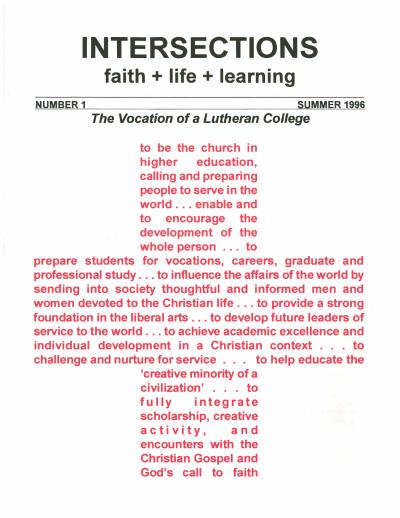 Editorial
From the Publisher
James M. Unglaube
Unglaube welcomes readers to the inaugural issue of Intersections, crediting Editor Tom Christenson and Capital University, and announces the new annual Vocation of a Lutheran College Conference whose continuing dialogue the journal exists to enhance. He gives thanks to the Lilly Endowment for a sizable grant supporting the 1996 conference, campus dialogues, and the birth of the publication.
-
Editorial
From the Editor
Tom Christenson
Christenson, feeling like a proud parent, welcomes readers to the inaugural issue and acknowledges three people without whom the publication would still be just an idea: Naomi Linnel of the ELCA office for Higher Education and Schools, publisher Jim Unglaube, and Capital University president Josiah Blackmore. He invites readers’ reactions, suggestions, and active involvement as editors, reviewers, authors, artists, and critics in shaping the dialogue across the ELCA college and university family.
-
Article
The Future of Lutheran Higher Education
Mark Schwehn
Schwehn’s keynote, framed against Otto Paul Kretzmann’s October 1940 inaugural at Valparaiso, organizes itself around four topics: the idea of a Christian University (Lutheran schools as a tributary of the Christian intellectual tradition, voices in a conversation in the spirit of H. Richard Niebuhr and Alasdair MacIntyre rather than phases of James Burtchaell’s devolutionary scheme); the pursuit of truth (against Foucauldian reduction of truth to power, with Hilary Putnam, toward a cruciform discipleship that discovers truth ambulando); the critique of knowledge (developing Christian theories of knowing in conversation with Benne, Lotz, Wolterstorff, LeClerc, and Augustine); and Christianity and liberal learning (objectivity refurbished as Thomas Haskell’s ascetic self-discipline, and the recovery of texts that have claims upon us).
-
Response
"Whose Future?" or "Social Justice and the Lutheran Academy?"
Marsha Heck
Heck argues that the future of Lutheran higher education lies less in defining Lutheran distinctiveness than in moral action grounded in face-to-face relationships with others. Drawing on David Lotz’s two-kingdoms theology of citizenship, Ernest Simmons’s relational reading of Luther, Arthur Preisinger’s indictment of the German Lutheran misreading of two kingdoms during the Third Reich, Starla Stensaas of Dana College, and Paulo Freire’s dialectic of empowerment, she calls Lutheran colleges to integrate moral reflection with moral action—to move students’ muscles against what is not true as well as to feel truths in their bones.
-
Response
Knowing and a Tradition to be Known
Kurt Keljo
Keljo, University Pastor at Capital, embraces Schwehn’s vocational call but challenges his epistemological framing. We are called to bear witness to the Truth more than to pursue it; truth and power need not be dissociated when power is understood cruciform-ly as love and service; alongside objectivity, a case can be made from the tradition for connected knowing (image of God, idolatry, repentance, Incarnation). Christians offer not a particular epistemology but a foundation for epistemology—a tradition to be known. He closes with James Fowler’s four marks of the “public church”: particularly Christian, prepared for pluralism, balancing intimacy with public engagement, and unafraid of ideological pluralism in confident, nondefensive civility.
-
Response
Lutheran Colleges: The Context for the Conversation
Thomas Templeton Taylor
Taylor of Wittenberg engages Schwehn’s first argument by sketching the institutional predicament of Lutheran colleges through three converging forces: the collapse of differences among old-line Protestant groups in the wake of ELCA-era ecumenism (with Robert Wuthnow); the secularization of American higher education described by George Marsden; and the post-war decline of liberal arts colleges under pressure to professionalize. The result is an “in-between stage” in which Lutheran colleges retain rhetoric without substance. Following Richard John Neuhaus’s “Eleven Theses,” he argues that, for a time at least, Lutheran colleges’ institutional affiliations must remain actively Lutheran if they are to remain in any sense Christian.
-
Response
Renewing Our Journey: Some Thoughts on Pursuing the Truth
John Rehl
Rehl, a Capital University graduate pursuing doctorates in theology at Chicago and in economics at Wisconsin, takes up Schwehn’s invitation to think again on the nature of truth. He sets aside truth as information, as object, and as mere words; recasts the church-related college’s task as a renewed emphasis on classroom teaching (Kierkegaard’s teacher as midwife) and on brave, articulate professors. He calls for moral education in courage, discipline, patience, and love, illustrates the costs of the fact-value split with examples from economics, and argues that we honor Lutheran heritage not by preserving it as a museum piece but by testing it—Luther’s theology of the cross over a theology of glory—and by preparing students for a world of Untruth, strengthened (with Julian of Norwich) by the promise that they will not be overwhelmed.
-
Institutional Focus
Diversity and Dialogue: Gustavus Adolphus College
Florence D. Amamoto
Amamoto, a third-generation Japanese-American Buddhist who teaches American literature at Gustavus Adolphus and regularly attends daily chapel, writes as an “inside outsider.” Engaging Schwehn’s closing call to refurbish the Lutheran college, she argues that church-related colleges are vitally important to society, that “refurbishing” must take up diversity, and describes how Lutheranism is manifest at Gustavus: Christ Chapel as the highest point on campus, the ecumenical chapel program led for thirty years by Chaplain Richard Elvee, the Nobel Conferences that pair scientists with philosophers and theologians, the First-term Seminar and Tuesday Conversations, the India study-abroad program organized by Deane Curtin, and the Sponberg Chair in Ethics. She names the pressures of money, secularization, and the publications-driven push for “excellence” that threaten this creative tension.
-
 Article
Cultivating Staff Flourishing in Lutheran Higher Education: A Framework for Advocacy and Engagement
Laree Winer
No. 58 · Fall 2023
Winer narrates her own “love affair” with Lutheran Higher Education to argue that the heart of the tradition — vocation, de-emphasized hierarchy, and shared humanity — equips NECU institutions to advocate for staff flourishing through data collection, professional development, and ongoing relational commitment.
-
 Article
What Does Ethical Leadership in a Changing World Require?
Kristina Frugé
No. 62 · Fall 2025
5 min audio
Frugé argues that ethical leadership in a changing — perhaps ending — world means cultivating trustworthy communities through patient, co-created relationship work, drawing on her experience stewarding the writing community behind Hungry for Hope: Letters to the Church from Young Adults.
-
 Editorial
From the Editor
Tom Christenson
No. 6 · Winter 1999
Christenson explains that three of the five papers from the 1998 Wittenberg Vocation of a Lutheran College conference appear here (with Robert Scholz and Cheryl Ney to follow in the next issue), passes on Andy Sheppard’s “Books for Belarus” appeal from Southwestern College, and reflects on Douglas John Hall’s The End of Christendom and the Future of Christianity—its claim that disengagement from cultural dominance is the prerequisite for faithful re-engagement, and its retrieval of Christ’s metaphors of “a little salt, a little yeast, a little light” as a possible session topic for a future VLC Conference.
-
 Article
Journey Conversations
Amy Zalik Larson, Sheila Radford-Hill
No. 40 · Fall 2014
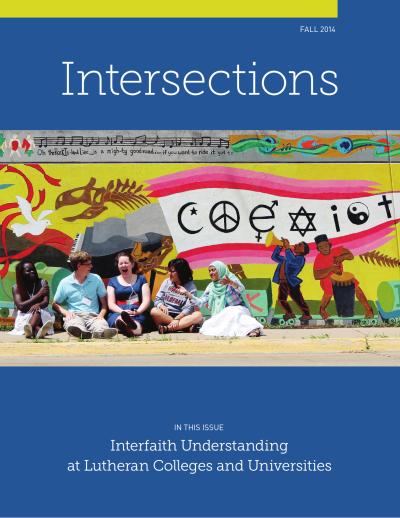
Larson and Radford-Hill describe Luther College’s Journey Conversations Project, a four-phase contemplative practice — quiet, listen, speak, respond — rooted in the Lutheran call to be true to one’s own faith while welcoming all faiths or none, and illustrate its fruit through faith journey stories from Luther students Sukeji Mikaya (South Sudan), Habibullah Rezai (Afghanistan), and Gifty Arthur (Ghana).
-
 Book Review
Assessing the Value of Liberal Arts: A Review of The Evidence Liberal Arts Needs, by Richard A. Detweiler
Robert D. Haak
No. 55 · Spring 2022
Haak reviews Richard A. Detweiler’s The Evidence Liberal Arts Needs, in which the former president of the Great Lakes Colleges Association analyzes 240 college mission statements and interviews more than 1,000 graduates to argue that liberal arts educational experiences have a measurable impact on adult lives of consequence, inquiry, and accomplishment — and invites NECU institutions into a further conversation about how Detweiler’s methodology applies to Lutheran higher education.
-
 Article
What Could the Lutheran Colleges and Universities Contribute to the ELCA Discussion of Sexuality—But What Would They Actually Contribute?
Robert Benne
No. 22 · Spring 2006
Benne hopes that Lutheran colleges might model fair moral discourse on sexuality by gathering a balanced mix of what James Davison Hunter calls “orthodox” and “progressive” voices from religion and social-science faculties, with the Great Tradition treated as the default position. He doubts this is what would actually happen: citing Klein, Stern, and Western’s research showing a ten-to-one liberal-to-conservative ratio in social-science and humanities associations, he suspects Lutheran faculties skew further left than other private colleges and would simply reinforce the ELCA’s already-progressive seminary and churchwide leadership.