Finding the Miracle in the Intersection of Mission and Limitations: Lessons from Latin America
Intersections No. 61 · Spring 2025
Those of us who work with university students know that many of them struggle to find a balance between living into their values and ideals and finding a career and a life that will support them financially. Should I be an aerospace engineer, or should I find a way to bring potable water to Africa? How do I live out my sociology degree—by working with former prisoners in their re-entry challenges, or by pursuing advanced degrees and a tenure-track teaching job?
This same search for balance is one that is plaguing the field of higher education as a whole: how do we as institutions of learning live into our values and mission, while also surviving financially? Do we need to sacrifice our ideals in order to pay the bills? If we prioritize our idealistic missions, do we automatically give up financial stability?
These are, at their core, vocational questions. Vocation—the crossroads between our mission and purpose and our real world opportunities, limitations, and challenges.
Our Lutheran institutions of higher learning are not unique in our struggle to understand the continuum between fulfilling our missions while also capturing enough tuition and funding in order to survive. In times of social upheaval and change, many organizations, communities, and individuals grapple with how to move forward on important projects with uncertain levels of sustainability.
“This same search for balance is one that is plaguing the field of higher education as a whole: how do we as institutions of learning live into our values and mission, while also surviving financially? Do we need to sacrifice our ideals in order to pay the bills? If we prioritize our idealistic missions, do we automatically give up financial stability?”
When our institutions need to accept changes to structure, size, and academic offerings, our students may wonder if their education and co-curricular experiences are of the quality that they had been promised. I have heard from students about this precise question, even while I work with other students whose post-graduation plans are currently derailed due to uncertainty about federal civil service and nonprofit jobs.
I have been thinking about how a few of my experiences with Lutheran nonprofits, as well as my time leading a study abroad program in Central America might have something to say to us in higher education as we navigate current challenges and as we counsel students to consider the balancing act that is purpose and real-world limitations.
Lately, as I have watched the news, I am reminded of the summer I spent in Washington, DC, interning at the public policy advocacy office of Lutheran World Relief (LWR). It was the summer of 2005, when the Central American Free Trade Agreement (CAFTA, which I had been told by communities in El Salvador and Nicaragua was going to be very harmful to them and their livelihoods) passed through Congress in an after-midnight vote after several members of Congress changed their votes due to strong-arming by the Bush administration. Plan Colombia, the main focus of LWR’s advocacy work at the time, was sending US weapons and Round-Up chemicals to disrupt coca production in marginalized farming communities, hurting Afro-Colombian Lutherans there.
The mission of LWR was to defend Lutheran communities from harm caused by U.S. policy in Latin America. The reality was that heavily funded interests could sway members of Congress, and LWR just didn’t have the budget to compete. However, Midwestern Lutherans in the Sal y Luz solidarity network, along with LWR staffers in Washington, used their voices to communicate the message of peace to strategic Congressional leaders. I remember an LWR colleague, exiled from Colombia at that time, telling me as we walked briskly up Capitol Hill for a meeting of the Congressional Black Caucus, “We may not have the money of K-Street, but we have good information that we can provide to members of Congress at the right time, to make real change”. In fact, while I was in Washington, the now-late South Dakota Senator Tim Johnson (an ELCA Lutheran) proposed a change to Plan Colombia based on what he was hearing from Lutherans in his state.
”We may not have the money of K-Street, but we have good information that we can provide to members of Congress at the right time, to make real change.”
—A lesson learned from a Lutheran World Relief colleague
The money that LWR did not have meant it needed to rely on regular people and their relationships of solidarity, which both reflected and built community in the Midwest and across the Americas.
It was that experience that taught me that fulfilling a big mission does not require exorbitant budgets, but rather dedicated, thoughtful people who respond to a call with listening and caring hearts, and strategic action. It was also an experience that convinced me that cross-cultural education and solidarity work are just as important as direct advocacy on Capitol Hill, a lesson that led me to work in study abroad in Central America at the Institute for Central American Development Studies (ICADS).
“It was that experience that taught me that fulfilling a big mission does not require exorbitant budgets, but rather dedicated, thoughtful people who respond to a call with listening and caring hearts, and strategic action.”
One more story, this time from the Caribbean coast of Costa Rica. This is where a small cooperative of rural women had received funding from the United Nations to build cabins for ecotourism which is a strategy formed worldwide to help address the decline in incomes from agriculture facing so many small farmers. At this particular farm, called El Yüe (named after a tree commonly found in the area), a study abroad student in economics gathered information on the various economic projects of the farm: organic banana production; a plant nursery; subsistence production of pigs, chickens and vegetables; and now ecotourism (food, lodging, and tours). The students aimed to provide information to the organization on how they could be more efficient and more profitable at their ecotourism project: How they could increase income in order to fulfill their mission?
In my opinion, what the student found was groundbreaking. First, he concluded that the farm was not efficient nor profitable in their ecotourism project. The cabins did not necessarily increase the farm’s overall income, but they did increase their stability, their community connections, and their ability to support local families. He found that time not spent on marketing the ecotourism project (a suggestion for improvement he was prepared to make) was actually spent doing community-building programs in the El Yüe library on literacy, self-esteem, recycling, and handicrafts. He also found that the diversified economic activities of the farm sustained the organization through the volatile tourism high and low seasons, climate change impacts on banana plants, and other disruptions and crises. The ecotourism project was treated like, and integrated into all of the other economic activities of the farm–one of many that contributed to the bigger economic and communal mission of the organization.
”He also found that the diversified economic activities of the farm sustained the organization through the volatile tourism high and low seasons, climate change impacts on banana plants, and other disruptions and crises.”
In my story above, did Lutheran World Relief achieve the repeal of Plan Colombia and raise enough money to feel relaxed and confident on Capitol Hill? No. Did they fulfill their mission to engage US Lutherans in advocacy in order to build solidarity networks and impact the lives of Colombians for the better? Yes.
Did the women at El Yüe achieve sustainable economic independence through transitioning from farming to ecotourism? No. Did they increase their economic stability while also building community, educating visitors, and maintaining their tropical forest biodiversity and organic banana production? Yes.
Were these two organizations able to rest on their laurels, with mission accomplished? No. Were they able to keep up their good (and difficult) work, sustained with a purpose that brought them joy and a community that supported them? Yes.
The main lessons I take away from these two stories, which I think can inform our work in higher education both at the institutional level and the student-facing level, are threefold:
There are unfair discrepancies in access to resources in the world, and many times those organizations that are working on education, peace, and well-being for the vulnerable are on the losing end of that discrepancy. This is a reality we must face, and one that we must work to change.
A lack of resources does not mean the mission of such organizations is misguided (though missions can and should be continually evaluated), nor does it mean that the mission is unattainable. We know this, intellectually, but our fear of scarcity often causes us to forget.
Creativity, grit, hard work, and strategic employment of the resources we do have can lead not only to the achievement of the mission, but can open up new understandings of the mission that make the purpose of our work more integrated, more communal, more life-giving, and more beautiful.
“A lack of resources does not mean the mission of such organizations is misguided (though missions can and should be continually evaluated), nor does it mean that the mission is unattainable. We know this, intellectually, but our fear of scarcity often causes us to forget.”
As Lutherans, we know that God’s salvific work did not happen in a place of wealth and luxury, but rather in a place of struggle and seeming defeat. We also confess as Lutheran Christians that we believe that God desires abundant life for all. My experiences in Washington, DC, and in Latin America have taught me that these two beliefs of ours are not at odds with each other, but rather their intersection is the miracle: in the places of struggle, lack of resources, and limitations, we find abundant, creative, and beautiful life that gives us strength to go on.
What does this mean for our institutions of higher education and our work with students? I think it means that we don’t have to be afraid of limitations or uncertainty, and we don’t have to give up our mission in the face of a lack of resources. We can return to our mission, our purpose, our calling, and see how the creativity that our limitations call out of us leads us into something more life-giving than we could have imagined.
-
 Editorial
From the Publisher
Lamont Anthony Wells
5 min audio
Wells introduces So That All May Belong: Lutheran Roots for Diversity, Equity, Inclusion, and Justice as a theological and institutional articulation of NECU’s commitments, and previews four accompanying essays that frame vocation as a societal responsibility rooted in justice and not solely an individual pursuit.
-
Editorial
From the Editor
Colleen Windham-Hughes
5 min audio
Windham-Hughes uses Fred Rogers’ neighborhood as a living embodiment of a Lutheran understanding of vocation — seeing dignity in each person, offering one’s gifts generously, and trusting that the well-being of the neighborhood is intrinsically connected to the well-being of every neighbor.
-
Institutional Focus
So That All May Belong: Lutheran Roots for Diversity, Equity, Inclusion, and Justice
Altheia Richardson, Angie Hambrick, Caryn Riswold, Colleen Windham-Hughes, Deanna Thompson, Marcia Bunge, Robert Clay
22 min audio
The full NECU statement grounds DEIJ work in Luther’s 16th-century reforms and Lutheran theological claims about the image of God, equal dignity, and the limits of human knowing — offering definitions, Lutheran roots, and calls to action for diversity, equity, inclusion, and justice, with belonging as the outcome of DEIJ at work.
-
Institutional Focus
Scriptures That Inspire Work for Diversity, Equity, Inclusion, and Justice
Altheia Richardson, Angie Hambrick, Caryn Riswold, Colleen Windham-Hughes, Deanna Thompson, Marcia Bunge, Robert Clay
9 min audio
A companion list of biblical verses — from Genesis 1:27 and Galatians 3:28 to Micah 6:8 and Luke 4:18-19 — that grounded NECU’s drafting of So That All May Belong, organized by the four DEIJ commitments and offered as an invitation to share other texts that ground and sustain the work.
-
Institutional Focus
So That All May Belong: Lutheran Roots for Diversity, Equity, Inclusion, and Justice [abridged]
Altheia Richardson, Angie Hambrick, Caryn Riswold, Colleen Windham-Hughes, Deanna Thompson, Marcia Bunge, Robert Clay
8 min audio
A condensed version of the NECU statement that consolidates Lutheran theological grounding for DEIJ and a single combined call to action for Lutheran colleges and universities — offered as a shareable summary alongside the complete document.
-
Article
Vocation at Full Stretch: Reflections on Follow Your Bliss and Other Lies about Calling and its Use among College Students
Jason A. Mahn
43 min audio
Mahn engages Bonnie Miller-McLemore’s Follow Your Bliss and Other Lies about Calling as required reading in a sophomore religion course, showing how her categories of missed, blocked, conflicted, fractured, unexpected, and relinquished callings empower young adults to perceive embodied, unplanned, and often painful dimensions of life as essential parts of vocation — and help close the gap between mission-driven and tuition-driven realities.
-
Article
How Mister Rogers’ Neighborhood Reminds Us About Work
Than Oo
5 min audio
Drawing on a Season 15 arc of Mister Rogers’ Neighborhood in which residents redirect pool funds to fix a plumbing problem, Oo finds in Fred Rogers’ vocation-honoring storytelling a reminder that limited resources are an invitation to creativity, perseverance, and optimism in higher education.
-
Reflection
Ecotones of Faith
Tracy Paschke-Johannes
7 min audio
Paschke-Johannes draws on the ecological metaphor of the ecotone — the life-teeming transitional space between two ecosystems — to claim that we are not called to minister in the world of the past or one fifty years hence, but to nurture the kairos moments God is creating in the freshwater-to-saltwater present.
-
 Editorial
From the Publisher
James M. Unglaube
No. 1 · Summer 1996
Unglaube welcomes readers to the inaugural issue of Intersections, crediting Editor Tom Christenson and Capital University, and announces the new annual Vocation of a Lutheran College Conference whose continuing dialogue the journal exists to enhance. He gives thanks to the Lilly Endowment for a sizable grant supporting the 1996 conference, campus dialogues, and the birth of the publication.
-
 Editorial
From the Publisher
Arne Selbyg
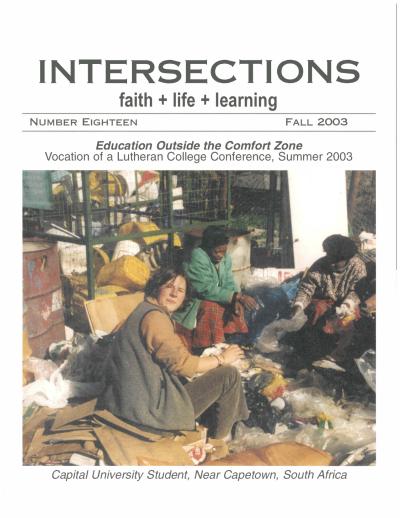
No. 18 · Fall 2003
Selbyg reports that the ELCA Church Council’s new strategic directions include the charge to “assist this church to bring forth and support faithful, wise, and courageous leaders whose vocations serve God’s mission in a pluralistic world,” and assures readers that Intersections, the Vocation of a Lutheran College conferences, and related programs will remain among the tools by which the churchwide organization reaches its strategic goals.
-
 Article
An Apostolate of Hope
David L. Tiede
No. 32 · Spring 2010
Tiede argues that the vocation of a Lutheran college is to be “an apostolate of hope” oriented by three metrics of our time: 12,000 (the Dow), 350 (parts per million of CO2), and $1.25 (the daily income of 1.4 billion people in extreme poverty). Drawing on Darrell Jodock’s “third path” for church-related colleges, Larry Rasmussen’s Batalden lectures, Mark Tranvik, Douglas John Hall, Bill McKibben, Stephen Privett, Peter Singer, and Augsburg’s Center for Global Education, he proposes that justification by faith, critical pluralism, stewardship of God’s earth, and love and justice for our students together prepare wise leaders to renew the future.
-
 Reflection
Colleges Lead Way: Curiosity, Faith, Discernment, Mission are Key
Mark S. Hanson
No. 28 · Fall 2008
Reprinted from The Lutheran (November 2007), Hanson names four marks of the colleges of this church—nurturing unquenchable curiosity, nourishing faith formation and exploration, modeling public moral deliberation, and preparing students for engagement in the world—and gives thanks for the colleges’ vocation to call us to stand outside ourselves and reach out in mission for the sake of the world.
-
 Book Review
The Information Deluge: Navigating the Digital Age with Recent Scholars
Virginia Connell
No. 39 · Spring 2014
From the reference desk at Concordia’s Carl B. Ylvisaker Library, Connell navigates Ann Blair’s Too Much to Know, Nicholas Carr’s The Shallows, Viktor Mayer-Schönberger’s Delete, and Howard Gardner and Katie Davis’ The App Generation, then describes information-literacy work at Concordia—primary-source assignments, Omeka and TimelineJS exhibits—that helps students move from app-dependent to app-enabled in the Lutheran tradition of reform.
-
 Response
Response to Mark Wilhelm: Vocation, Mission and Privilege
Marit Trelstad
No. 56 · Fall 2022
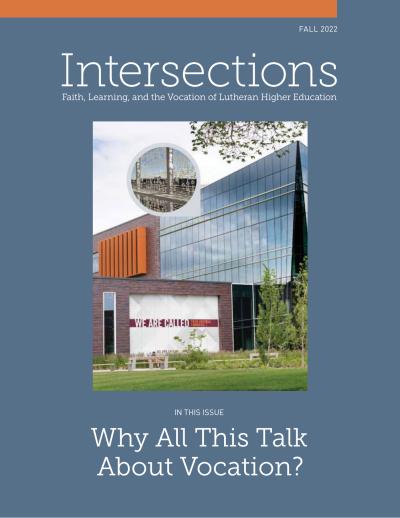
Trelstad affirms Wilhelm’s claim that vocation is the foundational shared mission of Lutheran higher education rather than one program among many, and presses the critique that calls to “vocational reflection” can mask privilege — arguing that an intersectional lens shows vocational discernment is in fact a matter of survival and flourishing for students from marginalized communities.