Celebrating the Reformation: The Lutheran Foundation of a Called Life
Intersections No. 46 · Fall 2017
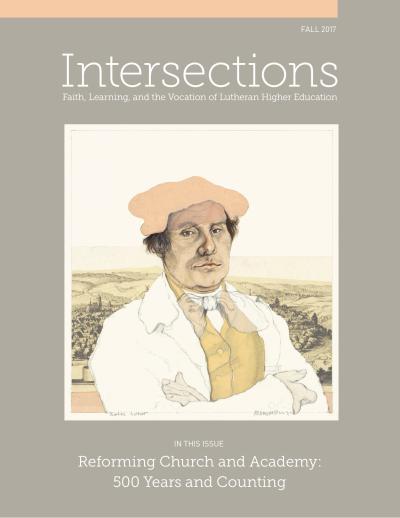
This year marks the five-hundredth anniversary of Martin Luther’s protest against the sale of indulgences. Luther was not only about objecting to the sale of salvation, he was also concerned to build a new platform for how to think about what it means to be a human being living before God and neighbor. The Lutheran tradition is grounded in something I have termed the “called life.” This means that all of life is lived within the framework of vocation or the idea that we are continuously summoned by God to love creation and our neighbors. The origin of this concept is found in the Bible and given further definition by Martin Luther. I begin this essay by looking briefly at how vocation came to be shaped by the monastic tradition. I then proceed to show how Luther’s rediscovery of justification by faith alone challenges this tradition and gives it a distinctly new shape. Finally, I describe what vocation means for our lives today as well as for Lutheran higher education in the twenty-first century.
The Monastic Impulse
In some obvious ways, it was not difficult to be a Christian in the first few centuries of the church’s existence. The Roman Empire attempted to consolidate and unify its vast holdings of lands and peoples by enforcing a common religion centered on the divinity of the emperor. Some Christians resisted this, claiming only Jesus was Lord. This often led to trouble, persecution, and even martyrdom. In other words, the idea of suffering for the sake of Christ was not some abstract ideal but a lived reality. Christians paid fines, lost jobs, sacrificed status, and even gave their lives for their faith.
By the beginning of the fourth century, the number of people professing faith had expanded significantly. Whether the cause was political expediency or an actual revelation, the Emperor Constantine converted to Christianity in 312 which led to the faith becoming legal. Later in the century it would become the only legal religion in the Roman Empire, thus laying the seeds in the west for what would eventually become known as “Christendom.”
Now Christians were faced with a new problem: what does it mean to be a Christian in a culture where Christianity is now the norm? As a result, the movement known as monasticism gained momentum. While monks and nuns had been present in small numbers since the first century, interest began to increase in a radical form of life devoted exclusively to God. The theology behind monasticism was given definition by the church father, Eusebius:
Two ways of life were given by the Lord to his Church. The one is above nature, and beyond common living; it admits not marriage, child-bearing, property or the possession of wealth…like celestial beings, these gaze down upon human life, performing a duty of priesthood to almighty God for the whole race…and a more humble, human way prompts men to join in pure nuptials, and to produce children, to undertake government, to give orders to soldiers fighting for right; it allows them to have minds for farming, trade and other secular interests as well as for religion. (Brown 205)
In the western church, it was Benedict of Nursia (480-543) who provided the monastic framework that would be followed by the many orders that developed in the middle ages. His Rule, or list of obligations for monks and nuns, mandated vows of poverty, chastity, and obedience. And it should be pointed out that the communities shaped by this ethos were remarkable places in many ways. They served as schools, hospitals, orphanages, and places of refuge. But, above all, it was monks, nuns, and priests who had vocations. They had been placed on a special path to salvation. The rest of humanity was left behind to take care of life on earth. As the church became more powerful in the middle ages, this understanding of monasticism went virtually unchallenged until the sixteenth century, the time of the Protestant reformation.
Above all, it was monks, nuns, and priests who had vocations. They had been placed on a special path to salvation.
The Challenge of Martin Luther
Martin Luther was born in 1483 in the city of Eisleben in Saxony in northern Germany. Neither of Luther’s parents had vocations at the time of his birth. His father, Hans, was a copper miner and he eventually became quite successful as the owner and operator of several mines. His mother, Margaret, managed a household, keeping track of the family, and she was also responsible for growing crops and tending to chickens and livestock. In the understanding of the church of the day, they were both members of the “lower level” of society that tended to earthly matters. The spiritual realm was the business of the three monasteries in the town.
As a young man, Luther did not have a vocation either. He was a good student, and as he progressed in his education he carried the hopes of the family. By the age of twenty-two he earned a master’s degree and now faced a decision to study for the three professions open to him: law, divinity, or medicine. Luther opted for law, probably in order to please his father. As a lawyer, he could earn a good income and perhaps even be hired as an advisor by one of the princely courts in the region.
Then came a great interruption. As he relates the story later in his life, not long after he began his legal studies he was walking home and was caught in a frightening thunder storm. Trembling, he got down on his knees and prayed to St. Anne, the patron saint of miners. He vowed in his prayer that if he were spared from the storm he would become a monk. Luther survived the thunder and lightning and, since he had made a vow, changed his life’s path and entered a strict monastery in the city of Erfurt, also in the region of Saxony. Most notably, he did not even inform his parents of his change of plans. This wounded his father severely and caused a breach in their relationship that took years to heal.
(I often pause at this point in Luther’s story when working with students or congregations. Like Luther, we often imagine our lives on some sort of path with the future, both short and long range, mapped out. And as we know, these paths are often interrupted. Sometimes these intrusions are dramatic and involve a death, serious injury or illness, or the loss of a job. In other cases, the interruption may stem from a new idea or an alternative way of looking at life. But it is important to pay attention to these “breaks” in life’s narrative. They can become significant opportunities to think about our own sense of calling and the direction we are headed.)
After his first year in the monastery, Luther took his final vows. It was stressed to him by his superiors that “not he who begins but he who perseveres will be saved.” And as time went on this phrase began to fill Luther with fear. Though he applied himself to the monastic disciplines with all the diligence he could muster, his conscience became increasingly troubled. He worshipped seven times a day. He regularly confessed his sins. He fasted for lengthy periods. But he found no peace. It should be noted that there was no shortage of grace in Luther’s life. He received Holy Communion and heard words of absolution from his spiritual advisor. But he also believed that “he had to do his part” in order to be acceptable to a holy God. Eventually he became haunted by the idea that he was not among God’s chosen. Should death come (and death was no stranger to people in that time), he was convinced that he would be engulfed by a fearsome eternal fire.
Luther’s eventual liberation came from a source outside of himself. While in the monastery, he continued to be recognized as a good student. He was selected to study the Bible and encouraged to become a teacher of Holy Scripture (he received his doctorate in 1512). It was while meditating on the Bible and especially Paul’s letter to the Romans that he gradually came to a new understanding of God. He began to realize that his attempt to make himself worthy of God’s love was a fruitless and even faithless task. God doesn’t love people because they eventually make themselves lovable with the help of grace. Rather, God’s love is for the unlovable. On the cross, Christ took upon himself all sin, and that included Luther’s sin as well. And if Luther’s sin was on Christ, then that meant it was no longer on him. If it was no longer on him, then he was free of sin. In other words, he was righteous because of Christ and not because he earned or deserved it. The new basis for his life was trust (faith) in Christ and not some watery combination of grace and good works.
But all of these ‘gods’ will eventually let us down. Beauty gives way to age. There is always someone smarter. Our wealth is haunted by fears of losing it.
(Some say that Luther’s experience is so remote from modern life. After all, most of us don’t normally fear God’s judgment or worry very often about hell. But are we really different? We also have our “gods” and they can be very demanding and merciless. For many of us our core identity revolves around things like looks, intelligence, income, status, or our “perfect” family. But all of these “gods” will eventually let us down. Beauty gives way to age. There is always someone smarter. Our wealth is haunted by fears of losing it. And most families harbor plenty of secrets that undermine any sense of perfection. As the song says, we look for love in all the wrong places. The truth is that we lead lives darkened by fear and anxiety. Is that so different from Luther?)
Vocation
So, in a great irony, Luther enters the monastic life in pursuit of the only vocation approved by the church of his day. He ends up rejecting the monk’s life as a true calling but in turn receives a genuine vocation as a preacher, teacher, spouse, and citizen. As he put it in a letter to his father (they had finally reconciled after fifteen years) in 1520:
My vow was not worth a fig…in short, it was taken in accordance with human doctrines and the superstition of hypocrites, none of which God has commanded. But behold how much good that God (whose mercies are without number and whose wisdom is without end) has made to come out of all these errors and sins (“Letter” 332-33).
Long after he married and had a family, Luther marveled at how his life unfolded:
I am the son of a peasant…and the grandson and the great grandson. My father wanted to make me into burgomaster (mayor). He went to Mansfeld and became a miner. I became a baccalaureate (college graduate) and a master (graduate school). Then I became a monk and put off the brown beret. My father didn’t like it, and then I got into the pope’s hair and married an apostate nun. Who could have read that in the stars? (Bainton 231)
So, what was Luther’s new understanding of vocation? He reasoned as follows: If God no longer needs our good works—in any sense—in order to save us, then good works must be solely for this life. That theological conviction opens the window to a new understanding of vocation. There is no longer a separate realm, closer to God, that a person attains by living out vows of poverty, chastity, and obedience. Now, according to Luther, everyone has a vocation and not just the monk, nun, and priest.
If God no longer needs our good works—in any sense—in order to save us, then good works must be solely for this life.
For Luther, there were three separate realms or spheres where callings were lived out. The first was the realm of the church. It was deeply grounded in the gracious Word found in the crucified and risen Christ. In this community, one heard and tasted the good news that God loves sinners. This love then flows out from the gathering of believers to the world and the other two realms of vocation, the domestic and civil realms. A believer was called to be a parent, spouse, and child in the home. She was also called to the world of work as a manager of the household or as a midwife. And, finally, a called life encompassed the civic realm where one looked after the common good. In other words, for Luther, vocation was always relevant. As God was active in creation, upholding and sustaining humanity, so were God’s “masks” (those living out their callings) constantly at work (labor, parenting, governing) in love and service of their neighbors.
The Called Life
Our next task is to translate Luther’s insights for a twenty-first century audience. The core idea stands: God has freed us in Christ to love our neighbors. But we can also update Luther somewhat while remaining faithful to his fundamental convictions. I often use a graphic that includes the following concepts:
OUR CALLINGS
Self
Family
Now Always Ordinary Struggle Justice/Others
Friends
Community/Citizens
Church/Community of Faith
Work
The words aligned vertically indicate the various spheres into which we are called in life. Notice there is overlap with Luther’s own vocational realms. But I have added “self” and “friends” as well. As for the former, we are both called to mind ourselves and take care of ourselves. In other words, we need to be careful that our body and its appetites do not lead us down a path of sensuality. We also need to watch what we eat, get proper exercise and rest, etc. In both the “minding” and “caring” of the body the goal is not our self-fulfillment but rather a health or wellness required to serve the neighbor.
While Luther doesn’t name friendship explicitly in his own understanding of calling, it is clear from his own life that he benefited greatly from the company of people he trusted and respected. His famous “Table Talks” are testimony to the influence of a large circle of colleagues on his thinking. In fact, in recent Luther scholarship there is a tendency to not just focus on Luther alone but rather on the “Wittenberg movement.” This new accent takes into account that Luther’s remarkable accomplishments often were dependent upon close collaboration of gifted colleagues (Arand et al).
Returning to our illustration, the horizontal terms reflect the qualities or characteristics of a calling. As mentioned, vocation is a present-tense word. You are never without one and therefore it is always relevant. Further, a sense of calling is often ordinary. This reflects a reaction against some who define vocation in a heroic way. This way of thinking suggests that a “real” calling involves something dramatic or spectacular. Of course, that might be the case, but most callings are fairly ordinary and even mundane. It might mean being patient with a roommate or visiting an aging parent. Not the stuff of headlines, but vocation is governed by the need of the neighbor or community and not necessarily by the publicity it generates.
It follows from the ordinariness of vocation that it also might mean a significant struggle. In The Freedom of a Christian, Luther stresses the need to bear the burdens of the neighbor. He envisions a love that actually participates in the suffering of the one in need (or the community in need) (“Freedom” 88). We should not be surprised that suffering is a close companion of living out a calling. Of course, we have to be careful here. Many have been told to remain in a calling and suffer because that is God’s will. (Think of the abused spouse or the poor laborer.) But the calling is to work to alleviate suffering and not rationalize it. Suffering in and of itself has no merit, but when done in love of a neighbor it might be corollary of a called life.
Attempts to domesticate vocation by identifying it with ‘bliss’ or ‘passion’ more likely have middle class comfort in mind and not the call of a first-century Jew who ended up on a cross.
Finally, a quality of the called life is a concern for justice. The called life receives its shape from Jesus of Nazareth, the one who crossed lines, offended the powerful, and reached out to the marginalized. Hence vocation is inextricably linked with sensitivity to the outsider and the forgotten. People caught up in a sense of calling ask the awkward questions and demand accountability from those in power. Attempts to domesticate vocation by identifying it with “bliss” or “passion” more likely have middle class comfort in mind and not the call of a first-century Jew who ended up on a cross.
Implications for Lutheran Colleges
I argue that the best way for Lutheran colleges and universities to embrace their identity is to affirm and embrace a robust sense of vocation. This is a topic that could easily stretch to several volumes. But let me at least highlight some of the essential qualities of such a school.
First, a college or university with a calling sees its students as made in the image of God. They might not see themselves that way, of course—some might even be offended by such a designation—but there is a great temptation for educational institutions to look upon students in an instrumental way, that is, as a means to another end. For example, I have heard language that designates students as “customers.” Well, customers are always right. The customer needs to be satisfied. The customer comes first. Is this the relationship we are seeking with our students? Aren’t we called to question and correct our students? Don’t we have an obligation to steer them on paths that look beyond goals of self-satisfaction to the common good? Recovery of students as ones made in the image of God opens up a new paradigm for the relationship between the school and the student, one that is rich with meaning, grounded in our tradition, and based in a sense of care for the student as a human being with ultimate value and not as a number on an account sheet or a client to be catered to.
Second, a college or university with a calling enlists the entire community to help students discern their vocation, particularly in the sphere of work. Many come with cultural-infused individualism that needs to be challenged. This is not about ignoring the individual but rather about questioning a mindset that sees the wants and needs of the individual as primary. As such, it involves a shift of questions. Instead of asking “How much money will I make?” or “Can I get promoted rapidly?” the new questions are more likely to reflect a self that has been “dislocated” from its position at the center of the universe. As students are exposed to different ideas, people, and experiences they begin to ask discernment questions like this: What are the needs of my community? How do my gifts fit in with those needs? How can we work together to solve this problem?
This is not to suggest that the only valid vocations in the world of labor are those that involve working with poor and marginalized people. We want people to go into banking or marketing with a strong sense of vocation. There is no room for bias against business majors and the suspicion that such folks are really greedier than those headed to service professions. As communities centered in vocation, we are simply saying that a life centered on the self is limited, short-sighted and harmful to the common good. That truth applies to all areas of vocation: family, work, citizen, and faith-community member.
A college or university with a calling makes room for faith and its convictions and questions.
Finally, a college or university with a calling makes room for faith and its convictions and questions. As schools of the church we cannot be silent about God. We affirm that God is at work in all sectors of our institutions (through God’s human “masks”) whether we recognize it or not. With a deep sense of humility, we will admit that faith or religion often gets in the way of serving the neighbor. Sometimes religious people employ God or faith to simply support their own agendas. We also recognize that many without faith often have a strong sense of calling and we should applaud such people in our midst, recognizing that we have the same goal of enriching the common good and that we have much to learn from their perspectives. The idea of vocation being proposed here is not for Lutherans only nor is it only for Christians. Voices outside the Christian tradition are a welcome and necessary part of the conversation.
But we must not take the “safe” path and relegate matters of faith to the private realm. A consumer-dominated culture such as ours would prefer this, of course. A relativized faith or gauzy sense of spirituality undercuts conviction and makes people more vulnerable to market forces bent on self-worship. But our Lutheran and collective sense of calling pushes back against these trends and insists on a place for faith at the table of higher education. It is messy, of course, and it doesn’t consist of trying to “Christianize” all knowledge as some schools from more conservative traditions attempt to do, but we do aspire to make vocation a part of the teaching and conversational horizon of all faculty and staff. It includes a wrestling with the theological dimensions of vocation as might happen in religion courses. This sensibility extends to the financial aid officer who goes beyond the call of duty to help a student find outside resources to finance his education. It also embraces the biology teacher who takes time to share her own sense of calling or the accounting class that wrestles with a case study about what a firm is called to do when tempted to cross ethical lines.
Closing Thoughts
As we return to the theme of the five-hundredth anniversary of the Reformation, we need to remember that the reverberations of Luther’s revolution are still felt in our day. One of the great gifts of this tradition is the way it extended a sense of calling from the narrow realm of the monk, nun and priest to the world of the teacher, mother, farmer, citizen, student, and child. Rightly understood, vocation has the power to transform the way we see our students and our commitments to them in the classrooms, labs, offices, and neighborhoods of our schools. Moreover, vocation has the power to change us and challenge our temptation to either cynicism or sloth. As members of Lutheran institutions, we are invited to cultivate the called life in all its dimensions as a vibrant and compelling alternative in the world of higher education.
Vocation has the power to change us and challenge our temptation to either cynicism or sloth.
Works Cited
Arand, Charles and Robert Kolb. The Genius of Luther’s Theology: A Wittenberg Way of Thinking for the Contemporary Church. Grand Rapids, MI: Baker, 2008
Bainton, Roland. Here I Stand: A Life of Martin Luther. Nashville: Abingdon, 1950.
Brown, Peter. The Body and Society: Men, Women and Sexual Renunciation in Early Christianity. New York: Columbia University Press, 1988.
Luther, Martin. “Letter to Hans Luther” Luther’s Works (American Edition), volume 48. Philadelphia: Fortress, 1963.
———. The Freedom of a Christian. Translated by Mark D. Tranvik. Minneapolis: Fortress, 2008
-
 Editorial
From the Publisher
Mark Wilhelm
Wilhelm reflects on how NECU’s focused work on Lutheran identity in higher education — including the forthcoming document Rooted and Open: Our Common Institutional Calling — turns out to be a fitting commemoration of the five-hundredth anniversary of the Lutheran Reformation, even though it did not arise from anniversary planning.
-
Editorial
From the Editor
Jason A. Mahn
Mahn returns to Luther’s opening thesis on whole-life repentance to argue that the deepest critique of the indulgence economy — and of our own American meritocracy — is the very assumption that grace and human striving can be measured, exchanged, and earned.
-
Article
Why Martin Luther and the Reformation Matter 500 Years Later
Kathryn A. Kleinhans
Adapted from a 2017 address to Wartburg College’s entering class, Kleinhans surveys Luther’s lasting impact in vocation, education, social service, and the necessary work of repentance — closing with the Lutheran World Federation’s Windhoek assembly and the Reformation World Exhibition’s call to live reform forward into the next 500 years.
-
Article
Reforming Our Visions of City Nature
Lea F. Schweitz
Through a Chicago story of Canada geese at North Pond, Schweitz takes up two Reformation-era ways of reading the “Book of Nature” — Konrad Rosbach’s moral readings and Philip Melanchthon’s scientific ones — and proposes a third: Luther’s sacramental principle that the finite is capable of the infinite, worn as “reading glasses” for an urban planet.
-
Article
Both Priest and Beggar: Luther among the Poor
Martha E. Stortz
Reading Luther’s deathbed remark “We are all beggars” against his “priesthood of all believers,” Stortz argues that priest and beggar are two sides of a human reality — one that locates civic responsibility for the poor at the heart of the Reformation legacy and that pushes beyond paternalistic service toward the systemic question of justice.
-
Article
In the Beginning of the Reformation Was the Word
George Connell
Drawing on a Concordia faculty pilgrimage to German Luther sites, Connell appropriates John’s prologue to frame the Reformation as a movement about words — the printed page, the university classroom, the Marburg confession, the Wartburg translation, Bach’s music, and the dining-room conversations of Table Talk — while soberly noting that words can wound as well as heal.
-
Article
Luther's Sutra: An Indian, Subaltern (Dalit) Perspective
Surekha Nelavala
Nelavala traces how Luther’s “sutra” — grace alone, faith alone, scripture alone, Christ alone — reached the mud hut of her Dalit grandparents in rural India, transforming three generations, and then reads the parable of the vineyard laborers from a subaltern perspective in which grace for all is the heart of God’s alternative kingdom.
-
Article
Reforming Lutheran Higher Education: Ecclesiological Reflection and Theological Leadership
Brian Beckstrom
Beckstrom diagnoses an “identity crisis” at ELCA colleges and universities rooted in inherited Enlightenment assumptions and a thin functional ecclesiology, and proposes that a Trinitarian, perichoretic understanding of God offers an ecclesiological foundation that holds together unity and diversity in a pluralistic, post-Christian context.
-
 Article
Sexuality over the Lifespan—Social Trends Pose Moral Dilemmas for Communities of Faith
Adina Nack
No. 22 · Spring 2006
Nack, a sociologist who presented to the ELCA Task Force for Studies on Sexuality, surveys empirical research on three life-stages flagged by the Task Force as particularly contested—premarital sexuality among adolescents and young adults, sexuality after divorce and within single parenting, and sexuality in late adulthood. Drawing on the Alan Guttmacher Institute, the Office of the Surgeon General, AARP, National Council on the Aging, and the World Health Organization’s 2002 definition of sexual health, she closes each section with questions about the church’s role in education, blessing of committed nonmarital relationships, and dismantling stereotypes about aging and sexuality.
-
 Article
2024 VHLE Conference: "Rooting Access" Panel Talking Points
Guy Nave
No. 60 · Fall 2024
Nave reads “access” across Deuteronomy 23, Ruth, Isaiah 56, Acts 10, and Matthew 15:21-28 as an ongoing biblical conversation that evolves from exclusion to ever-widening welcome — and presses ELCA institutions to shift their focus from “student readiness” to “institutional readiness.”
-
 Reflection
A Community That Connects
Conrad Bergendoff
No. 5 · Summer 1998
Excerpts from Conrad Bergendoff’s 1990 address at the opening of Augustana’s new library, prepared by David Crowe and published here as a memorial after Bergendoff’s death in December 1997. Bergendoff—Augustana class of 1915, president 1936–1962—recounts eighty years of Augustana memories, insists that “size is pretty much within you, not outside of you,” traces the institution’s bonds to Uppsala from 1860 (and the 1910 visit of the Rector Magnificat), and celebrates Augustana’s graduates “in practically every part of the world” as evidence that a small school can have a universal output.
-
 Article
Necessary Disruptions: Centering Vocation in the Common Good
Erin VanLaningham
No. 57 · Spring 2023
VanLaningham previews the forthcoming NetVUE volume Called Beyond Our Selves: Vocation and the Common Good, arguing that vocation, common, and good all need to be disrupted and expanded so that students might arrive at a wider sense of individual purpose and collective well-being.
-
 Article
Service Beyond the Comfort Zone
Kathryn Wolford
No. 18 · Fall 2003
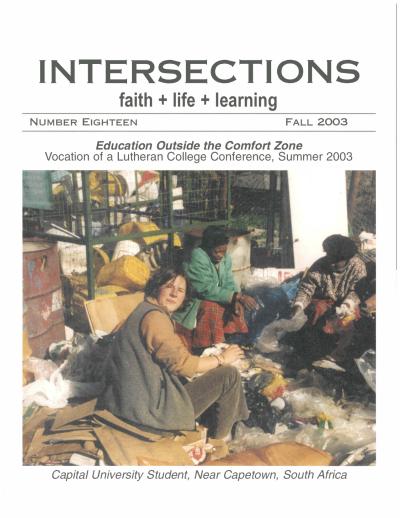
Wolford names economic globalization and the growth of civil society as the two issues shaping Lutheran World Relief’s mission, illustrating with the Guatemalan storekeeper undercut by subsidized “gringo” chickens, fair-trade coffee and chocolate campaigns, and Charles Onyango-Obbo’s warning about anti-terrorism laws in fragile African democracies. Drawing on Darrell Jodock, Art Simon, and the Good Samaritan, she frames the global vocation of Lutheran colleges as inviting students past comfort zones of race, class, ethnicity, and ideas through service-learning that links mercy and justice, and closes with a concrete LWR partnership invitation including site visits, internships, fair-trade campus campaigns, and the “A Place for Peace in Colombia” advocacy program.
-
 Article
No Child Left Behind Meets Philip Melanchthon: A Reflective Conversation
Kathy Book
No. 26 · Fall 2007
Inspired by Tim Lull’s My Conversations with Martin Luther, Book imagines an interview with Philip Melanchthon in the cobblestone courtyard of the University of Wittenberg, in which the Praeceptor Germaniae reflects on his pedagogy (Socratic questioning, brevity and example, declamations, repetition, and interdisciplinary connections), his graded curriculum from primer to university, and his collaboration with Luther on the responsibility of community, parents, and government for the education of all children — and finds his vision strikingly resonant with the No Child Left Behind legislation of 2006.