An Ecotone is a transitional area between two ecosystems, containing characteristics of both. Teeming with life, that is, mingling with other species from ecosystems different from their own, it is also a space where new plant and animal species are birthed. Often found where one body of water meets another (think lagoons), you can find creatures adapted to salt water evolving to live in freshwater. It’s an ecological wonder. It is also theologically rich; the space where our creator God continues to speak new life into being. A place where kairos moments are born and, if we’re open, new experiences, life, and possibilities are revealed.
It is also a space we are living in as Church and Body today.
In John 6:31, the crowd tells Jesus “Our ancestors ate manna in the wilderness” and Jesus replies, “Very truly I tell you…it is my Father who gives you the true bread from heaven. For the bread of God is that which comes down from heaven and gives life to the world….I am the bread of life. Whoever comes to me will never be hungry, and whoever believes in me will never thirst.”
When looking at the Greek tense, scripture tells us “manna” is not simply a story that resides in the faithful past of our forebears, but is an ongoing gift of God in the present. God’s liberating power is not confined to the past tense but is seen in the ever-present action of love. It is a life-giving power that originates in heaven and comes to us through Christ.
In ministry, it is common to hear a longing for the past–a time when things were “more stable” and when people “weren’t so distracted.” A time when the pews were full and the budget covered our vision. Those of us in ministry for less than 15 years have a gift—we’ve never seen or experienced times of stability in the Church. The world of our adult years has always been in flux. We have never known a time when there was harmony (perhaps fictional) between the Church and the world.
We were born in the ecotone.
“The world of our adult years has always been in flux. We have never known a time when there was harmony (perhaps fictional) between the Church and the world.”
In the kingdom of God’s ecotone, people are fed and nourished by manna from heaven…giving us new life here and now. Now, this takes us to a new ecosystem: a place where heaven and earth become one through the ONE. Ruach is breathing new life into being before our eyes…using our minds and bodies to speak the TRUTH. Ruach is creating kairos moments where we ourselves are evolving into something new. We have characteristics of what we once were, mixing with the beauty of God’s creation, and seeing within ourselves that we are being made new.
Ministry of this era is unbound–we don’t know what is to come, or how the Church will emerge. Life in the ecotones is all we have known. The previous freshwater ecosystem can’t support the new life being formed in the salty water. Yet all that is to come isn’t quite ready for the open ocean either. Something new is being nourished and emerging.
We aren’t called to minister in the world of the past. We won’t be equipped for the ministry that is to come in 50 years. Instead, we are empowered to nurture the ecotone that is RIGHT NOW. We can see the previous freshwater world that no longer exists, while also catching glimpses of the open ocean that will be.
“We aren’t called to minister in the world of the past. We won’t be equipped for the ministry that is to come in 50 years. Instead, we are empowered to nurture the ecotone that is RIGHT NOW. We can see the previous freshwater world that no longer exists, while also catching glimpses of the open ocean that will be.”
So live into THIS ecotone. Live into the LIFE God is creating. Feast on the manna and water of life that flows from above. Know that you are called and equipped by God.
-
 Editorial
From the Publisher
Lamont Anthony Wells
5 min audio
Wells introduces So That All May Belong: Lutheran Roots for Diversity, Equity, Inclusion, and Justice as a theological and institutional articulation of NECU’s commitments, and previews four accompanying essays that frame vocation as a societal responsibility rooted in justice and not solely an individual pursuit.
-
Editorial
From the Editor
Colleen Windham-Hughes
5 min audio
Windham-Hughes uses Fred Rogers’ neighborhood as a living embodiment of a Lutheran understanding of vocation — seeing dignity in each person, offering one’s gifts generously, and trusting that the well-being of the neighborhood is intrinsically connected to the well-being of every neighbor.
-
Institutional Focus
So That All May Belong: Lutheran Roots for Diversity, Equity, Inclusion, and Justice
Altheia Richardson, Angie Hambrick, Caryn Riswold, Colleen Windham-Hughes, Deanna Thompson, Marcia Bunge, Robert Clay
22 min audio
The full NECU statement grounds DEIJ work in Luther’s 16th-century reforms and Lutheran theological claims about the image of God, equal dignity, and the limits of human knowing — offering definitions, Lutheran roots, and calls to action for diversity, equity, inclusion, and justice, with belonging as the outcome of DEIJ at work.
-
Institutional Focus
Scriptures That Inspire Work for Diversity, Equity, Inclusion, and Justice
Altheia Richardson, Angie Hambrick, Caryn Riswold, Colleen Windham-Hughes, Deanna Thompson, Marcia Bunge, Robert Clay
9 min audio
A companion list of biblical verses — from Genesis 1:27 and Galatians 3:28 to Micah 6:8 and Luke 4:18-19 — that grounded NECU’s drafting of So That All May Belong, organized by the four DEIJ commitments and offered as an invitation to share other texts that ground and sustain the work.
-
Institutional Focus
So That All May Belong: Lutheran Roots for Diversity, Equity, Inclusion, and Justice [abridged]
Altheia Richardson, Angie Hambrick, Caryn Riswold, Colleen Windham-Hughes, Deanna Thompson, Marcia Bunge, Robert Clay
8 min audio
A condensed version of the NECU statement that consolidates Lutheran theological grounding for DEIJ and a single combined call to action for Lutheran colleges and universities — offered as a shareable summary alongside the complete document.
-
Article
Vocation at Full Stretch: Reflections on Follow Your Bliss and Other Lies about Calling and its Use among College Students
Jason A. Mahn
43 min audio
Mahn engages Bonnie Miller-McLemore’s Follow Your Bliss and Other Lies about Calling as required reading in a sophomore religion course, showing how her categories of missed, blocked, conflicted, fractured, unexpected, and relinquished callings empower young adults to perceive embodied, unplanned, and often painful dimensions of life as essential parts of vocation — and help close the gap between mission-driven and tuition-driven realities.
-
Article
How Mister Rogers’ Neighborhood Reminds Us About Work
Than Oo
5 min audio
Drawing on a Season 15 arc of Mister Rogers’ Neighborhood in which residents redirect pool funds to fix a plumbing problem, Oo finds in Fred Rogers’ vocation-honoring storytelling a reminder that limited resources are an invitation to creativity, perseverance, and optimism in higher education.
-
Article
Finding the Miracle in the Intersection of Mission and Limitations: Lessons from Latin America
Kat Peters
14 min audio
Peters draws on her time interning with Lutheran World Relief and leading a study abroad program in Central America — including a Costa Rican women’s farm cooperative whose ecotourism project was “unprofitable” but life-giving — to argue that the intersection of God’s preference for struggle and God’s desire for abundant life is itself the miracle higher education can claim amid scarcity.
-
 Editorial
From the Editor
Jason A. Mahn
No. 35 · Spring 2012
Mahn introduces five essays from the 2011 Vocation of a Lutheran College Conference at Augsburg, framing how Torvend, Anderson, Svennungsen, Tunheim, and Pribbenow press Lutheran colleges to turn outward—recovering the public character of Luther’s gospel, forming students for moral deliberation, investing in the infrastructure of civic renewal, and pursuing justice and education “off the main road.”
-
 Editorial
From the Outgoing and Incoming Editors
Jason A. Mahn, Robert D. Haak
No. 34 · Fall 2011
Outgoing editor Robert D. Haak reflects on a six-year run inheriting Intersections from founder Tom Christenson, the “powerful voices” that have driven the conversation (Dovre, Jodock, Christenson, Simmons, Morgan, Olsen, Wilhelm) and the newer ones now entering (Mahn, Bussie); incoming editor Jason A. Mahn, picked up from the airport in Bob’s pickup truck five years ago, names central issues that “Lutherans on Faith and Learning” engages and previews essays by Dovre, Jodock, McDonald, Hill, Turnbull, and Jodock again.
-
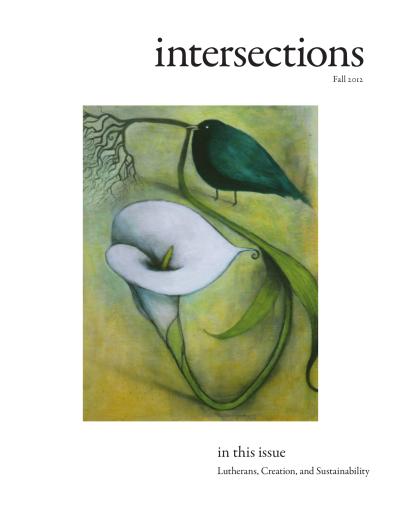 Institutional Focus
Farming and Eating Locally: An Interview with Garry Griffith about Augustana's Farm2Fork Program
Garry Griffith
No. 36 · Fall 2012
Griffith, Director of Dining at Augustana College (Rock Island), describes the Farm2Fork program’s shift from pre-packaged food to fresh produce sourced from local farms (beginning with Jim Johansen of Wesley Acres in Moline), the Augie Acres campus garden tended by students in learning-community courses, the bio-diesel conversion of used fryer oil for greenhouse heat and farm equipment, and the stewardship calling that grounds these efforts in Augustana’s Lutheran identity.
-
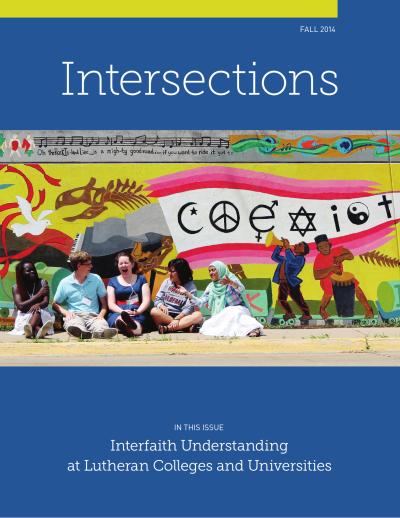 Article
Well, Well…Plumbing Our Depths, Telling Our Stories
Ann Boaden
No. 40 · Fall 2014
Beginning with a college visit that turned into a grieving mother’s confidence about her daughter’s last moments, Boaden uses John 4’s well of living water to argue that an interfaith education worthy of the name requires Lutherans to plumb the depths of their own tradition’s wells — with rituals, stories, and seasons intact — before they can see, respectfully, into the wells from which others drink.
-
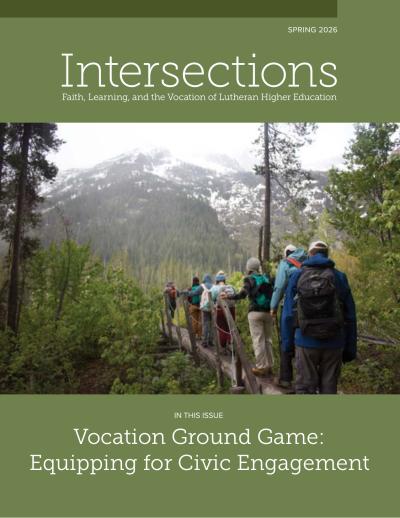 Editorial
From the Publisher & Editor
Colleen Windham-Hughes, Lamont Anthony Wells
No. 63 · Spring 2026
6 min audio
Wells and Windham-Hughes frame vocation as “ground game” — the practical, public living-out of faith through civic engagement — and introduce the issue’s focus on how Lutheran higher education equips students to repair the world.
-
Reflection
Dreaming God's Dream: A Sermon on Isaiah 56:1-2, 6-8
Stephan K. Turnbull
No. 34 · Fall 2011
Preached at the 2008 “Savvy with Substance” Convocation of the ELCA at Central Lutheran Church, Minneapolis, this sermon by parish pastor Stephan K. Turnbull (First Lutheran Church, White Bear Lake) sets the small dreams of pastors and academics—balanced budgets, peaceful congregations, coherent midterm papers—over against the prophet’s dream in Isaiah 56 of a God who gathers all nations to a house of prayer for all peoples. Turnbull calls educators, preachers, and church leaders to articulate God’s dream of getting the world back through the dying of Jesus the Messiah and the resurrection’s first fruits of new creation.