“Everybody takes an interest in students here–whatever that student does.” With this one statement, Athletic Director Curtis Campbell (Roanoke College) has captured one of the values that makes liberal arts education work: staff, faculty, and administrators see students and support what they do. The tradition of Lutheran higher education develops students as whole persons, supporting their exploration of vocation or callings in many aspects of their lives and undergraduate careers.
During one spectacular December weekend, the successes of student-athletes at Lutheran colleges were plain for all to see. In consecutive days California Lutheran University’s Women’s Soccer Team won the national championship and St. Olaf College’s Men’s Soccer Team won the national championship. One particularly spectacular weekend featured the success of three campuses in our Network of ELCA Colleges and Universities. Both of these historic wins took place at Kerr Field, on the campus of Roanoke College. The athletic accomplishments of three schools in the Network of ELCA Colleges and Universities (NECU) were in the spotlight simultaneously, thanks to the National Collegiate Athletic Association (NCAA) Division III championship games.
Salem, VA, home of Roanoke College, is commonly called “Championship City” by those involved in NCAA Division III (D3) sports. It is, by all reports, a beautiful place to be. Conference planners must think so, too, given that the Championship games held in December 2023 raised the number of championship games played there to 100 over the last thirty years.
Curtis Campbell says D3 sports exemplify the love of the game, the true amateur version of sports. Even as laws evolve to protect and compensate players–especially those competing at quasi-professional levels–in D3 players compete out of love for the game. D3 supporters cheer on their teams in true community spirit. At this level (the level of most athletic teams at NECU schools), players do not receive scholarships for athletics. Players are recruited as “student-athletes,” with much to gain as well as contribute to wider campus life. Coaches at D3 schools recruit for love of the game and community spirit as much as for competence in any given position. Coaches always want students who are excited about learning and thrive in the classroom as much as they thrive in competitive sports. This combination of academics and sports makes great scholar-athletes.
Excellence On and Off the Field
Frank Marino and Justin Oliver, the coaches of Cal Lutheran’s Women’s Soccer Team and St. Olaf College’s Men’s Soccer Team, respectively, both spoke with pride about the successes of their players in academics as well as sports. Asked about what characterizes his players, Coach Oliver responded, “we have high achievers on and off the field. We only recruit people that can succeed academically, athletically and socially. We had a 3.52 GPA; 27/31 students had above a 3.0.” Cal Lutheran’s Women’s Soccer Team has a cumulative 3.6 GPA and a 90% persistence rate to 4-year graduation. This kind of success takes a village, which is why many teams have a faculty or staff advocate. Dr. Molly George serves in that capacity for the women’s team at Cal Lutheran. During the long weekends of championship play out of state (where several players saw snow for the first time!), players had to negotiate due dates and exam conditions with professors. Dr. George enjoyed her role in facilitating alternative arrangements for players during their stay in Salem, VA. “As a faculty mentor, I found great satisfaction in developing and facilitating strategies to enable our students to thrive academically while excelling at the highest level in Division III sports. The impressive GPA of the women’s soccer team and their historic National Championship victory underscore Coach Marino and the coaching staff’s emphasis on academics. Additionally, our faculty’s commitment to supporting students both on and off the field is evident once they are educated about how to best support these incredible student athletes’ ability to multitask.”
“The road to success is never an easy path. Winning this championship took work, talent, some luck, but most importantly, a team of girls that became a family. Our small D3 team went from unranked to #1 in the Nation by taking the tournament game by game and being grateful for everything we earned. Our humility and determination allowed us to achieve so many goals we never could have imagined. However, the biggest asset to our team was believing in each other and translating off the field relationships onto the pitch. I have never been a part of a group so special and filled with love in all of my years playing soccer. Our love within our team also spread to our community at Cal Lu. The amount of support we received from other Cal Lu teams, faculty, and most importantly our parents gave us the strength to continuously push through this tournament. When I joined the Cal Lu Women’s soccer team I wasn’t joining just a winning program, but a team with an incredible sense of culture. This culture is what allowed us to become a Championship team. I will always dedicate our journey to the unbreakable bonds we created, and I will be eternally grateful to not only have a trophy but sisters for life.”
—Adri
Student-athletes have to learn effective time management, and it differs in peak season and off-season. Perhaps counter-intuitively, their time management is most effective during peak season, when they need to be mentally sharp in all situations and play time is contingent on satisfactory progress. Time management can be more challenging in the off season, when they have more time available. Without the press of daily practices and competitive play, it can be hard to prioritize tasks. Encouraging teammates to keep succeeding after winning a title is part of the team culture that has been built by Oles and Regals alike. According to Coach Oliver, “Winning is contagious and winning in the classroom translates to winning on the field and to winning in your relationships along the way.”
Building Team Culture
Coach Marino studied the connection between community and teamwork for his Master’s thesis. Marino says that relationships and team culture are key to success. “Everything builds on previous years. Getting off-the-field community right–serving others, building authentic relationships, leading by example–all of that translates onto the field.” At Cal Lutheran, Coach Marino has led book groups for each year related to team culture and building relationships since 2017. Shawn Howie ‘78 has led a few of the community-building activities for Regals Soccer. From “speed-dating” to small group conversation, Howie created opportunities for the players to know each other as people, to learn about each other’s dreams and goals, and to develop respect for one another as a baseline for team culture. Through both carefully constructed practices on the field and team-building activities off the field, players learn to prioritize collective success over individual achievement. This approach is true for all players, regardless of ability or play-time. Marino explains, “They do what’s best for the team, whether or not they’re contributing the way they want to be; they want what’s best for the team, not necessarily themselves.”
“Winning the NCAA Division III National Championship wasn’t even a consideration last year when our season came to an abrupt end after a loss in our conference tournament. Yet, we went on to play a record-breaking season this year and end as #1 in the nation for Division III women’s soccer. When people ask me how we did it I always describe our team culture. We’re more than a team and I fully believe that it’s what made us champions. Our team was built on a foundation of trust, understanding, and friendship, which wasn’t developed overnight. Many hours were poured into team bonding in hopes of building authentic relationships amongst each other. Understanding and empathizing with each other’s diverse stories is what got us through the struggles of a long and overwhelming journey to success. Our appreciation and respect for one another is what got us through score deficits and feelings of lost hope. In the end, making a family out of a team is what allowed us to celebrate each tiny victory until we got to our final destination.”
—Vale
Healthy team relationships make room for difficult conversations. The team-building process, which is extended, developed, and personalized through team captains, creates an environment where players can speak their mind and work together to solve problems, whether relational or individual. Howie explains, “There are mistakes in soccer all the time. And they can get in your mind.” Team culture can support players through physical injuries and mental distress. The Regals’ culture played a big role in helping the players persist through injuries and challenging games when they came from behind to tie or win in dramatic circumstances, such as overtime play and penalty kicks. Howard Davis, Athletic Director at Cal Lutheran says, "This group of amazing women are so connected and committed to one another. They were a joy to watch all season. So many times, throughout their playoff run this team's connection and grit stood out and were what made them successful.”
“Last soccer season was a dream come true. Transferring from the University of San Diego to Cal Lutheran for my final year, I anticipated a fun season to cap off my soccer career. However, it became much more. Pre-season involved setting standards, sharing goals, and bonding as a team. A casual mention of winning a National Championship sparked a shift in our mindset. Each practice and game became about striving for a collective goal. Early morning workouts and late practices tested our limits and prepared us for challenges. Our resilience defined us; even when trailing, we rallied to tie or win games. Our success stemmed from our unity and belief in each other. Despite a setback in the SCIAC tournament, we remained steadfast, guided by faith. And it paid off. We shattered records and clinched the national title, a testament to our coaches, teammates, supporters, and faith in God’s plan.”
—Eden
Team culture is a big part of the Oles’ success as well. Coach Oliver says, “Our success this year I think is the culmination of a lot of things. We had twelve seniors that had given everything to this program and are a huge reason we won. They are amazing soccer players and even better people. We had a team that had been through a lot of highs and lows together and that helped us this season especially. We also had a fantastic process that allowed us to go day by day and focus on being present together while working towards a national championship.” And every step of the way they shared their successes with their campus, and their campus community was there to support them.
Student-Athletes in Liberal Arts and Sciences
Lutheran Higher Education centers the dignity of all persons and seeks to develop students as whole human beings. That said, the time demands of sports are sometimes seen to compete with studies and the financial expenses are sometimes called into question during difficult budget years. Asked about the connections between athletics and liberal arts and sciences education, Coach Marino and Coach Oliver had this to say. “So much of what they learn is relatable to life. Working together as a team gets them ready to work with others in the world. They have to manage time to be successful in sport and class. And there are life lessons of leadership, relationships, and working really hard for success.” Coach Marino went on to say that, “Enterprise and other companies hire student-athletes because they know those employees arrive with a team mindset.” Coach Oliver agrees: “Our culture is why we had the success we did, we are a product of our culture. We have a team of genuinely good guys, that are high achievers on and off the field that love to be held to and hold others to very high standards. When things get difficult instead of getting more individualistic they lean on each other for help and support. They are great at picking each other up when they see someone is down, if someone is injured the next person steps up.”
Both St. Olaf and Cal Lutheran were awarded National Coaching Staff of the Year by the United Soccer Coaches.
The Regals’ Why
Tired and burned out from a tough season, the Regals gathered around a white board to reconnect with their WHY–to align their motivations and goals together. They have generously agreed to share their list with Intersections. We think it may help you and your team, too.
- Relationships are key to success
- Positive self talk and group conversation
- Have fun–enjoy each moment
- Appreciate sunsets
- Love each other, love the game, be truly grateful to God
- Remember our why
- Take care of your body
- Protect your peace
- Protect your mentality
- Love, respect and care for each other
- Love our seniors
- Focus on the controllables–energy, effort
- Appreciate the little things
- Focus on one good thing
- Treat each practice like you are warming up for a game
- Watch films and prepare well
- Take action–not just words
- Be united
- Team needs vs individual needs
- Appreciate our tiny victories
- Be a coach and be coachable
- Let the negative go
- Not complaining and not making excuses
- High level of communications
- Listen and be open minded
- Structured game plan
- Collectivity
- Consistency within games
- Full 90 minutes
- Creativity
- Be relentless
- Focus together
- Keep the passion–enjoy every moment
- Be positive
- Be close knit family
- Listen and be open minded
- Be creative
- Be relentless
- No energy vampires
-
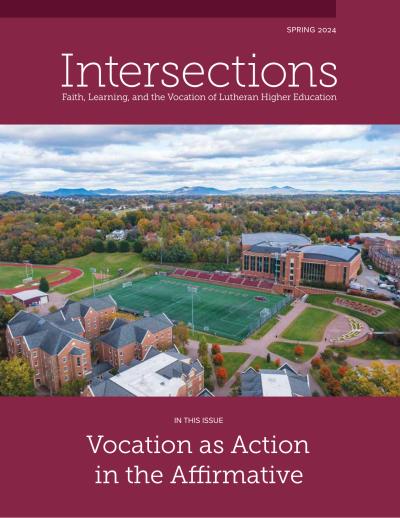 Editorial
From the Editor: Vocation as Action in the Affirmative
Colleen Windham-Hughes
Windham-Hughes frames vocation as practicing “at the borders of our incompetence” — every small yes to the callings we experience, every effort made in the direction of life, is action in the affirmative — and previews the issue’s essays on diversity, transformation, AI, championship team culture, and dreaming big within and beyond our limitations.
-
Editorial
From the Publisher: Navigating Affirmative Action, DEI Policies, and Lutheran Vocational Identity
Lamont Anthony Wells
Wells surveys the converging pressures on NECU institutions — the unsettled landscape of affirmative action, political and academic scrutiny of DEI work, and the preservation of distinctively Lutheran vocational identity — and previews how the issue draws on affirmative practices, sociological viewpoints, and theological responses to navigate a path forward.
-
Article
Forming the Division for Access, Equity & Belonging at Susquehanna University
Amy Davis, Dena Salerno, María L. O. Muñoz, Nina Mandel, Scott Kershner
Five Susquehanna University colleagues trace the institution’s 166-year arc from a Missionary Institute founded to remove barriers to education through the formation of a new Division for Access, Equity & Belonging in 2023, arguing that access rooted in Lutheran origins must continue to drive policy revision, infrastructure, and belonging for minoritized communities today.
-
Article
On Recruiting Diverse Students, Rooted in Mission
Eric Rowell, Jason A. Mahn
Jason Mahn interviews Eric Rowell, Assistant Director of Admissions and Diversity Outreach at Augustana College, about how recruiting students from a wide variety of backgrounds — rooted in Augustana’s Lutheran commitment to vocation and educating across difference — remains essentially unchanged in the wake of the Supreme Court’s 2023 decisions on affirmative action.
-
Article
What Our Lutheran Heritage Entails for Lutheran Colleges and Affirmative Action
Mark Ellingsen
Ellingsen argues that the Lutheran Two-Kingdom Ethic — far from leading to political reaction — supports the church-relatedness of ELCA colleges and obligates them to keep affirmative action alive, even reading a Chief Justice Roberts “loophole” in Students for Fair Admissions v. Harvard as an open door for Black community partnerships, ELCA congregations, and Lutheran colleges to act in the affirmative.
-
Reflection
On the Power of Transformation and Becoming Human
Ken Yanai Flores
Flores, a Cal Lutheran sophomore, reflects on personal and institutional transformation as the slow work of shedding the armor of trauma responses, engaging discomfort rather than turning away, and trusting that the work of becoming more human — more empathetic, knowledgeable, and free — will be reflected in our institutions as well.
-
Article
The Critical Role of Lutheran Higher Education in the Age of Artificial Intelligence
Jose Marichal, Maya Goehner, Tyler Haug
A Cal Lutheran political science professor and two of his students draw on Rooted and Open to argue that Lutheran higher education is uniquely positioned to stake out a middle path between AI utopianism and AI doom — cultivating a “healthy sense of human limit,” resisting data colonialism, and forming students to see the neighbor rather than the enemy as the world becomes increasingly synthetic.
-
Article
Low-Hanging Fruit, Moonshots, and Coffee: Dreaming Big Within and Beyond Our Limitations
Jeremy Myers
Myers shares the process used by Augsburg’s Christensen Center for Vocation to help teams move from a shared experience to next steps — an Ignatian-rooted Awareness Examen followed by naming low-hanging fruit, moonshots, and the coffee conversations that build the coalition to make it all happen.
-
 Editorial
From the Publisher & Editor
Colleen Windham-Hughes, Lamont Anthony Wells
No. 63 · Spring 2026
6 min audio
Wells and Windham-Hughes frame vocation as “ground game” — the practical, public living-out of faith through civic engagement — and introduce the issue’s focus on how Lutheran higher education equips students to repair the world.
-
 Editorial
From the Editor
Colleen Windham-Hughes
No. 62 · Fall 2025
5 min audio
Windham-Hughes plays on the shared Latin root of “education” and “seduction” (ducere, to lead) to warn against the No-saying seductions of giving up or condemnation, and to call educators to the riskier Yes of showing up to build third-space communities of truth-telling and hope.
-
 Editorial
From the Editor
Colleen Windham-Hughes
No. 61 · Spring 2025
5 min audio
Windham-Hughes uses Fred Rogers’ neighborhood as a living embodiment of a Lutheran understanding of vocation — seeing dignity in each person, offering one’s gifts generously, and trusting that the well-being of the neighborhood is intrinsically connected to the well-being of every neighbor.
-
Institutional Focus
So That All May Belong: Lutheran Roots for Diversity, Equity, Inclusion, and Justice
Altheia Richardson, Angie Hambrick, Caryn Riswold, Colleen Windham-Hughes, Deanna Thompson, Marcia Bunge, Robert Clay
No. 61 · Spring 2025
22 min audio
The full NECU statement grounds DEIJ work in Luther’s 16th-century reforms and Lutheran theological claims about the image of God, equal dignity, and the limits of human knowing — offering definitions, Lutheran roots, and calls to action for diversity, equity, inclusion, and justice, with belonging as the outcome of DEIJ at work.
-
Institutional Focus
Scriptures That Inspire Work for Diversity, Equity, Inclusion, and Justice
Altheia Richardson, Angie Hambrick, Caryn Riswold, Colleen Windham-Hughes, Deanna Thompson, Marcia Bunge, Robert Clay
No. 61 · Spring 2025
9 min audio
A companion list of biblical verses — from Genesis 1:27 and Galatians 3:28 to Micah 6:8 and Luke 4:18-19 — that grounded NECU’s drafting of So That All May Belong, organized by the four DEIJ commitments and offered as an invitation to share other texts that ground and sustain the work.
-
Institutional Focus
So That All May Belong: Lutheran Roots for Diversity, Equity, Inclusion, and Justice [abridged]
Altheia Richardson, Angie Hambrick, Caryn Riswold, Colleen Windham-Hughes, Deanna Thompson, Marcia Bunge, Robert Clay
No. 61 · Spring 2025
8 min audio
A condensed version of the NECU statement that consolidates Lutheran theological grounding for DEIJ and a single combined call to action for Lutheran colleges and universities — offered as a shareable summary alongside the complete document.
-
 Reflection
Walls: Talk At Gustavus Adolphus College
Elizabeth Baer
No. 5 · Summer 1998
Baer’s September 11, 1997 Gustavus Adolphus chapel homily on Joshua 6 turns from the trumpets to the walls—Robert Frost’s “Mending Walls,” the walls of the Warsaw ghetto in Vladka Meed’s On Both Sides of the Wall and Margaret Zassenhaus’s Walls, the Berlin Wall coming down in 1989—and then to the autobiographical, intertextual discourse of Gustavus chapel itself as a place where misunderstandings come down. An author’s note added after the March 29 F3 tornado reports the closing line (“LET’S MAKE THOSE WALLS COME TUMBLING DOWN”) as eerily prescient: roofs, windows, and 90% of campus trees were lost, but the Chapel walls and the eternal flame in the red glass lantern stood firm.
-
 Reflection
Caught in a Place Between Caesar and God
Darrel D. Colson
No. 54 · Fall 2021
Colson reflects on his anguish, as Wartburg’s president, over an Iowa law that prevents him from requiring student COVID-19 vaccinations — reading Luther’s “Whether One May Flee From a Deadly Plague” alongside the conflict between obeying the law and serving neighbor.
-
 Institutional Focus
LibGuide: Introduction to Womanist Theology
Elli Cucksey
No. 56 · Fall 2022
Cucksey, the head librarian at Trinity Lutheran Seminary, recounts how Beverly Wallace’s Introduction to Womanist Theology class — the first offering of the ELCA Seminaries’ Womanist Theology Initiative — led her to build a publicly available LibGuide that amplifies Black women’s voices and gathers the resources of the course for future students.
-
 Book Review
Learning Across Campus: Hearing Bok's Call to Conversation
David Ratke
No. 39 · Spring 2014
Ratke reads Derek Bok’s Our Underachieving Colleges from Lenoir-Rhyne and argues that Bok’s call to think holistically about undergraduate education and to dialogue across disciplinary boundaries names the work already underway at ELCA colleges. He weighs faculty attitudes, the role of skills in the core curriculum and the major, and the importance of the extracurriculum for student formation.
-
 Article
The Marks of an ELCA College: One Bishop's Reflections
Stanley Olson
No. 15 · Winter 2002
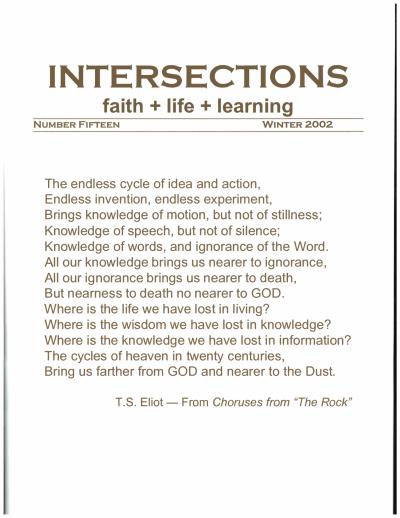
Olson, speaking as a bishop and “Harness Boy” whose job is to keep the church’s connections working, replaces his original four-noun outline (fealty, ingenuity, insouciance, focus) with eight marks the ELCA should be able to observe in its colleges: intentional Lutheran identity, significant Lutheran presence, Christian faith at every table, freedom of inquiry, coaching toward vocation, gravity and grace, nurtured community, and excellence by its own standards. Drawing on his survey of all twenty-eight ELCA college mission statements (two tables) and on Darrell Jodock and Mark Edwards, he argues that the Lutheran connection must be made explicit in mission, marketing, and faculty searches, and closes with six reciprocal expectations the colleges should hold of the ELCA—commissioner, mature parent, supporter of adventurous teenagers, advocate, steward of graduates, and a church faithful to its own Lutheran mission.
-
 Editorial
From the Editor
Robert D. Haak
No. 26 · Fall 2007
Haak introduces the issue with the question of whether “our Lutheranism” should have any discernible effect on how we operate as Lutheran colleges, and proposes a working list of “Lutheran” values that characterize our institutions — complexity, real evil, suffering as part of human experience, the centrality of discourse, transcendent values, attention to place, institutional self-criticism, and unity over division — inviting campuses to extend the conversation begun by Simmons, O’Hara, and the Wartburg colleagues.