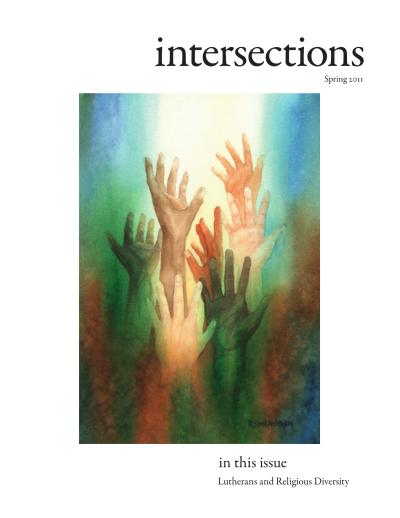
The articles in this issue were presented at the Vocation of a Lutheran College Conference in the summer of 2010. (This year’s conference will be held on July 30th–August 1st. The theme will be “A Calling to Embrace Creation: Lutheran Higher Education, Sustainability, and Stewardship.” Save the dates!) The theme of the conference that summer dealt with how our campuses respond to religious diversity.
There was a time, not so long ago, when religious diversity on our campuses revolved around which branch of the Lutheran tree one identified with—usually connected in some deep way with a cultural tradition of the founders of the college. The Swedish Lutherans of Augustana, the Danish Lutherans of Dana, the Norwegians of ….. Well, you understand. I remember coming to Augustana (RI) to teach in the religion department at a time when I was considered to be “the token German.” This was a sort of diversity, but hardly the same phenomena that the colleges face today.
In recent times we have been faced with student bodies—and faculties—that often do not identify themselves as Lutheran. The range of faith identifications today covers the wide range of religious diversity that occurs within American culture. At some institutions, “none” is the most predominant religious affiliation. For some time, Lutheran colleges and universities have addressed their relation to Judaism and Jewish students and faculty. At some places, such as Muhlenberg College, this conversation has produced dramatic results. An ever increasing number of our students identify themselves with Islam. How do we as Lutheran colleges and universities understand this changing landscape?
Today it would be unusual, to say the least, if anyone on a college campus spoke out against diversity of any kind. The experience on many campuses, however, is that while diversity is espoused, little in done to encourage and support diversity. Too often this is seen as the work of an individual or small group of people who take this on as their cause. Any time the issue comes up, the response is “well, that’s the responsibility of X.” The result is that often not much progress is made on these issues.
I would argue that diversity is important on our campuses. But I would also argue that assent to that proposition is not sufficient. Diversity is not an end in itself. It is important because of the work that it can do toward the end of educating our students well. How do we understand the role of diversity in this project for which we all exist? Is there a difference in our understanding of the need for diversity based on the Lutheran tradition from which we grow?
Darrell Jodock, in his article in this issue, argues that our theological tradition leads us to a “third path” in relation to religious diversity. He founds this “third path” on the Lutheran value of giftedness. I would suggest that this theological base could be expanded to include Lutheran understandings of the work of the Holy Spirit and the Incarnation. Lutherans believe that the Spirit of Christ speaks not only in the past but continues to speak even today. And we believe that the Spirit of Christ is not under our control but speaks as the Spirit wills. Our job as Lutheran Christians is to be attentive to that voice wherever it may be heard. And we know that the place of the Spirit is not limited to where we look. Often the Spirit speaks important words through the ones that we perceive as “the other.” It is because of this that diversity (religious and of all types) is crucially important on our campuses. Those voices of “the other” may be the Spirit of Christ speaking to us in this day. If we do not listen, or are not able to because we have somehow dismissed “the other,” we may well miss the most important words we are called to hear.
So our job as institutions of Lutheran higher education is to create places where the voice of “the other” is heard and valued. Again, this is not for diversity’s sake itself, but because of our theological understanding of how God interacts with this world.
Tonight in Wallenberg Hall at Augustana College in Rock Island, on September 9, 2011, Dr. Omid Safi spoke of fear and love in our world. Those who were able heard in his words the voice of God. It is true that not all in the audience could hear those words. But in this place, at a Lutheran college gathering, the voice of “the other” was heard, and the best of religious diversity was experienced. This is what we are about as Lutheran colleges and universities.
-
 Editorial
From the Publisher
Mark Wilhelm
Wilhelm notes that while the ELCA’s vocation in higher education remains vibrant, the landscape of churchwide leadership has shifted dramatically with the dissolution of the Vocation and Education unit, and expresses appreciation for the faculty and staff at ELCA colleges and universities who have stepped up to sustain the network during this time of transition.
-
Article
Vocation of the Lutheran College and Religious Diversity
Darrell Jodock
Jodock describes a “third path” for Lutheran colleges that is both rooted in the Lutheran tradition and inclusive of religious diversity — an alternative to sectarian and non-sectarian default models — and identifies six interlocking features of the Lutheran tradition (giftedness, an engaged God, wisdom, caution about claims to know, community, and an emphasis on service and community leadership) that shape how such a college engages interreligious dialogue and civil discourse.
-
Article
The State of Civil Discourse on Campus and in Society
Terence S. Morrow
Morrow examines the troubled state of civil discourse in the United States and on college campuses, drawing on three deep traditions — the liberal arts, Lutheranism, and the Anglo-American legal tradition — to argue that Lutheran colleges can serve students and society by acknowledging the tensions inherent in civil discourse and helping students navigate them, and surveys promising campus programs at St. Thomas, Tufts, Loyola, and Harvard.
-
Article
The New (con)Texts of Jewish-Christian Engagement
Karla R. Suomala
Suomala surveys four contemporary contexts of Jewish-Christian engagement on American college campuses — campus populations, Jewish studies curricula, the changing nature of Jewish identity among Millennials, and the shift from formal Jewish-Christian dialogue toward broader religious pluralism — and argues that at Lutheran colleges this success story can serve as a model for engaging the other religious neighbors who increasingly form part of our society.
-
Article
The Breadth and the Depth: Dimensions of Christian-Muslim Relations at Educational Institutions of the ELCA
Mark N. Swanson
Swanson reflects on the spatial metaphors of depth and breadth that shape Lutheran higher education and argues that the study of Islam and real conversation between Christians and Muslims can contribute to both the broadening of horizons and the deepening of faith, drawing on his experience at the Lutheran School of Theology at Chicago and pointing to hospitality as a Christian practice in which depth and breadth come together.
-
Article
Reconciled Diversity: Reflections on our Calling to Embrace our Religious Neighbors
Jacqueline Bussie
Bussie offers three concrete recommendations for cultivating reconciled religious diversity on Lutheran campuses — Lutheran listening and the telling of stories, engendering encounters with religious neighbors through curriculum and bridge-building events, and choosing empathy and collaboration over evangelism and creed — arguing that what students fear most in encounters with the religious “other” is the loss of their own identity and distinctiveness, and that we can show them how loyalty to one’s own tradition and reverence for different traditions can coexist.
-
 Book Review
Assessing the Value of Liberal Arts: A Review of The Evidence Liberal Arts Needs, by Richard A. Detweiler
Robert D. Haak
No. 55 · Spring 2022
Haak reviews Richard A. Detweiler’s The Evidence Liberal Arts Needs, in which the former president of the Great Lakes Colleges Association analyzes 240 college mission statements and interviews more than 1,000 graduates to argue that liberal arts educational experiences have a measurable impact on adult lives of consequence, inquiry, and accomplishment — and invites NECU institutions into a further conversation about how Detweiler’s methodology applies to Lutheran higher education.
-
 Article
The Vocation of Intersections on its Twentieth Birthday
Jason A. Mahn, Robert D. Haak, Tom Christenson
No. 43 · Spring 2016
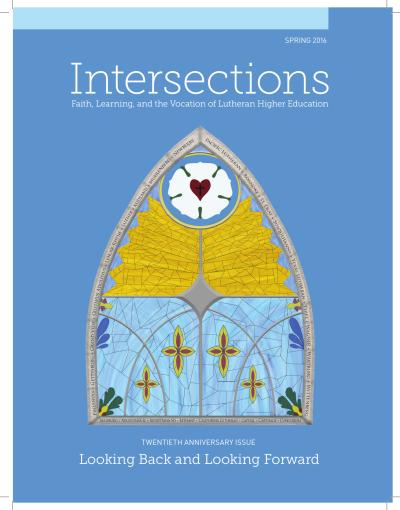
The three editors of Intersections — Bob Haak, Jason Mahn, and Tom Christenson (in spirit, following his death in 2013) — trace the twenty-year vocation of the journal itself: its 1996 birth at Capital University; its coming-of-age years of debate over institutional markers, two-kingdoms theology, and Lutheran identity; the ascendancy of “education for vocation” as the central marker of Lutheran higher education; and its ongoing identity in relation to a changing ELCA and to the broader cultural conversation about purpose, wholeness, and the vocation of higher education.
-
 Editorial
From the Outgoing and Incoming Editors
Jason A. Mahn, Robert D. Haak
No. 34 · Fall 2011
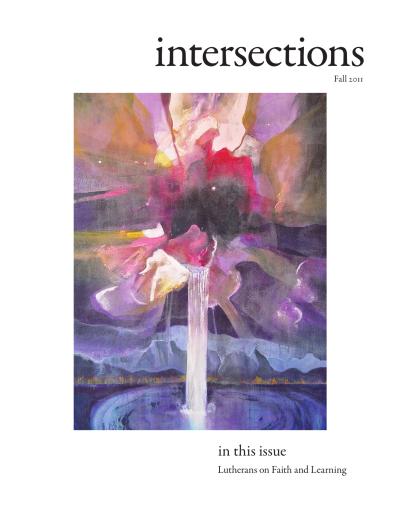
Outgoing editor Robert D. Haak reflects on a six-year run inheriting Intersections from founder Tom Christenson, the “powerful voices” that have driven the conversation (Dovre, Jodock, Christenson, Simmons, Morgan, Olsen, Wilhelm) and the newer ones now entering (Mahn, Bussie); incoming editor Jason A. Mahn, picked up from the airport in Bob’s pickup truck five years ago, names central issues that “Lutherans on Faith and Learning” engages and previews essays by Dovre, Jodock, McDonald, Hill, Turnbull, and Jodock again.
-
 Article
Called to Serve
Robert D. Haak
No. 31 · Winter 2010
Haak describes Augustana’s Center for Vocational Reflection (CVR) and its threefold framework of skills/gifts/talents, passions/values, and needs of the community. He surveys the CVR’s Working with Faith group, seminary visits, spiritual companioning, Servant Leader Internships, international travel reflection, and the major Senior Inquiry curriculum revision—then reports the lessons learned at Augustana: that multiple exposures matter more than any single program, that the language of vocation works even for non-religious students, that student-initiated ideas (like Erin Blecha’s Athletes Giving Back) often succeed most, and that the CVR will soon merge into a new Community Engagement Center.
-
 Editorial
From the Editor
Robert D. Haak
No. 30 · Fall 2009
Haak frames the issue around the question of Lutheran college identity as formed in distinction from some “other,” introducing essays by Witherup on the Joint Declaration, Reuther on Holden Village, Afzaal on Christian-Muslim dialogue, Dovre on the history of Midwestern Lutheran colleges, Radecke on service-learning, and Ratke on Wilhelm Löhe — each making the claim that the “other” is an essential partner in conversation who helps us know who we are and shape who we will become.
-
 Editorial
From the Editor
Robert D. Haak
No. 29 · Spring 2009
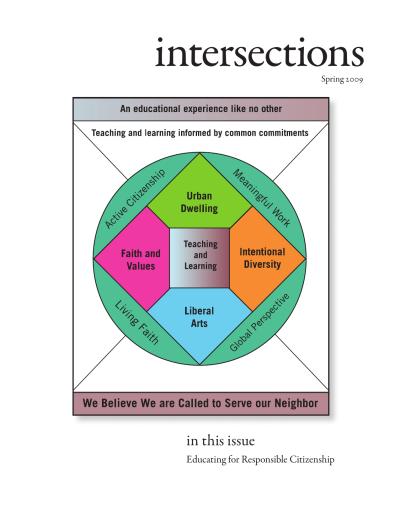
Haak frames the issue’s essays around the question of Lutheran colleges and the role of citizen, noting H. Richard Niebuhr’s typology in Christ and Culture and Luther’s own complex understanding of Christian and state, and offers a fitting farewell to Arne Selbyg with Mike Blair’s tribute song “A Fine Norwegian.”
-
 Article
Called to the Moment: A New Vocation for Lutheran Colleges
W. Kent Barnds
No. 52 · Fall 2020
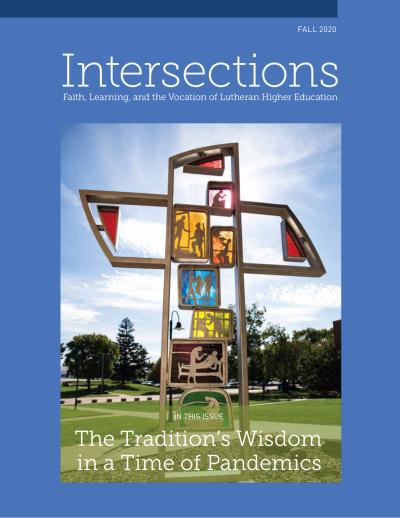
After a derecho ravaged Iowa in August 2020 and Pastor Katy Warren preached on 1 Peter 4, Barnds watched line workers, neighbors, and Augustana colleagues simply show up where they were needed — and proposes that the true vocation of a Lutheran college may be making the case for “meeting immediate need with a deep willingness” alongside the longer work of vocational discernment.
-
 Article
Practical Approaches for Lutheran Colleges to Engage Civil Society
Katherine A. Tunheim
No. 35 · Spring 2012
Tunheim distinguishes a college’s mission from its vocation—a calling from the community—and offers four examples of Lutheran colleges “dancing with their neighbors”: Augsburg’s engagement with the Cedar Riverside Neighborhood, her Gustavus students’ work with the St. Peter Soccer Club, St. Olaf football players in the All-Star After-School Program in Northfield, and Concordia students filling sandbags during the 2009 Red River flood. She presses Lutheran educators to ask the troubling questions that prepare students to lead with ethics rather than merely with money.
-
 Article
A Response to Paul Santmire
Don Braxton
No. 4 · Winter 1998
Braxton appreciates the dialectical structure of Santmire’s mandates—“skeletons in our closets and riches in our own vaults”—and reads it as a faithful expression of the Lutheran tradition of Paul, Augustine, and Luther. He argues that Santmire is on target in warning against premature flight to non-Christian traditions for environmental wisdom (theoretical sensitivity does not translate into ecological behavior in practice), and that classical Lutheran social ethics has too often been quietistic. But Lutheran ethics at its best is dialectical, not dualistic—recognizing the interpenetration of church and world, Law and Gospel, eschatological Kingdom and present realities, as in Hegel, Ritschl, Bonhoeffer, Reinhold Niebuhr, and Larry Rasmussen. Braxton commends environmental responsibility, social criticism of unsustainable practices, and a liturgical practice of resistance to instrumentalism as appropriate next steps for Lutheran liberal arts colleges, especially Capital University.
-
 Article
Rich and Poor in an Era of Globalized Religion and Economies: Challenges to Lutheran Colleges
Pamela K. Brubaker
No. 25 · Spring 2007
Brubaker opens with two World Council of Churches communion stories—a generous Aymara potato meal in Bolivia and a gated invitation-only lunch at a prosperous immigrant German Lutheran church in Brazil—to frame the question of which stance Lutheran colleges will adopt toward diversity. Drawing on Richard Hughes and Ernest Simmons on Lutheran “ecumenical confessionalism,” Linell Cady, Ulrich Beck, Held and McGrew, the World Bank’s 2006 Equity and Development report, Mark Juergensmeyer’s Global Religions, Harvey Cox on the Market as God, the WCC’s “economy of life” / AGAPE document, and Larry Rasmussen on universal human rights, she argues that part of the academic work of Lutheran colleges is to educate for critical citizenship by questioning neo-liberal assumptions and equipping students to claim social, economic, cultural, civil, and political rights for the whole human family.
-
 Institutional Focus
About Rooted and Open: The Common Calling of the Network of ELCA Colleges and Universities
No. 49 · Spring 2019
An institutional framing piece introducing Rooted and Open — NECU’s statement on Lutheran identity in higher education — with a roster of the faculty working group and writing team and an orientation to the essays in this special issue.
-
 Editorial
From the Publisher
Arne Selbyg
No. 17 · Summer 2003
Selbyg explains that the four essays in this issue grew out of the first Lutheran Academy of Scholars in Higher Education—a two-week seminar funded by the Lutheran Brotherhood Foundation and the Lilly Endowment, led for its first three years by Dr. Ronald Thiemann of Harvard Divinity School—whose official theme “Finding Our Voice—Christian Faith and Critical Vision” became informally “What’s Faith Got To Do With It?”