It is difficult
to get the news from poems
yet men die miserably every day
for lack
of what is found there.—William Carlos Williams,
from “Asphodel, That Greeny Flower”
Here at California Lutheran University, ’tis the season of departmental reviews and pre-accreditation preparation. As we collectively reflect on our institutional mission and evaluate our curricula, including core requirements and student learning outcomes, our constant question is whether or not we are offering our students what they will need to be successful in a rapidly changing world. Almost a quarter of our students are first-generation college students, hoping a California Lutheran degree will net them a job better than what their parents could find, and thus enable their families’ lives to improve. On our campus, providing pathways that might allow students to graduate in three years instead of four so as to lessen their student loan burden is framed as a justice issue. No doubt it is. And yet I worry about an undercurrent noticeable in many of our conversations about these issues, both formal and informal. As external voices increasingly call into question the value of a college education, it seems that “value” has come to mean “can it get you a job?” and “how much money will it make you?”
By these measures, even I, an English professor, must admit that poetry is not of much value. But market forces are not my concern when I step into a literature classroom. This is not naïveté: I understand that higher education is an increasingly expensive endeavor, and I agree that we have an enormous responsibility to provide our students with meaningful tools to survive in the increasingly challenging environment that awaits them. Yet if we let our students graduate thinking that even we—faculty, staff, and administrators of Lutheran colleges and universities—believe that a good job is the best measure of a good education, we will have failed them. Our stated University mission is “to educate leaders for a global society who are strong in character and judgment, confident in their identity and vocation, and committed to service and justice.” I do want our students to get good jobs. But more than this, I want them to find ways to make meaningful contributions through work they feel called to do. I want them to be able to think carefully, feel deeply, reflect honestly, know themselves, and listen and respond to the voices and needs of others. Perhaps most of all, I want them to seek, know, and value the immaterial, ineffable, and transcendent dimensions of their one sweet, brief, beautiful human life.
This is why I teach poetry. It really can help us not “die miserably.”
Introducing typical undergraduates to poetry is a fascinating and challenging task. I have discovered, as no doubt many others have before me, that by age 18 or 20 students have accrued a strange array of preconceived notions about the genre that I must work against every day. One common idea is that poems “can mean whatever you want them to mean.” While good poems are open to interpretation, the options are not endless. If the activity of interpretation were truly so open that meaning was contingent only on readers and not on the poem itself, we would have to assume that poets have nothing in particular to say, no specific impact they wish to make on readers, and no ability to create or communicate meanings of their own. In this view, there is no value in reading a poem; they have nothing to offer but pretty words. A second common belief is that poems are “puzzles” or “tricks” that must be figured out. In this view, poems are intended to be difficult, poets want you to feel stupid so they can feel superior, and the whole business is therefore to be avoided at all cost. No one wants to feel stupid, after all, and students who assume they won’t understand poems usually don’t even want to try. This type of student sees no value in poetry either, and usually adopts an attitude of dismissal or ridicule; it is much more comfortable than risking taking it seriously.
“From the epic narratives that shaped ancient cultures to ecstatic or prayerful expressions of religious devotees to elegies of deep grief to the simple or subtle insights of personal lyrics, poems speak to us about the human condition and the miraculous world we inhabit.”
The truth is that poets have a lot of specific and valuable things to say, and they actually want readers to listen and consider and understand. Indeed, some of the most significant and memorable things human beings have ever said, felt, thought, or believed have been expressed in poems. From the epic narratives that shaped ancient cultures to ecstatic or prayerful expressions of religious devotees to elegies of deep grief to the simple or subtle insights of personal lyrics, poems speak to us about the human condition and the miraculous world we inhabit. Reading poetry allows us to have a relationship with people from past times and other places; it allows us to see and feel, even briefly, what others have seen and felt; it helps teach us what we hold in common with others, and invites us to appreciate what is unique to each individual. To dismiss the genre outright is to seriously limit our opportunity to encounter and be challenged by all the big questions humans have asked about life and the universe, and to benefit from all the rich and multifarious ways people have explored and attempted to answer those questions.
In the lines I selected to open this essay, William Carlos Williams suggests that poetry is far from superfluous, a mere nicety, just a pretty little thing that people who are comfortable or nostalgic jot down for the fun of it to show their friends. Poetry is not practical, not newsy; yet, he argues, “men die miserably every day / for lack of what is found there.” One might easily question this claim. I once had a skeptical student say, eyes narrowed at me, well, if the person I love has a heart attack, the paramedics had better not pull out the sonnets of Shakespeare and start reading! Of course not. But imagine yourself in this same situation, and consider the next several hours or days: when you are sent home from the hospital without your loved one and you cannot sleep, and you lie there in the dark—or perhaps you sit up all night with every light on, hoping to keep darkness at bay—and you wonder if your beloved is still alive, if he or she is in pain, if there really is a just and loving God in this world full of suffering—marketable job skills will be of no value at all. Yet the sonnets of Shakespeare might bring you some real, even life-saving, comfort now. You might steady yourself, for example, by remembering the profound strength of your love, turning to some lines perhaps read at the ceremony that bound the two of you together:
Let me not to the marriage of true minds
Admit impediments. Love is not love
Which alters when it alteration finds,
Or bends with the remover to remove:
O no! it is an ever-fixed mark
That looks on tempests and is never shaken;
It is the star to every wandering bark,
Whose worth’s unknown, although his height be taken.Love’s not Time’s fool, though rosy lips and cheeks
Within his bending sickle’s compass come:
Love alters not with his brief hours and weeks,
But bears it out even to the edge of doom.
If this be error and upon me proved,
I never writ, nor no man ever loved.(Shakespeare, Sonnet 116)
Or those who value the Bible might turn to the poems sung by the psalmist:
The Lord is my light and my salvation—
whom shall I fear?
The Lord is the stronghold of my life—
of whom shall I be afraid? (Psalm 27:1)Though I walk through the valley of death
I will fear no evil… (Psalm 23:4)
The hard truth is that there are endless things we must survive out there in the real world that money and job skills can’t touch. We must survive, for example, all the ways in which our lives don’t turn out like we’d hoped or planned, or like what anyone prepared us for. We must survive worry, fear, and lack of security due to a troubled economic climate, a divisive political climate, and our suffering planet’s physical climate. We must survive long dark nights of the soul filled with loneliness and betrayal, anger and sadness, defeat and despair. We must survive illness, our own and others’. We must even survive death. For until our own death embraces us, each one of us will live to watch many others die: people we know, people we love, people we work with, people we admire; good people, young people, our parents and children, friends and lovers; cultural and political icons from our youth and from our own communities. It will be a long list. And yet poetry, I tell my students, really can help us live, and live well, in the face of death. It can offer much comfort. It can remind us of everything good and beautiful in the world. It can reassure us that we are not alone in our pain and suffering, even in times when no one else can be present with us. It can help give voice to our voiceless longings; it can give shape to our deepest and most complex feelings and give us means to reach out to others when otherwise we might be left mute and isolate.
In a frequently-cited essay on poets and poetry entitled “The Preface to the Lyrical Ballads,” first published in 1800, the Romantic poet William Wordsworth defines a poet as “a man speaking to men: a man, it is true, endowed with more lively sensibility, more enthusiasm and tenderness, who has a greater knowledge of human nature, and a more comprehensive soul, than are supposed to be common among mankind… [and] from practice, he has acquired a greater readiness and power in expressing what he thinks and feels” (300). This power of expression, what I often describe as the poet’s skill of translation, is invaluable. We need poets’ eyes, we need their knowledge, and we need their expansive word-hoards. We need the unique witness they bear to the world. We need their imaginations to stretch our own. Poets look at the world in uncommon ways, and see things there the common eye does not always see. In the same essay Wordsworth wrote that his “principle object” was “to choose incidents and situations from common life, and … to throw over them a certain coloring of imagination, whereby ordinary things should be presented to the mind in an unusual way” (289). In other words, the poet’s task is to defamiliarize the world the reader thinks he or she knows, to give us a fresh view of the things we see, and perhaps through this sense of newness, this fresh attention, we might gain new insights and a new sense of appreciation for things to which we have grown desensitized. The gift of fresh perspective is of untold value; it keeps our minds and hearts limber and helps us resist complacency. Poets look carefully at the world around them, and the poems they write both invite us and teach us to look and see and pay careful attention in turn.
“The gift of fresh perspective is of untold value; it keeps our minds and hearts limber and helps us resist complacency.”
To my mind, the skill of paying close attention might be what our students need most; they seem in remarkably short supply. In my Environmental Literature course, the assignment I give over the first weekend is simply to find a natural outdoor environment and spend an hour sitting still and paying attention. I ask them to leave their phones and electronic devices behind, find someplace with as little evidence of humanity as possible, sit down for one hour, and look around and notice things. Their brows immediately furrow. I don’t get it, they always say. What are we supposed to do? My earnest students are desperate for more information than this. They are used to teachers spelling out exactly what to do (and often exactly what to think). We would do well to remember that our incoming students have been schooled by the policies of No Child Left Behind ever since kindergarten, which means their instructors have been trained to teach toward tests; those students who are able to get into a liberal arts college have most likely achieved their success by keeping their heads down and following instructions well. They are unprepared to be asked to look around, and to notice what they notice.
I offer them guidance by way of questions. When you sit still and look around, what do you see? Grass, flowers, trees? What are their names? What are their colors and shapes? Are there many or few? In what season of growth? What color is the sky? What quality the light? What shape the horizon? Are there clouds? Still or in motion, skidding fast or oozing and morphing slowly like amoebas at low temperatures? Do creatures appear as you wait and watch? Do they notice you? Do they interact with you? Do you know their names as well? Tune in to the rest of your physical senses: what can you smell? What does the air feel like on your skin? What do you imagine or know to be making the sounds you can hear? Notice, too, what happens in your body and in your mind as you sit. Stay still. Don’t look at your watch. Just take it all in.
I also give them a few literary texts to prepare them for this activity. I assign readings from three esteemed American nature writers: an excerpt from Henry David Thoreau’s essay “Walking,” Annie Dillard’s essay “Living Like Weasels,” and Pattiann Rogers’ poem “Knot”:
Watching the close forest this afternoon
and the riverland beyond, I delineate
quail down from the dandelion’s shiver
from the blowsy silver of the cobweb
in which both are tangled. I am skillful
at tracing the white egret within the white
branches of the dead willow where it roosts
and at separating the heron’s graceful neck
from the leaning stems of the blue-green
lilies surrounding. I know how to unravel
sawgrasses knitted to iris leaves knitted
to sweet vernals. I can unwind sunlight
from the switches of the water in the slough
and divide the grey sumac’s hazy hedge
from the hazy grey of the sky, the red vein
of the hibiscus from its red blossom.All afternoon I part, I isolate, I untie,
I undo, while all the while the oak
shadows, easing forward, slowly ensnare me,
and the calls of the peewees catch
and latch in my gestures, and the spicebush
swallowtails weave their attachments
into my attitude, and the damp sedge
fragrances hook and secure, and the swaying
Spanish mosses loop my coming sleep,
And I am marsh-shackled, forest-twined,
Even as the new stars, showing now
through the night-spaces of the sweet gum
And beech, squeeze into the dark
Bone of my breast, take their perfectly
Secured stitches up and down, pull
All of their thousand threads tight
And fasten, fasten.
I ask them to read these texts thoughtfully, to underline details that stand out or seem interesting, and then to draw on these three models of observation and reflection as they sit. I also instruct them to bring pen and paper, but they are not to use these for at least the first 30 minutes. After that, I suggest that they jot down some notes about their surroundings and thoughts, anything that will help them remember the experience and return in their imaginations to that place and that hour after they have left it physically behind.
The results of this modest task are remarkable. The students return to the classroom completely wired, wanting to talk and talk about their experiences, where they went and what happened in their heads and bodies and hearts. Many freely admit they haven’t gone anywhere without their phones in years, and being unplugged causes a range of reactions, from relief and pleasure at an unfamiliar sense of freedom to temporarily increased anxiety. Most of them report experiencing a deep calm after a time and say they can actually hear themselves think. Is that rare? I ask. Yes, they all nod vigorously. What are the implications for that, I ask, given the fact that you are students, and your primary work is presumably to think? Do you know what your mind really needs in order to learn well and to do its best work? The questions give them pause. Two years ago, out of 30 students, two didn’t think they had spent a single hour outside alone in their entire lives. Several hadn’t done so since childhood, and reported being rushed with a profound and simple happiness they hadn’t experienced since then. Two women, too afraid of the possibility of rape or violence to risk being away from other humans alone, had decided to go together, and, once they found a quiet place, separated just far enough to get out of sight of each other behind trees, so they could hear one another call out if they needed to. For these two, being able to be alone and even semi-relaxed outdoors felt like a great gift. This seemed bittersweet to me. I asked all of us to reflect on the implications of a culture of violence that prevents people from accessing all the dimensions of deep rejuvenation we had just collectively described.
After the primary experience of immersion and reflection, we turn to literature again in order to study the strategies poets employ to translate into words their experiences in the natural world. We notice how poets attend to concrete detail, avoid clichéd language in favor of more fresh and striking words, and how they use the rhythms and sounds of language to try to recreate for their readers not only physical details and ideas, but also the subtleties of feeling and mood. Then, much to my students’ surprise and worry, I ask them to turn their own notes into poems. Environmental Science majors always outnumber the English majors in this course, and creative writing is not familiar to them. Yet most report that the process of reading poetry and then trying to produce it themselves helps them to grasp on a deep and organic level, not just intellectually, how to look carefully at their surroundings, appreciate even the smallest of details they might normally overlook, and not just reflect on but really take responsibility for their relationship to the environment. At the end of the semester, many cite this exercise as one of the best things they’ve done in college, because it helps remind them of valuable things their current choices and lifestyles simply don’t allow them to access: the spirit-renewing beauty of the natural world; the body-renewing pleasure of stillness; the mind-renewing gift of quiet and solitude.
Poetry is, most simply, language put together in a form that differs from regular speech or prose. And the differences are important. At a glance, we see that lines do not simply start on the left side of the page and march in a row all the way to the right like the prose sentences of an essay. Instead, poets use line breaks in order to produce certain effects. The placement of words and ideas outside the confines of a conventional sentence causes our minds to encounter them more slowly and in less linear ways, and allows for a range of associations to flow in ways that the form of prose does not invite. Sometimes, in poems with a traditional or closed form, such as a sonnet, there are fixed rules of rhyme and meter the poet must follow, and line breaks occur at regular intervals; in what is called open form or “free” verse, an author need not follow any set pattern, but may rely on instinct and purpose as guides. Line breaks organize the content of a poem, and play an important role in establishing the pace and mood of a work. Line breaks produce pauses within sentences, slow the reader down, and give special emphasis to certain words or phrases due to their placement. Consider, for example, the lines from William Carlos Williams that opened this essay. The units of words our brains encounter are not complete sentences, but shorter bits. In the space it takes for our eyes to move back and forth, our minds have time to consider the relationship between each unit and the next, and the next: “difficult,” “news,” “poem”; “die miserably every day”… each phrase increases in importance and weight, and we cannot just skim past on autopilot.
The words “for lack” stand apart as the shortest line in the excerpt, and they are also inset, suddenly lining up with the beginning of the statement. Our eye is drawn to them, and as we read, especially if we read aloud, our voice lands on “lack,” leaving the word and its meaning hanging sparse and lonely in the air while we must pause briefly to swing our eyes back to the new line. While our eyes and mind moves, the question lingers: lack of what? We come to the final phrase of the sentence with a sense of seriousness, though the answer given is not like the answer to a math equation. The poet is not trying to “trick” us, or make us feel stupid, but is rather trying to open up our linear minds and the assumptions we carry around in order to take in a challenging and serious claim: poetry is important. A matter of life and death. The fact that we might have hoped for a clearer answer is part of the poet’s purpose; if we go away with the question nagging at us—what is it, then, in a poem that matters? what could it be?—then Williams has done his job well. Rather than passively take his explanation, whatever it might have been, as “fact,” readers are invited to engage with the question, taking on the responsibility of approaching each new poem with specific attention, on the alert, actively seeking an answer for ourselves: what of value can you offer me?
“...readers are invited to engage with the question, taking on the responsibility of approaching each new poem with specific attention, on the alert, actively seeking an answer for ourselves: what of value can you offer me?”
Williams entices us, with just five brief lines of poetry, to approach poetry itself with an earnest question as to its value and its capacity to do meaningful, life-saving, misery-diminishing work in you and in those around you. If you do this, I tell my students, I promise you will not be disappointed. Poetry reveals to us the great big world, everything extraordinary and everything mundane. Poets speak for us, offering us good strong memorable words to express the depths and heights of feeling and ideas that often expand beyond the rational dimension of language. The special construction of poems stretches how we think, how we see relationships and make associations, and ultimately how we make meaning. For all these reasons, poetry is perhaps our best tool to give voice to those aspects of the human experience that are most meaningful, most necessary, and sometimes most difficult to express.
I leave you with two favorites. I hope they speak to you.
You do not have to be good.
You do not have to walk on your knees
for a hundred miles through the desert, repenting.
You only have to let the soft animal of your body
love what it loves.
Tell me about despair, yours, and I will tell you mine.
Meanwhile the world goes on.
Meanwhile the sun and the clear pebbles of the rain
are moving across the landscapes,
over the prairies and the deep trees,
the mountains and the rivers.
Meanwhile the wild geese, high in the clean blue air,
are heading home again.
Whoever you are, no matter how lonely,
the world offers itself to your imagination,
calls to you like the wild geese, harsh and exciting –
over and over announcing your place
in the family of things.(Mary Oliver, “Wild Geese”)
Listen to the voice
of each dead poet
as if it were your own.
It is.(Philip Dacey, from “Notes of an Ancient Chinese Poet”)
Works Cited
Dacey, Philip. Notes of an Ancient Chinese Poet. Bemidji, MN: Loonfeather, 1995.
Oliver, Mary. “Wild Geese.” Wild Geese: Selected Poems. England: Bloodaxe, 2004.
Rogers, Pattiann. “Knot.” Splitting and Binding (Wesleyan Poetry Series). Middletown, CT: Wesleyan University Press, 1989.
Shakespeare, William. The Complete Sonnets and Poems (Oxford’s World classics). Ed. Colin Burrow. Oxford: Oxford University Press, 2002.
Williams, William Carlos. “Asphodel, That Greeny Flower.” Asphodel: That Greeny Flower and Other Love Poems. New York: New Directions, 1994.
Wordsworth, William, and Samuel Taylor Coleridge. Lyrical Ballads (Routledge Classics). New York: Routledge, 1991.
-
 Editorial
From the Publisher
Mark Wilhelm
Wilhelm reports that decisions at the February 2013 LECNA and ELCA presidents’ meetings authorized reviews of funding and organizational practices and appointed a working group to draft a presidential statement on what it means to be a college or university of the ELCA, signaling a more substantive future role for the annual presidents’ gathering in shaping the shared identity and common mission of ELCA schools.
-
Editorial
From the Editor
Jason A. Mahn
Mahn introduces the issue’s six essays as parallel attempts—from poetry, economics, choral music, biology, religion, and Lutheran higher education—to resist our culture’s fact-value split, and uses Augustana’s Fritiof Fryxell, a 1922 biology and English graduate who began teaching just as the Scopes Trial ignited, to illustrate how church-related colleges have long held faith and disciplinary inquiry together.
-
Article
Calling Economists
Lynn Hunnicutt
Reading Luther’s Whether Soldiers, Too, Can Be Saved alongside Adam Smith’s Theory of Moral Sentiments and Wealth of Nations, Hunnicutt asks whether economists, too, can be saved—and whether economics can host a serious conversation about vocation. She traces her own move from Utah State to Pacific Lutheran University and its Wild Hope Center for Vocation, and turns to Deirdre McCloskey and George DeMartino as economists whose work makes room for vocation and the common good within the discipline.
-
Article
Singing Faith
Adam Luebke
Luebke describes the Waldorf College Choir as a community of faith whose daily devotions, century-long lineage from F. Melius Christiansen, and disciplined wrestling with sacred repertoire—from Fauré’s Requiem to African-American spirituals to Romans 8 sung backstage—form students spiritually as they form them musically, so that fully grasping what they sing becomes a discovery of why they sing.
-
Article
Living Biology
Stephanie Fuhr
Fuhr recounts how a one-credit Becoming Biologists course at Augustana College was rebuilt around the biological worldview after a student flagged John Janovy Jr.’s argument that values are legitimate tools in biology. Drawing also on Stephen Jay Gould’s The Mismeasure of Man, she argues that visions and values—not skills alone—inspire a life’s work in science and provide the foundation for lifetime engagement in the work of biology.
-
Article
Professing Religion
John D. Barbour
Barbour reflects on the vocation of a Professor of Religion at St. Olaf College, asking when and how a teacher should disclose personal faith in the classroom. Drawing on his graduate teachers Anthony C. Yu and Langdon Gilkey, and on Augustine’s Confessions, Dorothy Day, Malcolm X, C. S. Lewis, and Kathleen Norris, he argues that teaching autobiography invites teaching autobiographically—and that professing religion is finally a matter of how one believes, not just what.
-
Article
A Lutheran Dialectical Model for Higher Education
Ernest L. Simmons
Drawing on “The Freedom of a Christian,” simul justus et peccator, Richard Hughes, Joseph Sittler, Martha Nussbaum, and Tom Christenson, Simmons argues that the Lutheran tradition informs an open, dialectical educational model that holds Christian and academic freedom together. He locates vocation at the intersection of the practical (why are you here?) and the existential (why are you here?) and proposes Lutheran higher education as education for self-transcendence and leadership Soli Deo Gloria.
-
 Article
An Apostolate of Hope
David L. Tiede
No. 32 · Spring 2010
Tiede argues that the vocation of a Lutheran college is to be “an apostolate of hope” oriented by three metrics of our time: 12,000 (the Dow), 350 (parts per million of CO2), and $1.25 (the daily income of 1.4 billion people in extreme poverty). Drawing on Darrell Jodock’s “third path” for church-related colleges, Larry Rasmussen’s Batalden lectures, Mark Tranvik, Douglas John Hall, Bill McKibben, Stephen Privett, Peter Singer, and Augsburg’s Center for Global Education, he proposes that justification by faith, critical pluralism, stewardship of God’s earth, and love and justice for our students together prepare wise leaders to renew the future.
-
 Article
Faith, Understanding, and Action
Paul J. Dovre
No. 10 · Fall 2000
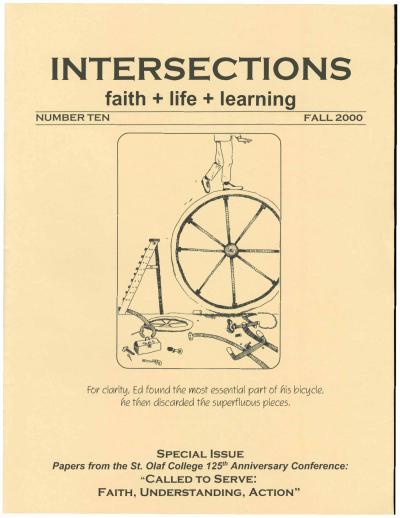
Dovre frames the St. Olaf 125th anniversary—originally read as part of a presentation with the St. Olaf Cantorei and organist Paul Manz—around T.F. Gullixson’s story of an immigrant woman who “turned her face to the west wind” and the 1874 gathering at the Holden parsonage of B.J. Muus, Harold Thorson, O.K. Finseth, K.P. Haugen, and O.O. Osmondson. He weaves Anselm’s “faith seeks understanding,” Harold H. Ditmanson on the universal relevance of Christian faith, and the music of Venatius Honorius Fortunatas, John Rutter, Herbert Brokering, Ralph Vaughan Williams, and John Tavener into a meditation on faith as motive, understanding as modus, and action as consequence, against the “ill winds” of poverty, child homicide, AIDS, and consumer gluttony.
-
 Book Review
Reviews
Matthew J. Marohl
No. 26 · Fall 2007
Marohl reviews two 2006 Lutheran University Press volumes from Grand View College (Des Moines, IA). Mark C. Mattes and Ronald R. Darge’s Imaging the Journey … of Contemplation, Meditation, Reflection, and Adventure pairs Mattes’s Lutheran meditations on seven themes (from a spirituality of communication to Alpha and Omega) with Darge’s photographs and Ronald Taylor’s short prayers, with Mattes’s writing on vocation singled out as the volume’s finest. The Grand View College Reader, edited by Mattes, Evan A. Thomas, Kathryn Pohlman Duffy, and Ronald Taylor, surveys the college’s Foundations, Creativity, and Vocation through chapters by Thorvald Hanson, Kenneth Sundet Jones, Kevin Gannon, Ammertte C. Deibert, Steven Snyder, and President Kent Henning, tracing Grand View’s Grundtvigian and Danish Lutheran roots.
-
 Poem
Poem
Emily Dickinson in Columbus, Ohio
Caitlin McHugh
No. 17 · Summer 2003
McHugh imagines Emily Dickinson waking up on a COTA bus to find “the world had ended, and her violets were gone forever,” then escaping the crowd to wander High Street, taste “actual brewed liquor,” quit “the act of reclusive-drama queen-ghost,” and finally smash a bouquet of violets when she realizes that “Beauty had not stopped for her death, but crawled bravely onward.”
-
 Article
Do You Teach in a Different Manner at a Lutheran College? Unraveling the Lutheran Knot and Highlighting the Glory in the Theology of the Cross
Curtis L. Thompson
No. 16 · Winter 2003
Thompson argues that being Lutheran means having a “knot in the stomach”—a dialectical “Yes and No” tension between law and gospel, two kingdoms, Word and world—and that this knot is held together by Luther’s theology of the cross supplemented by an under-appreciated theology of glory in which God shines through human beings and creation. He then traces how the Lutheran knot shapes his teaching at Thiel College in the Religion department, the first-year team-taught “History of Western Humanities,” the second-year “Science and Our Global Heritage,” and his work as Co-Director of Thiel’s Global Institute, concluding that only such “dialectical doublespeak” leaves him with the “at-once dreaded and delightful dis-ease of the Lutheran knot.”
-
 Reflection
Meditation—Band Chapel Service, St. Olaf College
Erik Haaland
No. 7 · Summer 1999
Haaland, a St. Olaf senior, offers a brief Band Chapel meditation that defines art as “the expression of what is deeply human through the manipulation of the physical world” and defends worship—architecture, stained glass, music, eloquence—as an art form requiring our best and most sincere efforts. When the God we worship and the salvation we proclaim do not seem near, artful worship offers not propositions but something real and tangible to hold on to.