Seeking the Common Good: Lutheran Contributions to Global Citizenship
Intersections No. 29 · Spring 2009
Three years ago, I taught a course at Luther College titled “Vocation as a Call to Citizenship.” This course was to examine Martin Luther’s thoughts on both vocation and social responsibility, to establish a connection with the contemporary debates on citizenship, and to explore some of the ethical consequences of such reflection on vocation as a call for global awareness. The first challenge to overcome was the expectation that the class would define each student’s vocation, as many thought of vocation simply as their future occupation in life. The second challenge was to relate the notion of vocation to a broader calling in life, one that both encompasses and goes beyond one’s profession. The third challenge was to aid students in thinking of themselves as global citizens, that is, as people whose local actions have global repercussions and vice-versa. The findings of that class created in me a deeper awareness that a liberal arts education at a Lutheran college has not only the possibility, but the responsibility of preparing students for mindful citizenship.
This idea was also affirmed by members of the Religion and Philosophy Department who decided to work on a collective publication titled “Knowledge as Discernment: Vocation, Advocacy, and the Classroom.” This book, which is an ongoing project, will offer an epistemological take on vocation, analyzing how the construction of knowledge inside and outside the classroom brings together vocation, advocacy, and experience. The overarching theme is the notion of vocation as discernment and how knowledge, in the context of a liberal arts college affiliated with the ELCA, addresses not only the vocation of teachers (who impart information) or the vocation of students (as they prepare for their careers). Rather, this project evaluates the epistemological role of vocation proper, as a lens through which the learning community (students and teachers alike) perceives its role in the world. The project also redefines vocation as more than one’s occupation, but rather the foundation of humanity’s call to exist, its capacity to discern and live fruitful lives together.
Institutionally, Luther College recently created its Center for Ethics and Public Life. As part of the ad hoc committee to define the nature and scope of such a center, I have great expectations for this work. By encouraging deep reflection about ethical matters and responsible citizenship, the center will promote research, writing, and an ongoing conversation about the public choices confronting society and the role ethics ought to play in making those choices. Besides bringing notable speakers to campus, the center offered an interesting course last spring titled “Global Citizenship, Ethics and Public Life: All It Offers is the World.” John Moeller, professor of political science and director of the Luther Center for Ethics and Public Life, developed the course in response to concerns about study abroad reintegration. Prof. Joy Conrad was the one to teach it. From the course description one learns that this was an opportunity for students who spent a semester abroad to evaluate their immersion in a foreign culture and to reflect on how this experience affected their values and influenced their concept of vocation. “We talk about major global issues and read about the theoretical framework behind problems and solutions,” said Conrad. “It’s when we ask how theories correlate with and affect the country in which the student lived—whether developed or developing—that the conversation gets really interesting.” (Westby)
These three initiatives give you a glimpse of how global citizenship is addressed on campus. There are, of course, many other activities carried out through teaching, scholarship, and service that foster a sense of global citizenship. Although not clearly stated in any of the examples, there is both a novel way of understanding what citizenship is all about, as well as the way a Lutheran theology offers hermeneutical keys to support this type of involvement. I would like to explore how Lutheran theology, through the Christian notion of neighborly love, fosters a sense of responsibility, accountability, and compassion toward the world. This, in turn, leads to a notion of citizenship that is more than civic engagement or service. Ultimately, to be a global citizen is a commitment to transformative participation in world affairs.
“…the Christian notion of neighborly love fosters a sense of responsibility, accountability, and compassion toward the world.”
A Lutheran Tenet: Love of Neighbor
A Lutheran reflection on civic responsibility, accountability, and commitment toward the wellbeing of others fosters an understanding of vocation as a call to citizenship. In his writings, Martin Luther spells out that to be a Christian is to live not in oneself but with an utmost concern for our neighbor:
…the good things we have from God should flow from one to the other and be common to all, so that everyone should ‘put on’ his neighbor and so conduct himself toward him as he himself were in the other’s place. (“Freedom” 79)
Indeed, Martin Luther’s ethics could be summarized with his statement that Christians live not in themselves, but in Christ and in their neighbor. Living in Christ through faith and in their neighbor through love, Christians give witness of the Word of God. By faith Christians are caught up beyond themselves into God. By love they descend beneath themselves into their neighbor. (Luther “Freedom” 80) Faith and love act out Jesus’ great commandment, bringing God and neighbor into the ethical living of believers: “You shall love the Lord your God with all your heart, and with all your soul, and with all your strength, and with all your mind; and your neighbor as yourself.” (Luke 10:27)
Recalling the doctrine of justification by faith, however, many believers tend to downplay the importance of good works in Luther’s theology. A common misunderstanding is a confusion regarding the role of the law in his theology. Whereas it is correct that good works have no place when it comes to the merit of salvation, nonetheless good works are an intrinsic part of Christian life. The fulfillment of the law in its civic or political use is a requirement for all Christians because it guides, compels, protects, and leads to good works. (Luther “Commentary”) The law, therefore, is not only good and necessary, but it is also God-given. It is the basis for a just society and serves as a constant reminder of our social responsibilities. It locates us in our social relationships in family, work, church, country, and as citizens, allowing us to spell out who the neighbor Jesus referred to actually is. Luther summarizes his position in the following way:
Christians, among themselves and by and for themselves, need no law or sword, since it is neither necessary nor profitable for them. Since, however, a true Christian lives and labors on earth not for himself but for his neighbor, therefore the whole spirit of his life impels him to do even that which he need not do, but which is profitable and necessary for his neighbor. Because the sword is a very great benefit and necessary to the whole world, to preserve peace, to punish sin and to prevent evil, he submits most willingly to the rule of the sword, pays tax, honors those in authority, serves, helps, and does all he can to further the government, that it may be sustained and held in honor and fear. Although he needs none of these things for himself and it is not necessary for him to do them, yet he considers what is for the good and profit of others, as Paul teaches in Ephesians 5:21. (“Secular” 373)
Jesus commands us to love our neighbor as we love ourselves. As human beings, we have to be constantly reminded of this imperative. Depending on us, we would look out only for what is good for us, for our family or friends. The egotistical and self-centered character of humanity prevents us from fully accomplishing the love of neighbor on our own. Either because we would use such good works for our own merit or because we would reduce the neighbor’s needs to our own interests, good works will spring only from justification itself. The use of the law in the theological or spiritual sense—when it refers to one’s salvation—is condemned. Still, there is a positive and needed use for the law also in the theological sense because it reminds humans that we are self-centered creatures, full of pride and eager to justify ourselves through our own good deeds.
According to Luther, faith springs into acts of love. Christians will seek the wellbeing of their neighbor not because it is the law, but because such good works are committed in freedom, out of love. Ultimately, good works are concrete expression of Christian service. A Christian vocation includes an active role in political affairs, in works of advocacy, and genuine concern for the wellbeing of others not because it brings us closer to God or because we achieve merits. Rather, this work is done as a result of our being justified. A Christian is free to serve. Ethical reflection, from a Lutheran perspective, is the concrete effort to acknowledge the right of others as God’s creatures, placing oneself as an instrument of God’s love. The good we do to others is done by God, who acts in and through us. Good works stem from a grateful heart, through an awareness that we live under God’s grace. By serving the other, one’s neighbor, one is also serving Christ.
“According to Luther, faith springs into acts of love.”
[The believer] confesses and teaches this gospel to the people at the risk of life itself. His whole life and all his effort are directed towards the benefit of his neighbor, and this not just in order to help him to attain the same grace; but he employs his strength, uses his goods, and stakes his reputation, as he sees Christ did for him and therefore follows His example. Christ never gave any other commandment than that of love, because He intended that commandment to be the test of His disciples and of true believers. For if (good) works and love do not blossom forth, it is not genuine faith, the gospel has not yet gained a foothold, and Christ is not yet rightly known. (“Preface” 18)
Although the core of Luther’s theology on good works is quite clear— and its importance undeniable— it is still surprising how easily this knowledge becomes abstract or its scope reduced to charitable actions. The concern for the wellbeing of neighbor, as Luther spells out, is the basis for an ethics of care. To care for another human being is to assure dignity and life in abundance, act for justice and peace, and enable that another may flourish as a full human being created in the image of God. It implies a genuine concern for the neighbor’s needs. It allows another to tell us what they require from us and how we can become involved in their life stories. The neighbor is not a mere receiver of one’s favor or charity. The neighbor is the other with whom I engage as an equal, the one who brings me closer to Christ, and the one I am Christ for.
To serve one’s neighbor—to genuinely care for her or him and assure their wellbeing—is to reclaim an ethics of care (cf. Deifelt for a more comprehensive account on care from a Lutheran perspective). A Christian lives in Christ through faith and in his/her neighbor through love. Through faith we relate to God, and through love we relate to other human beings. This leads to a concern for the wellbeing of others and not exclusively one’s own. One cares for the physical and spiritual wellbeing of others and fosters relationships that reflect the perception that we are God’ creation, redeemed and reconciled in Christ, and called forth to announce good news and practice good works.
This is deeply related to Luther’s reflection on vocation. Luther affirms that one serves God in whatever station one finds oneself. Vocation is how we serve God not in the attempt of achieving merits, but for the common good. Vocation is a calling in our life situation that permeates every aspect of our existence. Thus, his theological findings (for instance, that we are justified by faith through grace, that baptized believers are to live their faith in community, and— even if good works merit no salvation— that there is no Christian life without service to the neighbor) are intertwined with the actions in concrete, contextual realities. Although Luther’s teachings have sometimes been misunderstood as encouraging quietism or restricting a Christian’s concern to the ecclesial arena, they have nonetheless enlightened us on what it means to be a Christian and to live out one’s faith in light of that calling, vocation. A re-reading of Luther’s theology, with a particular focus on the role of believers in society, shows that Christians have an important role to play not only in the Church, but also in the social realm. Luther’s Two Kingdom theory demonstrates the creative tension in which Christians live, affirming that both Church and State are under the rule of God. To acknowledge this is to give Christians a social responsibility, a call to live a Christian life in the world.
One could skeptically ask, of course, how feasible this understanding of neighborly love in fact is, and to which extent it can be applied to citizenship. Martin Luther would be the first to admit the paradox of human existence, a reality of already and not yet, of simul iustus et peccator (sinner and saint at the same time), and the constant need for repentance of wrongs done and good left undone. A Christian life is not a life of accomplished deeds but one of unfinished struggles. That is why Luther so honestly recognizes that, although there are many people who are baptized, very few can truly be called Christian.
In addition, when relating Luther’s notion of neighborly love to the understanding of global citizenship, it is necessary to recognize that Luther’s views on the political debate are still shaped by a medieval mentality, one in which civil liberties and rights are not part of the common person’s horizon. The dramatic changes engendered by social and political movements (in Europe and elsewhere)— including such events as the French Revolution, the independence of former colonies, and the plea of women, blacks and native populations for the right to vote— forever changed power dynamics in society. These changes, albeit positive, also reflect an Enlightenment anthropology that assumes a modern, more individualistic view of the human being, i.e., one that is more concerned with individual rights and not necessarily the achievement of a common good. Is Luther’s theology still adequate for such a context? What is the role of human agency in Luther’s paradoxical approach to Church and Society? How can Luther’s theology of vocation prepare us to be better citizens?
Citizenship
Around the world, there has been a renewed interest in citizenship. Commonly understood, a citizen is a native-born or naturalized person who owes allegiance to a particular country and who is entitled to its protection. Due to our liberal mindset, we tend to associate citizenship with individual rights. When students are asked to define citizenship, the first round of the conversation focuses precisely on that: how individuals get to exercise their rights in particular societies and the right to vote is usually the first example offered. The second round of the conversation (and most often when specifically asked) includes the responsibilities and obligations citizens have to meet in order to be considered citizens. Only the third round of the conversation includes the wider community— whether one’s advocacy on behalf of particular social groups, a concern for particular causes, or any collective effort for the promotion of the common good.
Indeed, citizenship can be both the relationships between a state and an individual citizen and the political relationship between the citizens themselves. To be vested with rights and privileges also includes having duties and meeting obligations. The actions, opinions, and virtues of citizens allow them to be viewed as members of society. Yet, how the individual interacts with the collectivity and what rights and responsibilities one has in relation to the larger society depends on one’s cultural and political views as well as one’s social and historical location. A modern understanding of democracy defends that all citizens can be full and equal participants in the political process.
It is difficult for us to imagine society without the free and equal participation of all in the body politic. If one takes the social advancements of women as an example, women’s rights are a recent accomplishment at best, and still a longing for most. As pointed out by Sylvia Walby, until the twentieth century women in the US did not enjoy many features of either civil or political citizenship: “They lacked ‘liberty of the persons’ in that they did not have the right to control their own bodies in situations where they wished for abortion or contraception. Married women lacked the right to live anywhere other than where their husbands insisted.” (167) Married women lacked the right to own property and to conclude valid contracts. They did not have the right to be free from the physical coercion of husbands nor to refuse sexual intercourse. In marriage, husband and wife became one, and that one was the husband.
Women’s exclusion from civil, social, political and economic citizenship was based on the so-called natural order of creation. (Bonacchi and Groppi) Since Aristotle’s civic-republican thought, it was presumed that political virtues and qualities were inherent only to men, who shared natural rights. Because women were considered inferior beings, they were excluded from such rights and responsibilities. It was presumed that nature allocates specific traits to men and women, equipping males for the public world and females for childrearing and household chores. The classic republican tradition of political thought (including thinkers such as Aristotle, Machiavelli, and Rousseau) does not envision the participation and representation of all. The principles of exclusion, usually based on the natural order, presume that some are better equipped and have more rights than others. Throughout history, similar principles were invoked to create “others” who were kept at bay from the decision-making processes. This was the basis for keeping slaves, indigenous populations, and those who have been colonized as legal minors. To be “othered” was to be deemed socially, politically, or morally inferior. Ironically, the social principles that justify the enfranchisement of some continue to support the disenfranchisement of others.
“Is the language of rights enough to describe citizenship?”
Is the language of rights enough to describe citizenship? As Luther pointed out, there is also the component of responsibility (the neighbor who requires a response from me). In fact, there is a large body of literature dealing with citizen virtues, as exemplified by William Galston’s typology. He identifies four categories of virtues: 1) General virtues: courage, law-abidingness, loyalty; 2) Social virtues: independence, open-mindedness; 3) Economic virtues: work ethic, capacity to delay self-gratification, adaptability to economic and technological change; 4) Political virtues: capacity to discern and respect the rights of others, willingness to demand only what they can pay for, ability to evaluate the performance of those in office, willingness to engage in public discourse. (221-24)
In Aristotle’s writings, citizenship is worded in terms of obligations and duties: the free propertied male not only had the privilege but primarily the obligation to take public office, hence sacrificing his private life to do so. Of course, feminist scholarship has long questioned this “altruistic” notion of citizenship by pointing out that representation (public office) is a good means to establish and perpetuate power relations. Hence, the issue is not simply access to vote (which still can defer the responsibility of decision-making to others) or to be elected for public office, but to which extent one is a participant in the decision-making processes. In modern times, citizenship is increasingly identified as rights. Liberalism stresses not only the right to participate in public life, whether by voting or holding public office. It also includes the right to place private commitment ahead of political involvement. In other words, we are becoming aware of the increasing number of people who see it as their right not to be politically involved.
The language of rights and virtues (or responsibilities) does not fully encompass the process of transformation, accountability, and agency that citizenship engenders. Rights and obligations do not necessarily translate into a care for the res publica, for the common good, nor does it show the sentiment of belonging, of being situated in time and space, and the concern for one’s location. The principle of rights and obligations serves us to a great extent, but the issues of participation and advocacy cannot be addressed solely from this perspective. Here is where religious discourse and care might have an additional contribution to offer to the ongoing debate on citizenship and the common good. By focusing not solely on the rights and duties of citizens vis-à-vis the State, but addressing the principles that guide individuals and communities to be responsible, there is an epistemological shift. By drawing from religious teachings that foment citizenship participation, the debate is not restricted to virtues, but includes the responsibility to advocate for each other. When Luther unfolds the consequences of neighborly love, he establishes that this love is more than a virtue one possesses (as moral excellence or goodness) or an obligation (as fulfillment of the law). It is a way of life, an ability to interact, engage, and genuinely care. It is a responsibility in the sense that we respond to God’s call, voiced though the needs of our neighbor.
The creative tension between rights and responsibilities shows that citizenship refers not only to a legal status, but also to a normative ideal. How do we want to live together? Liberalism, for instance, gives priority to the individual, stating that there is an essential self, a core or essential structure of personhood that precedes the social dimension. Because freedom, self-determination and self-creation are highly valued, this self promotes its own perceived interests. A vision of community derives from a need for a set of rules to guide social interactions, a “social contract” (using Rousseau’s language) that assures liberties and individual rights. Liberalism operates under the premises that human beings are capacitated for common sense and rational reflection (making use of reason). The social interactions regulate the public sphere because they concern persons’ roles as citizens, taxpayers, voters, and legal benefit claimants. Liberalism defends that the private sphere—the realm of family and domestic issues, where religious and moral values are taught and cultural traditions passed on— should not be regulated in order to assure personal freedoms. This creates an interesting debate on the role of religion in liberal societies and the place religious organizations occupy in the overall political configuration. (An important conversation, in the next years, will be the role of faith-based initiatives in the United States.) Feminist theory has challenged this dichotomy between public and the private, and the border between them is much more nuanced today than earlier political theorists had established. Nevertheless, the question about the public role of religion is one that will remain with us for a while.
Communitarianism, on the other hand, defends that persons are deeply determined by their communities, thus rejecting the ideal of liberalism’s isolated individual in favor of a community-centered approach.
This recognition has led communitarians to assert, using the language of constructivism, that we are intimately interconnected beings (not originally isolated individuals); our personhood emerges out of complex engagements with the persons, places, practices, discourses, and traditions into which we are born and within which we continue to live. (Jones 145)
This approach defends that it is important to understand communities in their own terms and to engage in conversation regarding conflicting visions of community.
The definition of a citizen as somebody who inhabits the polis, the city, offers an additional insight. A citizen is somebody engaged and committed to the welfare of her or his environment. The awareness of one’s location—the geographical, social, economic, cultural and political location we occupy—cannot be taken for granted. A few years ago, as a visiting faculty member at Emmanuel College, in Toronto, I was co-teaching a class on multicultural education. In one of the sessions, I stressed the fact that in order to be a global citizen one needs to be aware not only of one’s immediate surroundings, one’s own sense of location, but also of what is going on around the globe. Even if one can never be truly aware of everything that goes on, a concern for contemporary issues facing the globe is vital for our sense of belonging. For me, personally, reading a newspaper and having access to information is crucial because I grew up under a military dictatorship in Brazil. Under censorship, almost no information was made available. So, I was utterly surprised when a student told me that she did not watch or read any news because she could not cope with it. Because the stories were always so overwhelming (and I agree, often violent), she just switched to another television channel when the news came on. In her words, it was a matter of survival. For her own sanity and wellbeing, she chose not to learn about the plight of other human beings. This, needless to say, gave me pause. I had never seen the concept of “survival strategy” applied to an intentional withdrawing from the world.
In the context of a liberal arts education at a Lutheran college, we might have the impression that students have plenty of access to information. Students are often overwhelmed by the amount of information. Flooded by data and not knowing what to do with it, students are tempted to escape from conflictive issues and retreat into their own virtual space. In fact, the withdrawing from the world that my Canadian student named as “survival” was a withdrawing into another world, one that can be made up virtually by switching channels, where one can select outcomes, or create identity. I suspect that many students in our classes feel and act the same way. They just don’t voice it as clearly. As Castells points out:
What we have come to call globalization is not simply a process that links together the world but also one that differentiates it. It creates new inequalities even as it brings into being new commonalities and lines of communication. And it creates new, up-to-date ways not only of connecting places but of bypassing and ignoring them. (Ferguson 243)
The very idea that human beings are social and political beings who join together to promote the common good seems flawed. People join efforts to promote self-interests, and it takes intentionality to negotiate differences, advocate for the rights of others, and to willingly engage in sustained debates on how we organize ourselves as society, how we employ natural resources, how we care for the environment, what entails fair wages, or how we educate the younger generations. If the goal of citizens is to promote justice in a community based on the fulfillment of those who share this just arrangement, then the desire for justice needs to be instilled. It is not a given reality. A Lutheran contribution to global citizenship is to reclaim the role of religion in creating values that inform decision-making. It informs us about the needs of the neighbor and compels us to think about our role in the world.
Through this calling we serve God’s creative work, we give witness of God’s love, and live according to Jesus Christ’s teachings. This belief, therefore, calls for a broadening of the concept of citizenship in order not to focus solely on individual rights and duties, but also on the ethical dimension of promoting the values of public responsibility, accountability, and life in abundance for all. If citizenship is not reduced to representation, but includes participation in the social and cultural fabric, then the notion of citizenship can be informed by religious values. As part of civil society, the church (independent of denomination) can educate for transformative participation. In doing so, it will answer its call to be a witness to the world at large.
Works Cited
Bonacchi, Gabriella, and Angela Groppi. O dilema da cidadania: direitos e deveres das mulheres. São Paulo: UNESP, 1995.
Deifelt, Wanda. “A Lutheran Ethics of Embodied Care.” Lutheran Ethics at the Intersections of God’s One World. Ed. Karen L. Bloomquist. Geneva: Lutheran World Federation, 2005. 49-62.
Ferguson, James. Expectations of Modernity: Myths and Meanings of Urban Life on the Zambian Copperbelt. Berkeley: Univ of California P, 1999.
Galston, William. Liberal Purposes: Gods, Virtues, and Duties in the Liberal State. Cambridge: Cambridge UP, 1991.
Jones, Serene. Feminist Theory and Christian Theology: Cartographies of Grace. Minneapolis: Fortress, 2000.
Luther, Martin. “Commentary on St. Paul’s Epistle to the Galatians.” Martin Luther: Selections from His Writings. Ed. John Dillenberger. New York: Anchor, 1962. 99-165.
———. “Freedom of a Christian.” Martin Luther: Selections from His Writings. Ed. John Dillenberger. New York: Anchor, 1962. 42-85.
———. “Preface to the New Testament.” Martin Luther: Selections from His Writings. Ed. John Dillenberger. New York: Anchor, 1962. 14-19.
———. “Secular Authority: To What Extent It Should Be Obeyed.” Martin Luther: Selections from His Writings. Ed. John Dillenberger. New York: Anchor, 1962. 363-402.
Walby, Sylvia. Gender Transformations. New York: Routledge, 1997.
Westby, Kate. “Citizens of the world: Center for Ethics and Public Life Offers First Global Citizenship Course Spring Semester.” <http://publicinformation.luther.edu/2007_08/march/students/globalcitizenship.html>
-
 Editorial
From the Publisher
Mark Wilhelm
Wilhelm introduces essays from the 2008 Vocation of a Lutheran College Conference held at Luther College under the theme “Educating for Responsible Citizenship,” previewing contributions from Paul Pribbenow on dual citizenship at Augsburg, Wanda Deifelt on Luther College’s engagement with civic vocation, Jose Marichal on the promise and peril of digital citizenship, and Arne Selbyg on his three experiences of being educated for citizenship.
-
Editorial
From the Editor
Robert D. Haak
Haak frames the issue’s essays around the question of Lutheran colleges and the role of citizen, noting H. Richard Niebuhr’s typology in Christ and Culture and Luther’s own complex understanding of Christian and state, and offers a fitting farewell to Arne Selbyg with Mike Blair’s tribute song “A Fine Norwegian.”
-
Article
Dual Citizenship: Reflections on Educating Citizens at Augsburg College
Paul C. Pribbenow
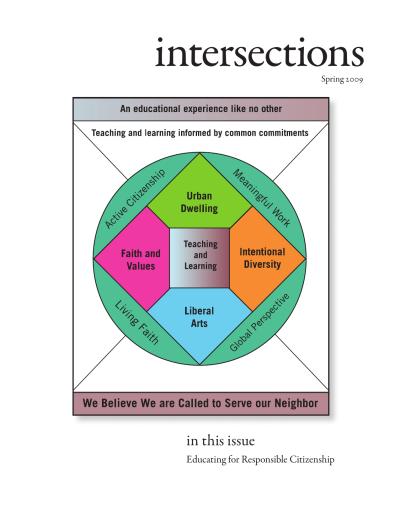
Pribbenow argues that the vocation of Augsburg College is to educate “dual citizens”—those able to live within the messiness of common work rather than resolve every tension once and for all. Drawing on John Courtney Murray on democracy as “the intersection of conspiracies,” Bill Moyers, Jean Bethke Elshtain, Stephen Carter, and the Augsburg vision statement “We believe we are called to serve our neighbor,” he names four common commitments and five principles of civic education that ground Augsburg’s incarnational mission in its city neighborhood.
-
Article
Students in the Cloud: Creating Digital Citizens
Jose Marichal
Marichal weighs the utopian and dystopian views of the “networked information economy,” drawing on Yochai Benkler, Manuel Castells, Henry Jenkins, Cass Sunstein, Robert Putnam, Nicholas Carr, and Andrew Keen to chart the promise and peril of life “in the cloud,” and proposes Aristotle’s intellectual virtue of phronesis—developed through Hubert Dreyfus’s five stages of skill acquisition—as the goal of digital citizenship for college faculty and their students.
-
Article
From Alien to Citizen
Arne Selbyg
Selbyg reflects on three experiences of being educated for citizenship—growing up in Norway under the legacy of Lutheran pastors and public school teachers who resisted the Nazi occupation, arriving in America as a resident alien, and becoming a naturalized American citizen—and proposes the jazz ensemble as a better metaphor for American society than the melting pot, one in which different citizens learn skills, study other instruments, and dialog with one another in service to the common music.
-
 Article
Liberal Arts and Professional Education: A Call for Philosopher-Servants
Steven C. Bahls
No. 24 · Fall 2006
Bahls, President of Augustana College (Rock Island), calls for a renewed commitment at Lutheran colleges to form “philosopher-servants” — graduates whose grounding in the liberal arts and the liberating gospel equips them for thoughtful service in business, education, nursing, and the other professions. Their impact, he argues, is “a good thing and a fact that we can be proud of as those who labor in Lutheran higher education.”
-
 Editorial
From the Editor
Tom Christenson
No. 15 · Winter 2002
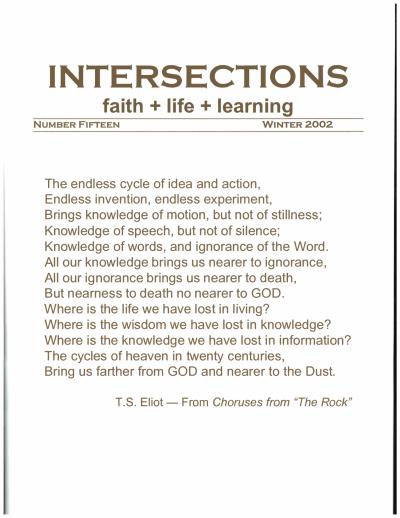
Christenson introduces an issue of varied voices—bishops and university presidents, philosophers and poets, students and their teachers—and defends the T. S. Eliot cover selection (“Where is the wisdom we have lost in knowledge?”) against the charge of being too depressing, arguing with cover artist Ida that Lutherans are realists about human accomplishments and that there is a huge difference between optimism and hope.
-
 Article
Finding Flourishing: Teaching Self-Care as Course Content
Emily Kahm
No. 49 · Spring 2019
Kahm argues that teaching self-care, self-awareness, and stress-coping as explicit classroom content embodies the “radical hospitality” of Rooted and Open and supports vocational formation against a consumerist culture, then offers concrete classroom techniques — a one-to-five energy check-in, ninety-second silence exercises, and full-day spiritual practices — that can be adapted across disciplines at NECU institutions.
-
 Reflection
Shelter in Place: Reflections from March 22, 2020
Jason A. Mahn
No. 53 · Spring 2021
On the fourth Sunday of Lent in 2020, Mahn meditates on the etymology of “shelter” (from shield) and on an email from a former student in Boston whose mutual-aid organizing models a Lutheran understanding of vocation: the upending of ego by divine love that frees us, finally, to see and serve the neighbor.
-
 Poem
Poem
Two Poems: The Advent Carol / The Madonna of Dohany Street
Brian Forry Wallace
No. 2 · Winter 1997
Two poems by Brian Forry Wallace of Capital University: “The Advent Carol,” a litany of the babies who were not adored—the Jewish baby shot with a Luger, the Black child hanged from a tree, the female messiah tossed into a river, the Tutsi infant cut by machetes, the Japanese newborn incinerated by atom bombs, the Chinese baby crushed by Japanese bombs, the aborted Mary’s child—ending with the baby “whom we do not understand, cannot feed, whom we kill”; and “The Madonna of Dohany Street,” on a Holocaust photograph in a Budapest museum of a dead mother and her dead Christ-child daughter in the former ghetto, in which annunciation, nativity, adoration, and crucifixion are seen together in a single instant.
-
 Article
Uneasy Partners? Religion and Academics
Storm Bailey
No. 11 · Spring 2001
Bailey, a philosopher at Luther College, takes up the reflex of describing church-related colleges as “pretty good in spite of the religion” and argues instead that religious commitment serves academic goals on three fronts: service as central academic purpose (Richard Hughes on Mennonite colleges in Models of Christian Higher Education), educational community (Plato’s dialogues, Parker Palmer, and Mark Schwehn’s Exiles from Eden), and integration of knowledge across disciplines against Nelson and Watt’s “entrepreneurial disciplinarity.” He then defends academic freedom on Christian grounds by drawing on Mill’s On Liberty argument from fallibilism, the centrality of epistemic weakness in the Christian tradition, and Wolterstorff’s claim that to infringe academic freedom is to desecrate an image of God—making personal and institutional religious commitment a foundation, not a foe, of the liberal academic ideal.