Opening Convocation, St. Olaf College
September 3, 1997
Last Saturday morning I drove from Northfield to the Minneapolis airport, and on the way, especially out on highway 19, passed dozens of cars bringing you first-year students to campus. It was wonderful. Car after car, van after van, stuffed to the ceiling with clothes, wicker baskets, plants, small furniture, the occasional carpet roll sticking out the side window. Best of all were the faces: Mom and Dad with mixtures of pride and sadness; you students, eyes wide with anticipation, excitement, sometimes fear; a few of you snoring away in the passenger seat. I loved it — at last you were coming.
I remembered the first day of college for my three children, and the outpouring of good advice with which I wanted to shower them on the drive to college. My own father had given me sage advice when he took me to college, and when our oldest child Rebecca was ready to go, so was I, with the accumulated wisdom of my years of teaching, well rehearsed and ready to deliver. She was coming to St. Olaf and we lived only two minutes away, so I had the advice reduced to a few precious pearls. She must have known. At the last minute she announced that her boyfriend was taking her and her stuff to college, and he did.
Four years later it was Jonathan’s turn, and he picked Luther College. I thought, Yes! A three-hour drive! I could unlock my word-hoard, embellish each point with literary allusions, humorous anecdotes, quotations from Oscar Wilde and Yogi Berra. Jonathan, too, must have known. Shortly before college began he bought a motorcycle, and Karen and I drove down to Decorah in a car filled with his stuff, Jonathan on his motorcycle in the rear-view mirror, grinning like Peter Fonda.
Allison, our youngest, bless her, understood. By the time she was ready to enter St. Olaf we had moved closer to campus, only 90 seconds away by car. She let me drive, and she let me speak. If she hadn’t you would all be hearing that speech tonight. But this is a different time, and a different audience, and I have other things to say.
Several years ago, after I thanked a colleague, now retired (but here tonight), for his Opening Convocation address, he said, “Well, it’s an assignment that ruins your summer.” This assignment hasn’t exactly ruined my summer, but it has made it more interesting as I have mentally drafted several different addresses. I’m only going to deliver one of them. It isn’t the talk that I thought I would give, but it is the one I am compelled to give.
Forty years ago this week I arrived on this campus as what we used to call a freshman. And, of course, I wish that I had known then what I know now. I thought I knew quite a bit, and I had a substantial amount of naive but short-lived self confidence. I remember one of my first evenings on campus, dressed smartly in my new cream-colored corduroy slacks, my new charcoal-gray crew-neck sweater, and my new white bucks. I was walking from my room in Ytterboe to meet my advisor, Professor Ditmanson, at his home on Lincoln Lane. As I crossed the football practice fields in the gathering dusk, feeling very Joe College and suave, I fell face-first into a shallow and muddy construction pit, considerably damaging my illusions of grandeur.
But now it’s forty years later, and I’m still here. Some of you in this audience had already been here a long time when I arrived, and you’re still here, too. Such longevity may sound frightening to you students, as it would have to me had I thought of it when I was your age, but it is less surprising the longer one comes to know and understand and love this place.
One surprising thing that’s still here tonight is Ytterboe Hall. When I lived in Ytterboe back in the middle ages we all complained about its decrepit condition, and we envied the senior men who had chosen to live in the comparative luxury of a spanking new dormitory called Kildahl. When I wrote home to complain about Ytterboe’s conditions I got no sympathy; Dad reported that he and his classmates thought it was in bad shape when he lived there in 1925. But there it stands, like old Emily Grierson house in Faulkner’s “A Rose for Emily”: “lifting its stubborn coquettish decay” above the campus greensward. Perhaps for the moment it stands as an emblem of one of those stereotypes of our Nordic ancestors: silent, unmoved, without heat or power — but still dangerous.
One title I considered for tonight was this: “Why Are We Here, and Why Do We Do These Things?” By here I mean not only here in Boe Chapel tonight, but also here in the enterprise of higher education, and in particular here at St. Olaf College. By we I mean the various groups of this audience: students, faculty, administration, staff, emeriti, and friends of the college. And by these things I mean ceremonial parade events like Opening Convocation, Commencement, and Honors Day, and other important St. Olaf events like daily chapel, the Christmas Festival, Alumni Day, Homecoming — and oh yes, the classes that start tomorrow morning.
Why are we here tonight, at Opening Convocation? I can’t speak for all of us as individuals. In fact, the only person out there whose motivation I think I know for sure is my mother. Many students are not here, perhaps understandably for this is your last evening of summer vacation, your last night without academic responsibilities. Most faculty are here, but not because we feel natural and comfortably in these arguably absurd garments, but for more profound reasons. And students, look around: you see here many people who don’t have to be here, but who are here because they love this place, they believe in this enterprise we call higher education, and they fervently hope that we all will conduct ourselves to make St. Olaf a stronger place, and that we will prepare and commit ourselves to nothing less than saving the world. We mustn’t disappoint them.
Two years ago American poet Jane Kenyon died of leukemia. My title is taken from the title poem of a recent collection of her work. Listen to her poem:
Otherwise
I got out of bed
on two strong legs.
It might have been
otherwise. I ate
cereal, sweet
milk, ripe, flawless
peach. It might
have been otherwise.
I took the dog uphill
to the birch wood.
All morning I did
the work I love.
At noon I lay down
with my mate. It might
have been otherwise.
We ate dinner together
at a table with silver
candlesticks. It might
have been otherwise.
I slept in a bed
in a room with paintings
on the walls, and
planned another day
just like this day.
But one day, I know,
it will be otherwise.
That time of otherwise has come far too quickly for Jane Kenyon. But her poem remains to remind us to be grateful for what we have — for the gifts of life, of health, of food, of place, of companionship, of beauty, of work that we love. For countless people in the world it is otherwise; we have been blessed and graced with this place, with this opportunity, and with each other. And for all of us it will one day be otherwise, as Jane Kenyon’s poem reminds us. Knowing that, we must embrace this opportunity, this academic year, and throw outselves into it with joy and thanksgiving that such a great gift deserves. One of my new first-year advisees said it perfectly in her essay of application to St. Olaf: “I believe in living as today was your last, but learning as if you had an eternity.”
Why ceremonies like Opening Convocation? These past two years have been for me, as well as for many of you, filled with ceremonial events. Funerals: of my father, of an uncle, of a student, of a colleague, of a colleague’s spouse. Weddings and Commitment Ceremonies: of my son, of my niece, of my godchild, of a former student, of a friend. Graduations. Ordinations. Confirmations. Baptisms. Retirements. Beginnings, conclusions, hellos, farewells, important passages and transitions. Tonight is one of those occasions for us.
As I have attended these moments I have been reminded over and over again why we do them, why we gather as we have this evening. We gather to celebrate, to encourage, to honor, to give strength, to express love. When two people commit their lives to one another in partnership, we are there to express support, and in the process most of us are moved to strengthen our own love relationship. When someone is buried we are there to give comfort, sympathy, and love to the bereaved, and in the process most of us are moved to re-examine our lives.
We’re here tonight, at the beginning of another academic year, for similar reasons. We are here to renew our commitment to this enterprise, to this college, and to each other. We are here to give each other energy. We are here to show our respect for education. We faculty put on these colorful costumes not to parade our degrees or to foster a sense of self-importance, but to honor what we are about to undertake together with you, our students. We know that the academic life at St. Olaf is a big deal, and these outfits are the best symbols of that we’ve got in our closets.
Most of you students are here at St. Olaf in large part because you have had good teachers who infected you with a zest for learning. I remember twelve years ago when Ernest Boyer, President of the Carnegie Foundation, spoke here as a part of President Mel George’s inaugural celebration. Boyer remembered heading off to the first day of first grade and asking his mother, “When will I learn to read?” She said that perhaps by the end of first grade he would know how to read a little. But when his teacher addressed the class at the opening bell, she said to her little first-graders, “Children, today we will learn to read,” and they did. He reported that the thrill that ran through him that day had served him constantly in a lifetime of education.
I was equally lucky. Miss Ellenburger, wherever you are, I thank you for my first year in school when you taught me to read, and for the support, encouragement, and inspiration that you gave me back in Madison, Wisconsin in 1945. When our family moved away during that first year, Miss Ellenburger gave me a Little Golden Book, The Lively Little Rabbit, inscribed with a loving message to me, and I have kept it as a reminder of the potential for good that we have as teachers.
I was lucky in college too. My wise advisers were Harold Ditmanson and Joe Shaw. I was blessed by the skills of Hildegarde Stiehlow, who taught me German, and Leigh Jordahl, who taught me Greek. I learned to love literature through the teaching of Art Paulson, and Marie Malmin Meyer, and especially Haldor Hove, without whose passion for Victorian literature I wouldn’t be here. I leaned ancient history from Clarence Clausen, European history from Agnes Larson, American history from Tubby Jorstad. These and many others were inspirations to me; all of you in this room, I hope, have similar lists of inspiring teachers. My colleagues, it’s up to us to be for our students what people like these have been for us.
Permit one anecdote about one of these teachers. I’m told that early one morning, late in her career, a colleague met Agnes Larson at the top of the long flight of stairs from St. Olaf Avenue to the Library. Aggie was just beaming with excitement, so much so that the colleague said, “Aggie! You look so excited and happy this morning! Is it your birthday?” “No,” she replied, “Today we begin the Renaissance!” May we all — students, faculty, staff — have many days this year of that kind of excitement.
And we come to Opening Convocation here in Boe Chapel because this place reminds of the ground of our being, the source of our grace, the place of truth. We gather here each weekday of the school year to praise God, to give thanks, to ask forgiveness, to refresh our spirits, to hear God’s word. We meet here to ask God, as we have just done, “to drive the gloom of doubt away…to fill us with the light of day.” This is the place where we can let our hearts unfold like flowers and where we can draw from the wellspring of the joy of living, thanking God that we have the grace today to do, as Jane Kenyon puts it, the work that we love.
We are here together not only to promote knowledge and to develop intellectual skills, but to sustain the human spirit. A liberal arts college is not a think thank. The human spirit can drown in a think tank — even at the shallow end. We can say of a liberal arts education what poet and physician William Carlos Williams said of poetry:
It is difficult
to get the news from poems [or from a liberal arts education]
Yet [people] die miserably every day
For lack
of what is found there.
So here’s the end of the first half of my talk. We have much to celebrate. We have much for which to be grateful. We thank all of those who have gone before us at St. Olaf, building this opportunity for us a day at a time, a year at a time, a career at a time. Some of you are here tonight, and we all thank you. If you hadn’t been faithful to your calling, and a to a vision of St. Olaf, it might have been otherwise. Instead, here we are again, ready to go.
Now I’d like us to think in a different way about the word “otherwise.” Not in the way Jane Kenyon used it, to mean “in a way different from this,” but to mean “wise about others,” in the way the word streetwise means “wise about the streets.” We all need to work to become otherwise, to become more perceptive about the other, about those who differ from us.
Many people, inside and outside the St. Olaf community, look at us and conclude that we lack diversity, that we are too much like one another. Certainly we are less diverse than many other colleges and communities in this country and other places in the world. We have been working hard at diversity, especially racial and ethnic diversity, and we will continue to do so. We have made progress; we are profoundly more diverse than when I was a student here. Today we are blessed with many international students who teach us to open our eyes to the world. And we have a remearkable inter-national studies program that will bring hundreds of you students and faculty into extended contact with other cultures.
But look around. This is who we are. This is our social reality for now. This is us, at least for this year. Let us not belabor the lack of certain obvious diversities; let us instead recognize the many diversities that we do represent, and respond rightly to those among us who are the other.
We are in many significant ways diverse. We are
women and men
young and old
gay and straight
Lutheran and Catholic
athletic and klutzy
Caucasian and rainbow
musical and tonedeaf
crass and tasteful
fascinating and dull
wise and foolish
Republicans and Democrats
healthy and ailing
wealthy and poor
arrogant and insecure
mean and kind
These are real kinds of diversity. Here at St. Olaf we have them all, and more that you have already added mentally to this list, or that you will remind me later that I should have included. We ignore these differences to our peril; we celebrate them to our benefit.
You know that we take these differences very seriously. Some of you here remember the service in this space almost 20 years ago, when Father Coleman Berry, the President of St. John’s University, spoke to us for chapel on Reformation Day. It was a wonderful ecumenical moment for St. Olaf. He spoke of growing up in Lake City, which he said was at that time evenly populated — and sharply divided — between Lutherans and Roman Catholics. He said that his family, like all Irish Catholic families, had an irascible Uncle Paddy who was always causing trouble or embarrassment. Finaly at age 80 Paddy was dying in the hostpital, and word came to the family that he had converted to Lutheranism! The family raced as one to the hospital, gathered around Paddy’s bed, and asked, “Paddy! Is it true? Have you become a Lutheran?” “Yes,” he responded, “I have.” “But, why, Paddy, why?” “Well,” he said, “I thought it would better to have one of them die than one of us!”
There is much of them and us in our world, even in a supposedly homogeneous place like this. And much of what matters in life depends upon how we relate to them, to the other. How faculty relate to students, and to the administration. How music majors relate to chemistry majors. How football players relate to computer nerds. How all of us relate to secretaries, and custodians, and the green army.
Like most of us, I have treated others as members of groups that I have stereotyped. And I have had major surprises. I think especially of Gus Eglas, a Latvian refugee who many years ago clerked in the campus bookstore and post office. Gus was built roughly like Kirby Puckett, looked and sounded hard and tough, and basically scared most poeple away. To me he was always kind, and after we dicovered that we both collected stamps, he invited me to his home to see his collection. He ushered me into his collection room, which he had converted from a garage. It held 134 stamp albums of every sort, and countless other things: the statue he had received, Latvia’s highest award for leadership in the Boy Scout movement; his many publications in postage stamp scholarship; drafts from the book he was writing with a Harvard ornithology professor, on all the postage stamps picturing birds catalogued by Linnaeus. He told me that when he had finally needed a garage again, he sold one of his stamp albums to finance it. I went home that night stunned and exhilarated, having discovered that gruff old Gus the refugee p.o. worker was one of this campus’ most prolific scholars and published writers. I try not to forget the lesson I learned that night.
Some of you know about Randy Cox, retired government documents librarian, who spent his entire career padding around in the bowels of Rolvaag Library. Over the years perhaps few students have know that he is one of the most prolific scholars on the campus, an international expert on the dime novel, on mystery fiction, and on Sherlock Holmes; that he owns and lives amidst the fourth largest library, public or private, in Northfield; and that he is an expert on everything to do with Batman.
The people who populate St. Olaf are special and precious and talented. Secretaries are artists, musicians, spouses of your professors and colleagues. Custodians are athletes, poets, parents of your classmates. Your classmate is fighting a serious disease, your teammate has just lost a parent. Your professor or colleague is looking desperately for a child’s cure, or is mourning the death of a spouse.
Some of us wear these abilities or needs on your sleeves, while others are more private. In order for us to be otherwise — to be wise about the others in our midst — we need to be alert to each other, which means we need to treat one another not as types or as functionaries, but as persons. We must connect with the other, care about the other, especially those who are close at hand.
Much of the word’s greatest literature is about the human need to be otherwise, and to relate to the other with understanding, with compassion, with love. Think of the tragic figures in literature who failed to understand and love the other, especially those close at hand. Othello. King Lear. Angel Clare of Hardy’s Tess of the D’Ubervilles. You can make your own list. But over and over again the artists of the world show us that in order to survive, the human spirit needs the connection with others, needs the love of others. Two of the great moments in American literature embody the truth that we must connect with the other: in Mark Twain’s Hucklberry Finn, you recall that Huck and Jim have been traveling down the Mississippi on a raft, both to escape — the 14-year-old Huck from his abusive father, the black slave Jim from his bondage to Miss Watson. They get separated, and then Huck discovers that Jim has been captured. Huck has been deeply ingrained with the religious and social moralities of his culture; he reasons that in helping Jim escape he has been wicked, for Jim is Miss Watson’s property. Huck has been sinful by helping Jim toward freedom. Huck later realizes that unless he turns Jim in, he, Huck will go to hell. He writes the letter telling Miss Watson where Jim is, and immmediately feels washed clean of sin. But then he begins to think of Jim not the black slave, but Jim the person, and the fact that Huck is now Jim’s only friend. Huck picks up the letter, holds his breath, says, “All right, then, I’ll go to hell,” and tears up the letter. Everthing he has learned tells him that Jim is property; everything he knows tells him that Jim is a person needing love. Huck chooses love.
In Flannery O’Connor’s short story “A Good Man is Hard to Find,” a young family traveling by car with a selfish and self-righteous grandmother have an accident and are dicovered in a remote rural ditch by an escaped convict named “The Misfit.” Because the grandmother recognizes The Misfit as a fugitive, he is obliged to kill the whole family one by one. Finally only the grandmother is left, deperately searching for a way to save her life. She invokes Jesus, causing the murderer to day, “Jesus was the only One that ever raised the dead… and He shouldn’t have done it. He thrown everything off balance. If he did what he said, then it’s nothing for you to do but throw away everything and follow Him, and if He didn’t, then it’s nothing for you to do but enjoy the few minutes you got left the best you can by killing somebody or burning down his house or doing some other meanness to him.” The Misfit, a pure empiricist apparently without the benefit of a good liberal arts education, doesn’t know for a fact whether Jesus raised the dead. He says “I wisht I had of been there… It ain’t right I wasn’t there because if I had been there… I would of known and I wouldn’t be like I am now,” and his suffering and humanity suddenly became obvious to the grandmother. Instinctively she says, “Why you’re one of my babies. You’re one of my own children,” she reaches out and touches him. Read the story to find out what happens next.
The story might more correctly be named, “A Good Woman is Hard to Find,” for Flannery O’Connor makes clear that the grandmother is not good until she unselfishly and kindly reaches out ot touch the man who has killed her family, until she has acknowledged the bond of humanity between them. The theological wisdom in the story comes from the most unexpected source, The Misfit. He rightly understands that “Jesus thrown everything off balance,” not only in his world, but in yours and mine. Only when we reach out to the other in an act of love and compassion, as Huck does for Jim, as the grandmother does for The Misfit, and as you and I must do for each other; only when we respond to each other not as types but as persons; only then are we living in the Gospel of grace and under the divine injunction that we love not only learning, not only teaching, not only St. Olaf, but that in the process we love the other, we love each other.
This summer Tim Lull, President of one of our Lutheran seminaries, said that if he were to visit a Lutheran college campus he would expect to find three things:
1. contentment
2. courage
3. cheerfulness
By contentment he did not mean complacency, or self-satisfaction, but rather the acceptance and gratitude of who we are as a college of the Church, a desire to be here rather than elsewhere, a love of this endeavor to which we have committed ourselves. By courage he meant the strength of mind and heart to ask the tough questions, to push beyond the easy answers, to go for truth rather than for victory or approval. He meant the dauntless quest of which we are about to sing. And by cheerfulness he meant the joy of which we have sung, a generosity of spirit, a sense of humor, a life of the possible, a sense of gratitude.
Would he find that contentment, and courage, and cheerfulness at St. Olaf? It should be our goal to assure it. At this place we understand that “Jesus thrown everything off balance,” and it ought to be obvious that we live accordingly.
One of my family’s loved ones has been fighting acute leukemia for the past six months, and six days ago received a bone marrow transplant that is his only hope for life. Two weeks ago the nurse who prepped him for the eight days of brutal radiation and chemotherapy that preceded the transplant said, “Michael, this is the first day of the rest of your life.” Suddenly for me that phrase ceased to be trite. The nurse went on to say, “And the day of your bone marrow transplant will truly be your second birthday.” I think of Jane Kenyon, and her profound gratitude for the gift of life. Her quiet joy for a day to do the work she loved.
Tomorrow, as the academic year begins, is the first day of the rest of our lives. It is the birthday of the people we are constantly becoming. Let us go into this new academic year with joy and thanksgiving for what we have been given, and for what we are doing here. Let us do this work that we love. Let us go into the year with renewed commitment to serve those for whom life is otherwise than we have it today. Let us go into this new year wiser about each other, alert to each other’s gifts and potentials and needs. Let us be good to each other. In a word, let us love one another. It is the divine imperative. It is the central message of the Gospel in which we have rooted our mission. It is what matters.
-
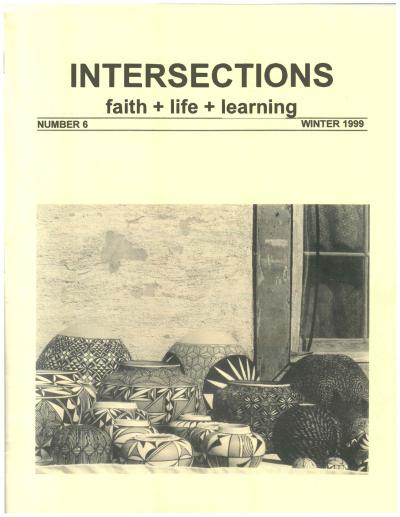 Editorial
From the Publisher
Arne Selbyg
Selbyg reports on the work of the Division of Higher Education and Schools to focus what makes Lutheran colleges and universities distinctive, recaps the 1998 Vocation of a Lutheran College conference at Wittenberg, previews the 1999 Susquehanna conference on “Identity and Fragmentation: Can the Lutheran Center hold?” (inspired by Yeats’s vision of the Second Coming), commends Ernest Simmons’s Lutheran Higher Education: An Introduction for Faculty (Augsburg Fortress, 1998), and announces a new NEH/NSF-style initiative called “The Lutheran Academy of Scholars in Higher Education.”
-
Editorial
From the Editor
Tom Christenson
Christenson explains that three of the five papers from the 1998 Wittenberg Vocation of a Lutheran College conference appear here (with Robert Scholz and Cheryl Ney to follow in the next issue), passes on Andy Sheppard’s “Books for Belarus” appeal from Southwestern College, and reflects on Douglas John Hall’s The End of Christendom and the Future of Christianity—its claim that disengagement from cultural dominance is the prerequisite for faithful re-engagement, and its retrieval of Christ’s metaphors of “a little salt, a little yeast, a little light” as a possible session topic for a future VLC Conference.
-
Article
Learning and Teaching as an Exercise in Christian Freedom
Tom Christenson
Christenson, the 1998 Wittenberg keynote, argues that what makes our institutions Lutheran is not the percentage of Lutherans served or employed, ethnic celebration, or self-conscious difference, but a theologically informed vision of the educational task framed by the linked ideas of gift, freedom, and vocation. Drawing on Joe Sittler, Wendell Berry, David Orr, Harold Kushner, John Updike, Frederick Buechner, and Luther’s On the Freedom of a Christian, he reframes the liberal arts as four “liberating arts”—critical/deconstructive, embodying/connecting, melioristic/creative, and arts of enablement and change—and closes with his mother’s “end-of-the-month soup” as an image of vocation in a particular place.
-
Response
Of Imaginary Cows and a White Toy Sheep: The Freedom of a Christian College
Ryan La Hurd
La Hurd, president of Lenoir-Rhyne and a former Thiel English professor and Augsburg academic dean, responds to Christenson by insisting (with Robert Kegan’s story of Tommy’s imaginary cattle farm) that a college is composed of people but is not itself a person, and so cannot share in Luther’s freedom of the Christian. Drawing on Benedict Anderson’s Imagined Communities, Lewis Hyde’s The Gift, George Marsden, Mark Schwehn, Jacques Barzun, and the Pew Higher Education Roundtable, he distinguishes the “imagined college” (the gift-economy realm of teaching and the alma mater) from the “real college” (the commodity-economy realm of fund-raising, deferred maintenance, and federal aid reconciliation that does not have such freedom)—and ends with Pablo Neruda’s “Childhood and Poetry” and the marvelous white toy sheep offered through a hole in a fence.
-
Response
Finding the Words: The Trouble of Being California Lutheran University
Pamela M. Jolicouer
Jolicoeur, provost and vice president for academic affairs at California Lutheran, recounts the marketing problem of a university whose middle name is Lutheran in a Southern California religious landscape where the operative modifier is “Christian” (Pepperdine, Azusa Pacific) and tests Christenson’s three themes against her own “alumni magazine test”—the Jesuit standard set by Santa Clara. She concludes that freedom, gift, and vocation, though not uniquely Lutheran, are the words she can actually use: with prospective faculty, with the constituent church bodies who pressed for “Christian” in the new CLU mission statement (compromise: “rooted in the Lutheran tradition of Christian faith…”), and with the “C student” alumna headed for a Ph.D. in psychology whose consciousness of her own gifts had evaporated.
-
Poem
Poetry: Rituals for an Uninvented Religion / On the Recently Discovered Mass Grave of Mice
Kevin Griffith
Two poems by Kevin Griffith of Capital University: “Rituals for an Uninvented Religion,” a seven-part liturgical bestiary of made-up customs (lead-filling cups in June, masks for the dying, two bottom-feeding August fish, wax grave markers with wicks, the leap-day child, and the carnival-free day of judgment), and “On the Recently Discovered Mass Grave of Mice,” prompted by New Zealand shepherds’ uncovering of 300,000 mouse skeletons, on the bones “each light as a child’s first question” and the “graveyard rush” we share with the good flock.
-
 Editorial
From the Editor
Robert D. Haak
No. 27 · Spring 2008
Haak frames the issue around the question of why Lutherans engage the world rather than retreat from it, locating the answer in the doctrines of creation and incarnation, and introduces essays by Erwin on globalism, Carlsen on local community engagement, Marty on multiple callings, and Mattes on the Grundtvigian heritage at Grand View. He also bids farewell to publisher Arne Selbyg, noting the fittingness of the Adinkra (“farewell”) cloth on the cover of this final issue under Selbyg’s leadership.
-
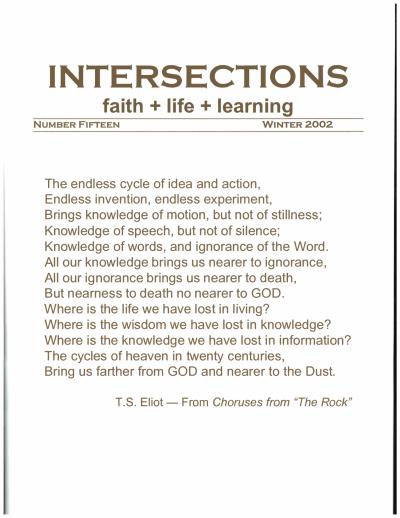 Editorial
From the Editor
Tom Christenson
No. 15 · Winter 2002
Christenson introduces an issue of varied voices—bishops and university presidents, philosophers and poets, students and their teachers—and defends the T. S. Eliot cover selection (“Where is the wisdom we have lost in knowledge?”) against the charge of being too depressing, arguing with cover artist Ida that Lutherans are realists about human accomplishments and that there is a huge difference between optimism and hope.
-
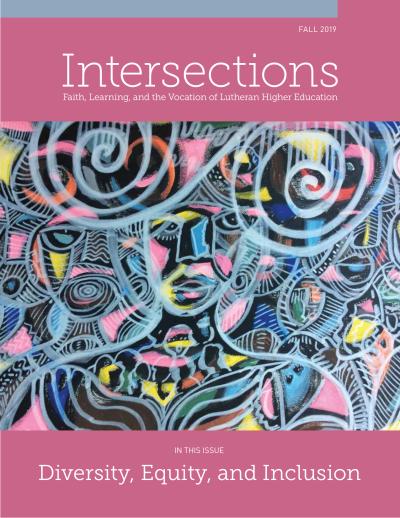 Reflection
Seeing in a New Way: A Meditation
Kara Baylor
No. 50 · Fall 2019
Baylor, the only Black campus pastor in the NECU, weaves Psalm 25, the parable of the Good Samaritan as re-read through Lenny Duncan, and the “crimson thread of divine justice” from Allen Dwight Callahan into a meditation that closes with the invitation she offered at the 2019 conference — to tie a crimson thread around the wrist as a symbol of collective commitment to moving beyond privilege toward inclusion and equity.
-
 Editorial
From the Editor
Robert D. Haak
No. 25 · Spring 2007
Haak frames the issue around the question of what holds the twenty-eight ELCA colleges together amid their geographic, economic, and theological diversity, introducing Mark Hanson’s address to the assembled college presidents, Randall Balmer’s outsider perspective on the commonalities of Christian liberal arts, José Marichal and Pamela Brubaker on diversity rooted in community and globe, Storm Bailey’s argument that being Lutheran is precisely what makes us embrace diversity, and Jaime Schillinger’s St. Olaf chapel reflection on the formative power of worship and liturgy.
-
 Editorial
From the Editor
Robert D. Haak
No. 28 · Fall 2008
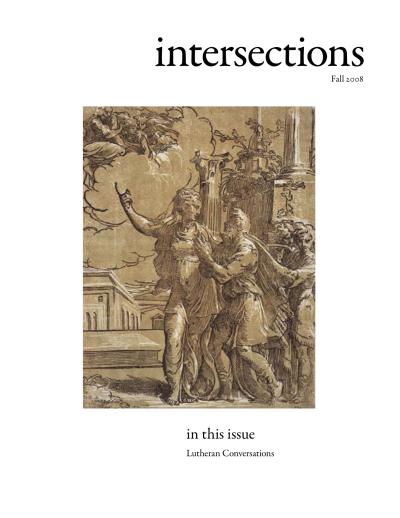
Haak frames the issue around “Lutheran conversations,” centered on the exchange between Robert Benne and Tom Christenson at Wartburg College’s ongoing campus conversation about what it means to be a “college of the church,” alongside Mark Wilhelm’s historical and social context, Lake Lambert’s sermon, and Bishop Mark Hanson’s short piece reprinted from The Lutheran—and points readers to the Lutheran Academy of Scholars seminar at Harvard as a place to continue the conversation.
-
 Editorial
From the Editor
Tom Christenson
No. 14 · Summer 2002
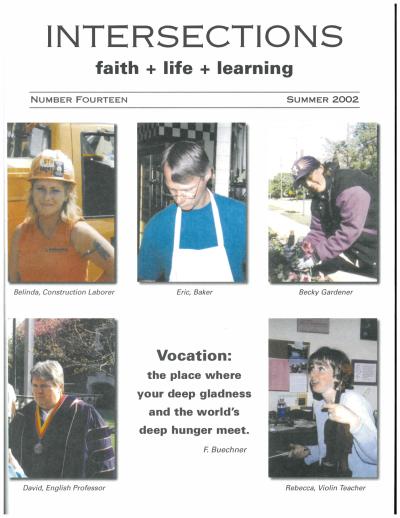
Christenson argues that whether or not the conversation is funded by the “Lilly lottery,” vocation should just be part of who we are and what we do at ELCA colleges, and proposes three low-cost conversations—among faculty (twenty dollars of wine, in vino veritas), with students throughout their four years, and with alumni—explaining why this issue is deliberately “fatter” than usual and inviting feedback on other single-topic issues.