In the 2016 Presidential campaign, the issue of sky-high tuition at American colleges and universities, and the severe debt loads students take on to attend those schools, became a front and center issue. Candidates offered major proposals for dealing with these issues and had vigorous debates about how to best implement and fund these plans. The interesting thing is that this debate only took place on one side of the aisle. The two main rivals for the Democratic Party’s Presidential nomination—Bernie Sanders and Hillary Clinton—offered different means to roughly the same vision, which was some form of free higher education for most Americans. Either of these policies promised to dramatically alter the state of higher education in the United States.
The Bernie Sanders plan would have made public colleges and universities tuition free, and the main mechanism for financing this policy was a Wall Street transaction tax which was estimated to bring in $75 billion per year (Sanders). Hillary Clinton’s plan, although not quite as extensive as the Sanders plan, also offered free tuition at public colleges and universities but only for families that with an income below $125,000. Clinton’s plan also came with a host of additional requirements such as requiring students to work 10 hours per week at work-study jobs (Clinton). For both candidates, these plans were a significant part of their overall campaign proposal portfolio. This was not the case on the Republican side.
Education after the Election
The question of student debt and the cost of higher education was not a prominent issue in the Republican primary. The eventual Republican nominee, Donald Trump, had very little to say about higher education during the general election campaign even after Hillary Clinton outlined her higher education affordability plan. Because of the asymmetry in the plans for higher education between the candidates from the two major political parties, the 2016 Presidential election offered a consequential choice for the future of higher education in the United States. Now that the election is over, and proposals for free tuition are unlikely to surface at the federal level again for a few years, what can we expect for higher education from the new administration? It should be said that late in the campaign Donald Trump, during a stop in Ohio, spent a few minutes discussing higher education. In a short six minutes, candidate Trump mentioned high repayment rates on student loans and administrative bloat at universities, criticized universities for not spending more of their endowments, and voiced concerns about free speech on college campuses as elements of higher education his administration would take on if he were elected (Jaschik, “Trump”).
Since President Trump’s election, his administration has not taken up any of the issues he mentioned in his brief statement. Since his election, the only specific movement President Trump has made on higher education has been his selection of Betsy DeVos for Secretary of Education. Mrs. DeVos was one of President Trump’s most controversial cabinet selections out of a host of controversial cabinet selections. The controversies surrounding Secretary DeVos’s nomination stemmed from her lack of experience and her strong support for voucher programs for K-12 public education. Her views on higher education are less well known, but shortly after her confirmation she gave a speech to the Conservative Political Action Conference (CPAC) indicating she will take a critical stance towards institutions of higher education. To the CPAC audience she stated that “the faculty, from adjunct professors to deans, tell you what to do, what to say, and more ominously, what to think. They say that if you voted for Donald Trump, you’re a threat to the university community. But the real threat is silencing the First Amendment rights of people with whom you disagree” (Jaschik, “DeVos”). The selection of a Secretary of Education is the only specific thing President Trump has done at the time of this writing with regards to public education.
However, shortly after the election, Jerry Falwell Jr, President of Liberty University and son of the right wing evangelical leader Jerry Falwell, said the Trump administration had asked him to head a task force on higher education. The purported purpose of this task force is to look at “overreaching regulations” coming from the Department of Education towards colleges and universities (Blumenstyk). At the time of this writing, the White House has not confirmed or denied that any such task force has been organized or that Mr. Falwell will lead it. There has been speculation that President Trump and Mr. Falwell have a mutual interest in rolling back some Obama-era regulations, specifically ones that strengthened standards for accrediting agencies which allow universities access to federal financial aid, and regulations which allows students who have been cheated by for-profit colleges to get their student loans forgiven. Liberty University enrolls over 65,000 students in online only courses (with approximately 14,000 residential students), and was the recipient of hundreds of millions of dollars in federal financial aid last year (Carey). Liberty University operates the second largest online university (only behind the University of Phoenix), so one can easily see how that institution is concerned about regulations that may shut off student financial aid and also empower students to greater recompense from the student loan burden in which they incurred from such institutions. Of course, this is also of interest to President Trump as the Trump Organization operated the now defunct for-profit institution, Trump University, for which the organization recently settled a $25 million dollar lawsuit from former students claiming fraud.
“Now that the election is over, and proposals for free tuition are unlikely to surface at the federal level again for a few years, what can we expect for higher education from the new administration?”
Perhaps the main focus for the future of higher education at the federal level is the reauthorization of the Higher Education Act. The Higher Education Act governs the administration of all the student loan and grant programs in the United States among a host of other issues. Congress has been trying to reauthorize the Act since 2013. Now with unified Republican governance, there might be some movement on the Act. Senator Lamar Alexander of Tennessee, the chair of the Education Committee, has some ideas for the reauthorization. His focus has been on scaling back regulations and streamlining the financial aid process. Senator Patty Murray of Washington, the ranking Democrat on the Education Committee, stated that her goals for the reauthorization were in “reducing college costs and the burden of student debt” (Stratford). After the expiration of the last reauthorization in 2013, bipartisan working groups were formed to see what common ground could be found for the next reauthorization. However, the political obstacles for a quick passage of the Higher Education Act are formidable; one should not expect a lot of quick movement on that legislation. Major legislation, such as this, usually requires some signaling from the administration along with some policy direction so that Congressional majorities can anticipate whether the administration will be receptive to the legislation. Since the Trump administration has not yet put a priority on higher education, no such signal or policy directive has been forthcoming, nor does one appear on the horizon anytime soon. This is especially the case with the Trump administration and the Republican leadership in Congress currently prioritizing big fights over tax reform and health care, which will consume much of the legislative agenda. This is not to mention many of the scandals emerging from the early days of the White House over the Trump campaign’s ties to Russia and ongoing concerns over the President’s conflicts of interest from his failure to adequately disengage himself from his business dealings.
International Students, Immigrant Students, and Trump’s Executive Orders
The most consequential move for higher education taken by the new administration was an action that was not taken towards higher education directly. It has nevertheless already had a significant impact on colleges and universities in the United States and portends even more. That of course was the Trump administration’s travel ban instituted by Executive Order (EO) in late January, 2017. The EO, titled “Protecting the Nation From Foreign Terrorist Entry Into the United States,” suspended the United States’ refugee admissions program for 120 days, placed an indefinite ban on refugees coming from Syria, and suspended visas for 90 days for anyone coming to the United States from Iraq, Syria, Iran, Libya, Somalia, Sudan, and Yemen—seven predominately Muslim countries. The EO had the immediate impact of preventing people en route to the United States with valid visas and green cards from entering the United States. This also included many undergraduate students, graduate students, and faculty. The Association of American Universities issued an announcement stating that the organization was filing an amicus curiae brief to a lawsuit against the Executive Order, stating that “its 60 U.S. universities may have as many as 10,000 students and faculty from the seven affected countries” (AAU).
Colleges and universities in the United States seemed universally against the travel ban. This was not because of the immediate impact they felt as their students and faculty were denied entry into the Unites States, but also because of the underlying values that the travel ban represented. The political scientist Mark Lynch compiled a list of statements from college and university leaders representing 264 separate institutions about the travel ban from across the United States. He found that not one statement was issued in favor of the ban and many statements emphasized that the ban struck directly at the global and open exchange of values and ideas that are at the core of the higher education mission in the United States (Lynch). Colleges and universities across the United States are not only concerned about the immediate impact the travel ban will have for their students and faculty, but are also worried about the long term consequences—such as creating a chilling effect for students contemplating studying in the United States, as well as undermining important values on which institutions of higher learning pride themselves.
“The ban struck directly at the global and open exchange of values and ideas that are at the core of the higher education mission in the United States.”
Along with the President’s Executive Order mentioned above he also issued a second Executive Order on immigration, “Enhancing Public Safety in the Interior of the United States,” which allows for a much broader priority system for deportation than under the Obama administration. Under the Obama administration, undocumented immigrants who were convicted of crimes were considered a deportation priority; under the new EO issued by President Trump that priority list has expanded to seven additional categories including: if someone has been charged with a crime, has been misleading in connection with any official matter before a government agency, has misused a public benefit or program, or who otherwise poses “a safety risk” in the judgment of an immigration officer (Alvarez).
These categories obviously increase the chance of deportation for many undocumented immigrants, including students at colleges and universities and their families. These categories are so broad that they might also put so-called “DREAMers” in danger of deportation. DREAMers refers to a category of undocumented immigrants who qualified under the Obama administration’s Deferred Action for Childhood Arrivals (DACA) program, which allows them a renewable two-year period of deferred action from deportation, and eligibility for a work permit. To be eligible, an individual would have to be under the age of 30, have entered the United States before the age of 16, and have been in the country continuously for 5 years. He or she also could not have a criminal record, and currently must be enrolled in school, graduated from high school, have gotten their GED, or have served in the military. The DREAMers label comes from the legislation the Development, Relief, and Education for Alien Minors (DREAM) Act that so far has failed to pass Congress but includes many of the same people eligible for DACA. Many colleges and universities around the country enroll in DREAMers. A possibility of a crackdown on their status could mean a serious disruption for these schools, not to mention the upheaval in the lives of the students who would be deported. President Trump has stated that DREAMers “shouldn’t be very worried,” but the detention of two DREAMers in Seattle and Mississippi have not served to assuage those fears (Levin).
Sanctuary Campuses
The possibility that students at universities and colleges across the country, including at many Lutheran colleges and universities, may be deported requires colleges and universities in the United States to consider the extent they are willing to go to comply with these laws. The concept of the sanctuary campus has been garnering attention since the election of Donald Trump. Sanctuary cities are perhaps more common than sanctuary universities, but the concept is much the same. Although the law does not define the term sanctuary city, its most narrow definition is a city (or country) in which the police will not hold people for 48 hours after their release at the behest of a detainer request by Immigration Customs and Enforcement (ICE) (Cameron). More broadly, the term is associated with the political orientation of a more open and welcoming view towards immigrants, both documented and undocumented. A sanctuary city, therefore, is a place that has taken some steps (even if it means just not complying with an ICE detainer request) to protect (at least some) undocumented immigrants from deportation.
What would it mean then for a college or university to become a “sanctuary campus”? Essentially, it would mean that the school would institute policies to protect undocumented students from deportation (Funke). There are a variety of policies that schools can institute which would minimize their collaboration with ICE. For example, the president of the University of Pennsylvania has stated that it is the university’s policy to not allow ICE, Customs and Border Protection (CBP), or United States Citizenship and Immigration Services (USCIS) onto campus without a warrant, and they will not voluntarily share any information about undocumented students “unless presented with valid legal process” (Heilweil). Other institutions, such as Wesleyan and Colombia, have instituted similar policies. In essence, what these schools—and others that have similarly designated themselves “sanctuary campuses”—have claimed is that they will not voluntarily comply with any orders that make them complicit in the deportation of any of their students. In addition to these pronouncements, a sanctuary campus may also consider additional things it can do to protect their undocumented students.
“What would it mean for a college or university to become a ‘sanctuary campus’?”
Perhaps the most important thing they can do for their students is exactly what they are good at—providing information and education. Colleges and universities in the United States can offer their undocumented students, and students who have friends and family who are undocumented, information on the protections that are afforded them by law, as well as information on paths to citizenship. They should also offer access to legal services, or utilize the legal services at their disposal, to help those students who may be facing deportation or have family members who may be deported.
Out of all the issues discussed in this essay, perhaps the most immediate and important concern for colleges and universities is to ask themselves what they are willing to do for their undocumented students and what obligations they have to them. In the current political climate it may be tempting for institutions of higher education to shirk the responsibilities they have toward their students. President Trump’s Executive Order that expanded the categories of people prioritized for deportation also stated that cities and counties that failed to cooperate with immigration enforcement could face penalties from the federal government in the form of withheld funds. In states like Texas, the governor has taken extreme measures towards punishing so-called sanctuary cities. He has also threatened to cut off funding for public colleges that don’t adhere to immigration law (Reigstad). (How the governor can do this without the consent of the legislature is unclear.) One should not underestimate the desire by the conservative leadership in many states and the president to enforce these very strict immigration policies, but colleges and universities must also remember their obligation to their students to provide a safe and welcoming learning environment.
There is a special role in the sanctuary campus debate for Lutheran colleges. In the determination as to whether to make their campus a “sanctuary campus” (whether explicitly by that name or not), ELCA colleges and universities should look to the church’s social mission on immigration. The message provides a tremendous amount of wisdom for ELCA colleges and universities to use as a guide. Of particular importance to the current issue of deportation of the undocumented is the following quotation:
Newcomers without legal documents also are among the most vulnerable. Congregations are called to welcome all people, regardless of their legal status. Persons who once were or now are without documents are members of our congregations, and we want them to feel and know that in the Church they are part of a safe and caring community. We encourage bishops and synods to show their support for congregations composed of or working with immigrants—who may or may not have documents. (ELCA 4-5)
This message makes it clear that Lutheran colleges and universities have an obligation to protect their most vulnerable students. This obligation goes beyond their obligations as educators, but is at the core of their identity as Lutheran institutions.
Works Cited
AAU. “AAU Files Brief in Travel Ban Case Detailing Impact of Travel Ban on Universities, Student, Faculty.” American Association of Universities. February 16, 2017. Accessed 1 May 2017, https://www.aau.edu/news/article.aspx?id=18402
Alvarez, Priscilla. “How Trump is Changing Immigration Enforcement.” The Atlantic. February 3, 2017. Accessed 1 May 2017, https://www.theatlantic.com/politics/archive/2017/02/trump-executive-order-immigration/515454/
Blumenstyk, Goldie. “Jerry Falwell Jr. Says He Will Lead Federal Task Force on Higher-Ed Policy.” The Chronicle of Higher Education. January 31, 2017. Accessed 1 May 2017, http://www.chronicle.com/article/Jerry-Falwell-Jr-Says-He-Will/239062
Cameron, Darla. “How sanctuary cities work, and how Trump’s executive order might affect them.” The Washington Post. January 25, 2017. Accessed 1 May 2017, https://www.washingtonpost.com/graphics/national/sanctuary-cities/
Carey, Kevin. “With Falwell as Education Advisor, His Own University Could Benefit.” The New York Times. February 1, 2017. Accessed 1 May 2017, https://nyti.ms/2jZjC8V
Clinton, Hillary. “Making college debt-free and taking on student debt.” hillaryclinton.com 2016. Accessed 1 May 2017, https://www.hillaryclinton.com/issues/college/
ELCA. “A Message on Immigration.” Church Council of the ELCA. 1998: 1-11.
Funke, Daniel. “Here’s where the sanctuary campus movement stands.” USA Today College. December 19, 2016. Accessed 1 May 2017, college.usatoday.com/2016/12/19/heres-where-the-sanctuary-campus-movement-stands/
Heilweil, Rebecca. “Penn, Trump’s alma mater, becomes sanctuary campus for undocumented students.” The Philadelphia Inquirer. December 1, 2016. Accessed 1 May 2017, http://www.philly.com/philly/education/20161201_UPenn__Donald_Trump_s_alma_mater__becomes_sanctuary_campus_for_undocumented_students.html
Jaschik, Scott. “Trump on Higher Ed.” Inside Higher Ed. October 14, 2016. Accessed 1 May 2017, https://www.insidehighered.com/news/2016/10/14/trump-makes-his-most-substantial-comments-yet-higher-ed
Jaschik, Scott. “DeVos vs. the Faculty.” Inside Higher Ed. February 24, 2017. Accessed 1 May 2017, https://www.insidehighered.com/news/2017/02/24/education-secretary-criticizes-professors-telling-students-what-think
Levin, Sam. “Seattle judge demands an explanation after undocumented ‘dreamer’ arrested.” The Guardian. February 15, 2017. Accessed 1 May 2017, https://www.theguardian.com/us-news/2017/feb/15/seattle-daca-dreamer-arrested-judge-trump-immigration
Lynch, Mark. “Universities overwhelmingly objected to the Trump travel ban. Here are the values they emphasized.” The Washington Post. February 20, 2017. Accessed 1 May 2017, https://www.washingtonpost.com/news/monkey-cage/wp/2017/02/20/universities-overwhelmingly-objected-to-the-trump-travel-ban-here-are-the-values-they-emphasized/?utm_term=.88eb70d4d6c4.
Reigstad, Leif. “Here’s What You Need To Know About Sanctuary Campuses.” The Texas Monthly. December 8, 2016. Accessed 1 May 2017, http://www.texasmonthly.com/the-daily-post/heres-need-know-sanctuary-campuses/
Sanders, Bernie. “It’s Time to Make College Tuition Free and Debt Free.” BernieSanders.com 2016. Accessed 1 May 2017, https://berniesanders.com/issues/its-time-to-make-college-tuition-free-and-debt-free/
Stratford, Michael. “Higher Education Act overhaul a long shot for this election year.” Inside Higher Ed. February 2, 2016. Accessed 1 May 2017, https://www.insidehighered.com/news/2016/02/02/higher-education-act-overhaul-long-shot-election-year
-
 Editorial
From the Publisher
Mark Wilhelm
Wilhelm describes how ELCA colleges and universities have shifted the definition of Lutheran higher education away from institutional markers toward alignment with educational values drawn from the Lutheran intellectual tradition — and previews a NECU-convened faculty working group whose recommendations will go to the ELCA college presidents at their June 2017 conference on Lutheran identity.
-
Editorial
From the Editor
Jason A. Mahn
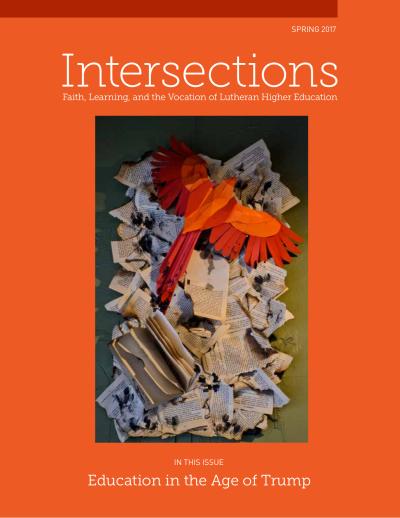
Mahn introduces “Education in the Age of Trump” by recounting a difficult academic year on his own campus — the Augustana “chalking” incident, a Latinx Unidos rally, and post-election conversations with marginalized students and quietly conservative Trump supporters alike — and frames the issue’s essays as careful (re)imaginings of the vocation of Lutheran higher education in an anxious political climate.
-
Article
Resistance in the Age of Trump: An Interview with Ivonne Wallace Fuentes
Jason A. Mahn, M. Ivonne Wallace Fuentes
In conversation with Jason Mahn, Roanoke College historian Ivonne Wallace Fuentes describes how she launched a local chapter of Indivisible after the 2016 election, how the skills of teaching and historical research carry over into grassroots advocacy, and how her sense of vocation (vocare) has become intertwined with the work of advocacy (advocare).
-
Article
Religion in the Age of Trump
Daniel A. Morris
Morris reads the 81% evangelical vote for Donald Trump through two historical theses: that evangelicals’ once-coherent story about Godly participation in political life has fallen apart, and that their long-running tendency to exclude others — once aimed at Black Americans and Catholics — has now turned decisively against Muslims. He argues that scholars of religion and politics have a responsibility to tell these stories well, and that appeals to classroom objectivity can no longer be a luxury.
-
Article
Room at the Table: Reflections on Identity and Inclusion from a Lutheran-Friendly Muslim
Rose Aslan
Aslan reflects on her experience as a Muslim professor of Islamic studies at California Lutheran University — teaching “Introduction to Christianity” from her strengths in the Abrahamic religions, preaching an Eid khutba in a Lutheran chapel, and conversing with the university’s convocators — and proposes “Lutheran-friendly Muslim” as a way of being host and guest at once in a pluralistic Lutheran institution.
-
Article
Jonah: The Anti-Hero of Vocation
Martha E. Stortz
In a chapel talk first given at Augsburg College’s Vocation 2.0 series in September 2016, Stortz reads the prophet Jonah as the great anti-hero of vocation — one who tries to outrun God’s call to the great city of Nineveh — and argues that, in a season of urban violence and divisive election-year rhetoric, the story is less about public calling than about being called by the publics in our midst.
-
Article
Why Did the Chicken Cross the Road? A Homily on Liminality and Vocation
Lori Brandt Hale
Drawing on Wes Moore’s The Other Wes Moore, Warren St. John’s Outcasts United, Victor Turner’s anthropology of liminality, and Dietrich Bonhoeffer’s poem “Who Am I?”, Hale considers how Hmong, Muslim, Latinx, LGBTQ+, non-traditional, and other students live in “double liminal” spaces — and asks whether liminality might itself be a place of transformation in conversations about vocation.
-
Poem
Poetry: After Months of Clouds, the Sun; First Bird
Farah Marklevits
Two poems by Augustana writing instructor Farah Marklevits: “After Months of Clouds, the Sun” calls the reader up from a desk of doom-scrolling addiction and into breeze and light, while “First Bird,” epigraphed by Emily Dickinson, watches a robin flit through mid-January Midwestern loam as a phenological fairy tale of dread and the urge to live.
-
 Article
Civic Engagement, "Baylor In Deeds," and Engaged Learning
Rebecca Flavin
No. 63 · Spring 2026
6 min audio
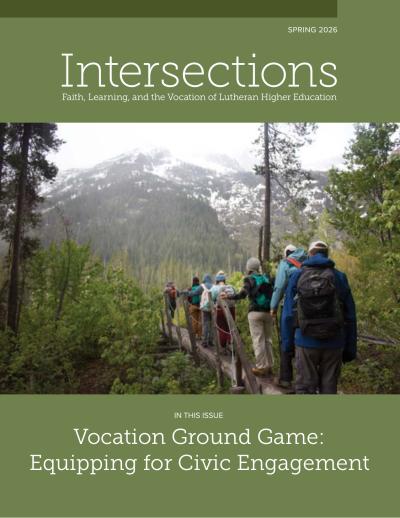
Flavin describes how Baylor’s strategic plan “Baylor in Deeds” and its Office of Engaged Learning are building civic engagement into the Arts & Sciences core curriculum, with early Global Engagement Survey data showing gains in civic efficacy and global civic responsibility.
-
 Article
Polarization, Incivility, and a Need for "Change"
Guy Nave
No. 48 · Fall 2018
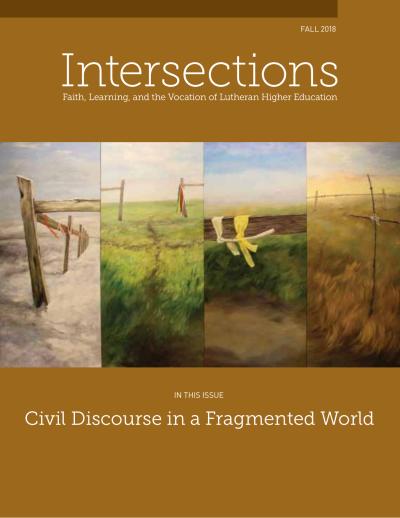
Nave argues that when Americans demand “change,” they usually mean that “others” need to see things their way — and that meaningful transformative change requires acknowledging the provisional nature of our perspectives, seeking to understand as much as to be understood, and bursting the ideological echo chambers of social media through projects like Clamoring for Change.
-
Article
Teaching and Mentoring in Service of Civic Engagement
Haco Hoang
No. 63 · Spring 2026
6 min audio
Hoang describes how her teaching, mentoring, and research at California Lutheran University — including a multi-year collaboration with the Lutheran Office of Public Policy on Lutheran Lobby Day — cultivate civic skills grounded in ELCA social statements and the Lutheran tradition of faith and reason.
-
Article
Putting the Kind Back in Human
Sarah Ciavarri
No. 48 · Fall 2018
Drawing on Brené Brown’s research on vulnerability and Edwin Friedman’s family systems theory, Ciavarri distinguishes “kind” from “nice” and argues that courageous, vulnerable, and playful truth-telling — rather than yelling louder or trading pithy memes — is the path back to one another and to our common humanity.
-
 Article
Marked by Lutheran Higher Education
Martha E. Stortz
No. 49 · Spring 2019
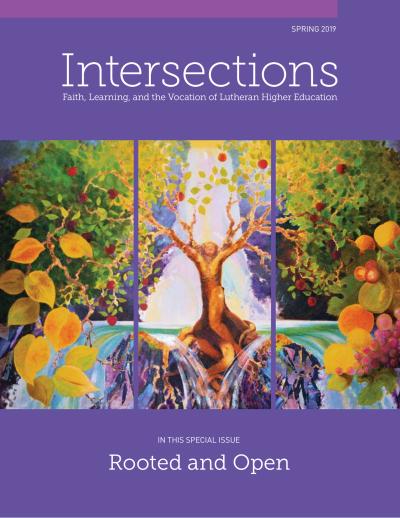
Stortz offers an “operating manual” to Rooted and Open by tracing how the writing team moved from descriptive marks of the institutions to aspirational verbs that mark people — “called and empowered, to serve the neighbor, so that all may flourish” — and shows how each mark generates educational priorities theologically grounded in the radical mystery of God, the wild generosity of God, and the God who became one of us.
-
 Article
Service Beyond the Comfort Zone
Kathryn Wolford
No. 18 · Fall 2003
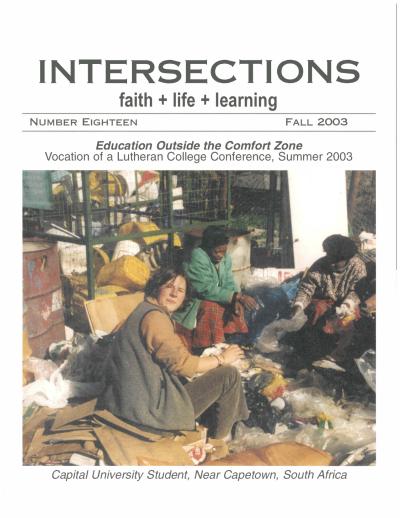
Wolford names economic globalization and the growth of civil society as the two issues shaping Lutheran World Relief’s mission, illustrating with the Guatemalan storekeeper undercut by subsidized “gringo” chickens, fair-trade coffee and chocolate campaigns, and Charles Onyango-Obbo’s warning about anti-terrorism laws in fragile African democracies. Drawing on Darrell Jodock, Art Simon, and the Good Samaritan, she frames the global vocation of Lutheran colleges as inviting students past comfort zones of race, class, ethnicity, and ideas through service-learning that links mercy and justice, and closes with a concrete LWR partnership invitation including site visits, internships, fair-trade campus campaigns, and the “A Place for Peace in Colombia” advocacy program.