What Could the Lutheran Colleges and Universities Contribute to the ELCA Discussion of Sexuality—But What Would They Actually Contribute?
Intersections No. 22 · Spring 2006
The churchwide assembly of the ELCA took on some tough sexuality issues during its August 2005 meeting in Orland, Florida. It voted to continue under the guidance of the 1993 Bishop’s Statement that there were no grounds in scripture or tradition for blessing gay or lesbian unions, but at the same time it refused to provide for the discipline of those who ignored that guidance. A narrow majority voted down the provision for the ordination of partnered gays and lesbians through an exceptional process. However, such a provision would have required a two-thirds majority since it would have meant constitutional changes.
The preassembly Sexuality Task Force and Church Council ducked the normative question that has to be answered by the newly constituted Task Force: are there adequate biblical and theological grounds for lifting the age-old and near-universal Christian proscription of homosexual conduct, even if it occurs in committed same-sex pairs? The clear answer to that question may lead to a church split, especially if the ELCA answers the question affirmatively.
The question before us is this: Would the active involvement of college and university faculties in this possibly church-dividing conflict be helpful? What I would hope for in answering that question is far different from what I think would happen.
What I would hope for goes something like this: I would hope for a balanced mixture of what James Davison Hunter calls the “orthodox” and “progressive” perspectives among the faculty of the religion and social science departments on the issues being dealt with by the ELCA. (By “progressive” Hunter means those who believe we ought to revise or reject central tenets of received moral tradition according to the enlightened opinion of the day, informed as it is by contemporary experience and practice. On the other hand, the “orthodox” believe that these central tenets are settled moral truths that have been revealed in the tradition and therefore cannot be compromised by even the most enlightened opinion of the day.) Between those poles would be a segment of the faculty who would occupy a middle ground on these contested sexuality issues.
Given this sort of balance, the Lutheran colleges could actually model fair discourse on something as volatile as the subject of homosexuality. Theological ethicists from both sides would be invited to make their best arguments, realizing that a moral tradition of two thousand year duration and of near universal acceptance among the major Christian churches would need overwhelming arguments and evidence against it to call it into serious question. In other words, traditional moral teaching would be given the benefit of the doubt and treated with high respect.
The social sciences would evenhandedly marshal the huge amount of new research on marriage, divorce, gay and lesbian unions, cohabitation, sexual abuse, and family life. Where our culture is heading on these issues would be presented from various ideological perspectives, but there would be a search for reliable empirical material that all sides would consider accurate. The many other disciplines could enter the conversation from their perspectives. And, of course, students would be invited to listen in and participate in appropriate ways.
Perhaps the conversation would not—and maybe should not—lead to a definitive conclusion. But such fair moral discourse could be funneled into the larger church discussion in the many ways already provided by the ELCA. Perhaps colleges could publish articles and books on these issues similar to what the seminaries did.
That is my idyllic expectation of how a Lutheran college faculty might carry on fair moral discourse. But such a marvelous thing is not likely to happen because the preponderance of “progressives” in the academy is so large that real moral discourse would be nearly impossible. That majority, reflecting American elite opinion in general, is so hefty that its opinions have often taken on the characteristics of unchallengeable truths. These “truths” are so deeply assumed by the majority that they no longer need to be argued; any intelligent person of good will would hold them. Those who depart from that alleged consensus are then considered to be neither intelligent nor goodwilled. Indeed, the “dissenters” are then often met with derision while those of the majority opinion are cheered on, sometimes literally so. Such an atmosphere tends to intimidate minority opinion and squelch debate.
I have much anecdotal evidence for the truth of such an analysis since I have been often in the minority in the academy and elite levels of the church on sexuality issues, as well as on political and other cultural issues. However, it is easy to move to other contexts where the deep-running assumptions are just the opposite. Neither situation makes for good debate. The academy, however, is definitely in the hands of the “progressives.”
The famous research by Klein, Stern, and Western1 indicates a ratio of more than ten to one in favor of liberals over conservatives in six nationwide social science and humanities associations. Political and cultural liberalism are not exactly correlated but there are some pretty strong convergences. Earlier studies done on Lutheran colleges suggest that they are more liberal than other private colleges. My hunch is that few Lutheran colleges would have a healthy balance between “orthodox” and “progressive” faculty on these hot-button sexuality issues. The imbalance would be sufficient to make debate very difficult. The great majority would wade in on the “progressive” side and merely reinforce the already progressive views of the seminaries and the national level of the ELCA.
Of course, if you believe that the “progressives” have the right “take” on this matter you might cheer this kind of contribution on the part of the colleges and universities. But such a one-sided contribution would not help the ELCA come to a careful judgment that both respects the Great Tradition and the challenges presented by the modern world.
But hold on. It would be possible to gather a fair balance of perspectives from across the colleges and universities that could indeed enrich this weighty debate. However, it would take the wisdom of Solomon and the courage of St. Paul to do the selection and the gathering. Thus far the ELCA has not been able to gather the proper balance for such fair moral discourse. Maybe the colleges and universities could actually pull off such a gathering. But who would do the selecting, the gathering, and the hosting?
End Note
1. For a summary of the findings see “National Survey Finds Academe Politically Imbalanced.” NAS Update 14.2 (2005): 9. The fuller study is published as Daniel B. Klein, Charlotta Stern, and Andrew Western, “Documenting the One-Party Campus,” Academic Questions Winter (2004-2005): 40-52.
-
 Editorial
From the Publisher
Arne Selbyg
Selbyg notes that both the ELCA and Intersections have undergone major changes this year—the Division for Higher Education and Schools is gone, replaced by the Educational Partnerships and Institutions group within the Vocation and Education unit, and the journal has a new editor (Robert Haak), a new home at Augustana College, a new printer, and a new design. He commends the issue’s focus on human sexuality and points readers to the first draft of Our Calling in Education.
-
Editorial
From the Editor
Robert D. Haak
Haak introduces himself as the new editor inheriting the journal from Tom Christenson and frames the issue around the question of what ELCA colleges might contribute to conversations about human sexuality. He summarizes the contributions of Yeager, Benne, Williams, Bussie, and Nack, and shares previously uncollected National Study of Youth and Religion data on the sexual attitudes and behaviors of Lutheran teens—including that 25% of regularly-attending ELCA teens report the church has done nothing to help them with their sexuality.
-
Article
A Church, the Human Condition, and the Fissured Face of Peace
D. M. Yeager
Yeager, a member of the ELCA Task Force for Studies on Sexuality, reflects on lessons for the church’s educational mission in the wake of the 2005 Churchwide Assembly. Drawing on Macquarrie’s The Concept of Peace, Polanyi on the personal coefficient of knowledge, Hannah Arendt’s The Human Condition, and responses to the task force report from Roy Harrisville III and Larry Rasmussen, she proposes “the fissured face of peace”—peace as the absence of hostility rather than disagreement—and maps how Arendt’s five conditions of human existence (life, earth, natality, mortality, worldliness, plurality) might shape Lutheran colleges’ curricula in history, epistemology, and the sociology of knowledge so that graduates can disagree without hostility and embrace the slow work of reformation.
-
Article
Sexuality over the Lifespan—Social Trends Pose Moral Dilemmas for Communities of Faith
Adina Nack
Nack, a sociologist who presented to the ELCA Task Force for Studies on Sexuality, surveys empirical research on three life-stages flagged by the Task Force as particularly contested—premarital sexuality among adolescents and young adults, sexuality after divorce and within single parenting, and sexuality in late adulthood. Drawing on the Alan Guttmacher Institute, the Office of the Surgeon General, AARP, National Council on the Aging, and the World Health Organization’s 2002 definition of sexual health, she closes each section with questions about the church’s role in education, blessing of committed nonmarital relationships, and dismantling stereotypes about aging and sexuality.
-
Article
Ethical Deliberation and the Biblical Text—A Lutheran Contribution to Reading the Bible
Ritva Williams
Williams articulates a Lutheran “critical traditionalist hermeneutic”—a phrase borrowed from her Hebrew Bible professor Robert Polzin—that honors Scripture as queen while keeping Christ as its king, and tests it by critiquing Robert Gagnon’s use of Romans 1:18-32 in The Bible and Homosexual Practice. Drawing on Lazareth, Lotz, Philip Esler’s Conflict and Identity in Romans, Stanley Stowers’ Rereading Romans, and Ben Witherington III, she proposes an alternative reading in which Paul recites a Hellenistic-Jewish ethnic caricature in 1:18-32 only to overturn it in 2:1-16, making the passage a critique of self-righteous stereotyping rather than the foundation of a moral doctrine on same-sex intercourse.
-
Article
Scarred Epistemologies: What a Theology of the Cross Has to Say about the Gay Marriage Ban
Jacqueline Bussie
Responding to Robert Benne’s claim (citing Gilbert Meilander and Wolfhart Pannenberg) that one cannot defend gay marriage on biblical or confessional grounds, Bussie reads three theses of Luther’s Heidelberg Disputation alongside Moltmann’s Crucified God and Martin Luther King Jr.’s Letter from Birmingham Jail to argue that the theologia crucis—with its insistence on calling the thing what it is, its acknowledgment of scarred epistemologies and simul justus et peccator, and its refusal to domesticate God—exposes the Ohio Defense of Marriage Act as scapegoating, selective literalism, and an unjust law that the Christian conscience must reject.
-
 Article
Point / Counterpoint: What It Means to be a "College of the Church"
Robert Benne, Tom Christenson
No. 28 · Fall 2008
Moderated by Wartburg College pastor Larry Trachte and introduced by Kathryn Kleinhans, this Wartburg campus conversation between Robert Benne (Roanoke College) and Thomas Christenson (Capital University) probes what it means to be a college of the church—Benne emphasizing ethos, vocation, and the Christian intellectual tradition over against secularization and generic education, and Christenson lifting up persistent vocational questions, the gift of difference, and induction into a community of discourse—and finds large common ground around hiring for mission, pedagogy that asks deep questions, and the courage to claim a living religious tradition while inviting everyone to the banquet.
-
 Response
Response to Bishop Olson and President Tipson
Robert Benne
No. 16 · Winter 2003
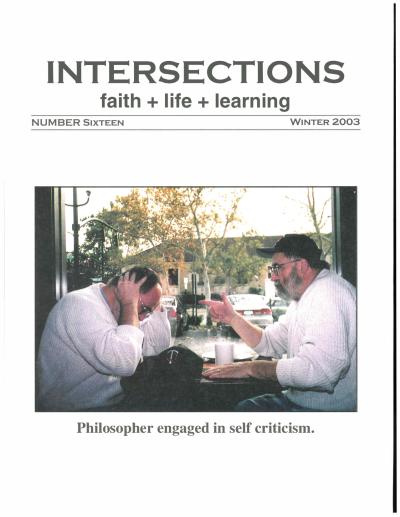
Benne responds to two articles in the Winter 2002 Intersections: former Bishop Stanley Olson’s “The Marks of an ELCA College,” whose narrow reading of the two kingdoms cedes all epistemological claims to secular knowledge, and President Tipson’s engagement with The Future of Religious Colleges, whose “rather unchastened Enlightenment spirit” underestimates how loaded the social sciences and humanities are with their own philosophical and religious assumptions. Drawing on Reinhold Niebuhr, John Milbank, and William Buckley, Benne defends a “critical mass” of pervasively Lutheran colleges and calls on bishops and pastors to take the schools seriously lest they drift from their religious heritage.
-
 Article
Toward an Adequate Theology of Christian Higher Education
Robert Benne
No. 10 · Fall 2000
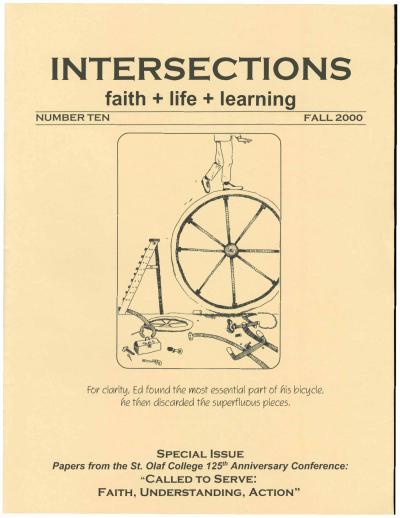
Drawing on his forthcoming Eerdmans volume Quality With Soul—Thriving Ventures in Christian Higher Education, which studies St. Olaf, Valparaiso, Notre Dame, Baylor, Wheaton, and Calvin, Benne argues that these schools have kept their souls because a critical mass of boards, administrators, faculty, and students treat the Christian account as comprehensive, unsurpassable, and central. He critiques four inadequate theologies of Christian higher education—pietism, liberal theology (Whitehead, Henry Nelson Weiman, the “values” turn, and accommodation to diversity and multiculturalism), “First Article” approaches (including Merrill Cunninggim’s Methodist version and a Lutheran two-kingdoms quietism), and reactionary/triumphalist theology—and contrasts the Catholic (Notre Dame), Reformed (Calvin, Wheaton, Baylor), and Lutheran (St. Olaf, Valpo) ways of relating faith and learning, calling Lutherans to recover “Christ and culture in paradox” as serious extended conversation rather than as a lazy excuse.
-
 Article
Integrity and Fragmentation: Can the Lutheran Center Hold?
Robert Benne
No. 8 · Winter 2000
Benne answers the conference’s question pessimistically—“the Lutheran center cannot hold in many, if not most of our colleges, because it was never there in an articulated form in the first place”—and distinguishes “Christ of culture” colleges like the Midland Lutheran of his youth (Lutheran by ethno-religious ethos rather than by articulated theology) from James Burtchaell’s “confessional colleges” that operated from a theologically distilled Lutheran humanism. Drawing on Alasdair MacIntyre and Mark Schwehn’s First Things essay on Christian universities, he sketches what a Lutheran center looks like (unity, universality, integrity, a tradition of thought) and how its distortion—reducing the Gospel to justification and ceding everything else to autonomous reason—splits Christ and culture as dangerously as the German church separated Gospel and politics. For colleges that have lost their center, he proposes an “intentional, robust pluralism” that guarantees a Lutheran voice in every department and an “affirmative action for Christians” in hiring.
-
 Editorial
From the Editor
Jason A. Mahn
No. 52 · Fall 2020
Mahn narrates a year of crisscrossing pandemics — Covid-19, economic collapse, partisan politics, and the long pandemic of white supremacy revealed anew by the murder of George Floyd — and argues that Lutheran liberal arts schools, by educating for vocation, are uniquely poised to help students respond with character and capable callings.
-
 Editorial
From the Publisher
Arne Selbyg
No. 25 · Spring 2007
Selbyg notes that most papers in this issue grew out of a pan-Lutheran conference organized by the Association of Lutheran College Faculties in fall 2006 rather than the annual Vocation of a Lutheran College conference, and argues that the ELCA’s ecumenical posture—truthful but open to learning from others—is a good foundation for institutions of higher education whose faculty likewise profess while remaining subject to change based on new research and insights.
-
 Editorial
From the Editor
Robert D. Haak
No. 30 · Fall 2009
Haak frames the issue around the question of Lutheran college identity as formed in distinction from some “other,” introducing essays by Witherup on the Joint Declaration, Reuther on Holden Village, Afzaal on Christian-Muslim dialogue, Dovre on the history of Midwestern Lutheran colleges, Radecke on service-learning, and Ratke on Wilhelm Löhe — each making the claim that the “other” is an essential partner in conversation who helps us know who we are and shape who we will become.
-
 Article
Vocational Re-Formation for a Multi-Religious World
Elizabeth Eaton
No. 40 · Fall 2014
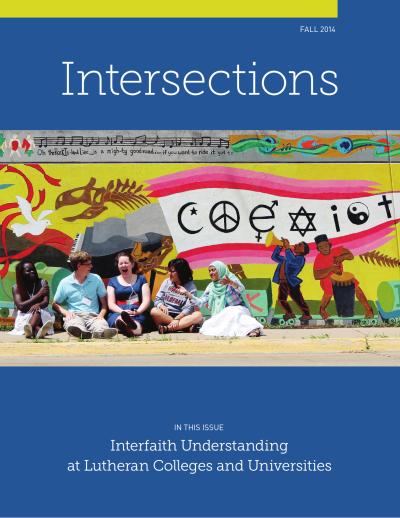
ELCA Presiding Bishop Elizabeth Eaton frames vocational formation for a multi-religious world as one of the most significant challenges facing the church and the liberal arts today, calling ELCA colleges and universities to live into Darrell Jodock’s “third path” that is both deeply rooted and dialogical.
-
 Article
Vocation and Civil Discourse: Discerning and Defining
Lynn Hunnicutt
No. 48 · Fall 2018
Hunnicutt draws on Rabbi Amy Eilberg’s reading of Moses’ calling to identify four features of vocational discernment — attention, wonder, communal consciousness, and humility — and argues that these same qualities are also key aspects of civil discourse, so that forming students for vocational discernment is simultaneously forming them for civility.
-
 Article
Reforming Our Visions of City Nature
Lea F. Schweitz
No. 46 · Fall 2017
Through a Chicago story of Canada geese at North Pond, Schweitz takes up two Reformation-era ways of reading the “Book of Nature” — Konrad Rosbach’s moral readings and Philip Melanchthon’s scientific ones — and proposes a third: Luther’s sacramental principle that the finite is capable of the infinite, worn as “reading glasses” for an urban planet.