Professing religion is for me at once a matter of teaching a subject matter and making an autobiographical statement. I’m a Professor of Religion and I sometimes profess my own beliefs, that is, I openly declare or affirm my religious views and explain why I have these convictions, often by telling a story. In my experience, these two aspects of my role at St. Olaf College do not always harmonize. I am often uncertain about whether or not to describe my own religious experiences and convictions. I will describe why this issue is controversial and, in the second part of this essay, offer some reflections on how my understanding of my vocation shapes my thinking about the role of personal narrative in teaching religious studies.
Speaking of Faith and the Study of Religion
According to many theories of religious studies and many views of religious commitment, academic study and personal faith are utterly distinct, if not irreconcilable. At St. Olaf and other ELCA schools, in contrast, I think these perspectives on religion are recognized as different yet often related. Our identities as colleges of the church means that we encourage explicit discussions of how learning and faith have influenced each other in our own lives. In practice, however, this is often not easy to do, and it is sometimes wise for a teacher to withhold information about his or her personal faith. There may be good reasons to conceal or “bracket” one’s views, especially in a Religion class, where students need to learn to think critically about religion, and not simply confess their faith. What kind of autobiographical statements are appropriate and helpful in a theology or religious studies course?
It can be pedagogically valuable for a professor to speak of his personal faith, just as it can be illuminating for a political scientist to explain her political opinions, an art historian to justify his assessments of works of art, or a scientist to espouse a particular energy or environmental policy. In most academic fields, teachers must learn to balance critical distance and passionate engagement with their subject matter.
There are peculiar challenges inherent in teaching Religious Studies that complicate matters. Very few students have any prior experience of studying religion in an academic context. Nonetheless, some of them think they already know all about the subject, or all they need to know, and some students think that all other views are wrong. Still others think that all views are equally valid. That is, they think that faith is a subjective, irrational experience, and there is therefore no way to reason about or assess claims about religious matters. For these students, all religious assertions are equally arbitrary; in the name of tolerance and being open minded, they dismiss normative arguments about the adequacy of various claims.
Students differ greatly in the degree to which they are willing and able to profess their own religious convictions. Some people feel confident about their faith and qualified to speak with authority about the Bible or their experiences in church or prayer meetings. Other students are tentative and uncertain, and some are alienated by what they see as false piety or attempts to convert them. We all bring a lot of baggage to the study of religion, but we are not equally willing to open our suitcases for inspection. It is a challenge for a Professor of Religion to establish a classroom environment where all students feel empowered to speak and write about their personal response to the subject matter, and all students are led to question their prior beliefs, doubts, and evasions of critical thinking.
“We all bring a lot of baggage to the study of religion, but we are not equally willing to open our suitcases for inspection.”
Most professors of religious studies in the United States consider personal references to faith (or lack of faith) to be out of place in an academic context. At public universities, professors must honor the separation of church and state. At private institutions, too, teachers may not want to open the door to proselytizers and those who only accept one religious position as valid. Furthermore, practitioners of religious studies have been anxious to prove that we can be as tough-minded and academically rigorous as our colleagues in other disciplines. The history of this field, which grew out of biblical and theological studies in Christian seminaries, has made many scholars cautious about revealing their personal convictions. Some teachers try to be as detached, scientific, impersonal, or value-neutral as possible. Or they may relentlessly analyze the problems in various patterns of belief without revealing their own position. At St. Olaf College, teachers rightly stress the need to bracket or hold in suspension one’s own beliefs in order to understand the worldview of ancient Israel, a medieval mystic, a Muslim theologian, or a Buddhist monk. Although the Religion Department was located in the basement of Boe Chapel for sixty years, until 2012, we have made it clear that we do not teach Sunday school. We don’t use religious language in the same way as those worshiping in the sanctuary.
I’m not worried about converting anyone, a highly improbable event. The issue is rather that when students know my views, some of them might stop thinking, either because they share those views and think the professor’s approval is sufficient justification, or because disagreement or fear of criticism makes them withdraw. It is also possible that some students might be swayed into parroting my ideas or beliefs in hopes of a higher grade. In all of these cases, what is at stake in a professor’s choices about self-disclosure is the consequences for students in terms of their academic engagement with the study of religion and their learning to become more thoughtful and articulate about their own deepest convictions.
Although I share these several concerns about the pedagogical dangers of a professor’s personal remarks about religion, I also think that something important is lost when a teacher is not able to articulate an individual response to the religious issues at stake. We would miss the chance to show our students how our intellectual and religious convictions are deeply connected to who we are as individuals. Students don’t care for self-indulgence, proselytizing, or bias in the classroom. They do welcome candid statements about what a professor thinks, including what he believes about some matter of faith, if he compares his position with other possibilities and invites discussion and contrasting views. This kind of teaching can stimulate students to think about how their own experiences shape and are shaped by their religious beliefs and practices.
Many of my most vivid memories of my teachers are when I got a rare glimpse of what made them tick, what personal concerns motivated their teaching a particular subject matter or book. My graduate school advisor, Anthony C. Yu, labored for decades on a four-volume English translation of the Chinese classic The Journey to the West, a sixteenth-century narrative about a monk who brings Buddhist scriptures from India to China. One day Tony told me that, when he was a young boy, his grandfather had read him this narrative as his family sojourned through China during the Second World War. My teacher’s bond with his grandfather and the circumstances of this harrowing journey helped me understand his devotion to this travel narrative and his desire to make it accessible to today’s “West.” Such self-disclosure was an infrequent event, I suppose partly because I didn’t ask for it. In dozens of religious courses in college and graduate school, I almost never learned what my professors believed or how they worshipped. A rare exception was Langdon Gilkey, who recounted vivid stories, both orally and in his memoir Shantung Compound (which I frequently teach), about how he came to appreciate the theologies of Reinhold Niebuhr and Paul Tillich because of Gilkey’s experiences in a Japanese internment camp in China during the Second World War. I saw how my teacher made sense of his life with these ideas, and why theology matters.
As I’ve gotten older, I’ve become more comfortable about revealing my views, which I used to conceal as much as possible. It’s easier for me than for some other professors to get autobiographical. The subject matter of my primary field, Religion and Literature, lends itself to comparisons with one’s own experience more easily than some other disciplines. Being tenured makes it less risky for me to reveal my own beliefs and experiences. Yet the power dynamics of the classroom and students’ vulnerability mean that a professor’s self-disclosure about matters of religious faith is always a questionable enterprise.
“The power dynamics of the classroom and students’ vulnerability mean that a professor’s self-disclosure about matters of religious faith is always a questionable enterprise.”
My scruples and uncertainty about waxing personal as I profess religion may reflect preoccupations of my generation. Recently I sat in on a class in a younger colleague’s course, “What is Religion?” He brings in visiting colleagues to introduce the department faculty to Religion majors. After I explained my interest in the question of how autobiographical concerns influence the scholarly study of religion, my colleague said, “Of course everything is autobiographical.” Well, yes, I thought, but there are better and worse ways of being autobiographical. Perhaps the next generation isn’t wrestling with my question, at least not in the same way. After several decades of post-modern theory, the ideals of objectivity and disinterestedness appear to many to be discredited Enlightenment myths that disguise power moves. There has been a huge change in academic culture during the time of my career, so that scholars are now free to “own” their location and perspective. Indeed, if they are not forthright about their “positionality,” they may be suspected of naïveté. But owning a location is not the same as disclosing autobiographical narrative; describing a position is not telling a story.
The tensions between disinterestedness and commitment, and between critical distance and transparency about one’s own position, will remain both controversial and crucial in pedagogy and scholarship. In class today, should I have said less or more about what I think about a particular religious topic? In discussing apocalyptic themes in biblical times and the contemporary world, should I reveal my dismay at the dualistic, world-denying, and judgmental attitudes that are often fostered by this worldview? Perhaps, but I must also try to show students why eschatological ideas can appeal to people in certain cultures and situations, especially those suffering persecution. In teaching a seminar on conversion, I’ve shown Robert Duvall’s fine film The Apostle. We explore how this movie evokes convictions about the ambiguous role of intense emotion in religious worship. How much should students and I go into the experiences that have led each of us to our views? How autobiographical should we get when, in my course on conscience, we explore rationalization, self-deception, and paralyzing guilt?
There is no simple answer to the question of when autobiographical statements are appropriate and helpful. Two convictions shape my ongoing thinking about this issue: beliefs about the value of the subject matter I most love to teach, and about my vocation as a professor.
Teaching Autobiography and Teaching Autobiographically
Most of my teaching and scholarship has focused on Religion and Literature, and I’ve been especially interested in autobiography. The great autobiographers—such as Augustine, Dorothy Day, and Malcolm X—reveal how what they think about God and faith grows out of their suffering, searching, and discernment of how God worked in their lives. Martin Luther claimed, in his usual dramatic way: “One becomes a theologian not by understanding, reading, or speculating, but by living, no rather by dying and being damned” (5/163:28-29). Luther’s example shows that “living and dying” can be integrated with understanding and reading, so this is not an either/or choice. I interpret certain autobiographers as theologians who model helpfully some of the ways in which personal narratives shape and are shaped by ideas about God. The attempt to understand one’s own life is not a narcissistic, self-absorbed endeavor, but a search for history, culture, and God. Experience is personal, but not merely personal; understanding oneself discloses all that shapes the self. And autobiography is not only about the past; it is often an attempt to find meaning that will orient the writer’s future living.
“Experience is personal, but not merely personal; understanding oneself discloses all that shapes the self.”
In addition to studying theories, doctrines, and systems of ideas, college students need to hear individual voices speak about a search for faith. My course “God and Faith in Autobiography” offers this approach to the study of Christian thought. C. S. Lewis, Langdon Gilkey, and Kathleen Norris, for instance, try to show the truth of their Christian convictions in ways that may persuade, provoke, or invite dialogue, and in any case give rise to thinking about fundamental theological questions. Is there a God? How can one know? What is God like? How should humans live together? How do we go astray or, in Christian terms, sin? What kind of redemption or grace can we hope for? What forms of solidarity or community are possible, including the church?
When we study religious autobiography, we ought also to practice self-scrutiny and narrative self-reconstruction, both to appreciate the skill and integrity of the great life writers, and to follow their example of “faith seeking understanding.” Teaching autobiography, I ought to teach autobiographically—once in a while. I sometimes suggest how these texts engender my own reflections or self-scrutiny in relation to religious questions. This is a helpful, if indirect, way to encourage students to think about the connections between their own lived experience and religious beliefs. I hope to encourage them to be creative readers of both texts and their own lives, by giving them an example that they can react to in various ways. I may suggest that Augustine’s account of stealing pears prompts memories of one’s own first awareness of wrongdoing. Kathleen Norris’s ideas about spiritual geography make us think about what spaces are sacred for each of us. (For me, growing up as a faculty brat across the street from Carleton College, it was the climbing trees, hiding places, skateboard sidewalks, and Frisbee fields of a college campus, which formed an enormous and intricate playground.) I try to connect the texts we read with our own lives, starting with my own. These autobiographical or confessional moments are only a small part of what goes on in my classroom, and usually pass in a minute or two, but they often seem to me highly significant. Students’ eyes seem to turn inwards, and I think they are reflecting on their lives, making comparisons, and probing dark recesses of memory. I hope the autobiographies my students read give them, too, touchstones that they may remember later, as they try to understand their own experiences. We learn to read ourselves by reading how others have written their selves, their lives.
“We learn to read ourselves by reading how others have written their selves, their lives.”
Augustine’s Confessions has always been the first text studied in my class “God and Faith in Autobiography,” for it is a compelling example of a search for God through understanding one’s history. Students do not always respond with enthusiasm to Augustine’s ideas, and they find some of his beliefs troubling—for instance, his understanding of sin as the bondage of the will. Sometimes I’ve tried to show them the value of Augustine’s views by sharing a personal experience. Once I described a situation involving my relationship to my brother. When he was about 25, he decided he wanted to be called by his first name rather than the middle name he had always used until then. For several years I resisted this change and continued to call him by his childhood name, which I loved. One day I was visiting a twelve-step group with him and was struck by the way in which Augustine’s ideas about habits both illuminated and were confirmed by this group’s dynamics. The essential method of twelve-step groups involves admitting that one is in the grip of a destructive addiction, that one is unable to change compulsive behavior by relying on sheer will power, and that only by relying on God (or one’s “higher power”) can one be freed from dependence on alcohol, drugs, sex, gambling, or whatever is controlling one’s life.
Augustine asserts that “the rule of sin is the force of habit, by which the mind is swept along and held fast even against its will, yet deservedly, because it fell into the habit of its own accord” (165). He portrays a loss of freedom in his failed struggle for chastity, his mother’s drinking problem, and his friend Alypius’s addiction to watching gladiator fights. In Augustine’s theology and anthropology, God’s grace helps a person to recover freedom by leaving behind old habits. The terrible thing about habits is that, although we form them freely, they may eventually cause us to lose our freedom. Augustine speaks of this paradoxical situation as the bondage of the will by itself. I choose to take those first drinks, but eventually I may be unfree to stop drinking. I will have freely lost my own freedom. We are then unable to change ourselves; a bad habit has bound our will. And yet in a mysterious way, just when one’s own will power has failed, a person may suddenly feel enabled to change by something beyond his will. It is as if an outside power has taken hold, and he is freed from the old habit and can respond to life in a fresh way. His will is enabled to assert itself and to form better habits. A psychologist has one way of explaining this change, but for the Christian, it is ultimately God’s grace that frees me from compulsive habits and allows me to embrace new possibilities.
I suddenly realized, in that twelve-step meeting, that my clinging to my brother’s old name was trapping him in a past from which he wanted to escape. And it was trapping me in a dead past that I had to move beyond not only for his sake but for my sake. Something moved and something melted inside me and I decided I must now call him by his new name. God’s grace allowed me to break out of a habit that was preventing new growth for me. For a while I still forgot and slipped into my old habit; it’s not as if grace had forever freed me from having to exert my will or from mistakes. But there was a turning point that day, and something more than my will was involved in deciding to try to break that habit. I realized the truth of Augustine’s insight into the bondage of the will in the form of habit. I understood how God’s grace releases a person from enslavement to habit and restores his freedom. After telling this story to the students, I asked them: Are there other situations you know of that might be illuminated by Augustine’s view of sin as the bondage of the will?
Many significant references to one’s own faith come at unpredictable moments in the course of teaching, rather than being planned. I’ve often found off-putting the kind of ritualized confessions of “social location” that many academics rehearse as, with the best intentions, they acknowledge their particular point of view: “I say this as a white, male, middle-class, Protestant, Midwestern, educated....etc.” Perhaps it is my scruples about too much self-disclosure, or a conflict between more flamboyant and more reserved parts of myself, that explain why many of my personal remarks come out in a spontaneous way that sometimes surprises me. I suspect that there is more going on psychologically than I fully understand in my fascination with both autobiographical texts and the issue of a professor’s personal disclosures. I’m struggling with the role of ego in teaching, as ambiguous, inevitable, and worth watching carefully. I am drawn to greater openness, even intimacy, with my students, yet suspicious of teachers who make themselves the center of attention instead of the subject matter. A guideline for autobiographical moments is the principle that an instructor’s reference to his own views or life should never be an end in itself, but is rather a matter of pedagogy, a strategy to explain the significance of a text or topic or to show students how one’s perspective influences one’s interpretation.
“One component of my own vocation is to nurture my students’ developing sense of vocation. That role includes helping them learn to respond to callings to explain their deepest beliefs in a thoughtful and articulate way”
An understanding of vocation shapes my thinking about expressions of personal faith in the classroom. I understand my work as a professor to include helping students to become more thoughtful and articulate about their own religious convictions. In our society there are many kinds of “calling” for each of us to do this, whatever our faith or ultimate concerns. I may want to explain how my beliefs or religious values influence how I cast my vote, assess a book or movie, or think that my work situation should be organized or reformed. A liberal arts education should prepare students for these demands and opportunities, which require one to be at once personal and engaged with a pluralistic audience holding other values. One component of my own vocation is to nurture my students’ developing sense of vocation. That role includes helping them learn to respond to callings to explain their deepest beliefs in a thoughtful and articulate way.
Professing religion isn’t simply a matter of declaring what I believe; it’s also demonstrating how I believe. Professing is performative action, a way of engaging with ideas and other people. It may or may not involve moral integrity and rhetorical persuasiveness, as one brings one’s convictions to bear on some controversial aspect of life. The way in which I avow my beliefs may reveal a capacity for self-criticism or the lack of this virtue. When I profess my own views, I may demonstrate imagination and empathy for other perspectives, or else lack of interest or disregard for alternatives. I espouse what I believe with some distinctive combination of epistemological humility and assertive advocacy. I may profess while acknowledging ambiguity and overarching mystery, and/or with a confident claim that “here I stand,” depending upon some fundamental conviction without which I could not think or evaluate with integrity. I may explain the reasons for what I believe yet also acknowledge the limits of reason. I may demonstrate the value of encountering ancient traditions and difficult texts, and of allowing myself to be transformed by them even when I argue or disagree. In all of these ways, the manner in which I profess my beliefs is often as significant as the substance or content of what I believe.
Most people have core convictions and values without which their lives would not make sense, and without which they would lack a coherent identity. Even if a person does not belong to an organized religious community, she needs to learn how to explain to others how she brings values to bear in personal decisions, and why these values are relevant to the world. One distinctive aspect of Lutheran colleges, at least in the ELCA tradition, is that we encourage explicit discussions of faith and belief in the classroom and in many other contexts. We share a common vocation to seek increased clarity and articulateness about our beliefs and their expression in our lives. In this sense each of us is a professor of religion.
Works Cited
Augustine, Saint. Confessions. Trans. R. S. Pine-Coffin. New York: Penguin, 1961.
Luther, Martin. D. Martin Luthers Werke: Kritische Gesamtausgabe (Weimar: Hermann Böhlaus Nachfolger. 1883-)
-
 Editorial
From the Publisher
Mark Wilhelm
Wilhelm reports that decisions at the February 2013 LECNA and ELCA presidents’ meetings authorized reviews of funding and organizational practices and appointed a working group to draft a presidential statement on what it means to be a college or university of the ELCA, signaling a more substantive future role for the annual presidents’ gathering in shaping the shared identity and common mission of ELCA schools.
-
Editorial
From the Editor
Jason A. Mahn
Mahn introduces the issue’s six essays as parallel attempts—from poetry, economics, choral music, biology, religion, and Lutheran higher education—to resist our culture’s fact-value split, and uses Augustana’s Fritiof Fryxell, a 1922 biology and English graduate who began teaching just as the Scopes Trial ignited, to illustrate how church-related colleges have long held faith and disciplinary inquiry together.
-
Article
Valuing Poetry
Allison Wee
Writing from California Lutheran University as “value” in higher education collapses into “can it get you a job?”, Wee makes a case for poetry as a life-saving discipline. Drawing on William Carlos Williams, Shakespeare, the Psalms, Wordsworth, Pattiann Rogers, Mary Oliver, and her own Environmental Literature assignment that sends students outside for an hour of attentive stillness, she argues that the poet’s skill of translation cultivates the close attention, fresh perspective, and immaterial dimensions of life her students need most.
-
Article
Calling Economists
Lynn Hunnicutt
Reading Luther’s Whether Soldiers, Too, Can Be Saved alongside Adam Smith’s Theory of Moral Sentiments and Wealth of Nations, Hunnicutt asks whether economists, too, can be saved—and whether economics can host a serious conversation about vocation. She traces her own move from Utah State to Pacific Lutheran University and its Wild Hope Center for Vocation, and turns to Deirdre McCloskey and George DeMartino as economists whose work makes room for vocation and the common good within the discipline.
-
Article
Singing Faith
Adam Luebke
Luebke describes the Waldorf College Choir as a community of faith whose daily devotions, century-long lineage from F. Melius Christiansen, and disciplined wrestling with sacred repertoire—from Fauré’s Requiem to African-American spirituals to Romans 8 sung backstage—form students spiritually as they form them musically, so that fully grasping what they sing becomes a discovery of why they sing.
-
Article
Living Biology
Stephanie Fuhr
Fuhr recounts how a one-credit Becoming Biologists course at Augustana College was rebuilt around the biological worldview after a student flagged John Janovy Jr.’s argument that values are legitimate tools in biology. Drawing also on Stephen Jay Gould’s The Mismeasure of Man, she argues that visions and values—not skills alone—inspire a life’s work in science and provide the foundation for lifetime engagement in the work of biology.
-
Article
A Lutheran Dialectical Model for Higher Education
Ernest L. Simmons
Drawing on “The Freedom of a Christian,” simul justus et peccator, Richard Hughes, Joseph Sittler, Martha Nussbaum, and Tom Christenson, Simmons argues that the Lutheran tradition informs an open, dialectical educational model that holds Christian and academic freedom together. He locates vocation at the intersection of the practical (why are you here?) and the existential (why are you here?) and proposes Lutheran higher education as education for self-transcendence and leadership Soli Deo Gloria.
-
 Article
Living at the Intersection of Fear and Hope
Mark S. Hanson
No. 32 · Spring 2010
Hanson draws on his January 2009 ELCA/ELCIC visit to Jordan, Israel, and Palestine—a Hebron Quran that did not burn, fifth graders dancing at the Hope School, a conversation with King Abdullah II—to frame the vocation of Lutheran higher education at the intersection of fear and hope. Engaging Brueggemann, Sittler, Buechner, Auden, Strandjord, Douglas John Hall, W. Robert Connor, Lewis Mudge, and Cynthia Moe-Lobeda, he argues that Lutheran colleges are called to critical inquiry that does not collapse into a hermeneutic of suspicion, to a “thinking faith” that resists religious fundamentalism, and to communities of discernment that work for the common good.
-
 Article
What is Required of You?: Higher Education Leadership in a Moral Key
Paul C. Pribbenow
No. 62 · Fall 2025
15 min audio
Drawing on Micah 6:8 and Stephen Carter’s “etiquette of democracy,” Pribbenow describes the three things Augsburg requires of every incoming student — show up, pay attention, and do the work — as a democratic social ethic that prepares students for engaged citizenship in a fractured public life.
-
 Article
Education for Peace and Justice
David J. O'Brien
No. 10 · Fall 2000
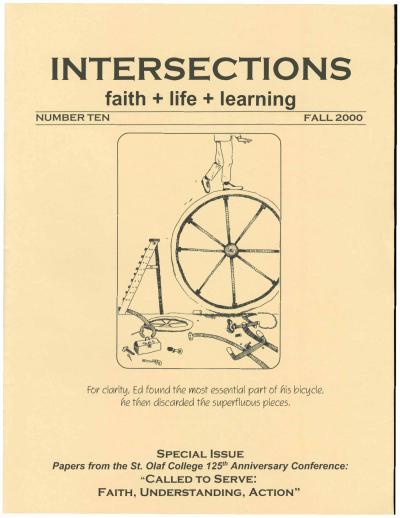
O’Brien surveys justice and peace education in Catholic higher education from Vatican II through the 1980s pastoral letters on nuclear weapons and the American economy, contrasting evangelical radicals (“what would Jesus do?”) with comfortable accomodationists, and argues that Catholic social teaching remains the church’s “best-kept secret.” Drawing on Bryan Hehir, David Hollenbach, Pope John XXIII, Patricia Hample’s “placing ourselves in the world to be of use,” and Martin Luther King’s last book on the “world house,” he develops pastoral care, solidarity (rooted in the mystical Body of Christ), and a realistic vocation-and-citizenship as the three needed responses for Catholic and Lutheran colleges alike.
-
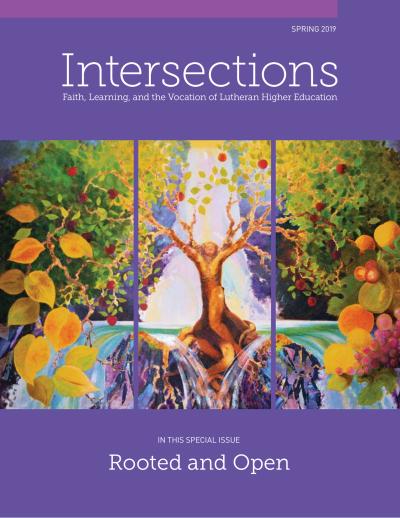 Article
Marked by Lutheran Higher Education
Martha E. Stortz
No. 49 · Spring 2019
Stortz offers an “operating manual” to Rooted and Open by tracing how the writing team moved from descriptive marks of the institutions to aspirational verbs that mark people — “called and empowered, to serve the neighbor, so that all may flourish” — and shows how each mark generates educational priorities theologically grounded in the radical mystery of God, the wild generosity of God, and the God who became one of us.
-
 Response
Tat for Teat: Ratke Responds
David Ratke
No. 9 · Summer 2000
Ratke, agreeing with much of VonDohlen’s critique but contending that VonDohlen misreads both Luther and the two-realms doctrine, marshals Luther’s To the Christian Nobility, On the Freedom of a Christian, Temporal Authority, Whether Soldiers Too Can Be Saved, and the “Sermon on Keeping Children in School,” along with Walther von Loewenich, to argue that Luther was well aware of structurally differentiated society, made no claim to a monistic epistemology, and intended the two-realms doctrine to combat—not introduce—dualistic bifurcation between sacred and secular. Our identity is “not as either Christian or academic, but as Christian and scholar.”
-
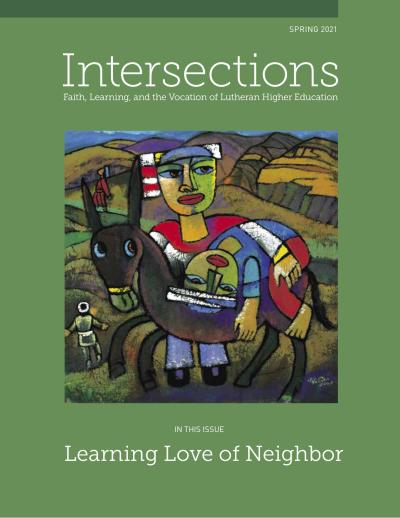 Article
Leadership in a Pandemic: Grace-Filled Lessons in Unprecedented Times
Marc Jerry
No. 53 · Spring 2021
Reflecting on his first year as president of Luther College at the University of Regina, Jerry argues that the best preparation for leading through a long crisis was not his economics or strategy training but seminary and pastoral formation—and that NECU institutions are called to a post-pandemic ministry of kindness, grace, and community.