If you look up the etymology of the word vocation, you see that it comes from Latin, via old French (vocaciun) and Middle English (vocacioun). The word stems from the root vox (voice), and is related to the Latin term vocare (to call).
One way to get at the definition of vocation is to consider cognates, or words that share the same root. These include: evoke, provoke, revoke, invoke, advocate, convocation, vocal, equivocate, and vocabulary. One might pause here and consider the relationship between one or two of these cognates and the sense of vocation as a call. Do they incorporate a notion of two parties—a sender and receiver? Do they include a sense of direction—of being for, to, or about something beyond both sender and receiver? Are they words that we might use in our work with students?
“Vocation’s cognates all presume a relationship of some sort. Convocation is a calling. Provocation is a work meant to incite action in another. To revoke signals the end of an agreement or understanding.”
Vocation’s cognates all presume a relationship of some sort. Convocation is a calling. Provocation is a work meant to incite action in another. To revoke signals the end of an agreement or understanding. Kathleen Cahalan defines vocation using prepositions, and notes that “prepositions express relationship. When we frame vocation through prepositions, callings become more relational, dynamic and multiple” (xi). Vocation also includes this notion. It presumes relationship in which one party (the caller) invites a response from another (the called).
Martin Luther’s understanding of vocation implies that all Christians are called to love and serve God by serving the neighbor, and that this is accomplished through specific callings to a particular station in life. Thus, vocation presumes a relationship between God and God’s people. According to Luther, these general and particular callings or vocations are what we are created for, and they give direction to the lives we live here on earth. Similarly, Calvin differentiates between a general call available to all people and a special call generally made available only to believers.
This leaves one to wonder how those who do not claim the Christian tradition might understand vocation. Does God call a Muslim or a Jew in the same way God calls a Christian? What about a Buddhist who does not share the monotheistic tradition of Jews, Christians, and Muslims? Or what about an atheist who does not believe in a higher power? Can we say that these people also possess vocations? If so, what might those callings look like?
These are difficult questions. Here is one possible resolution. Vocation presumes a relationship between the caller and the one receiving the call. Yet the nature of both caller and receiver may (and perhaps should) be broadly interpreted. So, for example, my friend may believe that she is called by nature to work for the preservation of the earth. Another friend might believe that he is called by his community to strengthen the bonds between neighbors. I happen to believe that I am called by God to, among other things, raise my two children. Interestingly, Luther even seems to imply that we are called by our tools—the ordinary equipment with which we work every day:
If you are a craftsman you will find the Bible placed in your workshop, in your hands, in your heart…Only look at your tools, your needle, your thimble, your beer barrel, your articles of trade, your scales, your measures, and you will find…they say this to your face, ‘My dear, use me toward your neighbor as you would want him to act toward you with that which is his. (as quoted in Wingren 72)
Returning to our list of cognates, we see that they are grounded in the everyday, ordinary things of life. Often, these cognates describe relationships mediated through words. It’s no surprise that discerning vocation generally requires language, phrases, and sentences. How else would we be made aware of what we might be and do with our lives? And yet, we sometimes (perhaps unwittingly) conflate vocation with this grand and vague sense of ourselves and what we are meant to become. By its grounding in everyday words—the same grounding that these cognates possess—we see that vocation is most definitely not vague and need not be grand. Rather, vocations often consist of a specific summons to a possibly ordinary (dare I say humble) life. It is this sacredness in the ordinary that Luther emphasized when he wrote in “To the Christian Nobility of the German Nation”:
A cobbler, a smith, a peasant—each has the work and office of his trade, and yet they are all alike consecrated priests and bishops. Further, everyone must benefit and serve every other by means of his own work or office so that in this way many kinds of work may be done for the bodily and spiritual welfare of the community. (130)
“Vocations often consist of a specific summons to a possibly ordinary (dare I say humble) life.”
One has to take care in claiming that vocation is grounded in words. I do not mean to claim that we lack a vocation until we hear specific words from an ultimate or supernatural source of our calling. Often the words through which we discover our vocations come to us in a distinctly ordinary way. Sometimes our calling comes in an invitation we receive over the phone. Or a friend points out something we are good at that we hadn’t known about ourselves; a professor suggests to a student that she should consider a particular course, or major, or study away opportunity; an acquaintance invites us to join a group and we discover that this is exactly where we belong. Vocation is not merely a vague sense or a spiritual intuition. Our vocations sometimes come to us through simple words uttered in ordinary conversation. Indeed, the person who utters such a call sometimes has no idea that their words have such profound impact.
The careful reader will note that I have referred to both vocation and vocations. This is not an editorial error. We can think of vocation as permanent (singular) yet changing (plural)—a general thing we are called to throughout our lives, and the particular things we are called to for a time. From both Luther and Calvin, we have this bifurcation of vocation—a general calling to lifelong obedience to God combined with particular and possibly temporary callings to each individual. While aspects of our vocation do not change, the numerous ways we live out these facets of our calling may.
Regardless of how you define it, then, vocation changes over time. When we are young, we are called to study and learn. As we graduate from high school or college, we enter the world of paid employment, hopefully in a job that suits our skills and abilities and serves the community around us in some way. For some (many, we hope), this job reflects an aspect of one’s vocation. As we approach retirement, we are called to refocus our energy away from paid employment and toward other forms of service to the community. Some will be called to care for parents or spouses through illness and death. When we recognize that discerning vocation does not depend on a once-for-all discovery, we are relieved of the pressure to help our students find their vocation (singular) while they are on campus and freed to equip them to discern for themselves their vocations (plural)—the ways in which they are being called to service in the world.
“When we recognize that discerning vocation does not depend on a once-for-all discovery, we are relieved of the pressure to help our students find their vocation (singular) while they are on campus and freed to equip them to discern for themselves their vocations (plural)—the ways in which they are being called to service in the world.”
The Lutheran heritage of our institutions, which makes our schools both rooted and inclusive, gives us the means by which we might foster the lifelong discernment of vocation. Our rootedness gives us a foundation from which students (and others) can learn about vocation and how it is discerned throughout life. Our inclusiveness makes our campuses welcoming of all into this discernment—whether they are students just beginning to discern, or post-retirement alumni thinking about how to give back. This heritage can make our schools a place where we practice our own vocational discernment and move out into the world bringing the gift of calling to those we encounter—our colleagues, our alumni and our friends.
Works Cited
Cahalan, Kathleen A. The Stories We Live: Finding God’s Calling All around Us. Grand Rapids, MI: Eerdmans, 2017
Luther, Martin. “Address to the Christian Nobility of the German Nation Concerning the Reform of the Christian Estate.” Luther’s Works (American Edition), volume 44. Philadelphia: Fortress, 1966.
Wingren, Gustaf. Luther on Vocation. Translated by Carl C. Rasmussen. Philadelphia: Muhlenberg, 1957.
-
 Editorial
From the Publisher
Mark Wilhelm
Wilhelm celebrates that NECU schools continue to educate for vocation but warns that the culture of Lutheran higher education is at risk — sustained largely by informal cadres of individuals — and introduces NECU’s Rooted and Open statement as a first institutional step toward reclaiming the 500-year-old Lutheran intellectual and educational tradition.
-
Article
One Life, Many Callings: Vocation Across the Lifespan
Katherine Turpin
Turpin, drawing on the collaborative research behind Calling All Years Good, traces how vocational discernment shifts through adolescence, younger adulthood, middle adulthood, late adulthood, and older adulthood — arguing that focusing vocation on entry into the workforce limits the capacity of intergenerational college communities to wrestle with calling throughout life.
-
Article
Vocation for Emerging Adulthood: Within and Beyond College
Adam Copeland
Copeland uses scenes from Master of None, David Brooks’ columns, Meg Jay’s The Defining Decade, and the stories of two ELCA college graduates to argue that emerging adulthood has fundamentally changed — and that Lutheran colleges should call out cultural lies about work, reframe vocation as meaning-making, and help graduates take small, wise steps into their twenties.
-
Article
Called to Compassion over the Course of a Life: A Buddhist Perspective
Florence D. Amamoto
Amamoto, an associate professor at Gustavus Adolphus shaped by Jodo Shin Shu Buddhism, argues that although Buddhism has no “caller” God, it has a strong sense of calling — we are called by the world to respond to the suffering around us with mindfulness, egolessness, and compassion — and that this lifelong journey is enriched by encounter with the Lutheran vocational tradition.
-
Article
Vocation and Dharma throughout Life's Stages: A Hindu Perspective
Vidya Thirumurthy
Thirumurthy traces her own attempt as a Hindu faculty member at Pacific Lutheran University to grasp the Lutheran concept of vocation, finding in the Bhagavad Gita’s teaching on dharma — duty fulfilled without expectation of reward — an equivalent that, like vocation, varies across the four stages of life and calls individuals to transform others through selfless service.
-
Book Review
Vocation on Campus: Reading Mark Tranvik's Martin Luther and the Called Life at Pacific Lutheran University
Alex Lund, Michael Halvorson
Halvorson and Lund — faculty member and student — review Mark Tranvik’s Martin Luther and the Called Life alongside PLU’s Wild Hope Center for Vocation, weighing the book’s warning against “vocation lite” against the challenge of speaking of God’s call to students in the Pacific Northwest’s “None Zone,” where most students have little exposure to Lutheranism.
-
Article
Luther, the Catechisms, and Intellectual Disability
Courtney Wilder
Wilder confronts Luther’s deeply troubling response to a child with disabilities at Dessau, then mines his Small and Large Catechisms for a Lutheran theology of inclusion — reading the Third Article of the Creed, the petitions of the Lord’s Prayer, and the sacrament of baptism as resources that affirm the full humanity of people with intellectual disabilities as faithful children of God.
-
Article
Lutheran Higher Education in the Land of Anxiety
Jon Micheels Leiseth
Leiseth, returning to Concordia from work with the ELCA’s Young Adults in Global Mission in Southern Africa, draws on Bessel van der Kolk and Babette Rothschild to argue that pervasive student anxiety functions as low-grade trauma that hijacks the storytelling at the heart of vocational discernment — and explores embodied, breath-based practices that might help students reclaim their stories.
-
 Article
Vocation and Civil Discourse: Discerning and Defining
Lynn Hunnicutt
No. 48 · Fall 2018
Hunnicutt draws on Rabbi Amy Eilberg’s reading of Moses’ calling to identify four features of vocational discernment — attention, wonder, communal consciousness, and humility — and argues that these same qualities are also key aspects of civil discourse, so that forming students for vocational discernment is simultaneously forming them for civility.
-
 Article
Calling Economists
Lynn Hunnicutt
No. 37 · Spring 2013
Reading Luther’s Whether Soldiers, Too, Can Be Saved alongside Adam Smith’s Theory of Moral Sentiments and Wealth of Nations, Hunnicutt asks whether economists, too, can be saved—and whether economics can host a serious conversation about vocation. She traces her own move from Utah State to Pacific Lutheran University and its Wild Hope Center for Vocation, and turns to Deirdre McCloskey and George DeMartino as economists whose work makes room for vocation and the common good within the discipline.
-
 Editorial
From the Publisher
Mark Wilhelm
No. 28 · Fall 2008
Wilhelm introduces himself as the new Director for Colleges and Universities and publisher of Intersections, thanks his predecessor Arne Selbyg, and previews an issue devoted to the aims and purposes of Lutheran higher education—reflections from Presiding Bishop Mark Hanson, two pieces from Wartburg College’s fall 2008 campus conversation about being a college of the church (his own essay and the Benne/Christenson dialogue), and a sermon by Lake Lambert III preached in the Castle Church in Wittenberg.
-
 Article
The Vocation of Intersections on its Twentieth Birthday
Jason A. Mahn, Robert D. Haak, Tom Christenson
No. 43 · Spring 2016
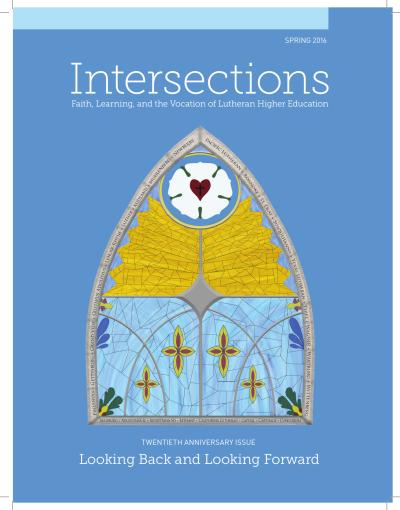
The three editors of Intersections — Bob Haak, Jason Mahn, and Tom Christenson (in spirit, following his death in 2013) — trace the twenty-year vocation of the journal itself: its 1996 birth at Capital University; its coming-of-age years of debate over institutional markers, two-kingdoms theology, and Lutheran identity; the ascendancy of “education for vocation” as the central marker of Lutheran higher education; and its ongoing identity in relation to a changing ELCA and to the broader cultural conversation about purpose, wholeness, and the vocation of higher education.
-
 Editorial
From the Editor
Colleen Windham-Hughes
No. 62 · Fall 2025
5 min audio
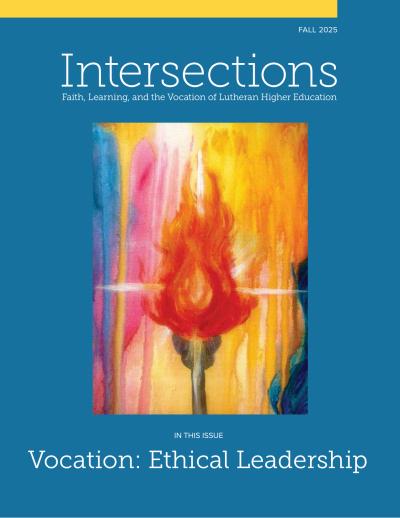
Windham-Hughes plays on the shared Latin root of “education” and “seduction” (ducere, to lead) to warn against the No-saying seductions of giving up or condemnation, and to call educators to the riskier Yes of showing up to build third-space communities of truth-telling and hope.
-
 Article
A Lutheran Learning Paradigm
Paul J. Dovre
No. 34 · Fall 2011
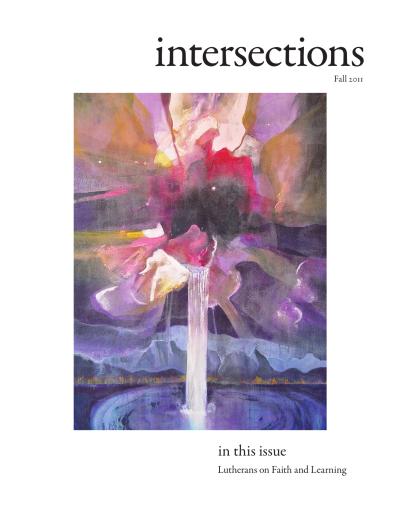
Drawing on Hughes and Adrian’s Models of Christian Higher Education and on Ernest Simmons, Darrell Jodock, Tom Christenson, Robert Benne, and Richard Hughes, Dovre sketches a Lutheran learning paradigm shaped by four deep narratives—the biblical, the confessional, the theological, and the vocational—and traces their implications for curriculum (the study of scripture, theology, and vocation), for the religion faculty’s college-wide responsibility, and for pedagogy (moral deliberation, dialectic, paradox, the engagement of faith and the secular disciplines).
-
 Editorial
From the Publisher
Arne Selbyg
No. 21 · Summer 2005
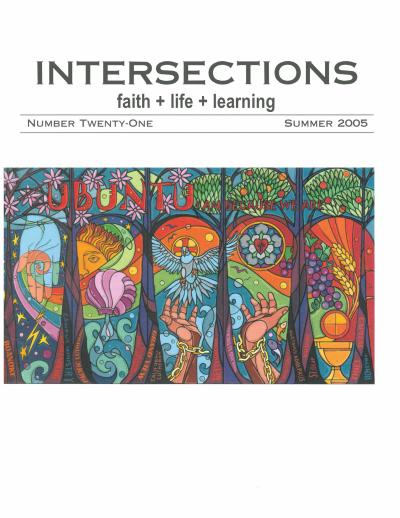
Selbyg notes that ELCA colleges and universities have remained more loyal to the church than the institutions of many other denominations and announces that with this issue Tom Christenson’s nine-year service as editor of Intersections comes to an end, with Bob Haak of Augustana College in Rock Island assuming the editorship and institutional support shifting from Capital to Augustana.
-
 Article
Teaching and Mentoring in Service of Civic Engagement
Haco Hoang
No. 63 · Spring 2026
6 min audio
Hoang describes how her teaching, mentoring, and research at California Lutheran University — including a multi-year collaboration with the Lutheran Office of Public Policy on Lutheran Lobby Day — cultivate civic skills grounded in ELCA social statements and the Lutheran tradition of faith and reason.