Intersections and the Vocation of a Lutheran College Conference give focus to a rich heritage of learning. It is a heritage that enables a community of scholars, as the late Ernest Boyer once said, to “probe both the deep places of the mind and the deep longings of the human spirit.” This ability, as we know, is not frequently found in higher education today and the lack of it has become an obvious weakness in late twentieth century education. This journal and the conference with which it is connected are meant to widen the scope of inquiry that the separation of mind from spirit has curtailed. I hope they will continue to be places of exciting and important ideas.
At the 1998 conference, another announcement will be made to strengthen this effort. I will be able to tell you of a publishing project named in honor of the late Conrad Bergendoff, a scholar and former president of Augustana College in Rock Island, Illinois. His writing, speaking, and teaching were penetrating expressions of faith and learning. Every few years the Division for Higher Education and Schools will publish a volume in the Conrad Bergendoff Series. These works will be written primarily by faculty from our ELCA Colleges and Universities and will support the development of an Academy of Scholars in Lutheran Higher Education.
The first volume, written by Professor Ernest Simmons of Concordia College, is now being published and will be available at our Vocation of a Lutheran College Conference this summer. It is a book to help faculty explore this heritage of learning and will be, as I indicated, the first of ongoing publications from the various academic disciplines.
My hope is that these three ventures — Intersections, The Vocation of a Lutheran College Conference, and the Bergendoff Series — will be vehicles to help faculty in our colleges and universities expand scholarship that probes both mind and spirit. If we do, we will benefit both church and academy. Just as importantly, we will also provide a distinctive education for students that is as rich as it is rare.
Robert W. Sorenson
Division for Higher Education and Schools
ELCA
-
 Editorial
From the Editor
Tom Christenson
Christenson introduces the issue as an illustration of the diversity of interests Intersections aims for, surveys the contents (Lagerquist on method, Mori on art and ritual, Baer on falling walls, Bergendoff as memorial, Funk and Powell in dialogue), urges readers to send in “your good stuff,” asks for distribution feedback, and closes with a sabbatical-year reading list—Kieran Egan, Robert Coles, Daniel Kemmis, David W. Gill, Sallie McFague, Roger Scruton, E.M. Adams, Freeman Dyson, Colamosca and Wolman, Gribbin and Goodwin, van Wyk, Wislawa Szymborska, and Flannery O’Connor.
-
Article
You Don't Seem Angry: Methodological Confessions Of A Lutheran Lay-Woman
L. DeAne Lagerquist
Lagerquist, opening from a colleague’s 1981 observation about her M.A. thesis on four female abolitionists, traces her path from feminist historian and battered women’s shelter advocate through the University of Chicago’s obsession with method to a more self-conscious account of her own. The method grows out of four Lutheran themes—original sin (caution and humility), the eighth commandment against bearing false witness (generosity and forgiveness), the neighbor as “little Christ” (cooperative interpretation), and vocation (interpretation as calling, located alongside feeding the hungry and visiting the lonely)—and shapes her ongoing work on a history of Lutherans in the United States with a plot about learning to live with diversity.
-
Article
Redemption Through Imperfection
Kyoko Mori
Mori, drawing on a visit to the Philadelphia Museum of Art with a friend, contrasts Marcel Duchamp’s Étant donnés—a peephole work whose mysterious motion sweeps every viewer into a shared, perpetual performance—with the static, glass-encased Liberty Bell as parody of spiritual experience. She extends the contrast into a meditation on rituals (comfort and consolation) versus art (truth, however painful), and on writing as a redemptive process that moves from orderly first drafts toward chaos and deeper, frightening truth—closing with master potters who skewed each finished vessel slightly so that art and decoration could be told apart. Parts are excerpted from Polite Lies (Holt 1997).
-
Reflection
A Community That Connects
Conrad Bergendoff
Excerpts from Conrad Bergendoff’s 1990 address at the opening of Augustana’s new library, prepared by David Crowe and published here as a memorial after Bergendoff’s death in December 1997. Bergendoff—Augustana class of 1915, president 1936–1962—recounts eighty years of Augustana memories, insists that “size is pretty much within you, not outside of you,” traces the institution’s bonds to Uppsala from 1860 (and the 1910 visit of the Rector Magnificat), and celebrates Augustana’s graduates “in practically every part of the world” as evidence that a small school can have a universal output.
-
Reflection
Walls: Talk At Gustavus Adolphus College
Elizabeth Baer
Baer’s September 11, 1997 Gustavus Adolphus chapel homily on Joshua 6 turns from the trumpets to the walls—Robert Frost’s “Mending Walls,” the walls of the Warsaw ghetto in Vladka Meed’s On Both Sides of the Wall and Margaret Zassenhaus’s Walls, the Berlin Wall coming down in 1989—and then to the autobiographical, intertextual discourse of Gustavus chapel itself as a place where misunderstandings come down. An author’s note added after the March 29 F3 tornado reports the closing line (“LET’S MAKE THOSE WALLS COME TUMBLING DOWN”) as eerily prescient: roofs, windows, and 90% of campus trees were lost, but the Chapel walls and the eternal flame in the red glass lantern stood firm.
-
Article
The Quest Of The Historical Jesus: Problem & Promise
Robert W. Funk
Funk, founder of the Jesus Seminar, frames the quest as the search for reliable data amid twenty-two ancient gospels and as a confrontation among three “parties”—the Jesus Party, the Apostolic Party, and the Bible Party. He surveys the Seminar’s 1985–1998 work (The Five Gospels, The Acts of Jesus, the color-coded reports), defends the synoptics over John, the priority of Mark, the Sayings Gospel Q and the Gospel of Thomas, and argues that a recovered Jesus—a teacher of a trust ethic, celebration, a kingdom without social barriers, a society without brokers, without cult rituals—may serve as catalyst for a sweeping third-millennium reformation that purges the “clogged arteries” of institutional Christianity.
-
Response
Beyond Data: The Poetry of Faith — A Response to Robert W. Funk
Mark Allan Powell
Powell, professor of New Testament at Trinity Lutheran Seminary, responds to Funk not as a New Testament scholar (Meier, Raymond Brown, and others can rehearse those debates) but as a Christian and a pastor. He challenges Funk’s closing implication that the institutional church’s “only function” is to protect Christian privilege (citing the ELCA’s 28 colleges, 1378 early childhood centers, AIDS hospices, and more), questions the suspicion of “derivative” faith, and proposes that piety is to theology what poetry is to prose—arguing, against Funk and with Marcus Borg, for a wholistic faith that holds history and myth, data and devotion, head and heart together.
-
 Article
Why Diversity and Civic Engagement Don't Talk to Each Other on College Campuses: The Need for Public Work
Jose Marichal
No. 25 · Spring 2007
Marichal opens with Thurgood Marshall’s line from Milliken v. Bradley and traces the “decoupling” of campus diversity and civic engagement initiatives back to their shared grounding in Benjamin Barber’s “thin” or pluralist democracy. Reviewing CIRCLE data on youth political disengagement, the limits of mandatory volunteerism, and persistent residential segregation, and drawing on Mary Ann Glendon, Lani Guinier, Caryn McTighe Musil, and Richard Rorty, he argues that only Harry Boyte’s notion of “public work” can bind diversity and civic engagement together—and contends that Lutheran colleges, with their understanding of vocation as call into the world, are uniquely positioned to build that infrastructure.
-
 Editorial
From the Editor
Tom Christenson
No. 2 · Winter 1997
Christenson opens with an invitation for reader submissions to balance the conference-paper format of the first two issues, then asks how college and universities can turn students positively toward learning. Drawing on Aristotle’s claim that study is loved for its own sake (which students greet with disbelieving laughter) and Neil Postman’s The End of Education, he argues that students lack narratives within which learning makes sense and proposes four Lutheran mega-narratives—stewardship of creation, the freedom of the Christian, the sacramental presence of the transcendent in the concrete and ordinary, and vocation—that could inspire learning at the 28 ELCA colleges and universities.
-
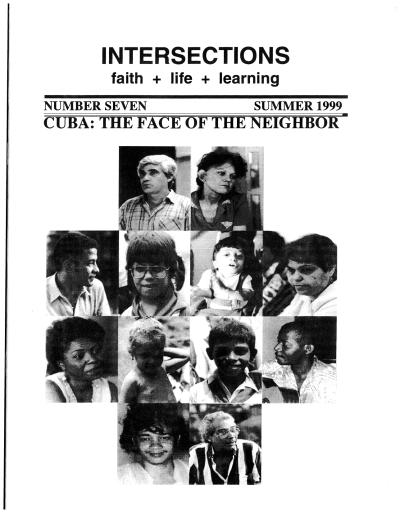 Editorial
From the Publisher
Arne Selbyg
No. 7 · Summer 1999
Selbyg celebrates the popularity of the previous issue—the first to draw on papers from the annual “Vocation of a Lutheran College” conference—and announces a new Lutheran Brotherhood Foundation grant that will fund the inaugural Lutheran Academy of Scholars in Higher Education, a two-week seminar at Harvard led by Ronald Thiemann on “Finding Our Voice: Christian Faith and Critical Vision.”
-
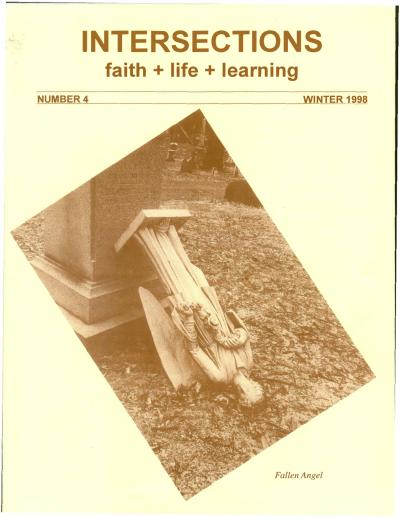 Article
A Response to Paul Santmire
Don Braxton
No. 4 · Winter 1998
Braxton appreciates the dialectical structure of Santmire’s mandates—“skeletons in our closets and riches in our own vaults”—and reads it as a faithful expression of the Lutheran tradition of Paul, Augustine, and Luther. He argues that Santmire is on target in warning against premature flight to non-Christian traditions for environmental wisdom (theoretical sensitivity does not translate into ecological behavior in practice), and that classical Lutheran social ethics has too often been quietistic. But Lutheran ethics at its best is dialectical, not dualistic—recognizing the interpenetration of church and world, Law and Gospel, eschatological Kingdom and present realities, as in Hegel, Ritschl, Bonhoeffer, Reinhold Niebuhr, and Larry Rasmussen. Braxton commends environmental responsibility, social criticism of unsustainable practices, and a liturgical practice of resistance to instrumentalism as appropriate next steps for Lutheran liberal arts colleges, especially Capital University.
-
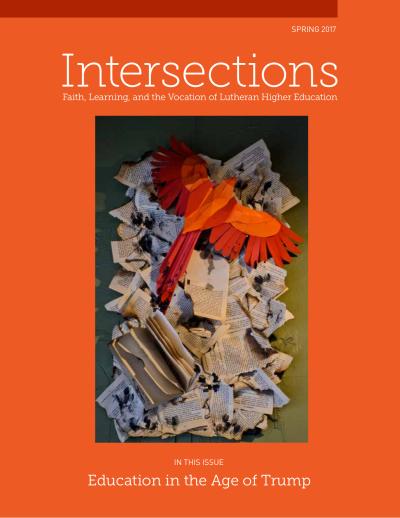 Article
Higher Education in the Age of Trump
Daniel B. Braaten
No. 45 · Spring 2017
Braaten surveys what the Trump administration has and has not done on higher education — from the selection of Betsy DeVos and a rumored Falwell-led task force to the travel ban and expanded deportation priorities — and argues that Lutheran colleges, guided by the ELCA’s social message on immigration, have a special obligation to consider what they will do to protect their most vulnerable students.
-
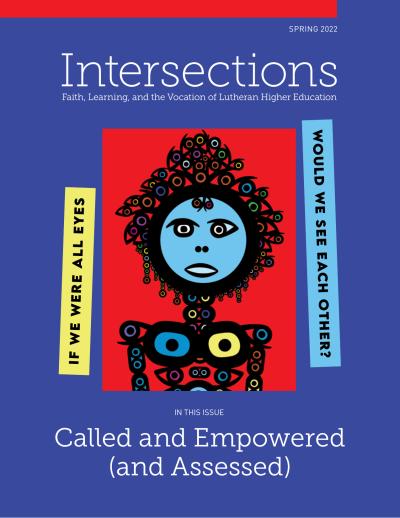 Editorial
From the Publisher
Mark Wilhelm
No. 55 · Spring 2022
Wilhelm announces his planned retirement on January 31, 2023, after serving as the founding executive director of the Network of ELCA Colleges and Universities, and gives thanks for the privilege of helping NECU articulate a shared vision for Lutheran higher education in twenty-first-century North America.