Having just completed the Year of Saint Paul and now commemorating the Year for Priests, one might easily overlook an anniversary that marks a milestone in ecumenical relations. I refer to the tenth anniversary of the signing of the Lutheran-Catholic “Joint Declaration on the Doctrine of Justification” on Reformation Day, October 31, 1999.1 This article would like to draw attention to this anniversary and why it should not remain in the shadows.
Background
The Joint Declaration (hereafter, JD) did not just suddenly appear out of the blue when officials representing the Lutheran World Federation and the Holy See signed the document in Augsburg, Germany on the eve of the third Christian millennium. Decades of painstaking dialogue had taken place to prepare for the Declaration. In the wake of Vatican Council II, many ecumenical dialogues were begun in earnest in the hopes that centuries of Protestant-Catholic division could, at least in modest ways, be bridged so that the heartfelt goal of Christian unity could be achieved.
By any measure, the multiple volumes of the Lutheran-Catholic dialogue testify to the success of this process. Experts and ecclesial representatives of both denominations participated in these fruitful dialogues. They covered topics like baptism, eucharist, righteousness, the papacy, and New Testament figures like Peter and Mary. These dialogues paved the road that led to the JD.
What Does the Declaration Say and Mean?
The document contains forty-four numbered paragraphs and an Appendix. The Preamble points out that the doctrine of justification by faith has historically been central to the teaching of Lutherans ever since Martin Luther himself, reflecting deeply on Paul’s Letter to the Romans, came to the insight that the salvation offered to humanity by God in Jesus Christ was free gift, not something to be earned by doing “good deeds.” God justifies us or makes us righteous. Unfortunately, a by-product of this understanding, coupled with Luther’s dissatisfaction with various Church practices of his day, like indulgences and the seeming “selling” of sacramental rites, led to the Protestant Reformation. As the JD acknowledges, “From the Reformation perspective, justification was the crux of all the disputes.” (#1) That is why it was crucial eventually to reach a point where the topic could be addressed in depth.
The intention of the JD was clear:
The present Joint Declaration has this intention: namely, to show that on the basis of their dialogue the subscribing Lutheran churches and the Roman Catholic Church are now able to articulate a common understanding of our justification by God’s grace through faith in Christ. It does not cover all that either church teaches about justification; it does encompass a consensus on basic truths of the doctrine of justification and shows that the remaining differences in its explication are no longer the occasion for doctrinal condemnations. (#5)
When one considers the centuries of controversy over this one teaching, the achievement of the JD stands out all the more. Both Churches acknowledge nothing short of a common view of the principal understanding of justification by faith.
This common understanding is expressed vividly in the paragraph that is the heart of the document:
In faith we together hold the conviction that justification is the work of the triune God. …Together we confess: By grace alone, in faith in Christ’s saving work and not because of any merit on our part, we are accepted by God and receive the Holy Spirit, who renews our hearts while equipping and calling us to good works. (#15)
These remarkable words are revolutionary. For Lutherans, this understanding represents an acknowledgement of the role that “good works” play in ongoing faith. They do not achieve our salvation but bear witness to it. For Catholics, this agreement overshadows any latent Pelagian2 or semi-Pelagian understanding that, in my experience, still rests in the minds of many Catholics. Our good works neither earn our salvation nor achieve a higher place in heaven. Rather, they give witness to the salvation that the incarnation, life, ministry, and especially the suffering, death and resurrection of Jesus Christ, has once and for all accomplished. God’s grace alone has been our salvation.
What Questions Remain?
Despite this unprecedented agreement, some questions remain to be ironed out. Late in the process, and taking everyone by surprise, including the officials of the Pontifical Council on Christian Unity in Rome that had spearheaded the agreement, Pope John Paul II pointed out that the agreement might be a bit hasty on three points. He noted, quite rightly, that Lutherans and Catholics still have differences of understanding on three related topics: concupiscence (the tendency to immoral desires) and the notion of simultaneously being sinner yet saved (Luther’s famous formula of simul justus et peccator); how to fit justification into the larger “rule of faith;” and the role of the sacrament of Penance.
Despite these demurs, the Pope acknowledged agreement to 41 out of the 44 paragraphs of the JD and permitted the signing to go on. He also insisted that these questions did not in any way call into question the essential matters of the agreement. In essence, the Pope said, there is more homework to be done! Thus the dialogue will continue.
What Authority Does the Declaration Have?
Some experts have raised the question of what authority the JD exercises. From a Lutheran perspective, one must acknowledge that the World Lutheran Federation does not represent all Lutherans, despite the fact that some 58 out of 61 million Lutherans worldwide are represented by this body. From a Catholic perspective, one might question what the JD means given the fact that Pope John Paul II had several demurs. But, as indicated above, the essentials of the JD remain in place and now become part of the ecumenical teaching of the Church.
In July, 2006 an even more interesting development took place that highlighted the possible impact that the JD can have on ecumenical relations. While meeting in Seoul, South Korea delegates from the Word Methodist Conference voted unanimously to sign onto the JD, thus adding another significant denomination to the common agreement. This unexpected gesture hinted that promoting a common understanding of such a central Protestant teaching could have enormous positive effect on ecumenism.
Why Promote This Anniversary?
A more serious pastoral question lurks in the background. How many Catholics really know (or care) about the JD? Even after a year recently devoted to Saint Paul, whose letters provide the source of this notion, one wonders how much of an impact the joint agreement has had. Justification by faith is a difficult topic to summarize from the pulpit. Many priests are hesitant even to broach the topic.
A Pastoral Strategy
How does one succinctly and in simple terms explain Paul’s teaching? I believe the tenth anniversary of the JD offers us another opportunity to promote this teaching in our parishes. While we live in a time in which the intense fervor of ecumenical dialogue so evident in the immediate wake of Vatican II has waned, it would be helpful if Catholics at least could understand that some real progress has been made in mutual Protestant-Catholic relations. We should no longer be caricaturing Lutheran teachings about justification. Nor should we be ignorant of our own Catholic teaching on the topic. As the JD notes, we now have a common understanding that accommodates two emphases, God’s grace and our good works in response to it.
The JD instructs us to promote a better, common understanding of this all-important teaching. As Saint Paul insists, Jesus Christ has justified us, declared and made us righteous, and thus has called us to live exemplary, ethically upright lives.
Pastorally, I suggest that on an appropriately chosen Sunday not too far removed from the anniversary homilists present a short, focused instruction on the JD and its significance. This, of course, requires a little homework. The main elements of such a homily (or perhaps an adult education session) should be clear:
- define justification, perhaps simply by reading Paragraph 15 of the JD and making a brief comment on it
- explain a little of the history of how and why the teaching of justification contribute to centuries of Protestant-Catholic division
- explain the role of good works, not as means of obtaining something from God, who has already extended salvation freely through the death and resurrection of his Son, Jesus Christ, but as a way to testify to the world that we have accepted God’s outstretched offer of salvation and are attempting to live it out in our lives
- give thanks for progress made thus far in Christian unity, symbolized well by the anniversary, and invite continued prayers for the deeper unity of the body of Christ.
In an age of mixed marriages and plentiful Protestant-Catholic contact, any promotion of better ecumenical understanding is bound to have a positive effect. Catholics should understand that our Church officially is still engaged in promoting Christian unity. It has not fallen by the wayside. This anniversary is a reminder that unity comes at a price. There is some give and take. Three denominations have now given and received on this vital theme. Ten years is perhaps not a long time for it to have sifted down to the pews, but surely, it is an anniversary worth bringing out of the shadows.
Endnotes
1. See “Joint Declaration on the Doctrine of Justification,” available on the World Wide Web at http://www.vatican.va/roman_curia/pontifical_councils/chrstuni/documents/rc_pc_chrstuni_doc_31101999_cath-luth-joint-declaration_en.html. I use the document’s paragraph numbers for quotations. The document was accompanied by an Official Joint Statement and an Appendix of recommended resources. The Holy See also published an Annex that outlined Pope John Paul II’s call for more dialogue on specific related issues.
2. This heresy began with Pelagius (ca. 350-425 CE), an ascetic teacher in Rome and North Africa. He promoted human free will and the ability to choose good over evil, seemingly denying the necessity of God’s grace for salvation. Saint Augustine was a major opponent to Pelagius’ teaching, although his teachings continued to influence many Christians over the centuries.
-
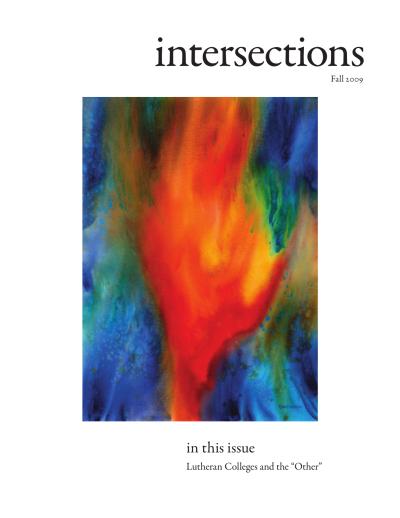 Editorial
From the Publisher
Mark Wilhelm
Wilhelm reports on the difficult financial season facing the ELCA churchwide organization — a ten-percent budget reduction announced in November and significant cuts to unrestricted grants for colleges and universities — while affirming that the ELCA’s commitment to the mission of its schools remains strong, including its commitment to engaging the “other,” the theme of this issue.
-
Editorial
From the Editor
Robert D. Haak
Haak frames the issue around the question of Lutheran college identity as formed in distinction from some “other,” introducing essays by Witherup on the Joint Declaration, Reuther on Holden Village, Afzaal on Christian-Muslim dialogue, Dovre on the history of Midwestern Lutheran colleges, Radecke on service-learning, and Ratke on Wilhelm Löhe — each making the claim that the “other” is an essential partner in conversation who helps us know who we are and shape who we will become.
-
Reflection
On Sharing the Sacred Sauna
Rosemary Radford Ruether
Reprinted from the National Catholic Reporter (August 1968), Ruether’s reflection from her time as a theologian on the faculty of Holden Village describes Lutheran community life in the mountains of northern Washington from a Catholic perspective — finding more catholicity in this Lutheran retreat than in many Roman Catholic communities — and culminates in a celebration of the Holden sauna as “the new sacrament, the new fellowship, the new theology.”
-
Article
Between Suspicion and Trust
Ahmed Afzaal
Afzaal argues that scholars and educators have a unique vocation to shift Christian-Muslim relations from suspicion to trust, drawing on the 2007 Muslim open letter “A Common Word,” Robert Shedinger’s Was Jesus a Muslim?, and Muhammad Iqbal’s Reconstruction of Religious Thought in Islam to argue that Christianity and Islam converge in the insight that religion is a spiritual force for social justice and human liberation — an insight obscured by the modern Western discourse of sui generis religion.
-
Article
Lutheran Colleges: Past and Prologue
Paul J. Dovre
Dovre offers a reminiscence rather than a research paper, drawing on Aristotle’s ethos, logos, and pathos to trace fifty years of change at Midwestern Lutheran colleges through the key issues of survival, respectability, faithfulness, and relationship to the church — from the dependence of the 1950s through the independence of the late twentieth century to the partnership of the 2000s — and identifies key variables (the student marketplace, faculty formation, and the identity/diversity paradox) for shaping the identity and mission of Lutheran colleges into the future.
-
Article
SCAM-ing Service-Learning and Mission Trips: A Satirical Essay
Mark Wm. Radecke
Radecke couches his research on best/worst practices in service-learning and short-term mission trips in a fictional Screwtape-style correspondence between Horatio Gumnut, CEO of “Spiritual Consultants and Mercenaries, Incorporated” (SCAM, Inc.), and Dwayne Pipe, an untenured professor seeking to sabotage a colleague’s Nicaragua mission trip — cataloging through indirection the disorienting dilemmas, commodification of the poor, exhaustion of reflective practice, and false noblesse oblige that derail such ventures, while pointing toward the genuine philoxenia, accompaniment, and structural awareness that mark a transformative experience.
-
Article
Wilhelm Löhe and Higher Education
David Ratke
Ratke recovers the educational vision of Wilhelm Löhe (1808–1872), spiritual father of Wartburg College and Wartburg Seminary, drawing on Löhe’s “Aphorismen über Schule und Schulunterricht” and other writings to argue that education is about the formation of whole persons by whole teachers in whole institutions, that all education is religious and never neutral, and that education is for eternity as well as the present — a vision in which the values of Christianity sanctify the so-called worldly means of education.
-
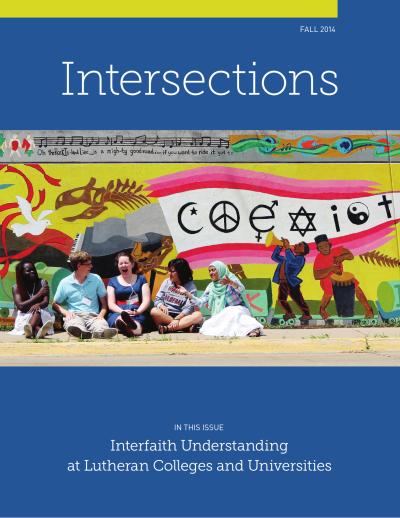 Article
Well, Well…Plumbing Our Depths, Telling Our Stories
Ann Boaden
No. 40 · Fall 2014
Beginning with a college visit that turned into a grieving mother’s confidence about her daughter’s last moments, Boaden uses John 4’s well of living water to argue that an interfaith education worthy of the name requires Lutherans to plumb the depths of their own tradition’s wells — with rituals, stories, and seasons intact — before they can see, respectfully, into the wells from which others drink.
-
 Reflection
Meditation—Band Chapel Service, St. Olaf College
Erik Haaland
No. 7 · Summer 1999
Haaland, a St. Olaf senior, offers a brief Band Chapel meditation that defines art as “the expression of what is deeply human through the manipulation of the physical world” and defends worship—architecture, stained glass, music, eloquence—as an art form requiring our best and most sincere efforts. When the God we worship and the salvation we proclaim do not seem near, artful worship offers not propositions but something real and tangible to hold on to.
-
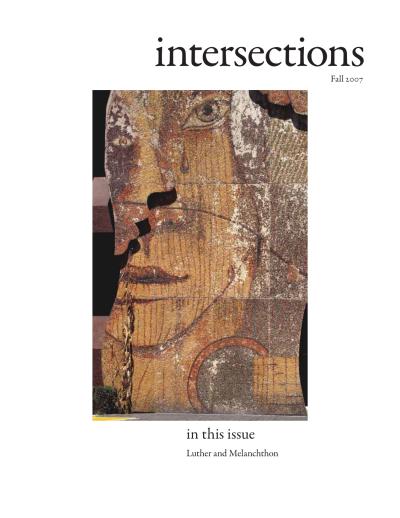 Editorial
From the Publisher
Arne Selbyg
No. 26 · Fall 2007
Selbyg notes that, while a stated purpose of Intersections over its twelve years and twenty-six issues has been the intersection of faith, learning, and teaching, surprisingly few articles have addressed how Lutheran faculty teach and why — and credits the editor for assembling essays from authors whose teaching has benefited from the ELCA Wittenberg Center, on the eve of the City of Wittenberg’s “Luther Decade” leading up to the 2017 Reformation anniversary.
-
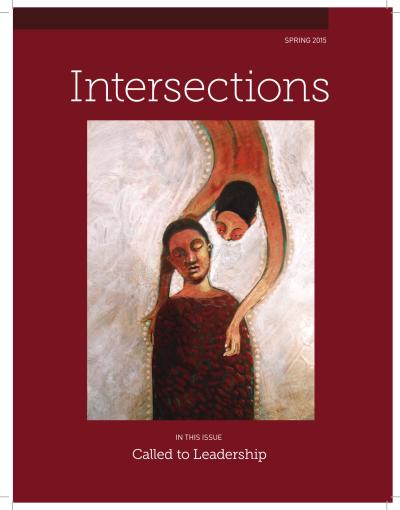 Book Review
Old and New Ideas of the Liberal Arts: A Review of Claiming Our Callings
David Crowe, Katie Hanson
No. 41 · Spring 2015
Crowe and Hanson review Claiming Our Callings: Toward a New Understanding of Vocation in the Liberal Arts (Oxford 2014), a collection of thirteen essays by St. Olaf faculty edited by Kaethe Schwehn and L. DeAne Lagerquist. They commend the book’s thoughtful, sincere engagement with consumerism, sustainability, Buddhist meditation, and Lutheran-Bonhoefferian theology — and recommend it for any liberal arts campus pulled between idealistic mission and career-minded pressure.
-
 Editorial
From the Editor: Why All This Talk About Vocation?
Colleen Windham-Hughes
No. 56 · Fall 2022
Windham-Hughes introduces the Fall 2022 issue built around Mark Wilhelm’s keynote “Why all this talk about vocation?” and previews five panel responses, two first-time conference reflections, and companion pieces on Womanist theology — framing vocation as a call not to privilege but to constructive and corrective work that undoes unjust systems.
-
 Editorial
From the Publisher
Mark Wilhelm
No. 34 · Fall 2011
Wilhelm bids farewell to Robert D. Haak, who is leaving the editorship of Intersections and the Augustana College Center for Vocational Reflection for a chief-academic-officer post at Hiram College in Ohio, and welcomes Jason A. Mahn as the incoming editor. He celebrates Haak’s tireless work to integrate the Lutheran concept of vocation into the practices and rhetoric of Augustana and ELCA higher education through six years of Intersections, and frames the journal as a vital tool for sustaining the conversation about education in a Lutheran key—even at colleges and universities where most students, faculty, and staff are not Lutheran themselves.