Dr. Conrad Bergendoff graduated from Augustana College (Rock Island) in 1915—at the age of 19—and from the Augustana Theological Seminary in 1925. He later earned a master’s degree from the University of Pennsylvania, his Ph.D. from the University of Chicago, and a Th.D from the University of Uppsala (Sweden). The author of many books and articles, Bergendoff concentrated on Swedish Reformation history, Martin Luther’s works, and Lutheran church history in America. He served as President of Augustana College from 1936 to 1962, and President of the Augustana Seminary from 1936 to 1948. Augustana’s fine arts building is named Bergendoff Hall.
In 1995 the Augustana community celebrated Bergendoff’s 100th birthday, and in December 1997 mourned his death.
The following remarks are excerpted from Dr. Bergendoff’s address marking the opening of Augustana’s new library in 1990. Though Bergendoff’s brilliant chapel talks are legendary, he used that occasion to make more casual remarks about his 80 years of Augustana memories.
These remarks were prepared by Dr. David Crowe, who has been at Augustana College for nine years. Crowe splits his time between teaching English and serving as Director of Honors Programs.
The happiest days of one’s life, I think, are the days when you are preparing for teaching and look forward to a career in academic work. Augustana has been richly blessed with teachers and as I look back over my life, it’s because I’ve had contact with teachers on both sides of the ocean that have shaped my own life… I congratulate the teachers here. If you can get to my age, nothing will give you greater satisfaction than to think of the success of your students.
I’ve been here since 1912, when I came as a student to Augustana and joined St. John’s Lutheran Church, where I have been more or less throughout the years. So my life has been centered right here in the Quad Cities. What has given me the greatest joy here is the opportunity to try to bring together part of the various activities which have been sort of put away each in their own corner. It isn’t what you yourself, by yourself, do — but what you’ve been able to do in cooperation with other people that gives you some kind of meaning in your own life.
And certainly, I think today of students. I was a little surprised that the mayor of Rock Island counted me among the fathers here at Augustana. The only other one that I think has done that is a student that came to me when I was in Wallenberg Hall and said, “Are you still alive?” He had seen my name around here—he thought I was one of the fathers or founders of Augustana. I’m not quite that old. No, I don’t call myself one of the fathers. I call myself one of the sons.
My father graduated here… So my connection with Augustana, it goes way back to the earliest days. And the students, when I came back here in 1912, were a small group. We were only 200 students. Strange thing is… I never thought we were small. Never thought it was a small school, even if we were only graduating a class of thirty. After all, size is pretty much within you, not outside of you. It’s what you yourself think that makes you a part of the greater whole. The thing that has struck me all through these years is how Augustana has been anticipating a global education. That’s now the thing today in the education field.
We’ve done that here since 1960. All of the faculty in 1960 and in 1875 when [the College] came [to Rock Island] were graduates of European universities. They were part of a much greater academic world than most of the institutions in the middle west, or even in the east. Bonds that we’ve had with Sweden from 1860, when you go back to the literature, you’re reading letters to the university professors of Uppsala, you’re following the curriculum that they had. In 1910 the Rector Magnificat—I like that term, Rector Magnificat—of Uppsala was here on the campus. And he said the graduates of 1910 would match any of the graduates of Uppsala at that time. And that’s, what, only 50, 60 years ago? No, I guess eighty years ago.
We’ve been a part of a much larger world than we ourselves have understood. And all of these contacts have given us an outlook that has made the institution a liberal arts college in the true sense of the word. Last week, what was it, 77 students came back from Asia. That’s been going on over twenty years. I doubt you’ll find many colleges that have had a more universal output in their whole history than Augustana has had. And I’ve tried to use my writings and research the last few years to discover things that we’ve forgotten. And we find in these early beginnings, something that has given us the inspiration for all the years that have followed. I said Augustana seemed to us large even in 1912 and now we’re over 2000 students, we’re part of a global educational world. It should give us some sense of our own importance in the task that we’re having to do with students.
And how can anyone who spent his life with students regret that kind of career? To be able to see this younger generation… and feel that we have somehow connected with them. You’ll find our graduates all over the world. Pick up the alumni directory and you’ll find them in practically every part of the world… many of them in high positions, even university presidents. So, it’s not a small school, and it’s not a small world. And to be able to connect our world with the world as a whole—that gives a liberal arts view. And to me that’s been the great advantage of spending the years here—that our view has taken us to the ends of the earth.
-
 Editorial
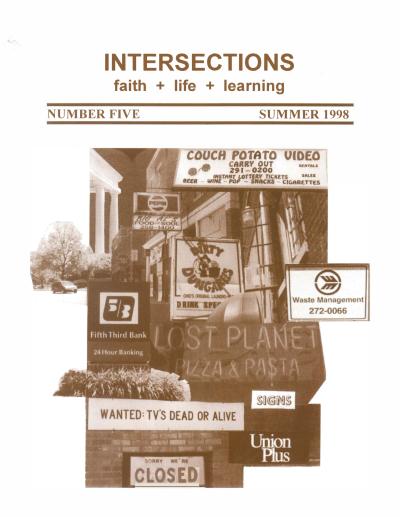
From the Publisher
W. Robert Sorensen
Sorenson frames Intersections and the Vocation of a Lutheran College Conference as vehicles for widening the scope of inquiry that the separation of mind from spirit has curtailed, citing Ernest Boyer on probing “the deep places of the mind and the deep longings of the human spirit.” He previews an announcement at the 1998 conference of the Conrad Bergendoff Series—named for the late scholar and former Augustana College president—whose first volume, by Ernest Simmons of Concordia College, will support an Academy of Scholars in Lutheran Higher Education.
-
Editorial
From the Editor
Tom Christenson
Christenson introduces the issue as an illustration of the diversity of interests Intersections aims for, surveys the contents (Lagerquist on method, Mori on art and ritual, Baer on falling walls, Bergendoff as memorial, Funk and Powell in dialogue), urges readers to send in “your good stuff,” asks for distribution feedback, and closes with a sabbatical-year reading list—Kieran Egan, Robert Coles, Daniel Kemmis, David W. Gill, Sallie McFague, Roger Scruton, E.M. Adams, Freeman Dyson, Colamosca and Wolman, Gribbin and Goodwin, van Wyk, Wislawa Szymborska, and Flannery O’Connor.
-
Article
You Don't Seem Angry: Methodological Confessions Of A Lutheran Lay-Woman
L. DeAne Lagerquist
Lagerquist, opening from a colleague’s 1981 observation about her M.A. thesis on four female abolitionists, traces her path from feminist historian and battered women’s shelter advocate through the University of Chicago’s obsession with method to a more self-conscious account of her own. The method grows out of four Lutheran themes—original sin (caution and humility), the eighth commandment against bearing false witness (generosity and forgiveness), the neighbor as “little Christ” (cooperative interpretation), and vocation (interpretation as calling, located alongside feeding the hungry and visiting the lonely)—and shapes her ongoing work on a history of Lutherans in the United States with a plot about learning to live with diversity.
-
Article
Redemption Through Imperfection
Kyoko Mori
Mori, drawing on a visit to the Philadelphia Museum of Art with a friend, contrasts Marcel Duchamp’s Étant donnés—a peephole work whose mysterious motion sweeps every viewer into a shared, perpetual performance—with the static, glass-encased Liberty Bell as parody of spiritual experience. She extends the contrast into a meditation on rituals (comfort and consolation) versus art (truth, however painful), and on writing as a redemptive process that moves from orderly first drafts toward chaos and deeper, frightening truth—closing with master potters who skewed each finished vessel slightly so that art and decoration could be told apart. Parts are excerpted from Polite Lies (Holt 1997).
-
Reflection
Walls: Talk At Gustavus Adolphus College
Elizabeth Baer
Baer’s September 11, 1997 Gustavus Adolphus chapel homily on Joshua 6 turns from the trumpets to the walls—Robert Frost’s “Mending Walls,” the walls of the Warsaw ghetto in Vladka Meed’s On Both Sides of the Wall and Margaret Zassenhaus’s Walls, the Berlin Wall coming down in 1989—and then to the autobiographical, intertextual discourse of Gustavus chapel itself as a place where misunderstandings come down. An author’s note added after the March 29 F3 tornado reports the closing line (“LET’S MAKE THOSE WALLS COME TUMBLING DOWN”) as eerily prescient: roofs, windows, and 90% of campus trees were lost, but the Chapel walls and the eternal flame in the red glass lantern stood firm.
-
Article
The Quest Of The Historical Jesus: Problem & Promise
Robert W. Funk
Funk, founder of the Jesus Seminar, frames the quest as the search for reliable data amid twenty-two ancient gospels and as a confrontation among three “parties”—the Jesus Party, the Apostolic Party, and the Bible Party. He surveys the Seminar’s 1985–1998 work (The Five Gospels, The Acts of Jesus, the color-coded reports), defends the synoptics over John, the priority of Mark, the Sayings Gospel Q and the Gospel of Thomas, and argues that a recovered Jesus—a teacher of a trust ethic, celebration, a kingdom without social barriers, a society without brokers, without cult rituals—may serve as catalyst for a sweeping third-millennium reformation that purges the “clogged arteries” of institutional Christianity.
-
Response
Beyond Data: The Poetry of Faith — A Response to Robert W. Funk
Mark Allan Powell
Powell, professor of New Testament at Trinity Lutheran Seminary, responds to Funk not as a New Testament scholar (Meier, Raymond Brown, and others can rehearse those debates) but as a Christian and a pastor. He challenges Funk’s closing implication that the institutional church’s “only function” is to protect Christian privilege (citing the ELCA’s 28 colleges, 1378 early childhood centers, AIDS hospices, and more), questions the suspicion of “derivative” faith, and proposes that piety is to theology what poetry is to prose—arguing, against Funk and with Marcus Borg, for a wholistic faith that holds history and myth, data and devotion, head and heart together.
-
 Article
Called to Serve
Robert D. Haak
No. 31 · Winter 2010
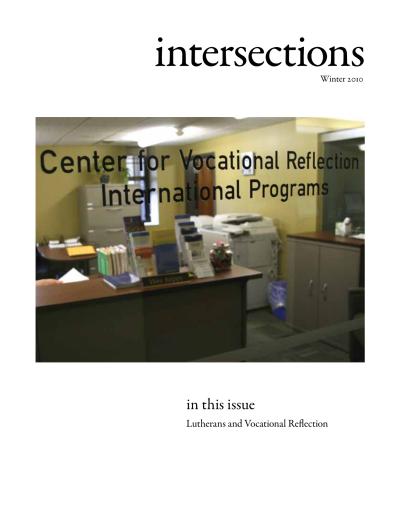
Haak describes Augustana’s Center for Vocational Reflection (CVR) and its threefold framework of skills/gifts/talents, passions/values, and needs of the community. He surveys the CVR’s Working with Faith group, seminary visits, spiritual companioning, Servant Leader Internships, international travel reflection, and the major Senior Inquiry curriculum revision—then reports the lessons learned at Augustana: that multiple exposures matter more than any single program, that the language of vocation works even for non-religious students, that student-initiated ideas (like Erin Blecha’s Athletes Giving Back) often succeed most, and that the CVR will soon merge into a new Community Engagement Center.
-
 Editorial
From the Publisher
James M. Unglaube
No. 2 · Winter 1997
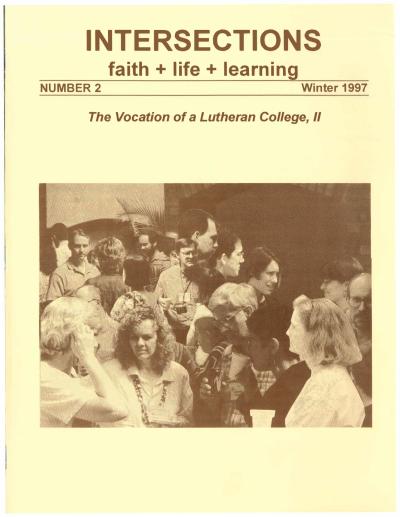
Unglaube reports on the second annual Vocation of a Lutheran College conference of August 1996, where Walter Bouman of Trinity Lutheran Seminary addressed “What is Lutheran; What is the Lutheran Tradition” (biblical, catholic, evangelical, sacramental, world-affirming—the world “received, enjoyed, served as God’s Gift”). He previews presentations by Wendy McCredie of Texas Lutheran and Baird Tipson of Wittenberg on how the Lutheran tradition is embodied in its colleges, and Bob Vogel’s challenge in “Coherence—And Now what?” that the tradition comes to life in how faculty give expression to their beliefs and values in the classroom and with colleagues.
-
 Editorial
From the Publisher
Lamont Anthony Wells
No. 62 · Fall 2025
5 min audio
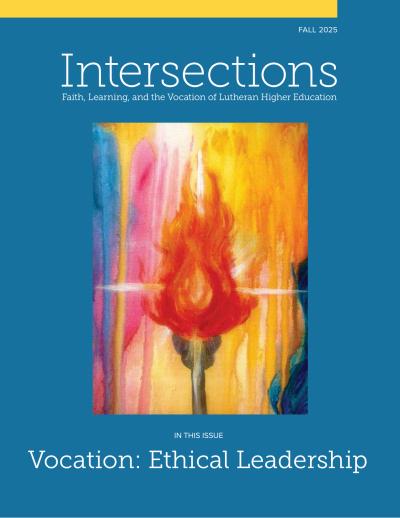
Wells frames the issue as a record of the 2025 VLHE Conference at Augsburg under the theme “Ethical Leadership in a Changing World,” arguing that vocation is never solitary but a collective, public witness of ethical formation, theology and care, flourishing and belonging, and leadership rooted in God’s grace.
-
 Article
Community-Building On Campus and Beyond
Krista E. Hughes
No. 54 · Fall 2021
Hughes describes Newberry College’s effort to build a “culture of community” that mirrors South Carolina’s demographics while reckoning with the institution’s founding ties to slavery — and names the challenges and promising city-college collaborations that shape this ongoing work.
-
Article
Ethical Leadership for a Changing World: A Shared Calling from Cradle to Career
Cory Newman, Janelle Rozek Hooper
No. 62 · Fall 2025
5 min audio
Hooper and Newman recount how an ELCA Barna survey on early childhood education sparked the realization at VLHE 2025 that ELCA colleges and the 1,200 Lutheran schools and early learning centers share identical challenges — and an untapped potential to form ethical leaders across the full educational continuum from cradle to career.
-
 Article
The Responsible Professional: Vocation and Economic Life
Martha E. Stortz, Tom Morgan
No. 51 · Spring 2020
Stortz and Morgan argue that the “value-added” of Lutheran higher education is a responsibility ethic — one that frames the professional as a first responder “called and empowered to serve the neighbor so that all may flourish” — and unpack the four criteria of the 1999 ELCA social statement Sufficient, Sustainable Livelihood for All as a framework for economic deliberation.