Chief Diversity Officer, Disrupter
Much of my role as a diversity, equity, and inclusion professional is that of a disrupter. That term is nowhere in the leadership profile that has drawn me to the various positions that I have held over the past two decades, or in my current job description as Vice President for Diversity, Equity and Inclusion at Augustana College. A disrupter of what? A disrupter of patterns, processes, and systems that are barriers to change.
Prior to working in higher education, I was a social worker employed by the largest public child welfare agency in the wealthiest county of a state on the east coast. The families for whom I provided services were some of the most vulnerable in the United States. These were poor families with young children. Not only were their resources limited, but also the communities where they lived were under-resourced. Yet, they were expected to meet the needs of their children according to a social standard that did not recognize the vulnerabilities inherent in these communities.
The roles of a social worker are vast—mediator, advocate, counselor, case manager, investigator, broker, educator, facilitator, organizer, manager. Over the span of a decade, I performed and fulfilled these roles multiple times over. Much of what I did as a social worker and now as a chief diversity officer (CDO) was to disrupt detrimental patterns. Sometimes the patterns prevented parents from meeting the needs of their children. Too often, I recognized that the processes employed by the systems allegedly helping these families preserved the detrimental patterns that needed disrupting. The very systems that were supposed to be helpful were in fact barriers to attaining the goal. Organizations, programs, and systems only work as well as those people who represent them.
Diversity Happens
The United States Census Bureau projects that within the next 25 years nearly half of all Americans will belong to a minority group.
The Public School Review reported in September of 2018 that non-Hispanic white students are now the numerical minority in public schools (49.7 percent), a decline by 15 percent since 1997. In that same period, the number of Hispanic students has grown by 50 percent to 12.9 million, and the number of Asian students has increased significantly as well (46 percent to 2.9million). The African American student population has remained relatively steady over the last 20 years, at 7.7 million in Fall 2018 (Pew Reports).
In March 2019, Race and Ethnicity in Higher Education: A Status Report was released by the American Council on Education. The report noted that “the student population in U.S. higher education is more diverse than ever” (ACE). In 1996, students of color made up 29.6 percent of the undergraduate student population: that percentage increased to 45.2 percent in 2016. The percentage of graduate students of color increased in the same period as well—from 20.8 to 32.0 percent. According to the report, however, “despite these gains, many areas of higher education continue to underserve and underrepresent students of color” (ACE, emphasis added). While the racial and ethnic makeup of students in higher education has become more and more diverse, faculty, staff, and administrators remain predominantly white, with nearly three quarters (73.2 percent) of full-time faculty identifying as white (ACE).
In September 2018, the Hechinger Report noted that “the college-going population will drop by 15 percent between 2025 and 2029 and continue to decline by another percentage point or two thereafter” (Barshay). This is referred to as the demographic decline. Given the decline (which will affect nearly all 4-year institutions, especially privates), students who will be most available for college will be students of color—the very students who are currently underrepresented and underserved and whose rate of persistence through graduation is currently lower than non-Hispanic whites.
Students who will be most available for college will be students of color—the very students who are currently underrepresented and underserved and whose rate of persistence through graduation is currently lower than non-Hispanic whites.
And we are already seeing the impact this has on higher education. The student body at historically white, persistently white, and predominantly white colleges and universities is more diverse than ever before. This trend will certainly continue, at least at those institutions that are interested in remaining relevant. Especially in light of the United States’ political climate and the social realities of our communities, higher education must recognize the realities of race and culture and the experiences of students of color—again, if we are to remain relevant.
Of course, diversity encompasses much more than race and ethnicity. Sex, nationality, gender, gender identity and expression, ability, religion and belief systems, age, socio-economic status, and sexual orientation—all of these are characteristics of diversity. People are diverse. I focus on race and ethnicity here because of the above demographic projections that impact higher education and because racism is prevalent in colleges and universities.
Think about the history of your institution. Who created it? For whom was it created? When you consider the history of the Lutheran institutions, racial exclusion is embedded in that history—as difficult as that is to admit. Among the many demographic diversities, race is the most visible. And yet, it is also at the greatest risk of being erased in our institutional discussions and ignored in our policies, practices, and procedures.
These statistics highlight the fact that diversity will happen—indeed, it has already happened. Inclusion, however, is not automatic. Inclusion is a choice.
Inclusion is a Choice
Colleges are a reflection of United States society. Consequently, colleges, too, suffer the effects of our turbulent history and poor race relations. Unfortunately, poor race relations mark not only our history but also our present and threaten to continue in our future.
Enrollment at Historically Black Colleges and Universities (HBCUs) is on the rise. According to the National Center for Education Statistics, total enrollment in fall 2017 was 298,138—an increase of 2.1 percent over the previous year. The increase occurred even as enrollments across the nation continued to decline. In the previous six years, HBCU enrollment at HBCUs dropped (beginning 2011) until reaching a fifteen year low in 2016. To what can the increase be contributed? Analysts suggest that setbacks in national race relations and the desire of students of color to learn in safe and nurturing environments have played roles. (Washington and Gasman).
Despite the financial challenges, students are still going to college. Why these colleges? What are they doing? HBCUs are more closely connected with the issues that black and brown students face and are equipped to assist in responding. It would seem that students of color establish their own social and academic environment when they do not feel accepted by the majority culture. They attempt to achieve unity with other black students to combat racism.
Surely, this is one of the reasons that HBCU student populations are on the rise since the parallel rise of Black Lives Matter. Students seek support in comfortable places. On historically white and persistently white campuses, students of color typically find a niche in the campus’s corners, in certain offices, and participate in programs created for “them”. Studies on the value of afrocentric experiences in constructing comfort zones at persistently white colleges and universities (PWCUs) reveals that 90 percent of the students of color were strongly in favor of an identifiable black community to support them academically and socially and to contribute to their ethnic identity development. This presents a major issue for PWCUs. They are after all PWCUs by historical design and current circumstances. There just don’t seem to be enough black and brown employees to create the kind of accepting, nurturing, supportive environment that students of color find in HBCUs.
Many of us posit that higher education is or should be a transformative experience. I argue that for students of color at PWCUs, their expectation is that the institution will transform to meet their needs so that they can thrive, so that they can embrace the academic experience without the distractions and damage that microaggressions cause. They do not want to feel tokenized, to be repeatedly involved in pilot programs, or invited to participate in ways that benefit the institution more than they benefit the student. They want and need to see themselves and hear the voices of those who look like them in course content, at the front of the classroom, and in co-curricular leadership. They hunger for their identities to be affirmed so that they can consider their vocations, rather than merely surviving the college experience.
They hunger for their identities to be affirmed so that they can consider their vocations, rather than merely surviving the college experience.
What can historically, predominantly, and persistently white colleges and universities learn from HBCUs to better meet the needs of students of color? We must look for ways to involve underrepresented minority students. How can we get them involved? What should we do? When we employ inclusive practices, their involvement will naturally increase.
Toward Inclusive Excellence
Inclusive excellence in higher education requires educators and campus administrators to ask whether “underserved students are experiencing the most empowering forms of learning and whether they are successfully achieving the knowledge, adaptive skills, and hands-on experiences that prepare them to apply their learning to new settings, emergent problems, and evolving roles” (AACU, Committing 7).
Inclusive excellence is a comprehensive approach that requires a fundamental transformation of the organization by infusing inclusion in every effort, aspect, and level of the organization (AACU, Committing 7). This requires active, intentional, and continual engagement with diversity throughout the organization—in any place where people might connect (AACU, Making). In short, inclusive excellence is the approach used to expose and address the barriers to institutional equity. It involves the recognition that an organization’s success is dependent on how well it values, engages, and includes a rich diversity of constituents.
Inclusive excellence is a comprehensive approach that requires a fundamental transformation of the organization by infusing inclusion in every effort, aspect, and level of the organization.
How does your organization show that it values diversity? How does your organization engage—that is, intentionally include—individuals and cultures)?
The work of the Chief Diversity Officer is far-reaching and encompasses a wide range of social identities, focal groups, and core areas (Worthington). Those same dimensions—different diversities or social realities, focal groups (or different constituents), and the core areas or work of the college—also help structure opportunities for institutional change itself, as depicted in Figure 1.
As noted earlier, inclusive excellence requires active, intentional, and continual engagement with diversity throughout the organization, in any place where people might connect—make that every place! Opportunities for inclusion are abundant throughout the institution. Traditionally, it was “minority offices” that provided the perspectives and practices related to diversity and inclusion. While this method proved to be effective decades ago, it is no longer an effective model. Core areas throughout the institution should be targeted for inclusion. Opportunities for change must target all of the key focal groups (See Figure 1). Colleges and universities must do more to engage underrepresented students and employees. They must also do better with the current resources allotted for targeting underrepresented students. Assessment of the effectiveness of existing programs is essential to determining progress on strategic goals.
Inclusion is a choice. Inclusive excellence must involve institutional change, which constitutes change in the ideas that govern institutions (Halal). If the institution’s practices have not evolved toward understanding underrepresented cultures, ensuring access to positions throughout the organization, and expanding the environment to create a more inclusive climate—one that embraces the needs and the humanity of underrepresented persons—then the ideas that govern the institution are still barriers toward institutional change.
What follows are some key changes that must be made if an institution is to strive for inclusive excellence. The list is not an exhaustive, but it can serve as a guide toward becoming more inclusive. The first three work from the premise that representation matters and that visibility matters.
Diversify Faculty
Other than coaches, faculty spend the most time with students during their years at college. Faculty have the greatest influence on the student body. They shape students’ learning by assigning reading material and assignments, and by identifying important aspects of the discipline(s). They help students to determine what is important and to think critically about tough topics. They prepare students for productive citizenship and job readiness. Students need to see themselves at the head of the classroom. Diversify the faculty.
Diversify Staff
Similarly, since the entire institution comprises the learning environment, students need to see representation across campus. At predominantly white institutions, racial and ethnic affiliation is obvious for students of color. Non-Hispanic white students see themselves throughout the campus—from the admissions process to athletics and other extra curriculars, to residence halls, financial aid, counseling offices, tutoring centers, and other student support offices. For non-Hispanic white students role models are everywhere, given the typical demographic composition of a historically and persistently white institution. Students of color at these institutions do not experience this unintended but still added benefit.
When students see themselves in professional positions, they can imagine themselves in, and aspire to, those positions. Currently, underrepresented students at most of our Lutheran colleges and universities have more of a chance to see themselves in areas where persons have not earned a degree than those offices where degrees are required. We must offer all students the similar benefit of role models on our campuses.
For first generation students, in particular, many have little idea of all of the doors their liberal arts degree can open for them. When students are able to see people of similar racial/ethnic identities and similar backgrounds in professional roles, they are affirmed. They can imagine their future; they also have someone they need to chat with who understands their plight. Those of us who graduated from liberal arts colleges know the possibilities. We must now implement practices that will inspire all and equalize access.
Infuse Diversity into the Curriculum
Infusing diversity in the curriculum offers students opportunities to discuss difficult topics and enhances skills necessary to address social realities. Many colleges are using courses to explore cultures and emphasize differing worldviews. The Association of American Colleges and Universities recognizes this as a high impact practice (AACU, High-Impact). There are many benefits of an inclusive curriculum. It affirms and normalizes many dynamics in the lived experience of underrepresented students on persistently white campuses. Non-Hispanic white students are also exposed to the realities of difference—to the power and privilege—attached to race and ethnicity in the United States and around the world. The educational benefits of an inclusive curriculum empower all students, with some level of competence, to engage in our diverse and changing world. Finally, exposure to an inclusive curriculum helps to develop skills necessary for the diverse workplaces student will enter. These skills are an added advantage when seeking employment. Employers seek culturally competent employees (Szrom).
Exposure to an inclusive curriculum helps to develop skills necessary for the diverse workplaces student will enter.
Invest in Learning
Students make a great investment to get a college education. Colleges must make a similar investment to ensure that the students’ learning is relevant, useful, and prepares them for society and the work force. Professional development is important. I have lost count of the amount of times a participant in a seminar or workshop has admitted that they don’t know “what to do with, about, or for” underrepresented students. They don’t know how to address issues such as slavery, systemic racism, and situations these students face. These weaknesses come from professionals who represent every facet of the college.
What is disappointing to me is that we allow professionals to continue to work with students without having the skills to engage, partner with, guide, and promote success for underrepresented students/students of color. Dare I say, we would not allow this lack of knowledge in any other area or for the bulk of our student body. Why do we accept lack knowledge around the culture and needs of underrepresented students? Don’t answer that! Just think on it.
We allow professionals to continue to work with students without having the skills to engage, partner with, guide, and promote success for underrepresented students.
There is a massive learning curve here. What will we do about the deficit of knowledge related to diverse populations? Answering that question gets us to where we want to go. Professional development is necessary. We must create opportunities for employees to learn about the populations they serve, as well as their co-workers. It goes without saying that colleges must sustain those programs and practices that are already effective and improve those that are ineffective.
Draw on Senior Leadership
Senior leaders must invest in the process of transforming the institution. Institutional change will not occur unless senior leaders shepherd the process. Senior leaders must practice inclusive leadership. They must understand diversity, equity, and inclusion and value each. They must explicitly recognize and support this work. They must include DEI goals as strategic pillars to institutional success and outline a clear plan to address and accomplish these goals. They must invest time to assess the institution’s relationship with diversity and its courage to identify barriers to inclusion. Finally, they must free up adequate resources to address the barriers, assess progress, and otherwise strive for inclusive excellence.
Conclusion
Inclusive practices do not come easily. They must be learned. There must be a thirst for cross-cultural learning that leads one to value cultural differences. While all of these suggestions (and others) are important, I cannot say enough about the importance of learning. When institutional leaders commit themselves to cross cultural learning, there will be less dependence on underrepresented students who are willing to call out institutional deficiencies and who then find themselves in situations where they are educating (or pleading with) administrators to transform the institution.
Inclusion must be an institutional value. I would posit that issues around diversity, equity, and inclusion might be the biggest challenge to our institutions, but also the most powerful driver of institutional change. Diversity motivates change. And inclusion is the evidence of it.
Works Cited
AACU (American Association of Colleges and Universities). Committing to Equity and Inclusive Excellence: A Campus Guide for Self-Study and Planning, 2015. Accessed 1 Oct. 2019, www.aacu.org/sites/default/files/CommittingtoEquityInclusiveExcellence.pdf
———. High-Impact Educational Practices, 2008. Accessed 1 Oct. 2019, www.aacu.org/leap/hips
———. Making Excellence Inclusive, 2012. Accessed 1 Oct. 2019, www.aacu.org/making-excellence-inclusive
ACE (American Council on Education). “Race and Ethnicity in Higher Education: A Status Report.” Accessed 1 October 2019, www.acenet.edu/Research-Insights/Pages/Race-and-Ethnicity-in-Higher-Education.aspx
Barshay, Jill. “College student predicted to fall by more than 15% after the year 2025.” The Hechinger Report, September 10, 2018. Accessed 1 Oct., 2019, https://hechingerreport.org/college-students-predicted-to-fall-by-more-than-15-after-the-year-2025/
Halal, Bill. “Institutional Change: A Higher Level Approach to Management Progress.” George Washington University, 2004.
Pew Reports. A Profile of Hispanic Public School Students, August 26, 2008. Accessed 1 Oct., 2019, www.pewresearch.org/hispanic/2008/08/26/one-in-five-and-growing-fast-a-profile-of-hispanic-public-school-students/
Szom, Madeline. “Why Cultural Competence Matters to Recruiters.” Insight into Diversity, February 10, 2016. Accessed 1 Oct. 2019, https://www.insightintodiversity.com/why-cultural-competence-matters-to-recruiters/
Washington, Amanda and Marybeth Gasman. “Why enrollment is increasing at HBCUs.” The Hill, August 22, 2016. Accessed 1 Oct., 2019, https://thehill.com/blogs/pundits-blog/education/292245-why-enrollment-is-increasing-at-hbcus
Worthington, R.L. “Advancing Scholarship for the Diversity Imperative in Higher Education: An Editorial.” Journal of Diversity in Higher Education 5.1 (2012): 1-7.
-
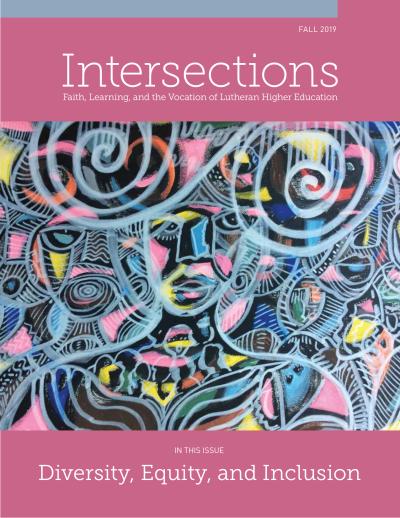 Editorial
From the Publisher
Mark Wilhelm
Wilhelm frames the issue by noting that a federal court’s vindication of Harvard’s race-conscious admissions process is a win for higher education’s commitments to diversity, equity, and inclusion — and argues that for Lutheran higher education, the commitment to diversity is an old and foundational claim, rooted in Christianity’s openness to all and reflected in the four diverse gospels of the New Testament.
-
Editorial
From the Editor
Jason A. Mahn
Mahn opens with Lenny Duncan’s observation that the ELCA is 96 percent white — the whitest denomination in the U.S. — and asks how teachers and administrators at historically, predominantly, and persistently white institutions can turn from white privilege and white supremacy toward spaces where people of color thrive and white people are re-formed into antiracist allies.
-
Article
The Perils and Promise of Privilege
Guy Nave
Nave argues that privilege is always used in one of two ways — to preserve privilege by promoting inequity, or to challenge privilege by promoting diversity, inclusion, and equity — and uses examples from Indianapolis Catholic schools, Martin Luther, and equity-mindedness research to call Lutheran institutions to address the racist practices and policies that reproduce whiteness on their campuses.
-
Article
The Vocation of White People in a Racist Society
Caryn Riswold
Riswold proposes that whiteness is a weakness borne of apathy, atrophy, and ignorance — an atrophied muscle of race-consciousness — and offers concrete practices (reading, adjusting one’s gaze, consuming media differently, drawing on ELCA social statements like the repudiation of the Doctrine of Discovery) for exercising that muscle and naming the vocation of white people in a racist and white supremacist culture.
-
Article
Learning the Language of Inclusive Pedagogy
David Thompson
Thompson frames inclusive pedagogy as a foreign language with its own vocabulary, grammar, and cultural values, and reflects on a year of immersing himself in readings, conversations, and workshops — arguing that proficiency grows when instructors study and practice these languages repeatedly and atrophies when ignored.
-
Article
The "V" Word: Different Dimensions of Vocation in a Religiously Diverse Classroom
Martha E. Stortz
Stortz responds to a sea of blank stares when she used the word “vocation” in a religiously diverse required course by offering five metaphors — place, path, relationships, lens, and story — that point to different dimensions of vocation across the world’s religions and help students articulate their callings on their own terms.
-
Book Review
The American Myth of White Supremacy: A Review of Myths America Lives By
Susan VanZanten
VanZanten reviews Richard T. Hughes’s Myths America Lives By: White Supremacy and the Stories that Give Us Meaning, which argues that the United States grounds its identity in five myths — Chosen Nation, Nature’s Nation, Christian Nation, Millennial Nation, and Innocent Nation — all informed by the primal myth of white supremacy, and considers what Lutheran theological values can offer for resisting that myth.
-
Reflection
Seeing in a New Way: A Meditation
Kara Baylor
Baylor, the only Black campus pastor in the NECU, weaves Psalm 25, the parable of the Good Samaritan as re-read through Lenny Duncan, and the “crimson thread of divine justice” from Allen Dwight Callahan into a meditation that closes with the invitation she offered at the 2019 conference — to tie a crimson thread around the wrist as a symbol of collective commitment to moving beyond privilege toward inclusion and equity.
-
Article
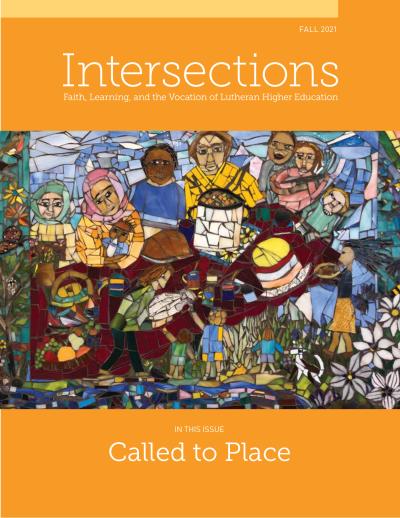
Conciliatory and Queer: The Radical Love of Lutheran Higher Education
Kiki Kosnick, Sharon Varallo
Kosnick and Varallo reflect in conversation on how Augustana’s Five Faith Commitments and its conciliatory ecumenical roots in the Augsburg Confession have given them — a non-binary queer first-generation faculty member and a twenty-one-year veteran — the “street cred” to act on radical love, build bridges to imprisoned and non-binary communities, and discover that Augustana is welcoming not despite the fact that it is Lutheran, but because of it.
-
 Article
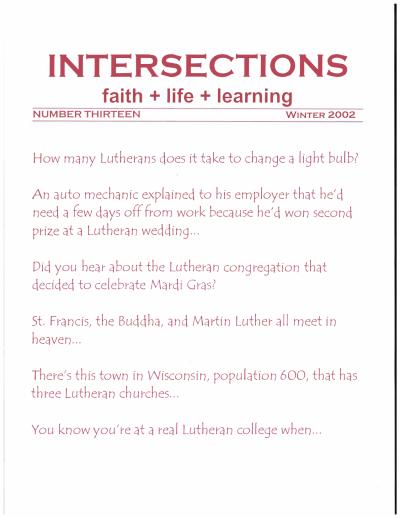
Freedom, Humor, and Community: A Lutheran Vision for Higher Education
Darrell Jodock
No. 13 · Winter 2002
Jodock’s inaugural lecture for the Bernhardson chair at Gustavus Adolphus develops three interlocking themes drawn from the Lutheran tradition as a deeper grounding for the liberal arts college than contemporary American assumptions. A sense of humor rests on Luther’s discovery that God takes the initiative—Luther could call himself a beggar, joke about the epistle of James, and credit Wittenberg beer for the Reformation—and underwrites the freedom of inquiry that John Updike traces to Grace Lutheran Sunday School in Shillington. Community, grounded in Augsburg Confession VII and Luther’s 1524 letter to the German city councils, makes the college a community of discourse pursuing wisdom rather than “the same old blockheads.” Freedom is both “freedom from” and “freedom for,” illustrated by Nechama Tec’s Polish Holocaust rescuers and by Jodock’s Holocaust-class corporate role-play in which students voted to build a factory in a death camp rather than risk losing their board seats—a vivid case for educating toward “a passion for justice.”
-
 Article
The Duty to Teach and Restore Bodily Autonomy: Reflections from the Classroom
Cynthia Richards
No. 57 · Spring 2023
Richards reflects on a Narrative Medicine course she taught at Wittenberg University in the wake of the Dobbs decision, in which students examined cultural “first recognitions” of the reproductive body and discovered that almost none had ever had a way of talking openly about their reproductive selves — an alienation she calls educators to address.
-
 Response
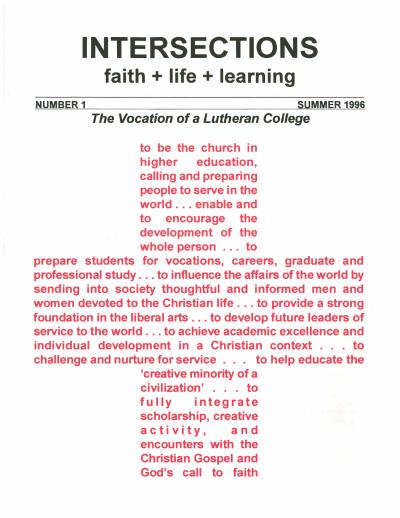
Lutheran Colleges: The Context for the Conversation
Thomas Templeton Taylor
No. 1 · Summer 1996
Taylor of Wittenberg engages Schwehn’s first argument by sketching the institutional predicament of Lutheran colleges through three converging forces: the collapse of differences among old-line Protestant groups in the wake of ELCA-era ecumenism (with Robert Wuthnow); the secularization of American higher education described by George Marsden; and the post-war decline of liberal arts colleges under pressure to professionalize. The result is an “in-between stage” in which Lutheran colleges retain rhetoric without substance. Following Richard John Neuhaus’s “Eleven Theses,” he argues that, for a time at least, Lutheran colleges’ institutional affiliations must remain actively Lutheran if they are to remain in any sense Christian.
-
 Article
Forming the Division for Access, Equity & Belonging at Susquehanna University
Amy Davis, Dena Salerno, María L. O. Muñoz, Nina Mandel, Scott Kershner
No. 59 · Spring 2024
Five Susquehanna University colleagues trace the institution’s 166-year arc from a Missionary Institute founded to remove barriers to education through the formation of a new Division for Access, Equity & Belonging in 2023, arguing that access rooted in Lutheran origins must continue to drive policy revision, infrastructure, and belonging for minoritized communities today.
-
 Article
Women Presidents in Higher Education: How They Experience Their Calling
Aimee Goldschmidt, Gary McLean, Katherine A. Tunheim
No. 42 · Fall 2015
Drawing on in-depth interviews with fifteen women college presidents and a transformative-learning-theory framework, Tunheim, McLean, and Goldschmidt trace a three-stage journey — identifying, interpreting, and pursuing the call — and ask what the language of vocation contributes to the preparation and mentoring of women leaders in higher education.
-
 Article
The University in the City of God: Beyond Dialectics and Rhetoric
Gregory A. Clark
No. 4 · Winter 1998
Clark, drawing on Alasdair MacIntyre’s Three Rival Versions of Moral Enquiry, distinguishes the preliberal, liberal, and postliberal university and argues that the liberal university’s pretense of dialectical neutrality has masked a particular rhetoric of its own. Following John Milbank’s Theology and Social Theory, he holds that every philosophy and institution is finally a rhetoric and that the church’s task is not to win on the secular university’s terms but to proclaim and embody an alternative city. The Christian college, then, should give up the apologetic pose of meeting secular reason halfway and instead practice the rhetoric of the gospel: a proclamation of Jesus, an enactment of Christian friendship and peace, and a willingness to be vulnerable to the violence of the world as Jesus was vulnerable to his own. Clark commends this stance to colleges related to the church.