You Don't Seem Angry: Methodological Confessions Of A Lutheran Lay-Woman
Intersections No. 5 · Summer 1998
Having just read my M.A. thesis study of four female abolitionists, a colleague puzzled, “You don’t seem angry.” This was in 1981. Women’s history was not at its beginnings, but it wasn’t mature either. The ERA’s ratification was still a possibility so the term post-feminist was still in the future and there wasn’t much talk of backlash. In my seminary classes there were more women than before, but still we were unusual enough to be noticed. I had been working as a volunteer advocate at a battered women’s shelter. In most places some women were angry and most had legitimate reasons to be at least a bit annoyed with society or people, institutions or the past. Learning to acknowledge and to express anger went contrary to the ideals for feminine behavior many women had learned. Nonetheless, anger was present in scholarly as well as popular writing, discussion and activity.
Why didn’t I seem angry as I recounted the lives of four extraordinary women whose lives were devoted to addressing the evil of slavery? Why didn’t I sound angry as I considered how their own lives echoed the limitations of slavery? Why wasn’t I angry as I realized that their lives were less than they might have been and that what they were had been ignored for so long? At the time I had a quick response. I noted that positive changes had been made. I suggested that the historian’s evaluation must look both to what has been achieved and to what is left to be done. Those were legitimate and even handed responses to my colleague’s question. At the time I was satisfied with them. I didn’t stop to ask if I really was angry without being able for various reasons to express that anger.
A Narrative Account of the Emergence of My Method
Now, a decade and a half later, I have a more complex response which must include asking if I am angry. In the years between I have earned a Ph.D. from the Divinity School of the University of Chicago; written lots of papers and read scores of books; taught hundreds of students; and engaged in unending conversations with colleagues. I have been angry about what I have read and have not been able to read, about what has been said to me, about not being heard, about things I have been asked to do, not allowed to do, and have done. The fault has been mine as well as others’. But when I listen to myself teach or to my contributions in conference discussions or read my own writing, I note that most of the time (there are exceptions), I still don’t seem angry. This is despite my judgment that life, now and in the past, is unfair and my conviction that anger would be an appropriate and justifiable response to that unfairness.
My activities in that fifteen years have also pressed me to be more reflective and self-conscious about my pre-suppositions as well as about my methods of study and interpretation. The University of Chicago is famous (if not infamous) for its obsession with methodological issues. My first quarter there I heard Martin Marty lecture on methods in the study of religion and read all the assigned books. While at Chicago, and forever afterwards if one is a graduate, scholars are expected to be articulate about their method. And feminists make a similar demand for honest disclosure of one’s own commitments.
Coming as I do from a confessional tradition both of these expectations seem reasonable, at least on one hand. On that hand, it is good to state clearly what one thinks and to give a good account of one’s faith, as Peter exhorts us. There is, however, another hand. (For Lutherans there is always another hand.) On that other hand I have reservations about salvation by methodology. It is possible to get the method clear and still to come to bad or wrong conclusions.
From the professor whose lectures on methods in the study of religion I heard I also heard a maxim that I have often quoted. He said, “If the people you are writing about don’t recognize themselves, you’ve missed them.” I understood him to mean that even if your method is impeccable and articulated in heavily footnoted, dense prose, it is possible to miss the subject of your work. This maxim has served me well. I added it to my earlier observation about evaluating in both directions and willingness to admit change for the better. Perhaps I was on my way to a method, even if it was something of an anti-method.
If I was, it produced the same result. When Marty wrote the preface to my study of women in the American Lutheran churches, he too noted, “this could have been a work inspired by anger. It is not.”1 Unlike my colleague, he was not puzzled by this. Rather he went on to say that the book (my book) “gives signs of care, or love.” And he suggested that the love manifests itself in patience. Marty, and anyone else who has spent more than an hour with me, knows that I am not naturally patient. And he admitted as much when he concluded the paragraph, “There must have been good restraint here.”
I got a job teaching students, many of them in their first year of college taking a required religion course that did not interest them much. Some of them got excited by the material; others stayed resentful. One of the later type taught me an important lesson about being a teacher. He came close to saying that his poor grade was my fault. He came so close to accusing me that I was compelled to examine myself to see if I was at fault, if he had come near to failing the course because I had failed him. (This sort of confession is also familiar to Lutherans.) Facing it straight on, looking at myself as clearly as I could, I found that I had not been without fault, but neither was my failure the sole cause of his. This was the moment in which I began to conceptualize my task as a teacher on analogy to a gymnastic spotter. The gymnast can be shown the moves and moved through them and caught when falling, but only the gymnast can perform the routine. The spotter can not be the gymnast. So I added to my method, take responsibility for what is yours, give others their own responsibility.
With graduate school friends I took part in an AAR session concerned with using autobiography as a source for studying women’s history. I read autobiographies by late 19th and early 20th century American women: Vida Scudder, Dorothy Day, and Pauli Murray. They were leaders in their churches, though in uncharted ways; they stayed in their churches, though in provisional ways. I read some contemporary women’s autobiographies and reflections on their own lives. And I wondered a good deal about why I was so attracted to this sort of material. In the midst of the reading, writing, and giving of the paper I realized that encountering ideas clothed in lives—in the particularities of lives presented by the living thinker of the ideas—both gave me better access to the ideas and imposed an ethical claim on me. Because the ideas were embodied in persons shaped by the world around them I could see where the ideas had come from. Seeing that and knowing the thinkers of the ideas was like being a friend to the authors. Yet another piece of this method emerged.
The participants in that session, the ones who were alive and reading papers, are part of a group of friends with whom I have been having an endless methodological conversation for all these years. It circles around a question about feminist scholarship. Can one be a feminist scholar without studying women? And if so, what would distinguish the scholar/ship as feminist. We have no claim on this question as our own. Our intense and episodic discussion has been informed by others whose work we have read or with whom we have talked. We wrote papers about this issue and gave them together in front of our peers.
In mine I spoke of being both a feminist and a denominational (Lutheran) historian.2 I considered the similarities in relationships of author, subjects, and audience. In the least developed section I tried to discern how being Lutheran influenced my historical work. I referred to my sense of vocation and I hinted that my understanding of simul justus et pecator might lay behind my willingness to measure both what has been accomplished and what remains to be done. But that was it. I couldn’t see more.
When I wrote that paper, and ever since, I have been chipping away at the task of writing a history of Lutherans in the United States. I’m trying to write it with a different plot, not the one about institutional mergers. This plot is to be about learning to live with diversity, inside and out. I want this to be a book about being Lutheran, not just about the Lutheran churches. And every day that I work on it I know that it won’t be all that I want it to be, nor will it be all that many potential readers are hoping for.
In this work I have been aided by teaching undergraduate students, many not Lutheran, few of whom will be historians, and by conversation with several colleagues. With one of them I have become engaged in a second endless, if episodic, conversation about Lutheran culture. We ask if there can be such a beast. We wonder if it would have to be more than one. We suggest what these Lutheran cultures might have in common. We recall our experiences as Lutherans who have lived both in the Midwest and on the west coast and who study what we are. And we wrote a paper together.3 We really wrote it together. Some of the words are his; some are mine. Some of the ideas are mine; some are his. In some places I can tell which are which because we disagreed or because his language is more sophisticated than mine or because we captured the dialogue. In other places I’ve forgotten which is which.
In the last months, the connections between being Lutheran and how I do my work have come clearer and I can see more. The connections may still be like trees walking, but I can describe them. Three events have been crucial: the ELCA Convocation of Teaching Theologians, teaching a seminar on Christian Women in the Third World, and the Lutheran Women’s Pre-meeting of the AAR/SBL. The topic of the first was pluralism.4 In the second I have been challenged by the witness of careful readers of the Bible whose starting points are other than my own. At the third I heard fertile discussion of papers in which Luther is read with unexpected partners, Mary Daly and feminist philosophy of science among them.5 One tender fruit is my “sudden” ability to articulate my method, to say why I hope not to seem (or to be) angry.
A More Explicit Discussion of the Method that Emerged
This method grows out of four Lutheran themes as they interact with one another. Although explanation requires that I present them in series and in a specific order, in practice all operate simultaneously and require one another. Together these four inform, and have long before I could say how, my approach to my work as scholar and teacher. Each theme might be taken to imply, or to generate, a step in the process of “interpretation.” However, that is not to suggest that the goal of understanding is achieved by mechanically following a method. That would be counter to the first theme. And, in so far as understanding is finally a miracle (a gift of God’s grace, though not a saving gift), I’m not at all sure that I’m willing to suggest that any human effort is alone enough for achieving it. Already my confession is mixed in with my method. The mixture will continue.
I. The first theme is original sin, a doctrine not much in favor among moderns living and thinking in the post-modern age. Neither are Americans in general nor feminists in particular fond of this teaching which posits a profound crack cutting through all of God’s good creation. Perhaps one evidence of such sin in me is the tenacity with which I cling to the notion. I hope that I do not do so naively. I am aware of how sin has been characterized in ways that have hurt women and I know that humans have connived ways to point to the speck in one another’s eyes without tending to the log in their own. I have done it myself. Nonetheless, I am convinced by several witnesses—the Bible, history, and my own experience among them—that the world is flawed in fundamental ways that humans can not repair by our own effort.
In a larger systematic matrix the move from assertion of original sin is to questions of Christology and soteriology. But this is not a discussion of the whole of Christian teaching, it is a discussion of one Lutheran laywoman’s method. And here the implication of recognizing the pervasive stain of original sin is simply the corollary that no interpretation is ever perfect. All interpretations are flawed by our shared state of sinfulness, by the limitations of our specific circumstances, and by the ways that sin inhibits our ability to understand one another.
Thus I assume that no reading of the Bible, or of historical evidence, or of the world today is ever perfect. This assumption requires an unwillingness to accept any particular reading as the final reading. This may seem a likely support for a hermeneutics of suspicion, but I intend rather caution. That is the attitude to be practiced not only toward others’ interpretations, but also toward my own which is also flawed by the same forces. Perhaps this might be called the step of caution and humility.
II. The second step comes from Luther’s Small Catechism, his explanation of the eighth commandment. This commandment may not spring directly to mind as what it prohibits is not a temptation much on our minds. “You shall not bear false witness against your neighbor.” Luther does not limit this commandment to plagiarism. In typical fashion he begins his explanation with the injunction to fear and love God and then turns the negative restriction into a wider ranging exhortation to positive action. That action includes defending the neighbor, speaking well, and explaining the neighbor’s actions “in the kindest way.”
Now, how can this be? If sin is so pervasive, aren’t these actions of my neighbor likely to be ill conceived and perhaps even evil? Indeed. But here we are urged first to depend upon God ourselves and then to see others with divine eyes. It is true that no interpretation is ever perfect and no action or motive is ever pure. Mine included. In the marketplace this leads to the warning, “Let the buyer beware.” We expect that the seller will try to cheat us by offering inferior or dangerous goods.
In the marketplace of ideas and interpretation, however there is a second move. After caution and humility must come generosity and forgiveness. These attitudes are no more popular in the academy than in the world at large. Yes, we can find the occasional, exemplary figure who truly is “a gentleman and a scholar.” But enough graduate students have been told to go for the jugular when they diagnose weakness in someone else’s work, or have left the seminar room bleeding, to convince me that urging generosity and forgiveness will sound odd.
Nonetheless, I am even more convinced that if all our understandings are cracked, we must be kind toward one another and gently bind up what is broken. A method beginning with original sin will recognize that humans (scholars included) come to their work with less than honorable motives and that the work that results is flawed and can be toxic. But if the next step is to obey the eighth commandment, then my method must also allow that the motives are mixed and can include honorable ones. Further it strives to attribute the best possible motives and to find the most true and useful reading of the work. Both imperfection and value are acknowledged in others’ work as well as in my own.
III. This mention of others moves to the third theme. In the Catechism the Christian is oriented (that is to say turned) toward the neighbor. So too in On the Freedom of a Christian where Luther relocates good works. They are no longer an effort to attract God’s favorable notice, but rather a grateful response to gracious divine action. As response these works are done in God’s presence but directed toward the neighbor in whom one sees Christ and for whom one reflects Christ. Seeing Christ in the neighbor is both a call to attend to the neighbors’ needs as to Christ’s own and an opportunity to learn of God.
In both ways the neighbor has a claim on me: to humbly offer the best, though imperfect interpretation I can make and to generously receive my neighbor’s best, though also imperfect interpretation. The inevitability of imperfection in all interpretations combines with this orientation towards neighbor and allows me to see the necessary, corrective social dimension to interpretation of the Bible, history, or the world around me. Neighborly cooperation in the task will not achieve a perfect interpretation; nor can it overcome the reality of sin. But the exhortation to see Christ in my neighbor, to attend to my neighbor’s needs, to be myself a “little Christ” compels me to try to overcome the distortions that sin creates between us and to work together for a more adequate, though still imperfect, interpretation.
IV. Then comes the question, what shall I (or now we) do with this work of the best, but still flawed, interpretation we can make together? The fourth theme is vocation—the call God makes to me to use what I have been given for the benefit of others. Perhaps this is merely re-sounding the third theme, the turn toward neighbor. Certainly it is the neighbor to whose benefit my gifts are to be used. Still, I think that there is more to be said about interpretation as a specific articulation of the common call to discipleship.
To place interpretation in the frame of calling is to locate authority with God in whose work I am delegated to participate. I am responsible in my work not only to my inner self, or even to my human community, but also to the one who is Truth. Both of these consequences increase the weight of the task and could prompt me to flee with Jonah onto a boat heading away from Nineveh. I am enabled to stay on shore when I recall that the calling comes after divine grace, not before. Further the calling that comes with, but after, grace is far larger and more encompassing than reading texts and trying to make sense of them. The fearsomeness of the task of interpretation is reduced when I recognize that there is other work to be done. Feeding the hungry, healing the sick, and visiting the lonely ground this heady, ephemeral work in embodied and immediate work. This is all the work of discipleship, of following after Jesus to the places where he intends to go. And it is all done in the odd time described as already, but not yet, a time of incompletion and imperfection longing for that which is not yet but will be.
Applying This Method
The true test of any method is in its application to specific cases. And mine is no exception. Even to write abstractly about how it might be applied is a step away from what needs to be done. Nonetheless, something must be said about how it might be done. I think that this simple method can be applied in almost any circumstance from reading a text to conducting a class. It works with the biblical texts, with theology, and with historical documents. No doubt its most vulnerable spots are precisely in its confessional grounding. I can not say if it will serve as well without that rootage.
I do know that these themes and their related steps under gird my approach to history and inform my understanding of Lutheran higher education. When I read about the past and humans in it I assume that they were flawed in common human ways and in ways specific to their time and place. I expect that their own testimony about their actions and thoughts are limited by those flaws and that my reading of their testimony is flawed in similar ways. I must come to them, their times, and their lives with caution and humility.
On the other hand, if I am to read, think, and write I can not be paralyzed by suspicions. Rather I resolve to not bear false witness against these folks, most of them dead and thus intensely vulnerable to the power of my interpretation. I look for their best hopes, their best actions. I allow them the limits of their circumstances and take account of those as I consider that for which they can be held responsible. I attempt to be generous and forgiving about what they did wrong so that I don’t miss what they did right.
If I am able to see both their imperfections and their contributions, I am able to learn from and with them. Building on their work, I endeavor to move a bit closer to a more adequate understanding of this world we share, even across the barriers of time. And I do this not solely for my personal pleasure or professional advancement. I am responsible in my work to God who is the source of life and is beyond time. What I learn must be of use to my neighbor.
The convictions behind this method, which I articulate in the language of four Lutheran themes, also stand behind my work as a teacher in a college associated with a Lutheran church. I find that a profound notion of the pervasiveness and depth of original sin is a realistic beginning for participation in any institution and especially for a college where our temptations are so often concerned with self-promotion or protection. Moreover, to be engaged in education requires that one regard the world and one’s students as lacking in some way. If they were not, what is the job about? But I must not face colleagues or students self-righteously, without an equal sense of the depth of my own fatal flaw. The task of education begins with caution and humility.6
On the other hand, if I am to learn and to teach I can not be overcome with despair. Rather I resolve to not bear false witness against colleagues, or students, or the people we study together. We are all alike in that we are imperfect and we need one another’s generosity and forgiveness. If I fail in this I will miss what these others have to offer and I will discover that they become increasingly unable to receive what I offer them. We all become the poorer, more ignorant, and to be pitied.
Claiming this commonality of imperfection and insight might go a long way toward overcoming the chasms widened by our polite unwillingness to speak for, or even hope to understand the speech of, someone unlike ourselves. For all the salutary benefits we have received by listening to formerly excluded voices, we have not helped ourselves if we replace one sort of privilege for another. One of the joys of having neighbors is the opportunity to share and to exchange. I borrow an egg from you; you enjoy my flowers’ scent; we use your snow-blower to clean both driveways. The interaction is not without caution or without generosity. It changes lives, but we do not move in together and become one family. So too in the classroom. My students and I are compelled to look to our “neighbors”, in person and on the page, with the hope that we will learn from them and the expectation that some of what we learn comes from the familiar and some from the difference.
What we learn does not stay in the classroom or on the campus. My college urges its graduates to “lives of worth and service.” The task of interpretation—of doing history, of studying, of learning—is not an end in itself; rather all that is done with the gifts God has given is returned by use for the benefit of others. Finally my method is the expression of my world view. It is my response to God’s calling. I hope that in my work I turn toward my neighbor with humility and generosity as well as with caution and forgiveness. If I am angry, may it be the anger of grief at my failures, not rage against what can not be changed.
Notes
1. L. DeAne Lagerquist, From Our Mothers’ Arms: A History of Women in the American Lutheran Church (Minneapolis: Augsburg Publishing House, 1987).
2. Published as “Who I Am and What I Do” in The Cresset (March 1993).
3. Michael Aune and L. DeAne Lagerquist, “Desperately Seeking Culture: Is There American Lutheran Culture?,” RRNSSSR 1996.
4. “Martin Luther in Feminist Focus,” Currents in Theology and Mission Feb. 1997, Vol. 24, No. 1.
5. “Pluralism: Promise and Problem,” Currents in Theology and Mission October 1997, Vol. 24, No. 5.
6. Mark Schwehn writes about the cultivation of virtues in the work of teaching. In particular he addresses the need for humility. Exiles From Eden (New York: Oxford University Press, 1993), p. 44–65.
-
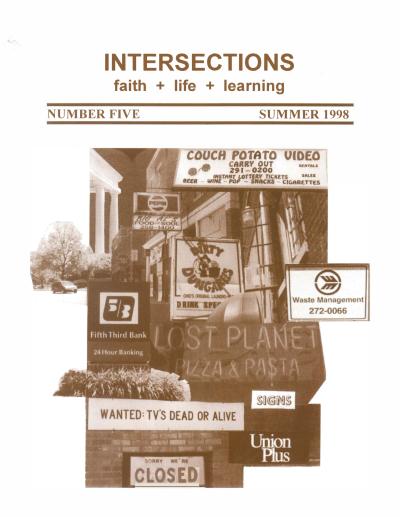 Editorial
From the Publisher
W. Robert Sorensen
Sorenson frames Intersections and the Vocation of a Lutheran College Conference as vehicles for widening the scope of inquiry that the separation of mind from spirit has curtailed, citing Ernest Boyer on probing “the deep places of the mind and the deep longings of the human spirit.” He previews an announcement at the 1998 conference of the Conrad Bergendoff Series—named for the late scholar and former Augustana College president—whose first volume, by Ernest Simmons of Concordia College, will support an Academy of Scholars in Lutheran Higher Education.
-
Editorial
From the Editor
Tom Christenson
Christenson introduces the issue as an illustration of the diversity of interests Intersections aims for, surveys the contents (Lagerquist on method, Mori on art and ritual, Baer on falling walls, Bergendoff as memorial, Funk and Powell in dialogue), urges readers to send in “your good stuff,” asks for distribution feedback, and closes with a sabbatical-year reading list—Kieran Egan, Robert Coles, Daniel Kemmis, David W. Gill, Sallie McFague, Roger Scruton, E.M. Adams, Freeman Dyson, Colamosca and Wolman, Gribbin and Goodwin, van Wyk, Wislawa Szymborska, and Flannery O’Connor.
-
Article
Redemption Through Imperfection
Kyoko Mori
Mori, drawing on a visit to the Philadelphia Museum of Art with a friend, contrasts Marcel Duchamp’s Étant donnés—a peephole work whose mysterious motion sweeps every viewer into a shared, perpetual performance—with the static, glass-encased Liberty Bell as parody of spiritual experience. She extends the contrast into a meditation on rituals (comfort and consolation) versus art (truth, however painful), and on writing as a redemptive process that moves from orderly first drafts toward chaos and deeper, frightening truth—closing with master potters who skewed each finished vessel slightly so that art and decoration could be told apart. Parts are excerpted from Polite Lies (Holt 1997).
-
Reflection
A Community That Connects
Conrad Bergendoff
Excerpts from Conrad Bergendoff’s 1990 address at the opening of Augustana’s new library, prepared by David Crowe and published here as a memorial after Bergendoff’s death in December 1997. Bergendoff—Augustana class of 1915, president 1936–1962—recounts eighty years of Augustana memories, insists that “size is pretty much within you, not outside of you,” traces the institution’s bonds to Uppsala from 1860 (and the 1910 visit of the Rector Magnificat), and celebrates Augustana’s graduates “in practically every part of the world” as evidence that a small school can have a universal output.
-
Reflection
Walls: Talk At Gustavus Adolphus College
Elizabeth Baer
Baer’s September 11, 1997 Gustavus Adolphus chapel homily on Joshua 6 turns from the trumpets to the walls—Robert Frost’s “Mending Walls,” the walls of the Warsaw ghetto in Vladka Meed’s On Both Sides of the Wall and Margaret Zassenhaus’s Walls, the Berlin Wall coming down in 1989—and then to the autobiographical, intertextual discourse of Gustavus chapel itself as a place where misunderstandings come down. An author’s note added after the March 29 F3 tornado reports the closing line (“LET’S MAKE THOSE WALLS COME TUMBLING DOWN”) as eerily prescient: roofs, windows, and 90% of campus trees were lost, but the Chapel walls and the eternal flame in the red glass lantern stood firm.
-
Article
The Quest Of The Historical Jesus: Problem & Promise
Robert W. Funk
Funk, founder of the Jesus Seminar, frames the quest as the search for reliable data amid twenty-two ancient gospels and as a confrontation among three “parties”—the Jesus Party, the Apostolic Party, and the Bible Party. He surveys the Seminar’s 1985–1998 work (The Five Gospels, The Acts of Jesus, the color-coded reports), defends the synoptics over John, the priority of Mark, the Sayings Gospel Q and the Gospel of Thomas, and argues that a recovered Jesus—a teacher of a trust ethic, celebration, a kingdom without social barriers, a society without brokers, without cult rituals—may serve as catalyst for a sweeping third-millennium reformation that purges the “clogged arteries” of institutional Christianity.
-
Response
Beyond Data: The Poetry of Faith — A Response to Robert W. Funk
Mark Allan Powell
Powell, professor of New Testament at Trinity Lutheran Seminary, responds to Funk not as a New Testament scholar (Meier, Raymond Brown, and others can rehearse those debates) but as a Christian and a pastor. He challenges Funk’s closing implication that the institutional church’s “only function” is to protect Christian privilege (citing the ELCA’s 28 colleges, 1378 early childhood centers, AIDS hospices, and more), questions the suspicion of “derivative” faith, and proposes that piety is to theology what poetry is to prose—arguing, against Funk and with Marcus Borg, for a wholistic faith that holds history and myth, data and devotion, head and heart together.
-
 Book Review
Post-Secular Religion on Campus: Conversing with Jacobsen and Jacobsen
L. DeAne Lagerquist
No. 39 · Spring 2014
Lagerquist guides readers through Douglas and Rhonda Hustedt Jacobsen’s No Longer Invisible: Religion in University Education and its companion volumes, unpacking the authors’ three-act story of campus religion (Protestant, Privatized, Pluriform), their three-by-two framework of historic/public/personal religion in belief and behavior, and the six questions they pose for campus conversations. She lifts up interfaith etiquette and vocation as especially fruitful zones for Lutheran campuses.
-
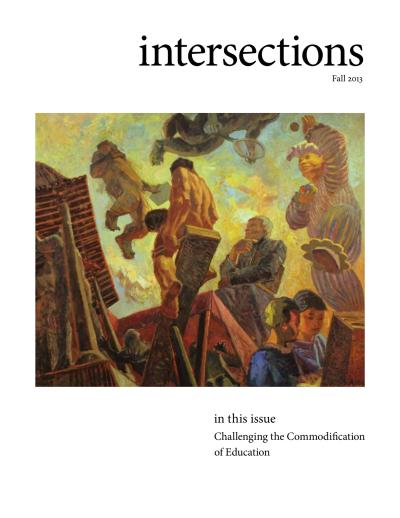 Article
Welfare of the City and Why Lutherans Care about Education
L. DeAne Lagerquist
No. 38 · Fall 2013
Lagerquist takes readers on a historical tour from sixteenth-century Saxony through the founding decades of Lutheran higher education in the United States to the present day, recovering Luther’s “gift economy” alongside Lewis Hyde and Oswald Bayer as a counter to the market logic that increasingly governs American higher education. She offers four propositions on vocation and commodification and proposes that Lutheran institutional vocation is to accept and pass along the gifts that come to our schools for the well-being of students, neighbors, and the world.
-
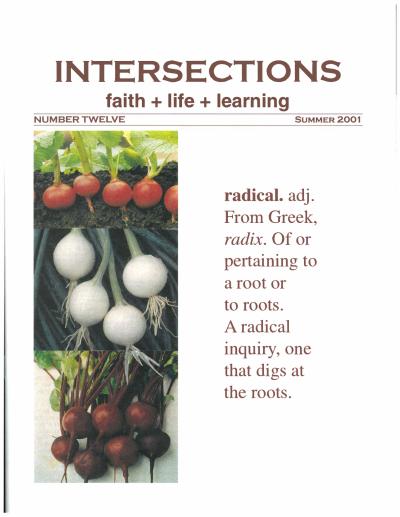 Article
The Vocation of a Lutheran College
L. DeAne Lagerquist
No. 12 · Summer 2001
Lagerquist places the twenty-eight ELCA-affiliated colleges in the context of American higher education from Harvard (1636) through the “old time college,” the post-Civil-War research university, and the postwar expansion—drawing on Christopher Lucas, Philip Schaff’s Neo-Lutheran/moderate/Old Lutheran categorization, Sydney Ahlstrom’s scholastic/pietistic/critical currents, Luther’s appeal to the German nobility, Lewis Hyde’s gift economy, and Alasdair MacIntyre’s After Virtue. She proposes five characteristic practices (the school as learning community, study of Bible and Christian tradition, participation in the arts as makers and audience, application of learning in service, and on-campus Christian worship) grounded in Lutheran teaching about grace, image-and-fall, gratitude, and revelation through created “masks,” and four virtues these practices engender in graduates—loving gratitude, faithful wisdom, bold freedom, and hopeful humility.
-
 Editorial
From the Publisher
Mark Wilhelm
No. 51 · Spring 2020
Wilhelm frames the issue by tracing how Lutheran educational ideals — once a primary source of contemporary higher education — were masked in the United States, and introduces a NECU initiative that uses the case of business ethics to explore Lutheran social teaching as an academic resource.
-
 Editorial
From the Publisher
Mark Wilhelm
No. 41 · Spring 2015
Wilhelm celebrates the leadership of ELCA colleges and universities within American higher education — from presidential service in major higher-education agencies to recognized leadership in global education and interfaith understanding — and lifts up the health of the ELCA network of schools as a church-related community that maintains shared identity while living as good citizens of the larger academy.
-
 Article
"Our Calling in Education": An Educator's Perspective
Cheryl Budlong
No. 23 · Summer 2006
Budlong, Professor of Education at Wartburg College, asks educators to reexamine their ‘mental models’ of what education itself means in light of the rapidly expanding literature on how young people learn. Drawing on Malcolm Gladwell, Eric Jensen, Ruby Payne, Judith Harris, Robert Slavin, and the AACTE’s Leading a Profession retrospective on the AACTE agenda 1980–2005, she calls on Lutheran educators to articulate vocation intentionally in their classrooms and to ground curricular and pedagogical reform in Wartburg’s focus on Discovering our Calling.
-
 Editorial
From the Publisher
Arne Selbyg
No. 18 · Fall 2003
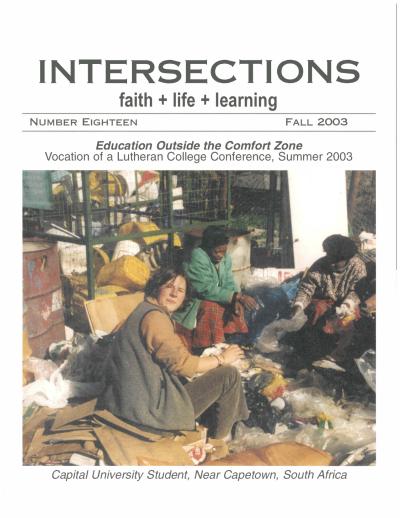
Selbyg reports that the ELCA Church Council’s new strategic directions include the charge to “assist this church to bring forth and support faithful, wise, and courageous leaders whose vocations serve God’s mission in a pluralistic world,” and assures readers that Intersections, the Vocation of a Lutheran College conferences, and related programs will remain among the tools by which the churchwide organization reaches its strategic goals.
-
Editorial
From the Publisher: Staying Connected
Mark Wilhelm
No. 38 · Fall 2013
Wilhelm frames Intersections as a tool for maintaining relationships among leaders in ELCA higher education, welcomes the journal’s new editorial advisory board, and points readers toward the 2014 Vocation of a Lutheran College conference at Augsburg and a special interfaith understanding conference at Augustana with Eboo Patel and Presiding Bishop Elizabeth Eaton.
-
 Response
Disputatio Pro Quo? The Search for Lutheran Education
Jon-David Hague, Kimberly Hague
No. 2 · Winter 1997
Kimberly and Jon-David Hague—both Luther College graduates completing graduate studies at Berkeley and Boston University respectively—respond to Bouman by offering Luther’s curriculum reform at Wittenberg University in the spring of 1518, only months after the 95 theses, as a model of the Lutheran voice in higher education. Inspired by humanistic principles, Luther introduced lectures on classical authors and the first instruction in Greek and Hebrew, giving students the tools to encounter scripture directly rather than receive dictated doctrine. The spirit of that reform—providing students with every possible tool while acknowledging that an instructor’s perspective is neither ultimate authority nor final word—remains useful for the search for Lutheran academia today.