Palestinian Christian Identity
Let me introduce myself. I am an Arab Palestinian Christian Lutheran. Most people in the world would not understand such a combination of identities because it is usually believed that all Arabs are Muslims, and that Arab Palestinians certainly are Muslims. But that, as you know, is not true. I would like to share with you how I regard and experience my Christianity and my Lutheran faith in the light of my Arab Palestinian identity. There are two premises which I find to be important:
1) The first premise is Incarnation Theology, which is essential to us as Palestinian Christians. Our identity is the one we have developed since the early church. This identity has not been hidden or disguised. Rather it has been incarnational, in the flesh, very open. My Palestinianity and my Christianity kiss each other.
My Palestinianity is something deeply rooted in biblical culture, both Old and New Testaments. If you study present day Palestinian culture, you will find many of our traditions are rooted in the Bible. Sometimes I think we are the living remnant of the biblical traditions. My Palestinianity extends to my Christianity because Palestine was, after all, the place in the world that our God chose to become incarnate in Jesus of Nazareth. This is the place of Jesus’ birth, ministry, death, resurrection and ascension. Plus, Jerusalem is the birthplace of the Christian Church. It was here that the Holy Spirit came in great power upon the followers of Jesus and enabled them to preach the gospel. The early Church was multi-cultural. The gospel was preached in Arabic (Acts 2:11) and the apostles and believers were called to witness to Christ in Jerusalem, Palestine and the uttermost parts of the world.
Turning it around, my Christianity extends to my Palestinianity through the life and teachings of Jesus Christ. In this place, Jesus taught us to be peacemakers, to be light, to share ourselves with others, no matter who they are, to feed the hungry, bring water to the thirsty, to clothe the naked, to welcome the stranger, to care for the sick, to visit the prisoner.
Sometimes people tell me my nationality is Christian, but there is no Christian nationalism. Rather, the Incarnation has to do with relationships: the divine to the human, the human to the divine. God became incarnate on earth; God did not remain in heaven. Christ taught us that the Incarnation gave a meaning for Palestinian identity—never exclusive, but inclusive—molded by love, forgiveness and reconciliation. Our relationships on this earth are shaped by the Incarnation of our Lord Jesus.
2) The second premise has to do with Lutheran history in the Middle East. It is certain that Lutherans cannot claim a historic tradition in Palestine. We cannot claim that Martin Luther came here to visit—Thank God! Rather than a staid tradition of Christianity in the Holy Land, the Lutheran doctrine brings us the freshness of the gospel. This means that no nation or land can claim the monopoly of preaching the gospel and administering the sacraments. Always it is going in a circle—out of Jerusalem to the whole world, but when Jerusalem neglected the freshness of the gospel, it returned to it through mission.
a) The Evangelical Lutheran tradition has rooted us in the theology of grace. This grace we receive freely from the cross of Christ. We Christians in the Middle East live in an ocean of Islam and Judaism, which means we are steeped in the theology of merit. In both the Old Testament and the Koran, there is a strong theology of retribution, of a punishing God who must be pleased through works of merit. But as Christians living in the theology of grace we know the love of God in Christ, a love which extends to all people—sinners, the marginalized, the oppressed and the oppressor. It is the grace of Christ that embraces me and others, drawing me nearer and nearer to my Savior. Through kerygma, diaconia and missio the love of Christ is given to everyone and we become the church of martyria, the church of witness. This is the freshness of the gospel.
b) The Evangelical Lutheran tradition has rooted us in the theology of the cross, which is the center of Lutheranism. This humbles me so that I am not a master in my country, but a servant—a servant not only for my own community but for everyone. The theology of the cross molds my whole identity and equips me for witness, enabling me, in addition, to take a strong role in mediation and dialogue with other Christian confessions or other religions, or with conflicting parties.
These two premises—the theology of grace and the theology of the cross—are part and parcel of the theology and tradition of the early Christian church. They continue today in the Lutheran and other Evangelical churches in the Middle East.
The Evangelical movement in the Middle East began in the 19th century. It is true that Evangelicals, including Lutherans, sometimes came with a triumphalistic missionary mentality aimed at converting Jews and Muslims to Christianity. But they soon ran into a rock wall; they could not convert the Muslims and Jews. They then turned to the Christians in the land, not to proselytize them but to bring the fresh gospel message. The Evangelicals have made an impact on the Middle East:
A. The Bible was translated into Arabic in 1864 by Evangelicals.
B. Schools and colleges were started by the Evangelicals which changed the whole mentality of the Middle East to be more cosmic, more global. The education program helped Arab Christianity to find its identity. To this day in the Evangelical Lutheran Church in Jordan and Palestine (ELCJ), the education program of our church in six schools is our direct mission in proclaiming the Gospel in word and deed. Our schools continue to be an oasis to mold the Palestinian Christian identity; to teach peaceful co-existence with other religions, especially Islam and Judaism; to emphasize peace education; to promote the role of women; to give high quality education; and to prepare the future generation to be active citizens for building the Palestinian modern, civil, and democratic society.
C. The role of women was promoted. The Evangelicals believed in educating both boys and girls. All women’s movements were and are given encouragement and support. The ELCJ is currently the only Church in the Middle East ready to ordain a woman.
D. Evangelicals brought ecumenism. For example, it was the Evangelicals who helped to form the Middle East Council of Churches (MECC). We invited all the Christian Church bodies to participate and named the four Middle East church families: Catholic; Orthodox; Oriental Orthodox; and Evangelicals. Included in the Evangelical family today are the Lutherans, the Anglicans and the Reformed.
I mention my own experience in order to elaborate on how we can equip students in our Lutheran colleges and universities to become leaders in the globalized world. We do this by helping the students mold their identity as Christians, not in a legalistic way but through the influence and molding of the love of Christ in human life and values. Sometimes when dealing with church workers or missionaries I discover they are very individualistic and become focused on petty things. People say this is probably due to age or insecurity. But for me, it is due to the lack of corporate identity with the Christian community. Christianity and nationality extend to each other. When their identity is clearly established, the students will be able to focus on their vocations. They will come to realize that God calls them to a vocation which may or may not be in the Church but will be a place where they are missionaries in their own field.
Understanding the Other Civilizations in a Globalized World
In a globalized world, we cannot be like ostriches, hiding our heads, saying “Everything is fine for me,” and not caring for the rest of the world. If we do this, we become selective and insensitive. If we do this, we are creating a new Tower of Babel, in which everyone is pushing him/herself to be the best, the highest, the most important.
Instead, we must learn in a globalized society to be aware and sensitive—for example, the global North must be aware and sensitive to the culture and needs of the global South, and the South must be aware and sensitive to the North; the same is true of the East and the West.
The education we provide our students must give them sensitivity to the other—the people who are different in culture, race, religion, and concerns.
Although we live in a globalized world, we notice a clash of civilizations. It is true—there is polarization in this modern world. Islam and the West are clashing—Africa and Europe are clashing. We see much xenophobia in the world, including Islamophobia, anti-Semitism, and Americanophobia, to mention just three of the fears. Like His Holiness Pope John Paul II, we must be willing to confess our fears and the actions that result from them. John Paul made a public confession of the fact that the Church had persecuted the Jewish people in past centuries and asked forgiveness for this sin. We must be courageous as Christian leaders in educating our children to recognize and confess our fears because contrition helps civilizations to co-exist and be in constructive dialogue.
Edward Said, a renowned Palestinian American educator, recently wrote about the modern clash of civilizations:
(Some people) have seen in the atrocities of 9/11 a sign that the Arab and Islamic worlds are somehow more diseased and more dysfunctional than any other, and that terrorism is a sign of a wider distortion (than) has occurred in any other culture.
We can leave to one side that, between them, Europe and the US account for by far the largest number of violent deaths during the 20th century; the Islamic world hardly a fraction of it. And behind all of that specious unscientific nonsense about wrong and right civilizations, there is the grotesque shadow of the great false prophet Samuel Huntington who has led a lot of people to believe that the world can be divided into distinct civilizations battling against each other forever. On the contrary, Huntington is dead wrong on every point he makes. No culture or civilization exists by itself; none is made up of things like individuality and enlightenment that are completely exclusive to it; and none exists without the basic human attributes of community, love, value for life and all the others. To suggest otherwise as he does is the purest invidious racism of the same stripe as people who argue that Africans have naturally inferior brains, or that Asians are really born for servitude, or that Europeans are a naturally superior race…. It is the purest drivel. On the other hand, there is the much more credible and serious stipulation that like every other instance of humanity, Arab and Muslim life has an inherent value and dignity, which are expressed by Arabs and Muslims in their unique cultural style, and those expressions needn’t resemble or be a copy of one approved model suitable for everyone to follow.
I, too, disagree with Huntington’s teaching about civilizations always battling against each other. It is wrong to stigmatize people and drive them apart. Unfortunately, our usual pattern is to demonize the other and turn aside in xenophobic fear, teaching others, including our children, also to hate and fear the people who are different from us. It is obvious to me that the Church should be the agent or instrument that works for dialogue. This is a dialogue that seeks the humanity of each other in our civilizations and cultures and that accepts the otherness of the other, building a culture of mutual trust and acceptance and seeing the richness of the various traditions and civilizations that God created.
Remember that St. Paul said, “Though I am free and belong to no one, I make myself a slave to everyone, to win as many as possible. To the Jews I became like a Jew, to win the Jews. To those under the law I became like one under the law (though I myself am not under the law), so as to win those under the law. To those not having the law I became like one not having the law (though I am not free from God’s law but am under Christ’s law), so as to win those not having the law. To the weak I became weak, to win the weak. I have become all things to all people so that by all possible means I might save some. I do all this for the sake of the gospel, that I may share in its blessings.” (1 Corinthians 9:19-23)
St. Paul accepted the other civilizations in their own context, recognizing their humanity, ready to dialogue with the people. He did not allow fences or barriers to keep him from knowing and caring about the people who were different from him. Instead, he made every effort to understand people in different civilizations and cultures.
In Ephesians 2, St. Paul also wrote, “For Christ himself is our peace, who has made the two one and has destroyed the barrier, the dividing wall of hostility, by abolishing in his flesh the law with its commandments and regulations…. He came and preached peace to you who were far away and peace to those who were near. For through him we both have access to the Father by one Spirit. Consequently, you are no longer foreigners and aliens, but fellow citizens with God’s people and members of God’s household…” (Ephesians 2:14-15a, 17-19)
The challenge of Lutheran churches and colleges in the world is how to teach our future generations the art of dialogue with other civilizations and respect the diversity of God’s creation, thereby developing understanding and trust, building a culture of just peace.
The Search for Justice
Together we must search for justice in our modern world. The politicians have proved that no nation can be independent without caring about justice for the other. It is a huge mistake to believe that justice belongs only to us. We may think that we deserve justice, peace and freedom because we have fought for it and have the right to it. It may not occur to us that others need to enjoy the same justice. I am noticing that the American people are speaking about liberation and justice in the whole world, and that is commendable. However, justice can never be understood only from an American point of view, or an African or Arab or Asian or European point of view. Justice must be seen from a justice point of view. I know there is no absolute justice in our modern world, only relative justice. But justice at this time can be secured by the international legitimacy, which is proclaimed in our globalized world.
Great American leaders like George Washington, Abraham Lincoln and Martin Luther King Jr. were instrumental, with many others, to gain justice and freedom for American people. However, when God gave justice and freedom to the American people, I do not believe God intended them to keep it all to themselves in a narrow way. These gifts were intended to be implemented for all nations living under oppression and searching for truth and liberation. Both the Old Testament and the New Testament speak of justice, mercy, and peace living together. In Psalm 85:10, the psalmist proclaims, “Justice and mercy kiss each other.” And in James 2:18, we read, “The harvest of justice is sown in peace to those who make peace.”
How can there be justice and peace in the world if there is no peace or justice in the Middle East? The State of Israel has militarily occupied Palestinian land and people for over thirty-six years. Occupation is a sin against God and humanity. It deprives the ones being occupied of their human rights and their dignity. It demoralizes the ones who are occupying the land and the lives of other people. In fact, occupation demoralizes first the occupier, then the occupied. This is the reason the Palestinian Christian churches, living under occupation themselves, are calling for an end to the occupation and calling for justice for both Israelis and Palestinians. When we call for an end to the occupation, we mean to liberate the occupier from the mentality of occupation and from insecurity and fear. We also mean that ending the occupation will liberate the occupied Palestinian people from pain and suffering, from the violation of their human rights. Justice in this conflict will bring security for the Israelis and liberation for the Palestinians. It is true, as many have said—there will be no security for Israel without justice for the Palestinians, and there will be no justice for Palestinians without security for Israel.
From the Palestinian Christian Church point of view, the resolution of this conflict will include a two-state solution; a shared Jerusalem; a just solution to the right of return problem for Palestinian refugees; a just solution to the presence of Israeli settlements in the West Bank and Gaza; and a fair distribution of water. This, we believe, is justice for both groups of people. Some say it is not enough justice, and that is true. But the international legitimacy helps us to provide the necessary justice for the two peoples, Israelis and Palestinians, and for the three religions—Judaism, Islam, and Christianity.
When the Israeli-Palestinian conflict can be solved, the result will be peace in the Middle East. That is because the Israeli-Palestinian conflict is the core problem in the Middle East. The long-term, ultimate result of solving this crisis will be peace in the rest of the world.
I often hear people in the U.S. ask, “Why should Americans care about what happens in the Middle East? It doesn’t have anything to do with us.” On the contrary, the problems and their resolution in the Middle East are not far from you. When justice and liberation came to South Africa, everyone in the world was influenced and affected, not just South Africa. It is the same for the Israeli-Palestinian peace process. The nations in our world are interdependent. No nation can selfishly enjoy justice without seeing the fruit of justice implemented in other countries.
At the moment, the people in Europe or the Southern Hemisphere look with great expectation to the kind of justice the U.S. is trying to implement in the whole world. It is very essential, as naive as I am, that the U.S. will liberate itself from “narrow, self-interest justice” and work as an honest broker for justice, truth, liberation, and peace in this world. The test of the U.S. is not how powerful it is in this world or how mighty its military may be. The test is this: can the U.S. implement justice with one standard for all the nations of the world, including itself?
The test for justice for the world and within one’s nation is right in front of us. If justice can be accomplished in the Israeli-Palestinian conflict and in other conflicts in the world, then the whole notion of justice is not only a theory but will be a practice everywhere. Justice within a nation is being demonstrated among Palestinians as we are developing our constitution and our laws. The Palestinian Christian Church is working hard to base the laws on equality for the adherents of the existing religions, with human rights, responsibilities and justice for all. Our long experience with injustice has taught us that justice starts at home. When we stand with others in their struggles against injustice, we come to know each other’s humanity. When I really care for you and you care for me, we are seeing the image of God in each other and justice is at hand. Let us together as churches raise our voices, becoming a symphony of justice in a world of injustice.
The Search for Unity
We are in an age of many ecumenical approaches. In particular, we are experiencing mutual recognition among church bodies and detailed discussions of the apostolicity of the Church. I believe we have to break the halo we may have become accustomed to wearing—a halo we have put on ourselves, feeling a kind of self-glorification. Fanatic Christianity, and there are also fanatic Lutherans, believes that somehow they own the Christ they hold so dear. At the end, however, they will discover they have only been holding each other’s hands, and Christ is not there.
It is the duty of Lutheran colleges and universities to educate our students in how we can see Christ in other churches and traditions, not only Lutheran. Maybe we have to learn from American and Palestinian ecumenical experience in learning to see Christ present with our Orthodox and our Catholic brothers and sisters, for example, and with other Christian groups. We need to live and experience unity in diversity.
Ecumenism can be most difficult, especially in Jerusalem. How can we understand other Christian confessions? It has been said that if Martin Luther had known the Patristic Eastern Church Fathers, he might have joined the Orthodox Church.
I see two very important movements in our modern ecumenical efforts:
A. We need international dialogue among the various Christian confessions in order to prepare the way for mutual recognition agreements. The Holy Spirit is working in the Church. For example, after five hundred years the Holy See and the Lutheran World Federation could sign an agreement on the doctrine of Justification by Faith. The document speaks about “differentiated consensus.” Though some Lutheran and Catholic scholars opposed the agreement, we are now on the track of discussing the Apostolicity of the Church with the Catholics. (Apostolicity for Lutherans: Gospel preached, sacraments administered purely—this assures the continuity of the apostolic traditions and the freshness of the Gospel.) There is no doubt—the Holy Spirit one day will guide our steps toward a common understanding on this and other theological issues. Mutual recognition agreements between denominations are a signpost to show us the way to unity. In John 10, Jesus spoke about “one flock and one shepherd.”
B. We also need local mutual recognitions among the various Christian confessions. Again, what is done in one area of the world affects all of us. The Episcopal-Lutheran agreements in Germany, France, the Nordic countries, England, Canada and the United States affect us in Asia and Africa. There is a direct mutual effect for whatever agreement of mutual recognition is written in the world. We see what others are doing; we listen to their theology and reasoning, and see possibilities for ourselves because the Church of God does not have national or ethnic boundaries. For example, my church, the ELCJ, has now decided to challenge the Evangelical movement in the Middle East because it has failed in the last decade to sign a multilateral agreement. The Evangelical churches include the Reformed Church (Congregational, Presbyterian), the Anglican Church and the Lutheran Church (ELCJ). And so, influenced by other agreements around the world, the ELCJ is working on two specific agreements:
- We will pursue the Jerusalem Lutheran-Anglican Mutual Full Recognition Agreement which is already in process.
- We will begin work on a Lutheran-Reformed Agreement in the Middle East.
If the ELCJ succeeds on these two tracks, we would be building bridges between the Anglican and Reformed churches in the Middle East. We would be preparing fertile ground for a multilateral agreement in the future, such as the Anglican-Lutheran-Reformed agreement in France, the DeReuilly Agreement.
What is the benefit of such agreements? Either we Christians learn to live together or we will die together. If the Christian Church takes seriously the call to deny itself, to carry the cross and follow Jesus, then the Church needs to be a living witness. We cannot be that living witness with our divisions unless we are united with our sisters and brothers in other Christian confessions. We gain strength to continue to be a Church of martyria, giving ourselves to Christ and being his living witnesses, serving where he calls the Church to be.
One day a Muslim shopkeeper in the Old City of Jerusalem stopped me as I was walking to my office at the Lutheran Church of the Redeemer. “Look at that woman over there,” he said. “I can tell she is a Christian.” I asked the man, “How do you know that?” And he replied, “Because she is carrying that handicapped child, and she takes care of handicapped children that are not her own. You Christians are better than we are.” I told him that we Christians are not better than Muslims, but we practice sacrificial love because our Lord Jesus gave himself for us on the cross to save us equally in order that we would serve others equally. Our mere existence is a living martyria, a living witness in itself. Our call from Christ is to be a living witness united in our diaconia, mission and service. Then we will hear what the early Christians heard from the community around them: “See how they love one another.” Can our communities say that about us now? Mutual recognition helps us be a stronger witness in the world and it is an ultimate necessity that these mutual recognition agreements do not remain with church officials and leaders. There must be active reception of the agreements among the grassroots and especially among college students.
The Necessity of Interfaith Dialogue in a Broken World
Narrow religion can be a source and a tool to create religious extremism. This extremism, in turn, adopts intolerant positions or biased attitudes with exclusive claims on the truth. These groups easily succeed where poverty and injustice prevail. We are challenged and obstructed by religious fanaticism and extremism because these groups think they are the sole defenders of God and God’s true religion. They forget that God does not need defenders of religion. These groups can easily be a threat to world justice and peace, creating intolerance and turmoil instead. Cardinal Arinze is right when he says that extremism is often characterized by an intransigent attitude toward co-religionists and others who hold different views, or who live in a different concept of society. This frequently leads to violence. Some extremists even go further and deny the right of religious freedom to those whose religious convictions differ from their own.
For me as a man of dialogue for the healing of the world, there is no religion which monopolizes the existence of tolerant and intolerant groups in its midst. We find both tolerance and intolerance existing in Christianity, Judaism, Islam and other religions. But we can never allow intolerant groups to hijack God or religion. We need to ask, in our 21st century: “How can religion through interfaith dialogue contribute to tolerance among religions; justice, peace and reconciliation; and the healing of our world?”
Interfaith dialogue must be prophetic. It must not create more bitterness and injustice but must be able to heal.
Our present global situation demands that religions work together for justice and peace. I speak of this from first-hand experience because our Lutheran schools in Palestine have both Christian and Muslim students. We work together to develop a peaceful coexistence, teaching our children about non-violence and peacemaking in addition to a strong educational curriculum. I am also a part of significant dialogue groups in Jerusalem and in various parts of the world which connect Jews, Christians, and Muslims. I find this to be one of the most rewarding parts of my work as the Lutheran Bishop in Jerusalem.
First: Interfaith dialogue ought to regard the theology of creation in a serious way. Why did God create us differently? Why do we differ in our various religious beliefs? It can be that there is no immediate answer except that all people of all religions are created in God’s image. Yes, there are serious differences, doctrines, traditions and norms. Interfaith dialogue does not change these things nor does it erase them. Rather, interfaith dialogue helps us to see God’s presence in the other person. When we see that, then we can admit that the Creator granted every one of us equal human rights and equal values. We Christians are called in our interfaith dialogue to challenge our world with a strong theology of creation and redemption. God created all human beings and nations equally. Through God’s Son, Jesus Christ, on the cross, God saved all the world equally. This is the basic theology that drives us to heal the world and combat any kind of racism, extremism, superiority, anti-Semitism, Islamaphobia and xenophobia in our modern world.
Second: Interfaith dialogue must be courageous to seek common values from the respective religions. It sometimes seems that the globalized consumerism, materialism, and secularism leave our world stripped of values and instead impose the principles of self-interest. Thus, relationships are dependent only on the self-interests of both parties. For this reason I call on all religions to seek for the common values that promote family, equality, justice, peace, tolerance, and reconciliation. A world without values is a world of chaos. A world with values is a world that promotes pluralism, equality, democracy, and respect for other religions and traditions, even those that are strange to us.
Third: Together with people of other religions, we must work together to bring justice and healing to the world. We are not to please politicians who seek war. Rather, religious people can be prophetic if they offer the longstanding, peaceful means of religion to solve world problems. Interfaith dialogue can challenge the world with authority. Stop war! Stop the militarization in our world that is threatening to kill humanity! Stop the proliferation of conventional and non-conventional weapons that can burn our world hundreds of times. How much money is spent on armaments, weapons, military operations and occupation, on killing people? It is the prophetic role of world religions to call for the disarmament of the whole world, not only one country or some countries we don’t like. The world religions can assume their prophetic role if they stand against militarism and call for non-violent means to solve world problems. We are to tell the world: “The money you spend on power and militarization should be spent on eradicating poverty in the world, in providing education, in bringing justice and equality, in conquering the HIV and AIDS virus, cancer and other diseases.”
Fourth: Interfaith dialogue must promote peace education. We truly need to learn about the other religions as they want to be perceived and not as we want them to be. Peace education must be high on the agenda. Peace education helps the adherents of one religion to have a positive picture of the adherents of different religions and avoid any kind of stigmatization, demonization or dehumanization. Such understanding helps everyone to co-exist with tolerance, love, and hope. I believe all religious people must repent for the ways in which we have distorted God’s image in the other.
Our world will be safer, richer, and stronger if dialogue with other religions will guide us to build a just, new world order of security, freedom, and tolerance, a modern civil society and culture of peace.
And so it is vitally important to teach our students to be interested in dialogue with others different from ourselves. We want to raise a generation that works to promote a culture of peace and justice in a world that has no justice, no peace. However, if we think that Lutherans can do justice alone, we are very mistaken. It is when we find common values in others that we can together build a new generation of peace.
Facing a Dangerous Trend
It is very important to be sure that students in Lutheran colleges and universities are aware of the difference between being an Evangelical and being part of an evangelistic group. This is a struggle we are currently having in the Middle East.
No religion can claim it is free of fanaticism or extremism. Extremists in the three religions—Christianity, Judaism, and Islam—are more vocal than moderates. It is not my responsibility to speak of the other two religions. Instead, charity starts at home and to be successful, self-criticism also starts at home. We need to teach our students, the future generation, about the nature of Christian right-wing groups, also called the Evangelical Right. These groups are biblistic in their approach to world problems. They believe in Dispensationalism, the Rapture, Armageddon, the conversion of Jews to Christ and the end of the world.
I think their main focus is not on Christ as the fulfillment of prophecy, but on the political Kingdom of God on this earth as prophecy fulfilled. Some may say these groups exist in the United States and Europe and it is there they make trouble. But they are also troublesome to us in the Middle East. Why?
A. First of all, they carry the name Evangelical. It is very difficult to explain to Muslims the difference between Evangelical and evangelistic. Our name as Lutheran Palestinians is the ELCJ. We have much at stake in helping people in the Middle East to understand who we are and what we believe, especially because the evangelistic groups are co-opting our name. At a recent meeting of the Heads of Evangelical Churches in the Middle East, we even discussed the possibility of changing our name because of the confusion and distrust that exist and are growing. We do not want to be linked or equated with these right wing groups. No one should be able to kidnap the word “evangelical” from us with its privilege of proclaiming the fresh good news to my people and to others.
B. Secondly, these right wing groups carry scenarios that are alien to our modern world and to our faith. This scenario includes the return of the Jews to the land through the establishment of the State of Israel in 1948 and the occupation of the balance of historic Palestine in the 1967 War. The take-over of Jerusalem, to these groups, is the beginning of the Final Dispensation. For this reason, they promote the destruction of the Muslim Dome of the Rock and the building of the Third Temple; although, according to Jewish teaching, the Third Temple should not be built by human hands but will come from heaven with the Messiah. This activity is intended to hasten the Second Coming of Christ. In their scenario, Jesus will come to Armageddon and the rapture will take place. Up to this point some Jews would have been converted to Christ, but the majority of Jews would not have become believers. They will be killed right along with other nations who do not believe in Christ. Those who do believe will rule the world with Christ.
For me, a Palestinian living under occupation, I am horrified about the killing of a Jew because of non-belief in the Messiah. These right wing groups portray themselves now as being philo-Semitic, but in the long run they are actually anti-Semitic. I denounce their anti-Semitic scenarios. In June of this year, I was very pleased to hear that the Catholic bishops in Illinois denounced these right wing groups as “false prophets.”
It is for all these reasons that last January I declared this right wing ideology to be not only sick—but to be an actual heresy, similar to those in the Third and Fourth centuries. The present day heretical groups do not seek the Crucified Christ but the Christ of the Sword. They do not seek the heavenly Jerusalem but the earthly one.
C. Thirdly, these evangelistic right wing groups insinuate themselves into politics. They support the government of Israel in all its policies, including the violation of human rights and the building of illegal settlements on confiscated Arab land. Near my own home in Beit Safafa, just to the north of Bethlehem, there is an Israeli settlement named Givot Mattous, which has been funded by evangelistic right wing groups. The right wing groups also become involved in U.S. policies as well as other places where there are crises.
D. Finally, the evangelistic groups are calling for the transfer of all Palestinians to Arab countries, violating all kinds of human rights. They want the land for Israel without any Palestinians in it. These groups are the enemies of peace, the enemies of justice, and the enemies of reconciliation—all in the name of Christ and of their sick, heretical ideologies.
I believe it is the duty of Lutheran colleges and universities to help the future generation develop the spirit of discernment in order to understand the difference between sound theology and fanatic theology. It is our duty to educate open-minded, moderate human beings who are sensitive and open to other cultures and other people. By doing this, we can keep humanity from failing into hopeless xenophobia and be responsible stewards in this world, where we are only visitors.
Conclusion
You might ask, “What can we do for you?”
I remember when I was in Finland studying theology, I learned that Lutheran colleges in the U.S. gave one scholarship each year to prepare a student to build a civil society and democracy in his or her own country. I believe, with all modesty—being an oppressed person myself and looking at the wonderful opportunities your children have in the U.S.—that it would be so good if our Palestinian children could have similar opportunities.
Therefore I propose the following:
- I propose that each year, each U.S. Lutheran college and university educate one Palestinian young person to come back and serve the Palestinian people and the Palestinian Lutheran churches and schools;
- I propose that the U.S. Lutheran colleges and universities be places where our Palestinian Lutheran pastors and consecrated deacons can come to upgrade their knowledge and skills in theology, in practical ministry and in focusing our Lutheran identity;
- I propose that the U.S. Lutheran colleges and universities also be places where our Lutheran school teachers and administrative staffs can come to upgrade their educational and administrative skills;
- I propose that we exchange visits on the college and university levels, so that our Palestinian Lutheran pastors and administrators come to share their knowledge, experience and skills with you. We invite you to come to Palestine and Israel for sabbaticals and study, to learn about us and our churches and schools, to stay with us. In this regard, I want to mention Dar al-Kalima Lutheran Academy in Bethlehem for theology, music and the arts, and also Abraham’s House in Beit Jala, which is a study and reconciliation center for all three religions. It also is a lovely guest house. In addition, there are ELCJ study and participation opportunities in Jerusalem, Beit Sahour, Ramallah and Amman, Jordan.
“The fields are white unto harvest,” Jesus said, “but the laborers are few.” (Matt. 9:37) It is the responsibility and the privilege of Lutheran colleges and universities to prepare the people of God, not only in the U.S. but also people of God in other civilizations, cultures and traditions, to be equipped and qualified to work in God’s Kingdom of love, justice, hope, peace, reconciliation, and salvation on this earth.
-
 Editorial
From the Publisher
Arne Selbyg
Selbyg reports that the ELCA Church Council’s new strategic directions include the charge to “assist this church to bring forth and support faithful, wise, and courageous leaders whose vocations serve God’s mission in a pluralistic world,” and assures readers that Intersections, the Vocation of a Lutheran College conferences, and related programs will remain among the tools by which the churchwide organization reaches its strategic goals.
-
Editorial
From the Editor
Tom Christenson
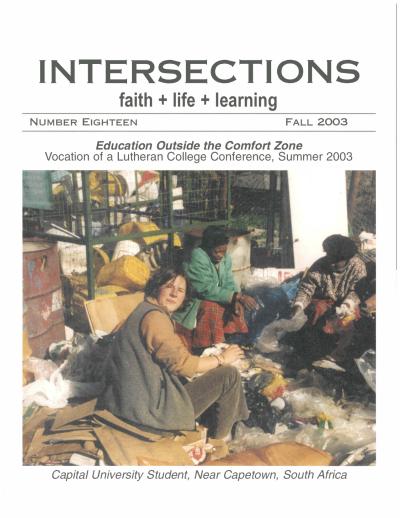
Christenson draws on a ten-year alumni survey at Capital University showing that students most often credit practica, internships, travel-study, and service-learning—not classroom hours—as the places they best learned the university’s stated outcomes, and introduces this issue’s papers from the Summer 2003 Vocation of a Lutheran College Conference on education and global outreach.
-
Article
"The Earth is the Lord's And the Fullness Thereof": Six Theses Regarding Global Education at the Colleges of the Church
Christopher M. Thomforde
Thomforde surveys the breadth of global education across ELCA colleges—Susquehanna, Bethany, St. Olaf, Luther’s international students, Concordia’s language villages—and then frames its future around six theses: global education is a theological enterprise that teaches the First Commandment through dialog, wonder, and disillusionment; it necessitates coming to terms with “the stranger” and “hospitality” (drawing on Diana Eck); it is in, for, and against the world; it nurtures vocation and forms L. DeAne Lagerquist’s “cosmopolitan citizens”; it requires sympathetic engagement of faculty, staff, and administration in the spirit of pioneers like Ansgar Sovik; and it calls the ELCA colleges to exercise the gift of administration to bring greater clarity and collective coordination to the portfolio of programs offered across the twenty-eight institutions.
-
Article
Service Beyond the Comfort Zone
Kathryn Wolford
Wolford names economic globalization and the growth of civil society as the two issues shaping Lutheran World Relief’s mission, illustrating with the Guatemalan storekeeper undercut by subsidized “gringo” chickens, fair-trade coffee and chocolate campaigns, and Charles Onyango-Obbo’s warning about anti-terrorism laws in fragile African democracies. Drawing on Darrell Jodock, Art Simon, and the Good Samaritan, she frames the global vocation of Lutheran colleges as inviting students past comfort zones of race, class, ethnicity, and ideas through service-learning that links mercy and justice, and closes with a concrete LWR partnership invitation including site visits, internships, fair-trade campus campaigns, and the “A Place for Peace in Colombia” advocacy program.
-
Article
Educating for Peace: 21st Century Models for Thinking Globally and Acting Locally
Janet E. Rasmussen
Rasmussen opens with a rabbinic story about the one-step distance between East and West and describes Pacific Lutheran University’s four-phase “Global Education Continuum”—Introductory, Exploratory, Participatory, Integrative—developed with Teagle Foundation support and grounded in Perry, Bennett, and Musil. She illustrates intentional global/local partnership through three case studies: Barbara Temple-Thurston’s Trinidad-and-Salishan initiative; the China Partners Network with the Amity Foundation, Good Samaritan Hospital, and PLU’s Wang Center; and Ann Kelleher’s three-institution “Norway in Namibia” partnership with Hedmark University College, the University of Namibia, NAMAS, and the Ondao mobile schools for the Himba people. She closes with Daloz, Keen, Keen, and Parks’s Common Fire research and Lee Knefelkamp’s call to be “communities of peace.”
-
 Article
Practical Approaches for Lutheran Colleges to Engage Civil Society
Katherine A. Tunheim
No. 35 · Spring 2012
Tunheim distinguishes a college’s mission from its vocation—a calling from the community—and offers four examples of Lutheran colleges “dancing with their neighbors”: Augsburg’s engagement with the Cedar Riverside Neighborhood, her Gustavus students’ work with the St. Peter Soccer Club, St. Olaf football players in the All-Star After-School Program in Northfield, and Concordia students filling sandbags during the 2009 Red River flood. She presses Lutheran educators to ask the troubling questions that prepare students to lead with ethics rather than merely with money.
-
 Article
Rooted and Open: Background, Purpose, and Challenges
Mark Wilhelm
No. 49 · Spring 2019
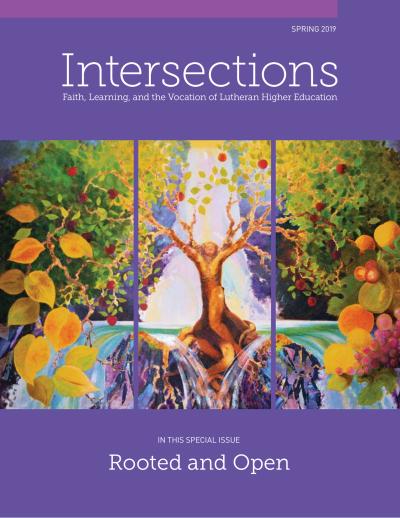
Wilhelm traces Rooted and Open’s seventy-year backstory — from Conrad Bergendoff’s 1948 call for a Lutheran philosophy of education through the recovery of the vocation tradition — and describes the document’s process, purpose as a teaching and study resource, and the embodiment, contextual, and cultural challenges it implies for NECU institutions.
-
 Editorial
From the Editor
Tom Christenson
No. 13 · Winter 2002
Christenson previews a varied issue—Darrell Jodock’s Bernhardson inaugural lecture, Ernie Simmons’ Valparaiso conference talk on student/parent attitudes, two South Africa travel pieces by Brian Wallace and Corin Wesner, and reviews of Richard Hughes’s and Robert Benne’s recent books—and tells the story of “the church lady from hell,” a mid-fifties returning student who condemned everyone in the class with “God and I think…,” to ask what a religious tradition without a sense of humor would look like.
-
 Editorial
From the Editor
Tom Christenson
No. 19 · Summer 2004
Christenson reflects on the scarcity of time in over-committed academic lives and posts a tongue-in-cheek help-wanted advertisement for his own successor as editor. He introduces the issue’s four authors as “three friends and one new acquaintance” whose work addresses Lutheran higher education, the significance of Paul Ricoeur, the implications of being a reformation community, and the perils of teaching ethics.
-
Article
Critical Engagement in Public Life: Listening to Luther's Troubling Questions
Samuel Torvend
No. 35 · Spring 2012
Torvend narrates the medieval “spiritual/temporal” division and the neo-platonic devaluation of the body that shaped the world into which Luther was born, then traces the disruptive questions Paul’s letters provoked in Luther: about indulgences, the two estates, vocation, and the public reach of baptism. He argues that Luther’s reform — expressed in Kirchenordnungen, social welfare reform, public schools, and writings on lobbyists, usury, and monopolies — carries a “genetic encoding” of public engagement that Lutheran colleges should reclaim against the temptations of holy apathy and Christian nationalism.
-
 Article
Why Interfaith Understanding is Integral to the Lutheran Tradition
Jason A. Mahn
No. 40 · Fall 2014
Mahn returns to the root of the Lutheran tradition — church, theology, and pedagogy — to argue that interfaith encounter is not the vanishing point of Lutheran identity but central to it, beginning with confession of Luther’s anti-Judaic legacy, working through the typology of exclusivism / inclusivism / pluralism, and showing how the kenotic Christ and the theologian of the cross open Lutherans to authentic encounter with religious others.