–I–
Walking in to campus one day I was greeted by a pin oak decorated with various contraceptives, both mechanical and pharmaceutical. Affixed to the trunk of the tree was a sign: “Birth Control Doesn’t Grow on Trees!”
This slogan is true enough if access to birth control is what you’re interested in, but the ecologist knows better. Birth control does grow on trees, and unless a lot of women stop relieving themselves altogether, it’s going to continue to do so. As long as there are traces of hormonal birth control in our ground water, and as long as trees send their roots in search of that water, birth control will grow on trees. Hormonal birth control has reached such concentrations in our streams and lakes that it is feminizing male fish.1 The eighteenth-century poet, Alexander Pope, in anticipation of such unintended consequences as this, said:
From Nature’s chain whatever link you strike,
Tenth or ten thousandth, breaks the chain alike.
(Essay on Man 1.245-46)
But then Pope was a better ecologist than most of us, for although he lacked the science of ecology he had the benefit of an essentially pre-modern cosmology. For him the analogia entis and the intricate world of correspondences still obtained; he believed that we have a place on the chain of being and that we violate it if we attempt to behave as beasts or gods. What is more, he wasn’t one of those specialists who increase knowledge at the cost of fragmenting it. By contrast we moderns, assuming as we do that we are much more “advanced” than Pope (apparently for no other reason than that we live later than he), inhabit a world where birth control grows on trees and male fish are being emasculated.
I mention Alexander Pope here at the start to suggest that if there is a balm in this toxic Gilead of ours it will be found not in the future but in the past; I mention the Birth Control Tree for a similar but slightly different reason: it joins in a single image things ancient and modern, natural and man-made. Trees, whether in life or imagination, are old; two of them stand at the beginning—indeed at the heart—of our religious tradition, and they call to mind many things, among them life itself, for example, and the knowledge of good and evil. Control, on the other hand, is a fairly new thing; it stands at the beginning—indeed at the heart—of the modern project we call the Enlightenment, and it too calls to mind many things, among them the Faustian bargain or vast weedless monocultures alongside the Interstate Highway and Defense System. And whereas the Tree is a natural artifact made by an artistry we can never fully know, Control as we understand it is entirely of human making and works not by artistry but by trickery or force or both. If eating of the tree came with a consequence, the principal aim of Control is to outrun consequence. The old Tree reminds us that we are limited, not boundless, creatures; the new Tree, newly decorated, promises to deliver us from limits. And whereas the two old Trees in the garden anticipate a third on a hill whereon death vanquished Death and hope vanquished despair, under the new Tree life vanquishes Life, and hope, far from vanquishing despair, gives way to it.
Now I should say before it’s too late that I do not propose to enter an argument about “reproductive rights.” In our age of increased but fragmented knowledge that’s an argument that can no more be had than won. If they could talk the fish would tell us that we are not large-minded enough to have it. Rather, I am speaking here, as William Blake did, of the despair that inevitably follows upon the lust for possession and control where possession and control are neither possible nor desirable. “The bounded is loathed by its possessor,” Blake said. “If any could desire what he is incapable of possessing, despair must be his eternal lot” (“There Is No Natural Religion” [b], iv, vi). I wish to suggest that these two sentences capture exactly our posture toward Creation and our condition with respect to it. The more we presume to bind nature, to control her, the more we as her possessors will loath her, and because we desire—but will always be denied—complete control of her, despair is our inevitable end. On the gates of modernity hangs a sign: abandon hope all ye who enter here.
I should also mention that what I have to say here applies to the political Left and Right equally, which fight as only siblings can. If the “Right” believes that human nature is sacred and that the natural world is our gas station (“Drill, baby, drill”), the “Left” seems to believe that the natural world is sacred and the human body our amusement park (“Get your rosaries off my ovaries!”). The incoherence of these current political positions ought to be obvious to anyone who can tie a shoe. Both positions are ruthlessly individualistic; both have made possession their goal; both are leading us to despair—the specific characteristic of which, as Kierkegaard said, is that “it is unconscious of being despair” (178).
– II –
I’ll grant that the news on only a few environmental issues—population, climate, soil, and water—certainly conduces to despair:
Population
Population is tricky business; it’s bedeviled by one of our pet topics, birth control, about which we’re pretty muddled, and hardly ever qualified by one of our most pressing concerns, standard of living, which we are mulishly unwilling to confront—especially in higher education, where we tout “green” standards on Club-Med campuses.
But consider this: the global population doubled between 1960 and 2000 and currently exceeds 6.5 billion. The projection for 2050 is 9 billion, notwithstanding the decline in birth rates among the 25 wealthiest nations. A population of 9 billion, says Paul Conkin in The State of the Earth,
raises innumerable issues about available resources, about the level of pollution and waste, about massive extinctions, and about the quality of human life in crowded cities. Countries with nearly stable or even declining populations do not face some of these problems, but these are the very countries with the highest levels of consumption, resource use, and emissions. [The US, comprising about 5 per cent of the global population, emits nearly 25 per cent of all greenhouse gasses (32).] They also have economies that are predicated on a continued growth in living standards. The pressures on the earth thus come from both directions, from the multiplying poor and the indulgent rich. (23)
But alongside this doubling of the population we’ve seen a doubling, since 1970, of food production—thanks to an official government push to drain farms of their farmers and replace the farmers with oil, machines, credit, and petroleum-based chemical inputs. But doubling food production has come at the expense of farmers, farms, farmland, rural communities, real fertility, and edible food. These are expenses that the selective bookkeeping we call the economy has managed to keep off the books; it has “externalized” them, as economists like to say, which means to lie about them, to charge them to someone else, usually the unborn. To top it all off, we still have more than 800 million people worldwide who are underfed, to say nothing of those in the so-called developed world whom cheap calories have magically rendered at once overweight and undernourished.
What too few people realize about all this is that, allowing for the effectiveness of vaccines and the temporary benefits of antibiotics, achieving a global population of 6.5 billion was possible only by massive infusions into our daily lives not of contemporary but of ancient sunlight in the form of oil, peak production of which we will soon reach if we haven’t reached it already. A population inflated by cheap oil cannot be sustained in its absence. Resource wars and massive starvation will not likely occur; they will certainly occur.
Climate
The causes and effects of climate change, to say nothing of the disputes surrounding it, have been widely published. Here are just a few remarks from the Inter-Governmental Panel on Climate Change (IPCC) summary report for policymakers:
- Warming of the climate system is unequivocal, as is now evident from observations of increases in global average air and ocean temperatures, widespread melting of snow and ice and rising global average sea level.
- Global GHG emissions due to human activities have grown since pre-industrial times, with an increase of 70% between 1970 and 2004.
- Altered frequencies and intensities of extreme weather, together with sea level rise, are expected to have mostly adverse effects on natural and human systems.
- Anthropogenic warming and sea level rise would continue for centuries due to the time scales associated with climate processes and feedbacks, even if GHG concentrations were to be stabilized.
- Anthropogenic warming could lead to some impacts that are abrupt or irreversible, depending upon the rate and magnitude of the climate change.
- Partial loss of ice sheets on polar land could imply meters of sea level rise, major changes in coastlines and inundation of low-lying areas, with greatest effects in river deltas and low-lying islands.
- As global average temperature increase exceeds about 3.5°C, model projections suggest significant extinctions (40 to 70% of species assessed) around the globe.2
Water
All that melted ice won’t mean more usable water, however. According to Lester Brown of the Earth Policy Institute, in the leading grain-producing states (Texas, Oklahoma, and Kansas), the “underground water table has dropped by more than 30 meters (100 feet). As a result, wells have gone dry on thousands of farms in the southern Great Plains, forcing farmers to return to lower-yielding dryland farming” (40).
The stories of aquifer depletion in China and India are grimmer. A World Bank report on water supplies around Beijing predicts serious shortages there, and Tushaar Shah of the “International Water Management Institute’s groundwater station … says of India’s water situation, ‘When the balloon bursts, untold anarchy will be the lot in rural India.’” In parts of Mexico “the water table is falling by two meters or more a year”—at a time, by the way, when one of Mexico’s chief sources of income, the Cantarell Oil field, is in steep decline. “Since overpumping of aquifers is occurring in many countries more or less simultaneously, the depletion of aquifers and the resulting harvest cutbacks could come at roughly the same time. And the accelerating depletion of aquifers means this day may come soon, creating potentially unmanageable food scarcity” (Brown 40-41).
Soil
And we haven’t even come around to talking about rates of soil erosion. At one time our prairie loam was about fifty feet deep in some places (Conkin 47), but the U.S. is losing soil ten times faster than the rate of natural replenishment; China is losing it thirty to forty times faster. Over the last forty years (that is, during the height of the agricultural revolution that American Agribusiness is so proud of) 30% of the world’s arable land disappeared (Lang).
Soil and water, however, are related—rather like links in the kind of chain that Alexander Pope was interested in. Better soil retains water better, and better retention in turn allows soil to do a better job of supporting biodiversity, which is the only kind of multiculturalism that really matters: if it dies, so will all the multiculturalists.
But intensive agriculture has so depleted water and oil resources that we have decided to intensify corn production so that we can put food in our gas tanks. This is such a good idea that we’re currently losing about twenty-four pounds of soil per gallon of ethanol produced. Water pollution from increased use of nitrogen-based fertilizers and pesticides will worsen each time we put another acre in corn to support our addiction to the automobile, which means that cities and utilities will have to spend more money to remove those excessive amounts of nitrogen from tap water. That is, to purify our water we will have to poison it even more.3
On top of all this we face what Hamlet called “that monster, Custom.” That is, we face over a century of habit, a century of monstrous inertia.
– III –
In other words, we have work to do. In my own attempt to think our problems through to the end I have been unable to wander very far from the three main points that follow. Each involves a kind of reorientation, the first practical, the second philosophical, and the third theological.
Practical Reorientation
One of the first things we must do, especially in higher education, is disabuse ourselves of the belief that energy and technology are interchangeable. When energy goes into decline, technology will not step in to take us up the mountain for a weekend of downhill skiing, nor will our current alternative energy sources pick up where oil left off. In terms of Energy Returned on Energy Invested (EROI), oil is special and almost certainly irreplaceable. The bulldozer that built our interstate highways isn’t going to be retrofitted with a little wind turbine spinning merrily around on top of its cab. Neither solar energy nor wind nor coal nor hamsters running in their exercise wheels will do for us what oil has done. It doesn’t do any good to invent new technologies if there’s no energy to run them. There’s no use saying that “someone will think of something.” Thinking about technology does not call energy into being.
We must also disabuse ourselves of the belief that disciplinary knowledge and specialization, whether in school or out, are sufficient to the demands of responsible citizenship. Specialization perpetuates ignorance just as surely as a highly reticulated division of labor and long distances between production and consumption. We educate for disciplinary expertise and thereby shrink awareness of the world’s complexity—as when, for example, a graduate knows how to budget for food but doesn’t know anything about the production of it.
This is why I have often wondered whether general-education curricula should include interdisciplinary courses on oil and agriculture—and whether passing such courses should be a graduation requirement. It is why I continue to be perplexed by the fact that students can major in economics or business, go on to earn MBAs, and never be told a single thing about thermodynamics or the basic principles of ecology.
The perils of this negligence are easy to illustrate. What, for example, do leading economists think are the dangers of climate change?
- William Nordhaus, Sterling Professor of Economics at Yale: “Agriculture, that part of the economy that is sensitive to climate change, accounts for just three percent of national output. That means there is no way to get a very large effect on the US economy.”
- Oxford economist Wilfred Beckerman, in his small 1995 book entitled Small Is Stupid: Blowing the Whistle on the Greens: global warming is not a problem because it affects only agriculture, which is only three percent of GNP. “Even if net output of agriculture fell by 50 percent by the end of next century, this is only a 1.5 percent cut in GNP.”
- Thomas Schelling, former president of the American Economic Association and in 2005 a Nobel laureate: “In the developed world, hardly any component of the national income is affected by climate. Agriculture is practically the only sector of the economy affected by climate, and it contributes only a small percentage—three percent in the United States—of national income. If agricultural productivity were drastically reduced by climate change, the cost of living would rise by one or two percent, and at a time when per capita income would likely have doubled.” (Daly 14)
Leaving aside the question of whether these redoubtable and well-educated economists intend to eat in the future, we must call them out on their errors. “[I]t is not true,” says the economist Herman Daly, “that agriculture is the only climate-sensitive sector of the economy; just ask the insurance companies or the folks in New Orleans.4
Apparently you can be an expert in the dismal science but never know anything about the real wealth of the world that backs the paper. This is one of the great crimes of higher education; it is also one of its great cheats.
All of this is part of a larger question concerning the problem of ecological illiteracy, which, as the forgoing suggests, is an unselective pestilence as likely to blast a Nobel laureate as a frat boy.
A third thing we must do is assign proper value to basic human tasks and skills and to those who can perform them. For too long we have been dismissive of the knowledge and the skills—call them the domestic arts—by which we all live; for too long we have lived by surrendering skills and purchasing necessities; for too long we have assumed that the machines and the ungraduated will supply all our real needs. Deracinated and deracinating vandals that we are, chasers of whatever grant money inflates our egos, we have taught our children and students to be as we are: global citizens, citizens of every place, which is to say citizens of no place—that is, not citizens at all, but parasites.
But when globalization fails in the absence of cheap energy, dead for want of an oil transfusion, we are going to have to recover the basic skills and habits of local culture. I say let every house that can, but also let every college campus, have a large, highly visible vegetable garden tended by everyone who likes to eat; let us have compost heaps steaming everywhere to remind us to pay our debt to the soil. Let us have leaders committed to dismantling, not enlarging, our vast system of technological dependencies, and adults committed to living defensibly and responsibly and competently before the young. The time is now to stop talking about large-scale solutions only and to start enacting the small-scale manageable solutions available to each of us. No one can care for a globe, but everyone can care for a neighborhood. Such care, however, cannot be carried out by the ecologically illiterate or the specialists bent on enlarging knowledge by fragmenting it.
Philosophical Reorientation
But we also have real intellectual labor to get done, and I think it begins with nothing less than first understanding, then dismantling, the modern project in whose iron grip we have been squirming for several centuries now. The great difficulty here is again a matter of habit. We don’t really know that we’ve been squirming. We think we’re being caressed and fondled.
This project was inaugurated by such well-known villains as Machiavelli, Hobbes, Locke, and Bacon, and then perpetuated by people who have never heard of them or read them—as well as by people who have. It is a project that even its most self-conscious critics still believe in and still want to believe in, the alternative being unimaginable to them.
If Classical thought recommended that we know ourselves, that we order our desires, that we orient ourselves by our possible perfection, that we reconcile ourselves to Nature and her limits, Modernity has suggested the opposite: that we be ourselves, that we orient ourselves by our desires, and that we employ those desires in mastering Nature to satisfy our infinite appetites.
Machiavelli’s recommendation—that we increase our power to extract what we want from nature, that we subjugate nature and conquer an unyielding and niggardly Fortune lest it turn our infinite desires into misery (See, for example, the chapter on Fortuna [XXV] in The Prince)—provided a theme upon which various impresarios of the Enlightenment played variations. They are well known, so I’ll rehearse them quickly: We have Hobbes’s famous “perpetuall and restlesse desire of Power after power, that ceaseth only in Death” (1.xi, p. 55); we have Descartes’ promise that science will make us “lords and possessors of nature” (Part 6, p. 46); and we have Bacon’s goal of easing man’s estate by vexing Nature’s secrets out of her (XCVIII) in order to achieve what Hobbes called “commodious living” (1.xiii, p. 71).
This attitude toward Nature has led to “commodious living” all right. In easing our estate by becoming masters and possessors of nature we have turned the whole world into one great big commode, and everything, not just the morning toast but everything, ourselves included, is swirling ever nearer the vanishing point. We have been doing precisely as the architects of modernity suggested: torturing Nature to extract her secrets and confiscate her wealth. “Social progress,” said Thomas Huxley a couple hundred years later, “means a checking of the cosmic process at every step” (81). Progress means establishing “an earthly paradise, a true garden of Eden, in which all things should work together towards the well-being of the gardeners: within which the cosmic process, the coarse struggle for existence of the state of nature, should be abolished” (19).
But such gardeners are not living by the limits of the garden; they are living—rather, they are attempting to live—by the limits of their own “intelligence,” an intelligence that, as the diminished health of the garden indicates, has been disastrously fragmented.
I don’t think it will do to take the usual cool post-modern stance and say with wry or ironic condescension that “of course we know the Enlightenment is over.” No one really behaves as if this is so. How we can say this and yet act as if we’re going to science our way out of the ecological crisis in large measure created by the methods and assumptions of science is just one more example of how good we are at reconciling ourselves to incoherence.
More torture isn’t the solution to too much torture. More commodious living isn’t the solution to too much commodious living. More easing of man’s estate isn’t the solution to too much easing of man’s estate. The more we try to keep the world we’ve built running the more we will empty ourselves of love, first for the world and then for one another, until, as Blake said, the bounded is loathed by its possessor. We have presumed to possess Nature—as many in this country once presumed to possess slaves—with the expectation that we can escape the loathing. This, as our history shows, is madness. It is also a good example of despair as Kierkegaard understood it.
The delusion that we’ll science our way out of our problems persists for a number of reasons, one of which is that we want it to persist, and we want it to persist because we recognize, if only subconsciously, its intricate and inextricable relation to our standard of living and the artificial wealth that has temporarily bankrolled it. But artificial wealth depends on real wealth. Artificial wealth increases only at the expense of the real wealth of the world. You can’t have your fifth cell phone in as many years apart from extraction and pollution, which are the alpha and omega of our economy, the ultimate condition of which will be exhaustion. Comfortable with this state of astonishing incoherence, we are utterly unimpressed with Nature’s economic principle of return or the natural cycle of death and resurrection by which Nature renews herself. No: we want the extractive economy that enriches itself temporarily by destroying itself permanently. Our standard of living requires it.
But the delusion that we’ll science our way out of our problems persists for another reason that may hit a little closer to home for those of us in higher education. It persists because we have consented to a version of the university that is in every way compatible with our role as Nature’s torturer. According to the older view, the university is the custodian of knowledge and wisdom; according to the new one, the university is the producer of knowledge and the scoffer at wisdom. But it ought to be obvious by now that to produce knowledge at the cost of transmitting wisdom is to prepare a catastrophe. By a kind of institutionalized myopia we have supposed that such crises as we face in population, climate, water, and soil have nothing to do with our preferring one version of the university to the other, and there is little indication that someone is going to come along anytime soon to spit in the dust and apply the healing mud to our eyes.
The thing to do, really, is to get one thing straight: that we are the custodians, not the manufacturers, of knowledge, wisdom, ways, skills, restraints, and virtues (most of which we’re going to have to relearn—or learn for the first time). Absent this knowledge and wisdom, absent these ways, skills, restraints, and virtues, we will move comfortably into the role of Nature’s jailer, interrogator, and torturer, and the university we inhabit, not content with any talk of restraints or limits, will say to its subjects, “publish or perish.” The best way not to perish in this menacing climate is to imitate the extractive economy. The best way to “produce knowledge” is to run the academy on industrial standards—that is, to proceed from extraction to exhaustion with no concern for the effects on real places of whatever knowledge gets produced.5
Now I am not against research or writing or scholarship. Obviously scholarship has a place in the university. But it is a great danger to conduct it in contempt of the past, which is to say with no real knowledge of books written before last Tuesday, or of practices pre-dating the invention of the combustion engine. It is dangerous to act with no understanding that Nature imposes limits of her own, limits that modernity has been at great pains to ignore and abolish.
Lacking premodern definitions of ourselves and of nature—that, for example, we were made a little lower than the angels; nature is our Mother but also our judge—we live by other definitions, specifically the ones dreamed up in the nightmares of the knowledge producers who haven’t enough wit to deviate from the script handed them by their dissertation committees, who cannot tolerate the notion that the university is the custodian and conservator of knowledge, and who scoff at Religious fundamentalists but are themselves Progressive fundamentalists. Only in such a place as the modern university—conceived in desire and suckled on despair—could we come round to thinking of nature not as our mother or judge but as a kind of ATM stocked secretly each night by leprechauns. It may seem that I am overstating the case, but I don’t think I am. We are a deeply superstitious people: we believe that money, not topsoil, produces food; we believe that if we run out of topsoil, scientists will invent it; we scoff at people who believe in Big Foot but firmly believe in an Invisible Hand. We are incredible dupes.
What will expose the prevailing superstition once and for all will be the last secret Nature parts with under torture—and it will be the one secret we don’t want to know: that she doesn’t have any funds left. And we, who could have been living by Nature’s economic principle of return, which has always been available to us from the past, will realize—too late, I’m afraid—what anyone with a bank account ought to know: that you cannot draw endlessly on funds to which you contribute nothing. We are writing checks against a natural capital that is finite. It has a bottom to it.
C.S. Lewis, deeply suspicious of what he called “the image of infinite unilinear progression,” would have loved the Birth Control Tree.
There is a paradoxical, negative sense in which all possible future generations are the patients or subjects of a power wielded by those already alive. By contraception simply, they are denied existence; by contraception used as a means of selective breeding, they are, without their concurring voice, made to be what one generation, for its own reasons, may choose to prefer. From this point of view, what we call Man’s power over Nature turns out to be a power exercised by some men over other men with Nature as its instrument. . . . And all long-term exercises of power, especially in breeding, must mean the power of earlier generations over later ones. (55-56)
Lewis was taking a stand against a project (we call it modernity) that has at its core (1) the belief that man is a progressive animal and (2) the presumption that he has an unassailable right to conform nature to his desires by the means of applied science. His ultimate concern was that Control would bring about the abolition of man, and he took pains to be clear about it: to live in contempt of tradition is to secure for ourselves our own demise: “There neither is nor can be any simple increase of power on Man’s side. Each new power won by man is a power over man as well. Each advance leaves him weaker as well as stronger” (58). The story of American farming is a good example: it is the story of machinery evicting farmers from the land. We should have no difficulty in our moment of technological gee-whizzery illustrating what is meant by the abolition of man. We’re endangered and won’t even put ourselves on the list.
“Man’s conquest of Nature,” Lewis said, “turns out, in the moment of its consummation, to be Nature’s conquest of man…. All Nature’s apparent reversals have been but tactical withdrawals. We thought we were beating her back when she was luring us on” (68).
I mention Lewis here because half a century ago he articulated fairly well our own situation: it isn’t that in this great modern project of ours we haven’t quite yet figured out how to quit destroying the sources we live from and that pretty soon—somewhere along that line of infinite progression—we will figure it out. It isn’t that at all. It’s that we have made a Faustian bargain and sold our soils. Destruction has turned out to be the inevitable consequence—and, with it, the desecration of Nature and the obsolescence of ourselves. And yet we’re still patting ourselves on the back for how clever we are.
If the light within us is darkness, how great is the darkness?
Now I am not going to pursue this line any further than simply to mention it, but what this means, I believe, is that there are not, as we have been told, two orders, the natural and the moral. There is one order. In violating the natural order, we violate the moral order as well. Likewise, offenses against the moral order register in Nature. We live and move and have our being in these offenses. We must learn to see the despoiled creation as the consequence of these moral violations.
Theological Reorientation
If I am going to recommend that in education we cease treating the past with contempt and that we stop leap-frogging into the dark future without at least shedding some light on it from the past, I feel obliged to do the same with respect to matters of faith. So I come now to the third point—theological reorientation—to say that there is such a thing as orthodoxy and there are dangers that attend those who ignore it. And, again, we cannot behave as superstitious fundamentalists of progress. We cannot behave as if the Tradition has nothing to offer.
The word “vocation,” for example, gets batted around a lot these days, though by now overuse has rendered it a kind of deflated currency. But it seems to me that the Protestant notion of vocation is nevertheless one of the most important contributions of the Reformation. If you begin with a high doctrine of creation, as is the tendency in the Protestant West, or with a high doctrine of the incarnation, as is the tendency in Catholicism and Eastern Orthodoxy, you are obliged in consequence to recognize the essential goodness of matter. God pronounced the creation very good and in time found it worth dying for. As one of the hymns of the Church puts it, God did not “abhor the Virgin’s womb.” And we in our vocations—not only as celibates in the cloister or at the altar but also as married woodcutters and farmers and professors—are engaged in the task of restoring the fallen order to its essential goodness. This is emphasized in some versions of Calvinism especially and it is, I think, an improvement upon the older version of Vocation according to which only those called to celibacy “have a vocation.” We must fulfill our several callings for the good of others, for the glory of God, and in the service of a lapsed creation that groans in the agony of its exilic fallenness.
But even this improvement upon or expansion of the notion of vocation must be understood in the context of the Church’s insistence on the inherent goodness of matter. It would have been quite impossible, I’m convinced, for the Church to have held off the various versions of Gnosticism—and to have condemned them as heretical—were it not for her strict doctrinal Trinitarianism and her rich practical sacramentalism. But you see both are part of the significance of the word orthodox, which means at once “right worship” and “right doctrine.”
Now the most efficient definition of Gnosticism I know of is this: that creation and fall were one and the same event—that we fell not when we ate of the tree but when, becoming incarnate, we made eating necessary. It follows that our salvation will come only by our being delivered of the flesh, its life in the world, and by the accumulation of knowledge necessary thereto. All this, we must remember, the Church rejected.
I want to make two quick applications of this rejection of Gnosticism, one bearing upon education and the other upon our view of Nature.
The first, bearing upon education: we suffer an inveterate Gnostic tendency in education. In holding that the life of the mind is a higher calling than the life of the body, in educating students for intellectual but not physical tasks, we set the life of the body in the material world at a discount and so perpetuate a suspicion of the creation. Education is an easy elevator ride up out of the drudgery of real work in real material conditions. That work will be done by those who have not purchased a diploma. Education’s attendant technology—the elevator is a good example—promises to deliver us from the constraints and limitations of the flesh. St. Augustine railed against his former pals, the Manichaeans, for being unwilling to pick their own food. We, it seems to me, are the new Manichaeans. We wish to live, but we wish to live by doing no more work than writing checks, and we invite our students to live only by the sweat of their check-writing. There is no use pretending that we don’t tell this story exactly to the high school students we recruit and whose abject dependents we have become. “The education we offer you will allow you to sit down for the rest of your life until you come to that strange modern invention known as retirement, when you will be endlessly provided for and endlessly entertained (and still ‘sexually active’). The treadmill will move electronically so that there will be only minimal bodily involvement in your exercise; the electric can opener will deliver your wrists from any exertion whatsoever, and when you brush your teeth the toothbrush itself will move so you don’t have to. You will have risen above the limits of your life in the flesh. You will have used your body for sex (without consequence) but nothing else (also without consequence). Thus you will have conformed the world to your desires.”
I’m suggesting here that our technological fascination is essentially an attempt to overcome the hateful limitation of the flesh and that our unthinking capitulation to it betrays a heretical tendency, the consequence of which is the destruction of the very creation that was worthy of a dying God.
The second application (of the Church’s rejection of Gnosticism), bearing on our view of Nature: the theology of the Church teaches us that grace comes by means of nature, not in contempt of it; that the finite world contains the infinite—just as the Virgin Mary, the created, contained God, the creator. The Church teaches that we achieve the infinite by penetrating the finite—not by skipping alongside it or running from it or crashing through it with the brute unintelligence of a bulldozer. It is by eating bread and wine, not by thinking about them, that we receive God. We are baptized in water, not in contempt of it or by closing our eyes tightly and thinking hard about it. Our first experience of God is bodily and, if our death be good, so is our last, just as a baby’s first experience of her mother is physical. That the Church should be called our Mother at whose breast we are fed is altogether apt. In God, said St. Irenaeus, nothing is empty of sense.
Now if it is true that nature is the means—not the source, but the means—of grace (this would include the spoken and written word; it includes music and everything the senses experience), we may legitimately wonder what the doctrine of the control of nature, which has led to the destruction of nature, does to our experience of grace. I raise this as a question because I believe it’s a real question. We have cut ourselves off from nature; to what extent, therefore, have we cut ourselves off from grace?
William Lynch once provided an apt analogy that might help us answer the question: you see what happens to a beached fish when it tries to get its oxygen directly from the air instead of by the mediation, as it were, of water: first it goes into contortions until at last it dies. We who would get grace “directly” rather than by the mediation, as it were, of nature are like this beached fish exactly: first we go into contortions—behold our desperate haste to succeed in such desperate enterprises—until at last we die. A fish needs oxygen but can’t get it except by means of the water, just as we need grace but cannot get it except by means of nature. Fully immersed in water, which is its home, the fish can thrive; fully immersed in the creation, which is our home, we can thrive. Take the fish out of the water, or take man out of creation, and the result is the same. The fish can no more survive without water than we can without bread and wine—or indeed without water. We were no more made to despise or skip out on creation than the fish was made to despise or skip out on water. This, I take it, is an apt emblem of our sacramental relationship to the world, and according to it the Eucharist may imply not a special but a normal—or rather restored—state of affairs. Lest the point be lost, I am suggesting that the more we evict ourselves from creation by the technologies that render the body obsolete, and the more we alienate the creation by destroying it, the more like a fish out of water we become. What contortions afflict us we may well behold; what death awaits us we may well be hastening.
– IV–
I conclude now with a few words about hope. I frame them between (1) the doctrine of the incarnation, which reminds us that, although flesh apparently isn’t good enough for those of us who get our community life from Facebook, it was nevertheless good enough for God, and (2) our eschatological hope grounded not just in the resurrection but in the resurrection of the body, which is yet another of the Church’s affirmations of creation.
There are several apocalyptic delusions lining the bookshelves of the Family Christian Bookstore these days, and they offer the false hope that salvation comes not by pilgrimage through the world, as the New Testament teaches, but by escape from it. This is the old Gnosticism rearing its ugly heretical head. In this version of human history, the whole show ends when a vengeful God opens up the ultimate can of whoop-ass and goes in search Dandies, Darwinians, and Democrats. This version, complete with the Heavenly Hoover that sucks all the good people off the earth just in time, strikes me as contrary to the whole sweep and tendency of the Christian Bible, which, if I read it aright, moves incrementally away from positing a vengeful God and toward pointing out the consequences that people bring on themselves. We see this, for example, in the whole movement away from ritual sacrifice. “Go and find out what this means,” Jesus says, quoting Hosea—and against the backdrop of the Abraham-Isaac story: “I desire mercy, not sacrifice.” Even the Gospels present the death of Jesus in essentially non-sacrificial terms. Jesus gets lynched under Roman law. There are guilty perpetrators whose guilt is obvious and identifiable. Such a movement away from placing violence and bloodthirstiness at the divine doorstep and toward placing them at ours opens onto a view of history in which everything, all the mischief so perplexingly presented in the apocalyptic literature, redounds on us. Such is the inclination of Rene Girard, for example, who is working out of the Christian tradition, but it is also the inclination of Elie Wiesel, who obviously isn’t. One of the many fascinating things about Wiesel is that he cannot shake his own obsession with the long-standing kabalistic notion that the fate of God is intimately bound to the fate of man, that God is in exile waiting for man to deliver Him, that our eschatological hope rests with God, to be sure, but that it also rests with us, or rests perhaps in that difficult synergistic work according to which we learn to say with the Mother of God, “be it done unto me according to thy word.”
But if the mischief redounds on us, as I am inclined to say it does, so too does the hope. Now one feature of hope is that it increases as people behave in ways that make hope possible. For example, more and more people are concerned about where their food comes from. More and more of them see the value in local agriculture, in local living, in communities built to human rather than to mechanical scale. Farmers’ markets, CSAs, and garden co-ops are springing up everywhere. Go to one and what you hear is the buzz not of engines but of humanity, of God’s image and the delight God’s image takes in God’s creation. And what you feel in the air there is not a warm fuzziness; it is the hope that always increases as men and women behave hopefully. This is an operation of grace coming to us by means of the flesh. Neither the garden nor the market is the source of hope; neither place is the source of grace, but such places and the people in them, their work and their talk and their very presence, are its vehicles. Hope here is not so much in the ends as in the means.
But I don’t see how we can justify bringing the Baconian approach to Nature and claim to be hopeful men and women. I don’t think gizmos help us become fully human, notwithstanding the childish giddiness we exhibit with each new purchase—no doubt intended to evict some aspect of our bodily life from this refulgent creation. We’re not alive and fully human if we live in contempt of Nature, removed far from it, way at the far end of a broken connection.
To prepare to make things right—trouble notwithstanding, trouble be damned—to prepare for something, is to be hopeful.
And let’s remember that hope is a theological virtue that we are required to have. We are not required to be optimistic, but we are required to be hopeful. I rather doubt Jesus was optimistic riding into Jerusalem. But then optimism wasn’t required of him.
When the rivers of your country are too polluted to drink from, it’s time to get a new country—so said Edward Abbey. There are two ways to do that: to up and leave (we’ll call that the automatic rapture option), or to remake the country. The second is obviously the more noble, the more hopeful, option. And let us not forget that in our founding myth we are exiled from Eden but not from creation. We’re not at liberty to leave—regardless of what the Left-Behinders think.
We’re told that God gave his only begotten son not because God so loved heaven but because God so loved the world. We’re also told that for freedom did that only begotten son set us free, which is to say that we are not bounded creatures loathed by a possessor. We are free, rather, and loved. Why, therefore, would we desire to possess and to bind the world—or one another? The end of such desire is not hope but despair.
End Notes
1. See, for example, <http://www.environmentalhealthnews.org/newscience/2007/2007-0905philbyetal.html>.
2. See <http://www.ipcc.ch/pdf/assessment-report/ar4/syr/ar4_syr_spm.pdf>.
3. See “The Unintended Environmental Impacts of the Current Renewable Fuel Standard (RFS): A Guide to Future RFS Policy.” Environmental Working Group. Available: <http://www.saveourenvironment.org/factsheets/a_guide_to_future_rfs_policy-environmental_working_group.pdf>.
4. “But that’s not the error that concerns me,” Daly continues. “The error that concerns me is to treat the importance of agriculture as if it were measured by its percentage of GNP. Surely these distinguished economists all know about the law of diminishing marginal utility, consumer surplus, the fact that exchange value reflects marginal use value and not total use value, and so on. Presumably they also know that the demand for food in the aggregate is famously inelastic. So in the light of all of those things, it seems pretty obvious that the percentage of agriculture in GNP is not a constant of nature, and that in the event of a collapse of agriculture, it could increase enormously” (14). See Daly, et al.
5. Patrick Deneen has usefully called attention to the Clark Kerr’s Godkin Lectures of 1963 (later published as The Uses of the University), which argued for a new “multiversity” that would be “central to the further industrialization of the nation, to spectacular increases in productivity with affluence following, to the substantial extension of human life, and to worldwide military and scientific supremacy” (199). These lectures touched off the Berkeley protests, which later transmogrified into anti-authoritarian demonstrations. “Worth noting is that both Kerr and the liberationist protesters—antecedents of the modern Right and the modern Left—agreed on the fundamental point that what was desirable was the dismantling of the classical liberal arts tradition. Both ultimately came to share the belief that the object of the university was human liberation from old restraints—whether material (to be solved through science and modern economics) or moral (to be overthrown by Left campus radicals). Today’s university faculties are largely populated by denizens of the liberationist Left in the form of the faculty, while the administration remains dominated by technocratic professionals who largely evince allegiance to Kerr’s declared ambition to pursue the aims of the multiversity. An unholy alliance exists in which both sides pursue their agendas separately but utterly compatibly, both in profound agreement that what is most fundamentally undesired is a return to liberal education. For both, a liberal education represents a restriction on the aims of the modern university. Both seek liberation, but on terms that would be unrecognizable to the original definition of ‘liberal’ in the term ‘liberal education.’ . . . The one thing needful in our time—an education in self-restraint, limits and tradition, the lessons our colleges and universities were designed to reinforce—is the one thing that our great universities are no longer well-designed to provide since our elders generally agree such an education is undesirable.” (Deneen, “When Campuses Became Dysfunctional”)
Works Cited
Bacon, Francis. Novum Organum in The Complete Essays of Francis Bacon. New York: Washington Square, 1963.
Blake, William. Blake’s Poetry and Designs. Ed. Mary Lynn Johnson and John E. Grant. New York: Norton, 2008.
Brown, Lester. Plan B 4.0. New York: Norton, 2009.
Conkin, Paul. The State of the Earth. Lexington: UP of Kentucky, 2007.
Daly, Herman, et al. “People, Patterns, and Philanthropy in Rural America.” Hudson Institute’s Bradley Center, Washington, DC, June 30, 2008. Available: <http://www.hudson.org/files/documents/BradleyCenter/Transcript_2008_06_30_Rural_Philanthropy.pdf>.
Deneen, Patrick J. “When Campuses Became Dysfunctional.” Minding the Campus. May 13, 2009. Available: <http://www.mindingthecampus.com/originals/2009/05/by_patrick_j_deneen_in.html>
Descartes, Rene. A Discourse on Method. Trans. John Veitch. London: Dent, 1994.
Hobbes, Thomas. Leviathan. Ed. Richard E. Flatham and David Johnston. New York: Norton, 1997.
Huxley, Thomas. Evolution and Ethics. New York: Appleton, 1929.
Intergovernmental Panel on Climate Change (IPCC), 2007: Summary for Policymakers. In: Climate Change 2007: The Physical Science Basis. Contribution of Working Group I to the Fourth Assessment Report of the Intergovernmental Panel on Climate Change [Solomon, S., D. Qin, M. Manning, Z. Chen, M. Marquis, K.B. Averyt, M.Tignor and H.L. Miller (eds.)]. New York and Cambridge: Cambridge UP. Available: <http://www.ipcc.ch/pdf/assessment-report/ar4/wg1/ar4-wg1-spm.pdf>
Kerr, Clark. The Uses of the University. The Godkin lectures at Harvard University, 1963. Cambridge: Harvard UP, 1963.
Kierkegaard, Søren. The Sickness Unto Death. Trans. Walter Lowrie. Princeton: Princeton, 1941.
Lang, Susan S. “‘Slow, insidious’ soil erosion threatens human health and welfare as well as the environment, Cornell study asserts.” Cornell University ChronicalOnline. March 20, 2006. Available: <http://www.news.cornell.edu/stories/march06/soil.erosion.threat.ssl.html>
Lewis, C.S. The Abolition of Man. 1944. New York: HarperCollins, 2001.
Lynch, William. “Theology and the Imagination.” Thought 29 (1954): 61-86.
Pope, Alexander. Norton Anthology of English Literature. Vol. C. Ed. Lawrence Lipking and James Noggle. New York: Norton, 2006.
“The Unintended Environmental Impacts of the Current Renewable Fuel Standard (RFS): A Guide to Future RFS Policy.” Environmental Working Group. Available: <http://www.saveourenvironment.org/factsheets/a_guide_to_future_rfs_policy-environmental_working_group.pdf>.
-
 Editorial
From the Publisher
Mark Wilhelm
Wilhelm invites readers to enjoy or revisit the presentations from the 2009 Vocation of a Lutheran College Conference, then reflects on the Higher Learning Commission’s denial of Dana College’s request to transfer accreditation to a for-profit purchaser—an event that effectively ended Dana’s sale and prompted ELCA colleges and universities to welcome Dana students and faculty—and argues that the irreversible entry of for-profit operators into liberal arts education gives the Lutheran community further reason to continue the conversation about the vocation of a Lutheran college.
-
Article
Living at the Intersection of Fear and Hope
Mark S. Hanson
Hanson draws on his January 2009 ELCA/ELCIC visit to Jordan, Israel, and Palestine—a Hebron Quran that did not burn, fifth graders dancing at the Hope School, a conversation with King Abdullah II—to frame the vocation of Lutheran higher education at the intersection of fear and hope. Engaging Brueggemann, Sittler, Buechner, Auden, Strandjord, Douglas John Hall, W. Robert Connor, Lewis Mudge, and Cynthia Moe-Lobeda, he argues that Lutheran colleges are called to critical inquiry that does not collapse into a hermeneutic of suspicion, to a “thinking faith” that resists religious fundamentalism, and to communities of discernment that work for the common good.
-
Article
Practicing Hope: The Charisms of Lutheran Higher Education
Martha E. Stortz
Stortz names four charisms—theological gifts of identity rather than commodities—that Lutheran higher education brings to a culture of fear: semper reformanda as flexible, responsive institutions; the freedom of a Christian as simul justus et peccator critical inquiry that holds opposites in creative tension; regard for the other as “neighbor” rather than friend or alien; and the priesthood of all believers as a public, civic calling to know the poor. Drawing on Augustine, George Lindbeck, Patricia Killen, James Clifford, Earl Shorris, Carter Lindberg, and Augsburg’s Center for Global Education, she argues that immersion trips, neighbor-regard, and welfare reform witness that the gift Lutherans bring is hope grounded in Christ in you, the hope of glory.
-
Article
Hope in a Period of Economic Decline
Rebecca Judge
Judge reads the 2008-2009 recession against the panic-free 1982 downturn and argues that this panic comes from the genuine surprise of a generation that had been told—by George Will and others—that business cycles had been tamed by deregulation, globalization, and Greenspan. Drawing on Luther’s “Trade and Usury” and Large Catechism, Paul Tillich, Stephen Marglin, Karl Polanyi, and Larry Summers, she critiques the “crude utilitarianism” of Homo economicus and benefit-cost analysis, finding hope in the possibility that this recession will renew a national conversation about moral obligation to neighbor in a market whose “raging bull” has broken out of its squeeze chute.
-
Article
An Apostolate of Hope
David L. Tiede
Tiede argues that the vocation of a Lutheran college is to be “an apostolate of hope” oriented by three metrics of our time: 12,000 (the Dow), 350 (parts per million of CO2), and $1.25 (the daily income of 1.4 billion people in extreme poverty). Drawing on Darrell Jodock’s “third path” for church-related colleges, Larry Rasmussen’s Batalden lectures, Mark Tranvik, Douglas John Hall, Bill McKibben, Stephen Privett, Peter Singer, and Augsburg’s Center for Global Education, he proposes that justification by faith, critical pluralism, stewardship of God’s earth, and love and justice for our students together prepare wise leaders to renew the future.
-
Article
"Annoying the Student With Her Rights:" Human Life Coram Hominibus; Reflections on Vocation, Hope, and Politics
Caryn Riswold
Riswold takes a student’s course-evaluation complaint that she had been “annoyed with her rights” about voting as the entry point for reflection on fear of change, mistrust of difference, and right-wing extremist violence—Poplawski, Von Brunn, Roeder, and the Sotomayor hearings. Drawing on Gerhard Ebeling’s reading of Luther’s fourfold relationality (coram Deo, mundo, meipso, hominibus), Brian Gerrish, Alister McGrath, Gustaf Wingren, Philip Hefner, Mary Rose O’Reilley, and bell hooks, she argues that the vocation of the Lutheran college is precisely to “annoy students with their rights” by forming them for socially responsible voice grounded in faith active in love.
-
Reflection
The Neglected Miracle of Pentecost
Susan M. O'Shaughnessy
O’Shaughnessy, in a homily delivered at Concordia College in 2008, reads the Pentecost narrative of Acts 2 through Maria Lugones and Elizabeth Spelman’s 1983 critique of white feminism’s cultural imperialism. She argues that the miracle is not the disciples’ speaking but the immigrant Jews’ hearing—and that the writer of Acts withholds the content of what was said precisely to teach disciples that people of privilege know less than the foreigner, the immigrant, the oppressed, the woman, the child, and must learn to listen in new languages before they can speak.
-
 Editorial
From the Editor
Tom Christenson
No. 20 · Fall 2004
Christenson introduces an issue featuring “young and old, angry and encouraging, prophetic and hopeful” voices unified by the assumption that Christians engaged in thinking and educating will ask hard questions: how to raise concerns about militarism and the new American “imperialism,” what a Lutheran law school will say about training a new generation of attorneys, and what Lutheran colleges communicate to undergrads about vocation. Such faithful criticism, he argues, is part of who Lutheran institutions are.
-
 Article
Modeling Virtue: In Which a Social Psychologist Decides He Can Do Good Without Freely Choosing It
Chuck Huff
No. 9 · Summer 2000
Huff, recalling his 1975 sophomore disillusionment with a sterile introductory psychology in South Georgia (and Danny Saunders’s question from The Chosen), defends a scientific psychology as model-making rather than meaning-finding, traces the collapse of Lawrence Kohlberg’s totalizing theory of moral development into chastened mini-theories, and presents William Damon and Anne Colby’s interview study of twenty-three “moral exemplars” whose lives were marked by self-good unity, constant self-examination in community, a felt inability to have done otherwise, religious grounding, and genuine happiness. Following Aristotle on virtue as learned habit and the Christian tradition of the “slave for Christ,” he concludes that goodness flows from the choice of constraints rather than from the lone free-will hero of fairy tales, complicating C. P. Snow’s two-cultures divide. Originally the 1998 Mellby Lecture at St. Olaf.
-
 Article
Jonah: The Anti-Hero of Vocation
Martha E. Stortz
No. 45 · Spring 2017
In a chapel talk first given at Augsburg College’s Vocation 2.0 series in September 2016, Stortz reads the prophet Jonah as the great anti-hero of vocation — one who tries to outrun God’s call to the great city of Nineveh — and argues that, in a season of urban violence and divisive election-year rhetoric, the story is less about public calling than about being called by the publics in our midst.
-
 Article
Dual Citizenship: Reflections on Educating Citizens at Augsburg College
Paul C. Pribbenow
No. 29 · Spring 2009
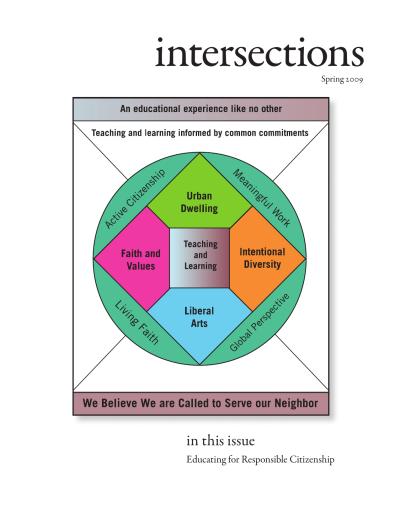
Pribbenow argues that the vocation of Augsburg College is to educate “dual citizens”—those able to live within the messiness of common work rather than resolve every tension once and for all. Drawing on John Courtney Murray on democracy as “the intersection of conspiracies,” Bill Moyers, Jean Bethke Elshtain, Stephen Carter, and the Augsburg vision statement “We believe we are called to serve our neighbor,” he names four common commitments and five principles of civic education that ground Augsburg’s incarnational mission in its city neighborhood.
-
 Editorial
From the Publisher
Arne Selbyg
No. 12 · Summer 2001
Selbyg reports that the Lutheran Brotherhood Foundation and the Lilly Endowment have funded the Lutheran Academy of Scholars, which since 1999 has gathered ten to twelve Lutheran scholars at Harvard for two-week summer seminars under Ronald Thiemann (themes: “Finding Our Voice—Christian Faith and Critical Vision” in 1999–2000 and “The Lutheran Public Intellectual: Faith, Reason and the Arts” in 2001), and announces that the academy will move to Berkeley in 2002 under Ted Peters to take up the intersection of faith and science.
-
 Reflection
David Kamins
David Kamins
No. 40 · Fall 2014
Kamins, a Jewish student at Muhlenberg College, reads Rabbi Joseph Soloveitchik’s The Lonely Man of Faith alongside his own journey at the Interfaith Understanding conference on the eve of Shavuot, finding in the dual figures of Adam I and Adam II a way to remain firmly grounded in his faith community while going out to learn from those around him.