Why All This Talk About Understanding the Mission of NECU Member Institutions as a Vocation?
Intersections No. 56 · Fall 2022
Introduction: Lutheran Higher Education is Vocation-Based Education
The theme of the 2022 Vocation of Lutheran Higher Education Conference asks the question, “Why all this talk about vocation?” The answer: We talk about vocation in the Network of ELCA Colleges and Universities because the concept of vocation provides an accurate understanding of the mission of the institutions in our community. Lutheran higher education (LHE) is vocation-based education. So, why all the talk? We do so because, for the Lutheran intellectual and educational tradition, the mission of a college or university is rooted in and explained by the concept of vocation. LHE, properly understood and implemented, is vocation-based education.
The received understanding of Lutheran higher education as a service for Lutherans is an artifact of the era of European Lutheran immigration. Lutheran colleges and universities were all founded in that era as service agencies to meet the higher education needs of Lutheran young adults. Even though that era is long over, Lutheran higher education has only recently recovered vocation-based higher education as the authentic description of the mission of LHE. After presenting a description of what has been recovered, I will then describe my sense that it is time review and assess our commitment to vocation-based education. It has been approximately 50 years since the work began to recover the Lutheran Reformation’s understanding of vocation-based education. After five decades, it is time to take stock, address shortcomings, correct missteps, and place ourselves in a stronger position to reaffirm our common commitment to vocation-based higher education.
Vocation-Based Education: Higher Education in a Lutheran Key
We begin with an overview of vocation-based education as the authentic expression of LHE by employing a simple musical metaphor. Even as the selected key, major or minor, sets the tone and is the musical foundation for a song, the concept of vocation sets the tone and is the conceptual foundation for the mission of LHE. Practices central to a vocation-based mission in higher education as conceived in the 16th century Lutheran reformation are these:
First, education is to be available to the entire community. The Lutheran movement of reform in 16th century Europe was not just about reform of religion and the church. It was also about the reform of society. One of the hallmarks of the reform of society brought about by the Lutheran reformation was an insistence that education should be provided to the community as a whole—including the revolutionary argument for the education of women—instead of just the wealthy through private tutors or through training for church leadership in monasteries. Access to education for the whole community is a core practice of LHE, rooted in the Lutheran Reformation of the 16th century.
Remember, as I mentioned earlier, that LHE is an educational tradition that was the first to insist upon education being available to the entire community. Lutheranism taught that God wanted all to be educated, giving the best opportunity to our cities and communities to thrive under wise leaders who would govern well. The commitment is most polemically and brazenly resident in an anecdote attributed to Martin Luther in which he is to have said that he would prefer to be governed by a well-educated and wise Muslim than an uneducated, stupid Christian. This was a bold statement about championing universal education in a time when the Ottoman Empire was threatening to conquer Christian Europe.
Vocation-based education commits an institution to provide access to all, open to all, and is the foundation for your institution’s freedom to be composed of persons from multiple backgrounds, as well as Lutherans, and to serve diverse constituencies as well as the constituency called the Lutheran church. Because it is a Lutheran institution of higher education, your mission is to educate whoever constitutes your institution’s community. Embracing vocation-based education as an institutional commitment is to embrace the foundational rationale for the demographic, personnel and enrollment changes that have occurred over the last seventy-five years at ELCA-related institutions and for your current mission to serve a diversity of key constituencies.
Second, vocation-based education defines education as the community calling individuals to discover their purpose in life and how they can use their education to benefit others as well as themselves; to serve the neighbor and contribute to the common good. Education is not just about receiving knowledge but about the use of knowledge and about developing an understanding of the communal obligations that come with knowledge. Vocation-based education certainly enables students to fulfill their personal needs and wishes, but vocation-based education also enables students to discover a sense of purpose through discerning how their lives will benefit the common good. A commitment to educating students to live meaningful, purposeful lives that benefit the common good as well as the individual is a defining practice of vocation-based education. We have come to discuss this practice often and in a variety of settings, such as this annual conference and our engagement with the Network for Vocation in Undergraduate Education.
Third, vocation-based education is holistic education. It is education that engages the whole scope of human knowledge and invites students as whole persons—body, mind, and spirit, into learning. It is an education rooted in the liberal arts, and it is the prerequisite to education having the capacity described above, namely, to call students to understand that knowledge is to benefit the common good as well as the individual.
A fourth practice of vocation-based education that receives less attention, even though it has been named in conversations about vocation and higher education in our Network of ELCA Colleges and Universities (NECU). This less discussed practice is that a commitment to vocation-based education is an institutional commitment embodied in the practices of individuals. One of the reasons that NECU is concerned to sponsor “all this talk about vocation,” including these annual conferences, is to encourage your college or university to understand and claim that, as an institution, it has a vocation and that its vocation is fulfilled when students discover their vocations. If I were to turn the question posed on the cover of our conference program into a declarative statement, it would read, “We have all this talk about vocation because NECU member colleges and universities should understand that their institutions have a vocation as surely as students, faculty, staff, and administrators do.
It is easy to avoid developing and sustaining an institutional commitment to vocation-based education by reducing the vocation-based education to one, often optional, tool—typically co-curricular programming—for assisting with the education of students. My friend, David Cunningham, who is director of NetVUE, does exactly that in his chapter, “Colleges Have Callings, Too: Vocational Reflection at the Institutional Level,” which is found in NetVUE’s second volume of scholarly articles, Vocation Across the Academy: A New Vocabulary for Higher Education. David argues in his chapter, that colleges and universities should add the richness of vocational reflection to their development of mission statements. Even as a student’s education can be enhanced by exposure to vocational reflection, so too, David suggests, vocational reflection at the institutional level can enhance a college or university’s understanding of its mission.
“Vocation-based education—an institutional commitment to community-wide, holistic education that calls students to use knowledge for the common good as well as personal benefit—defines the mission of Lutheran higher education.”
For LHE, David’s suggestion, while praiseworthy, is an example of reducing vocation to a programmatic application of the concept that keeps the concept of vocation from defining the institution’s calling, purpose, and mission. It provides a way of thinking helpfully about the mission; it does not define the mission. And it does not truly express what it means to claim that “institutions have a calling, too.” For LHE, the calling or vocation of an institution of higher education to hold in trust a commitment to vocation-based education. An institution’s vocation is not to use vocational reflection occasionally as an adjunct to strategic planning by its trustees—although that is good to do—nor is it to provide vocational reflection opportunities for its students—although that is also important to do. For LHE, the calling or vocation of a college or university is to ensure that its total educational mission, curricular and co-curricular, is vocation-based education.
Vocation-based education—an institutional commitment to community-wide, holistic education that calls students to use knowledge for the common good as well as personal benefit—defines the mission of Lutheran higher education. Resting on this foundation supports the delivery of an educational excellence. Doing so also protects institutions against forces favoring the commodification of education or those who would encourage your institution to succumb to educational fads.
Toward New Work and Correcting Things Not Done Well or Ignored
Having offered an overview of higher education in a Lutheran key, let us now turn to my belief that it is time to review and assess our work in reclaiming an understanding of LHE as vocation-based education.
This review and assessment must be done not because we erred when we recovered the theological concept of vocation as the driver of the mission of LHE. Instead, we must do so because we have work left undone, despite all the efforts in recent decades to restore and reclaim vocation-based education. This new work will include confessing and correcting mistakes and shortcomings made along the way in the movement to restore vocation to its central place. Taking-up work left undone, as well as confessing and correcting our past missteps, will allow us to more completely affirm and more deeply embrace vocation-based education as the shared mission of our community of higher education.
By my lights, we should address several constructive and corrective tasks. There may be more that other could identify.
First, let me turn to the constructive work we still need to do.
A. Constructive Work
A major task for NECU is the creation of a comprehensive list and definitions of key subsidiary vocation-based educational practices. The purpose is not to restrict or dictate your individual institution’s programs. Your institutions will continue to embody vocation-based education in a variety of ways. Nonetheless, it would be helpful if we could develop a list and definitions of high-level, subsidiary practices for our shared mission.
Several of your institutions have created such lists, sometimes for internal coaching or professional development programming and sometimes for marketing and communications purposes. Rooted and Open: The Common Call of the Network of ELCA Colleges and Universities also discusses key, high-level practices of LHE. We have, however, never developed and agreed upon a list as the Network of ELCA Colleges and Universities. Our collective enterprise would be enhanced by a shared list.
Some of the practices that would certainly be included are:
Humility in the fulfillment of our vocation. We approach our academic mission to educate for vocation not with arrogance but with a spirit of humility, always open to testing our commitments and ideas with insights from others. A Lutheran understanding of humility requires not a spirit of personal degradation but a willingness to recognize the interests and needs of others. Humility involves not putting oneself down but lifting another up. The concept of humility in the task of education is closely related to vocation-based education’s core practice of education as a calling to understand knowledge as a benefit for the common good as well as one’s own interests.
A spirit of service. Service, within and without the campus and engaged in humility for the sake of the common good is a principal feature of vocation-based education.
Freedom of inquiry and expression. The questioning of received knowledge as well as an openness to exploring new learnings, all without fear, must make a shared list. As expressed in Pacific Lutheran University’s statement about what it calls the “core elements” of LHE, all need to recall that the modern notion of academic freedom is not rooted in secular sources but in the intellectual tradition springing from the Lutheran reform of education in the 16th century. I will add that no straight line exists from 16th century Germany to the modern academy, but as the PLU statement states: “…It was the 16th century Lutheran reformers who first advanced the notion that freedom from coercion or reprisal was the singular condition in which teaching, learning, and research could take place.” A concern academic freedom was derived from the foundational Lutheran theological conviction about the freedom of the Christian person. The Lutheran Reformation’s reform of society extended this freedom to schools free of coercion and reprisal.
Other nominees. One surely would be the conviction that interfaith relationships enrich learning, as in the description of the Bernard Christensen legacy at Augsburg University. Care for the earth as well as human community would be another, as would be a welcoming spirit of hospitality in the exercise of higher education.
Whatever the list’s content, an agreed upon list with common definitions would helpfully provide a shared vocabulary and ideals for our collective work.
Three other critiques of our recovery of vocation-based education deserve further attention and public discussion.
“Vocation” as an intrusion of religion into higher education. A standing critique of vocation-based education is that it represents an inappropriate and potentially dangerous intrusion of religion into higher education. Widespread interest in considering vocational reflection as a tool for higher education has not eliminated the distrust felt by some about borrowing any theological concept to inform educational practice. NECU should foster more dialogue about the congruity between the ideals of the academy and the educational ideals of the Lutheran intellectual tradition. This dialogue should include an honest assessment of the sad history of the Christian churches attempt to limit free inquiry in higher education and a clearer articulation of the protections for free inquiry and academic autonomy afforded by the Lutheran intellectual and educational tradition.
Privilege. Some object that a commitment to vocation-based education is an arrogant exercise in privilege. The earliest commentary on this issue that I am aware of was made by the theologian Robert McAfee Brown, in his 1961 book, The Spirit of Protestantism. Brown notes, as do contemporary critics, that a sense of vocation in one’s daily work is not readily shared by those whose work is drudgery and whose lives in general have no time for reflection about vocation. A response to this critique requires recognizing and admitting that our engagement with vocation-based is a luxury by the world’s standards. But all aspects of private, residential, liberal arts-based higher education are a privilege in today’s world. We must redouble efforts to acknowledge the obligation that having this privilege imposes on us. We must commit ourselves to enhancing the common good, including the promotion of economic justice. We must also better describe that the Lutheran concept of vocation, at its root, defines the value and dignity of all human life and activity. It is a claim that one’s primary vocation in life can be outside of work-for-pay and that one can take pride in contributing to society through less-than-desirable work (as my father did at a furniture company after giving up his preferred work as a dairy farmer) while finding one’s true vocation outside of work-for-pay.
Secularists’ objections to God who calls. The critique is that a commitment to vocation-based education is impossible for those who do not accept the existence of God. How can one practice vocation-based education if there is no god who calls? The critique sometime contains an implicit, adjunct charge to the more general critique that vocation-based education is an inappropriate intrusion of religion into the academic enterprise of higher education.
It is true that, in Christianity, the one who calls is God through Christ. In the Lutheran church and its theology, Christians are to discern how God is calling them to live. In Lutheranism, this discernment always occurs in community. That insight about the role of community in discerning one’s vocation provides a response to the critique that vocation requires a caller. Those involved with LHE, but who are not Christian or theistic, are not required to affirm that God is calling them to their vocation. They should, however, come to understand that we are all in some form of community and that the voice of our community has a role in discerning our vocation. None of us is self-generated. The “community” of our parents gifted us with life, and the ongoing gifts of community, including assistance with vocational discernment, remain important for us all.
We have, however, underplayed this insight in our work. We must strengthen it the future.
B. Corrective Work
In the future, NECU must also address those things we have avoided or minimized despite the existence of resources in the Lutheran intellectual tradition for the work. Two concerns stand out for immediate attention: Affirming the diversity of our institutions and redoubling our commitments to diversity, equity, inclusion, and justice in vocation-based education.
DEIJ. NECU institutions have embraced the movement toward commonly known as diversity, equity, inclusion, and justice in higher education. The embarrassment is that our institutions did not make this move until external forces pushed the agenda.
The Lutheran tradition is part of the larger Christian movement, which at its best, has been a champion of what we now call DEIJ. The biblical prophets’ call for economic justice, the Christian insistence that God shows no favorites but welcomes all, the biblical commands to offer hospitality, and the rejection of a second century proposal to eliminate the diversity in the four gospels of the New Testament by harmonizing them into a single narrative are all testimony that we should have received the message! We need to confess that we should have been in the lead for DEIJ, not among those who reacted to calls from others.
NECU should more actively confess our past failures related to DEIJ and double-down on our new commitments. Notable African American alumni of NECU institutions have universally commented in conversations with me that, although they are deeply grateful for their education and the opportunity to attend a NECU college or university, they never felt truly welcomed or part of their college or university community as a student. They urge a clear-eyed look at our past and an ever-stronger contemporary commitment to DEIJ.
In the effort to more fully embrace DEIJ, we should continue to take full advantage of the resources provided by secular agencies and the best of our political ideals about equality. We should, however, remember that we have a resource richer than the insistence on equal rights. The Lutheran tradition, along with others in the religious community, calls for DEIJ based on what Dr. King called “the beloved community.” The answer to racism and injustice lies more in embracing the trajectory of the moral arc of the university bending toward justice and living into the beloved community than mere assertion of political rights. We have much to offer through living out our vocation as LHE.
Diverse Constituencies/Multiple Vocations. In our effort to reclaim a shared vocation to vocation-based education, it has been too easy to forget that this common calling or vocation is lived out in specific places and contexts, resulting in a rich diversity of institutionally specific missions. By failing to emphasize the diversity of missions rooted in the shared work and mission of NECU institutions, we have inadvertently failed to recognize and celebrate how our 27 distinctive institutions serve a wide array of publics, bringing different expressions of the gifts of LHE to many.
By failing to actively celebrate the diversity among its institutions, NECU has failed to tutor our member institutions that they need not bracket their Lutheran identity when reaching out to their diverse constituencies. NECU should help member institutions to understand that their Lutheran affiliation invites service to a diversity of constituencies. Serving a variety of constituencies is as much a measure of a college or university’s “Lutheran-ness” as is a NECU member’s service to the Lutheran community. A college or university does not need abandon or bracket a Lutheran identity when serving non-Lutheran constituencies. The vocation to do so is baked into a Lutheran affiliation. We should have made this truth clearer in describing the openness of LHE in NECU’s statement, Rooted and Open.
Making use of an undeveloped resource within the Lutheran intellectual tradition could help us learn to celebrate serving diverse communities as an integral part of an institution of LHE. The contemporary Lutheran insight that individuals have multiple vocations should be extrapolated to describe the vocation of a Lutheran institution’s relationship with multiple constituencies.
I have multiple vocations: I am a husband, a pastor, a higher education bureaucrat, a registered member of the democratic party, and member of St. Luke’s Lutheran Church of Logan Square in Chicago. Each vocation is distinctive. In each role I have different tasks, but they are all founded on the vocation to which God has called me. I did not need to tell the Broadway Democrats (where I was a member while living in New York) that I was a Christian and that I understood my Democratic Party membership to be an expression of my vocation as a disciple of Jesus, but I also did not need to hide it. In the same way, a college or university can be member of NECU and affiliated with the ELCA (or ELCIC) while at the same time relating to other groups and communities with other educational interests without in any way abandoning or needing to bracket its Lutheran institutional identity. Sharing that identity directly with diverse constituencies is not a necessity, but a college or university should also not feel compelled to hide or mask its NECU identity.
NECU has committed itself in its recently adopted strategic plan to improve our collective understanding of the richly diverse expressions of Lutheran identity among NECU institutions. It’s a first, albeit overdue, step toward repairing this lapse in shared work.
Conclusion
In all our future work, fostering a kinder and gentler attitude in our conversations about embracing a common calling to vocation-based education will be important. The concept is quite foreign to many people as an organizing principle for high education, and we need to be kind in our effort to restore LHE’s original focus on vocation-based education. As I noted above, we must recognize that many in the academy distrust drawing on any theological concepts or religious traditions as resources for higher education owing to the occasionally foolish—even arrogant and astonishingly parochial—actions by the churches who have sponsored higher education in the United States. Hence, some persons will have difficulty with the concept of vocation and oppose using the term. Even persons coming from a Christian perspective have difficulty with vocation-based education because of they (mistakenly) fear it represents a lukewarm version of LHE, education that is sort-of Lutheran without being too Lutheran. Vocation-based education’s Lutheran authenticity is not self-evident even to some who come to higher education out of a Christian commitment. So, the difficulty is felt by persons at our institutions from within the academy and from persons active in the Lutheran church as well as the academy. Leaning into an understanding of LHE as vocation-based education is a long-term project. We need a gentile perspective as we pursue the task.
Our journey as the Network of ELCA Colleges and Universities has only recently begun. As we strive to reclaim a living heritage for higher education bequeathed to us from the 16th century Lutheran Reformation, we have incomplete work to conclude, mid-course corrections to execute, and some new work to take-up as we continue to live into the 500-year-old intellectual and educational tradition of LHE.
-
 Editorial
From the Editor: Why All This Talk About Vocation?
Colleen Windham-Hughes
Windham-Hughes introduces the Fall 2022 issue built around Mark Wilhelm’s keynote “Why all this talk about vocation?” and previews five panel responses, two first-time conference reflections, and companion pieces on Womanist theology — framing vocation as a call not to privilege but to constructive and corrective work that undoes unjust systems.
-
Response
Response to Mark Wilhelm: Vocation, Mission and Privilege
Marit Trelstad
Trelstad affirms Wilhelm’s claim that vocation is the foundational shared mission of Lutheran higher education rather than one program among many, and presses the critique that calls to “vocational reflection” can mask privilege — arguing that an intersectional lens shows vocational discernment is in fact a matter of survival and flourishing for students from marginalized communities.
-
Response
Response to Mark Wilhelm: DEI, Great; DWS (Dismantling White Supremacy), Even Better
Vic Thasiah
Thasiah argues that if Lutheran colleges and universities want to live out their commitment to the flourishing of all, DEI is good but DWS — dismantling white supremacy — is even better, and offers three Lutheran sensibilities (suspicion of self-righteousness, the decolonial shockwave of the cross, and critical thinking that can still register awe) that can make DWS a core practice of higher education.
-
Response
Response to Mark Wilhelm: Distinguishing Between Identity and Vocation
Andrew Tucker
Tucker proposes that NECU’s next most faithful step is to faithfully and effectively differentiate vocations and identities — arguing that identity is who you are, vocation is what you do, and that recognizing the plurality of both helps Lutheran institutions name which work is theirs to take up and which is good work that belongs to someone else.
-
Response
Response to Mark Wilhelm: Vocation—Wide Perspective Questions
Mary-Paula Cancienne
Cancienne, drawing on Iain McGilchrist, asks whether higher education has prioritized micro lenses at the expense of the macro view, and invites educators to hold the drama of individual vocation stories within a wider plot that includes James Webb Telescope wonder, climate grief, the long shadow of enslavement, and the resilience of native populations.
-
Response
Response to Mark Wilhelm: Adopting the Framework of ‘Because’ and ‘Therefore’
Paul C. Pribbenow
Pribbenow describes how Augsburg University responded to its dramatic demographic transformation (from 18% to nearly 70% BIPOC entering students over sixteen years) by adopting an institutional vocational statement and a simple “because/therefore” framework for translating particular Lutheran theological convictions into institutional programs, policies, and practices.
-
Article
Work Works
Julius Crump
Crump argues that in an era of class-stratified careerism and the “ruins of neoliberalism,” commencement-speech rhetoric about heroic vocation will not resuscitate vocation — instead, professors embodying vulnerability, extemporaneity, and contemporaneity in the classroom can show students that consistent work, embodied as service to others, is itself worthy.
-
Reflection
Why All This Talk About Vocation?
Madyson Ray
Ray, a junior at Midland University and the only student attendee at the 2022 conference, reflects on four workshops — on teaching womanist thought, on supporting student-athletes, on resistance to the word “vocation,” and on vocational reflection — and brings home concrete ideas including a women’s-history scavenger hunt and semester-long vocational reflections.
-
Institutional Focus
LibGuide: Introduction to Womanist Theology
Elli Cucksey
Cucksey, the head librarian at Trinity Lutheran Seminary, recounts how Beverly Wallace’s Introduction to Womanist Theology class — the first offering of the ELCA Seminaries’ Womanist Theology Initiative — led her to build a publicly available LibGuide that amplifies Black women’s voices and gathers the resources of the course for future students.
-
Article
Doing the Work One’s Soul Must Have
Beverly Wallace, Yolanda M. Norton
Norton and Wallace describe the Womanist Experiential Learning Initiative — including the Beyoncé Mass, study-abroad partnerships in Portugal, Brazil, and Ghana, and the Black Girl Magic Academy for teenage girls — as a way of centering Black women’s voices in theological education and doing, as Katie Geneva Cannon put it, “the work…that one’s soul must have.”
-
 Editorial
From the Publisher
Mark Wilhelm
No. 55 · Spring 2022
Wilhelm announces his planned retirement on January 31, 2023, after serving as the founding executive director of the Network of ELCA Colleges and Universities, and gives thanks for the privilege of helping NECU articulate a shared vision for Lutheran higher education in twenty-first-century North America.
-
 Editorial
From the Publisher
Mark Wilhelm
No. 53 · Spring 2021
Wilhelm reflects on an NPR report of teenagers’ pandemic diaries and the fraught Christian history of struggling to live out Jesus’s ethic of love, framing the issue as a record of NECU institutions working out how to act for the common good through the pandemic of 2020–2021.
-
 Editorial
From the Publisher
Mark Wilhelm
No. 52 · Fall 2020
Wilhelm argues that the “hackneyed” expressions of higher education — “you are not just a number,” “the college experience,” “risen to the challenge” — tell the simple truth about NECU institutions even as the Covid-19 pandemic has pushed budgets, employees, and campus life to the breaking point.
-
 Editorial
From the Publisher
Mark Wilhelm
No. 51 · Spring 2020
Wilhelm frames the issue by tracing how Lutheran educational ideals — once a primary source of contemporary higher education — were masked in the United States, and introduces a NECU initiative that uses the case of business ethics to explore Lutheran social teaching as an academic resource.
-
 Editorial
From the Publisher
Mark Wilhelm
No. 50 · Fall 2019
Wilhelm frames the issue by noting that a federal court’s vindication of Harvard’s race-conscious admissions process is a win for higher education’s commitments to diversity, equity, and inclusion — and argues that for Lutheran higher education, the commitment to diversity is an old and foundational claim, rooted in Christianity’s openness to all and reflected in the four diverse gospels of the New Testament.
-
 Article
Rooted and Open: Background, Purpose, and Challenges
Mark Wilhelm
No. 49 · Spring 2019
Wilhelm traces Rooted and Open’s seventy-year backstory — from Conrad Bergendoff’s 1948 call for a Lutheran philosophy of education through the recovery of the vocation tradition — and describes the document’s process, purpose as a teaching and study resource, and the embodiment, contextual, and cultural challenges it implies for NECU institutions.
-
 Editorial
From the Publisher
Arne Selbyg
No. 16 · Winter 2003
Selbyg reports that “vocation” is surely among the top three words in Intersections’s history and congratulates nine ELCA institutions—Augsburg, Augustana (Rock Island), Concordia (Moorhead), Gustavus Adolphus, Luther, Pacific Lutheran, St. Olaf, Valparaiso, and Wartburg—on receiving roughly two-million-dollar Lilly Endowment grants for the “Programs for the Theological Exploration of Vocation,” while reminding readers that for Lutherans the priesthood of all believers means callings to be accountants, nurses, police officers, and home makers count as fully as callings into ministry.
-
Book Review
Unconventional Wisdom and Talking about God: A Review of Beckstrom’s Leading Lutheran Higher Education in a Secular Age
Ann Rosendale
No. 53 · Spring 2021
Rosendale reviews Brian Beckstrom’s Leading Lutheran Higher Education in a Secular Age, recommending its diagnosis of the gap between espoused and perceived Lutheran identity at ELCA schools and its prescription—Trinitarian Missiological Ecclesiology and a campus-wide willingness to talk explicitly about God.
-
 Book Review
Robert Benne: Quality With Soul: How Six Premier Colleges and Universities Keep Faith With Their Religious Traditions
Joy Schroeder
No. 13 · Winter 2002
Schroeder reviews Robert Benne’s Quality With Soul (Eerdmans, 2001), which assesses the secularization documented by James T. Burtchaell’s The Dying of the Light and names six “bright lights” that resist it: Calvin, Wheaton, Baylor, Notre Dame, Valparaiso, and St. Olaf. Benne argues that piety alone or “generic Christianity” is insufficient—a school’s specific denominational intellectual tradition must permeate mission statements, classroom, and chapel, sustained by a critical mass of identifying faculty (he proposes a 2:1 ratio and at least one-third communicant membership), a first-rate theology department as “trustworthy guardian,” and visionary presidential and board leadership. Schroeder flags the under-representation of student and faculty voices but commends the book as required reading for presidents, board members, and faculty seminars at church-related institutions.
-
 Response
"Whose Future?" or "Social Justice and the Lutheran Academy?"
Marsha Heck
No. 1 · Summer 1996
Heck argues that the future of Lutheran higher education lies less in defining Lutheran distinctiveness than in moral action grounded in face-to-face relationships with others. Drawing on David Lotz’s two-kingdoms theology of citizenship, Ernest Simmons’s relational reading of Luther, Arthur Preisinger’s indictment of the German Lutheran misreading of two kingdoms during the Third Reich, Starla Stensaas of Dana College, and Paulo Freire’s dialectic of empowerment, she calls Lutheran colleges to integrate moral reflection with moral action—to move students’ muscles against what is not true as well as to feel truths in their bones.
-
 Article
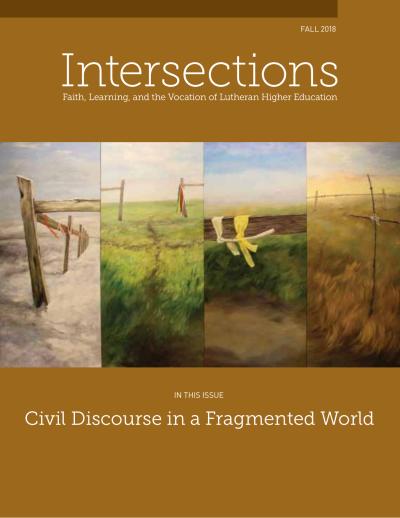
The Musician's Vocation
Jeffrey Bell-Hanson
No. 48 · Fall 2018
Bell-Hanson argues that musicians, who exercise profound influence over the emotional flavor of a moment, are called not merely to technical proficiency but to a sense of vocation: understanding their art well enough to use it responsibly, to intend truthfulness rather than manipulation, and to articulate its significance in dialog with other disciplines.
-
 Article
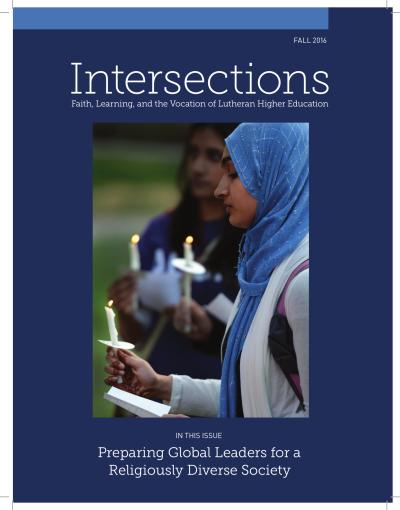
Religious Diversity and the Vocation of a Lutheran College
Darrell Jodock
No. 44 · Fall 2016
Jodock argues that a college which takes its Lutheran values seriously is well positioned to foster inter-religious relations along a “third path” that is both religiously rooted and inclusive. He traces the relational and communal character of Lutheran theology, develops a Lutheran understanding of deeper freedom, the theology of limits, and human complexity, and shows how a down-to-earth image of God offers theological resources for overcoming the anxiety and fear that block interfaith engagement.