In his pamphlet entitled, Whether Soldiers, Too, Can Be Saved, Luther addresses the question of calling and whether some callings are false. The cover letter to the honorable Assa von Kram notes that “…you and several others asked me to put my opinion into writing and publish it because many soldiers are offended by their occupation itself” (Luther 93). This and a related question—what sort of work can be properly classified as a vocation?—deserve reflection to reach a deeper understanding.
Like Luther, I have reached the conclusion that economists, too, can be saved and that my vocation as a professor of economics and my students’ careers as learners (and eventual practitioners) of the discipline can be proper vocational callings from God. This essay will give a brief description of how these questions have arisen in my life and work and consider where vocation does (and where it could) intersect with the discipline of economics. I will touch on the question of defining a “proper” vocation as it relates to how one characterizes preferences in economics. However, a full comparison of vocation and preferences will have to be the subject of another essay.
In Fall 2002, I was in my fifth year as an assistant professor of economics at Utah State University. My research was proceeding at a reasonable pace and I was meeting my teaching and service obligations, so tenure (while not guaranteed) seemed likely. Yet I had the distinct and nagging sense that Utah State was not the place for me to make a career. Part of this was for personal reasons—but the sense of mis-fit was deeper than that, and had to do with the separation I felt of faith from work. Professors at public universities must take care to separate religious faith from what is taught in the classroom, and I believe that this separation is important at any university. But in Utah, where it is impossible to live without bumping up against religious faith and its effects on everyday life, this seemingly artificial separation bothered me. If Luther was right, and every person has a vocation (a calling from God to a particular kind of work in the world) then it ought to be possible to live out this calling as part of a life of faith, instead of separate from it. I longed for a workplace where I could more overtly talk about and live my life of faith.
Not surprisingly, an opening at Pacific Lutheran University that Fall struck me as a calling. The background sense of searching I had been experiencing made the listing (in my field and at a university owned by my church) seem to be exactly what I’d been waiting for. God was calling me—what else could I do but apply?
As it turns out, I was right in ways I could not have imagined. Since arriving at Pacific Lutheran, I have been drawn into the University’s Wild Hope Center for Vocation. This work has given direction to my own sense of calling, and more importantly to my work with students, both inside and out of the classroom. It has also afforded me the opportunity to think deeply about vocation and its relationship to my role as a faculty member.
Whether Economists, Too, Can be Saved
Luther begins his essay by noting that there is a distinction between the occupation of soldier, and the soldier (man) himself. He then notes that ultimate salvation depends not on the occupation one holds, but on the grace that comes through faith in Christ. Since acts do not save, no war (no matter how justified) will earn salvation. The remainder of Luther’s essay is divided into three parts. In the first part, he argues that the occupation of soldier can be godly, for a number of reasons. He then goes on to conclude that some wars are justified and therefore godly. Finally, Luther argues that the person who holds the occupation of soldier can be godly, and that soldiers may work for pay. Interestingly, Luther sketches out a simple model of the feudal economy, in which soldiers provide protection for farmers, who (in turn) feed soldiers. He writes,
The farmers feed us and the soldiers defend us. Those who have the responsibility of defending are to receive their income and their food from those who have the responsibility of feeding, so that they will be able to defend. Those who have the responsibility of feeding are to be defended by those who have the responsibility of defending, so that they will be able to provide food. (128)
This is a rudimentary version of the circular flow diagram taught in economics courses today, with the soldiers purchasing inputs (food) from farmers, and providing an output (protection services) to those same farmers.
“Is the call to economics as a field a proper vocation?”
Now an economist is not a soldier. We are not called to take up arms against others. And yet, our policy prescriptions affect human lives and can, on occasion, lead to human suffering and even death.1 We are seen, by some, as promoters of greed—as facilitators of acquisitiveness. Of course, self-interest, which is assumed in the standard modeling framework (Walsh 401-405), and greed are not the same, but the confusion of the two is common. And so the question arises: Can an economist, too, be saved? Is the call to economics as a field a proper vocation?
As with soldiers, one may distinguish between the person and the occupation. As Luther notes, a man sometimes “takes a work that is good in itself and makes it bad for himself by not being very concerned about serving out of obedience and duty” (129). What matters is the reason the role is undertaken. Thus, one who “seek[s] only his own profit” is not right or good, even when the work is justifiable (129). Motivation matters. Yet the question remains whether a person may be saved even as they serve in an “unjustified” occupation (if such a thing exists).
Luther himself was a professor, and remained so even after he began the reform movement within the Catholic church. Thus, it seems clear that Luther would agree the role of professor is a proper vocational calling, as long as one does not use it to seek money or favors. But what about economics as a calling? Can one legitimately profess economics? Perhaps a distinction can be made between the field and the occupation. As a professor of economics, I am called, first and foremost, to profess. Economics is the discipline I am trained in, and the topic I profess most regularly, but it is through this profession that I serve both my students and colleagues. This is my vocation.
Self-Interest and Being-Called
Is the profession of economics, then, an unethical thing? After all, doesn’t economics promote self-interest above all and help devise ways for firms and individuals to obtain more at the expense of other people (including unborn future generations), non-human creatures, and the earth? Am I not training little self-interested (greedy) creatures to build empires and exploit the world around them? You will not be surprised to learn that my answer to this question is “no”—with some qualification. For one thing, “study of” is not the same as “advocacy for.” While it is true that rational self-interest is a foundational assumption in almost all economic modeling, this is a statement of the human condition, not necessarily an assessment of its desirability.
Adam Smith, the founder of modern economic theory, defends the distinction between self-interest and mere greed. In both of his two major works, The Theory of Moral Sentiments (1759) and The Wealth of Nations (1776),2 Smith assumes that self-interest is not in-and-of-itself morally objectionable. He writes:
We are not ready to suspect any person of being defective in selfishness. This is by no means the weak side of human nature, or the failing of which we are apt to be suspicious… Carelessness and want of economy are universally disapproved of, not…as proceeding from a want of benevolence, but from a want of the proper attention to the objects of self–interest. (Moral Sentiments XII.II.87)
And yet, what Smith here describes as mere human nature and neutral motivation for economic action was for Luther the root of sin. Indeed, closely related to self-interest is Luther’s view that people are “curved in on themselves.” Yet notice that, for Luther, the condition of being curved in on oneself is morally objectionable; it closes us off from God and the needy neighbor. It is the duty of the Christian to live life in service to the common good. What is this life lived in service to the common good? Luther’s answer: Vocation.
Unlike Luther, then, economists take self-interest as a starting point and use the assumption to better understand human action, not its motivation. This is the point of departure, and also where economics ceases to consider vocation as it is understood in other disciplines. Thus, to ask a mainstream economist to consider vocation is tantamount to asking her to move into some distant and slightly uncomfortable vacation rental home, with its coffee maker that doesn’t work in the way she’s used to and the neighbors who speak a dialect that she has trouble understanding. It might be possible, even pleasurable, but it is not quite like home where she knows which drawer holds the apple slicer.
In short, the economist takes no position on this fundamental aspect of the human condition. Instead, she considers the world as it exists, through the lens of self-interest. Indeed, most economists would say this is not properly a part of our discipline. It is a foundational assumption that is rarely noticed, and even less commonly questioned.
In other words, if being self-interested is morally neutral, then no claims regarding who should be served can be made. The economic agent is left alone, to serve who he wills in his self-interested way. This is not to say that each person has the capacity to fulfill all of his needs, but rather that by invoking the self-interest of others, his own needs are also satisfied. Self-interest, not direct attention to the neighbor’s need, becomes the root of true benevolence. As Smith writes in his later work:
But man has almost constant occasion for the help of his brethren, and it is in vain for him to expect it from their benevolence only…It is not from the benevolence of the butcher, the brewer, or the baker, that we expect our dinner, but from their regard to their own interest. We address ourselves, not to their humanity but to their self-love, and never talk to them of our own necessities but of their advantages. (Wealth of Nations 13)
Smith further notes that as long as markets are free and information is easily available, self-interested is guided, as if by an invisible hand, to improve society’s general level of welfare and therefore the welfare of others. It is possible to go even further and explain altruistic behavior while remaining within the realm of self-interest, so that people are concerned with the welfare of others and the common good due to their self-interested nature (Andreoni; Becker). But this concern for the welfare of others is not the same thing as vocation. Economics has no sense of responding to a call to serve the common good in the way that Luther describes vocation. Instead, because the discipline assumes self-interest, serving the common good is a result which must be shown to come from a reinterpretation of self-interest.
“This concern for the welfare of others is not the same thing as vocation. Economics has no sense of responding to a call to serve the common good in the way that Luther describes vocation.”
Now, this setting aside of moral questions regarding human nature has enabled economics to make great strides in describing the world around us. Metaphors like Smith’s invisible hand or Marshall’s scissors of supply and demand (Marshall V.III.7) help us understand the nature and advantages of markets as a way to organize economic activity. Advances like David Ricardo’s description of gains from trade (ch. 7)—the idea that engaging in trade can make both trading partners better off—suggest that individuals and countries are better off with open economies than with closed. Cournot’s use of mathematical models to describe competition between firms has enabled new discoveries and relatively accurate accounts of outcomes in many industries (ch. 4-8). In all of these cases, self-interested behavior was assumed, never questioned. Vocation simply doesn’t arise in this work. Furthermore, many of these ideas would be difficult, if not impossible, to describe if the writer had to justify the use of self-interested behavior before presenting his theory. What McCloskey calls “prudence only”—at the exclusion of the other virtues—has gotten us a long way (“Bourgeois Virtue” 297-317).
Accounting for Vocation
Since the question of who should be served does not arise in mainstream economics, the discipline is left without obvious tools to address questions of vocation. This is not seen as a problem, as mainstream economics does not often see a need to consider vocation. That said, the work of two economists (among many others whose deserving work is not mentioned here) questions both the assumptions of the mainstream economic model and the desirability of the discipline’s so-called neutrality on ethical issues. This work might provide a way to consider vocation while remaining within the discipline of economics, at least as broadly construed.
First, Deirdre McCloskey has written a number of works in which she questions the assumptions economists make. Starting with The Rhetoric of Economics, and through The Bourgeois Virtues, McCloskey points out that mainstream economic analysis relies on only one of the seven classical virtues, that of prudence. She notes that this limited view leaves us unable to address many questions of interest (which, I would say, includes questions of vocation), and causes some of our claims to be silly, at best, and harmful, at worst. This idea that the discipline might properly address other virtues, while still remaining recognizably economics, could provide a way to incorporate questions of vocation and the common good into economics. It could also lead us to more sensible conclusions and away from what McCloskey calls the “the unexamined rhetoric of economic quantification” and “the rhetoric of significance tests” (Rhetoric of Economics, ch. 7-8).
“This idea that the discipline might properly address other virtues, while still remaining recognizably economics, could provide a way to incorporate questions of vocation and the common good into economics.”
Second, George DeMartino has called for the discipline of economics to address questions of ethics in a more rigorous way. The consideration of who is harmed by the actions of economists is an ethical question that DeMartino suggests needs to be addressed. Who should be served is a closely related topic that will naturally arise as DeMartino’s challenge is addressed. And this question leads directly to what I define here as vocation. Economic ethics does not necessarily (or only) imply an economic understanding of vocation. It might also provide an avenue into the question of what should occur. “Should” is not a word that mainstream economics is well-equipped to address, although it is a necessary word for thinking about vocation.
As it stands, mainstream economics does not, and for many cannot, address vocation. Because we take self-interest as given, questions of calling and serving the common good cannot be completely or perhaps even adequately addressed. This, I believe, is a loss for the discipline. While it seems safe to conclude that economists, too, can be saved—even those who have no interest in virtues other than prudence or in questions of ethics—our discipline would be enriched by the addition of those who work outside the standard paradigm. So, then, I issue this call to action: Let us go forth and find ways to talk about vocation, even as we remain economists.
End Notes
1. An example of the way the decisions of economists affect human lives can be found in the causes of the Great Depression of the 1930s. Many economists conclude that government actions taken at the behest of economic policymakers either caused or contributed to the duration and severity of the depression. See “Symposia: The Great Depression” in Journal of Economic Perspectives 7:2 (Spring 1993). Among the causes considered are government monetary and fiscal policies as well as nations’ adherence to the gold standard.
2. While self-interest is generally assumed in The Wealth of Nations, it is one of many human characteristics addressed in Smith’s other major work, the Theory of Moral Sentiments. This work, then, is necessary background reading for The Wealth of Nations, and it is unfortunate that some consider only Smith’s second book without the context given in the first.
Works Cited
Andreoni, J. “Impure Altruism and Donations to Public Goods: A Theory of Warm-Glow Giving.” Economic Journal 100 (June 1990): 464-77.
Becker, G.S. and Barro, R.J. “A Reformulation of the Economic Theory of Fertility.” Quarterly Journal of Economics 103:1 (Feb. 1988): 1-25.
Cournot, Anotine A. Researches into the Mathematical Principles of the Theory of Wealth. Trans. Nathaniel T. Bacon. London: MacMillan Company, 1897.
DeMartino, George. “A Professional Ethics Code for Economists,” Challenge 48:4 (July-Aug. 2005): 88-104.
Luther, Martin. “Whether Soldiers, Too, Can be Saved,” Luther’s Works (American Edition), volume 46. Philadelphia: Fortress, 1967.
Marshall, Alfred. Principles of Economics, 8th ed. London: MacMillan Press, 1920.
McCloskey, D. “Bourgeois Virtue and the History of P and S.” The Journal of Economic History 56:2 (June 1998): 297-317.
_____. The Bourgeois Virtues: Ethics for an Age of Commerce. Chicago: University of Chicago, 2007.
_____. The Rhetoric of Economics. Madison: University of Wisconsin, 1998.
Ricardo, David. On the Principles of Political Economy and Taxation, 3rd ed. London: John Murray, 1821.
Smith, Adam. The Theory of Moral Sentiments. United Kingdom: Empire, 2011.
_____. The Wealth of Nations, Bantam Classics Edition. New York: Bantam, 2003.
“Symposia: The Great Depression.” Journal of Economic Perspectives 7:2 (1993): 19-102.
Walsh, Vivian. “Rationality as Self-interest versus Rationality as Present Aims.” American Economic Review 84:2 (Feb. 1994): 401-405.
-
 Editorial
From the Publisher
Mark Wilhelm
Wilhelm reports that decisions at the February 2013 LECNA and ELCA presidents’ meetings authorized reviews of funding and organizational practices and appointed a working group to draft a presidential statement on what it means to be a college or university of the ELCA, signaling a more substantive future role for the annual presidents’ gathering in shaping the shared identity and common mission of ELCA schools.
-
Editorial
From the Editor
Jason A. Mahn
Mahn introduces the issue’s six essays as parallel attempts—from poetry, economics, choral music, biology, religion, and Lutheran higher education—to resist our culture’s fact-value split, and uses Augustana’s Fritiof Fryxell, a 1922 biology and English graduate who began teaching just as the Scopes Trial ignited, to illustrate how church-related colleges have long held faith and disciplinary inquiry together.
-
Article
Valuing Poetry
Allison Wee
Writing from California Lutheran University as “value” in higher education collapses into “can it get you a job?”, Wee makes a case for poetry as a life-saving discipline. Drawing on William Carlos Williams, Shakespeare, the Psalms, Wordsworth, Pattiann Rogers, Mary Oliver, and her own Environmental Literature assignment that sends students outside for an hour of attentive stillness, she argues that the poet’s skill of translation cultivates the close attention, fresh perspective, and immaterial dimensions of life her students need most.
-
Article
Singing Faith
Adam Luebke
Luebke describes the Waldorf College Choir as a community of faith whose daily devotions, century-long lineage from F. Melius Christiansen, and disciplined wrestling with sacred repertoire—from Fauré’s Requiem to African-American spirituals to Romans 8 sung backstage—form students spiritually as they form them musically, so that fully grasping what they sing becomes a discovery of why they sing.
-
Article
Living Biology
Stephanie Fuhr
Fuhr recounts how a one-credit Becoming Biologists course at Augustana College was rebuilt around the biological worldview after a student flagged John Janovy Jr.’s argument that values are legitimate tools in biology. Drawing also on Stephen Jay Gould’s The Mismeasure of Man, she argues that visions and values—not skills alone—inspire a life’s work in science and provide the foundation for lifetime engagement in the work of biology.
-
Article
Professing Religion
John D. Barbour
Barbour reflects on the vocation of a Professor of Religion at St. Olaf College, asking when and how a teacher should disclose personal faith in the classroom. Drawing on his graduate teachers Anthony C. Yu and Langdon Gilkey, and on Augustine’s Confessions, Dorothy Day, Malcolm X, C. S. Lewis, and Kathleen Norris, he argues that teaching autobiography invites teaching autobiographically—and that professing religion is finally a matter of how one believes, not just what.
-
Article
A Lutheran Dialectical Model for Higher Education
Ernest L. Simmons
Drawing on “The Freedom of a Christian,” simul justus et peccator, Richard Hughes, Joseph Sittler, Martha Nussbaum, and Tom Christenson, Simmons argues that the Lutheran tradition informs an open, dialectical educational model that holds Christian and academic freedom together. He locates vocation at the intersection of the practical (why are you here?) and the existential (why are you here?) and proposes Lutheran higher education as education for self-transcendence and leadership Soli Deo Gloria.
-
 Article
Vocation and Civil Discourse: Discerning and Defining
Lynn Hunnicutt
No. 48 · Fall 2018
Hunnicutt draws on Rabbi Amy Eilberg’s reading of Moses’ calling to identify four features of vocational discernment — attention, wonder, communal consciousness, and humility — and argues that these same qualities are also key aspects of civil discourse, so that forming students for vocational discernment is simultaneously forming them for civility.
-
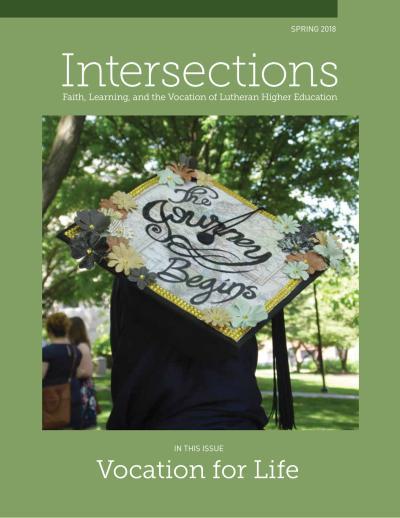 Editorial
Guest Editorial
Lynn Hunnicutt
No. 47 · Spring 2018
Hunnicutt traces the etymology of vocation through its cognates — evoke, provoke, convocation — to argue that vocation presumes a relationship between caller and called, that callings are often grounded in ordinary words and humble lives, and that recognizing vocation as plural and lifelong relieves colleges of the pressure to help students find a single calling while on campus.
-
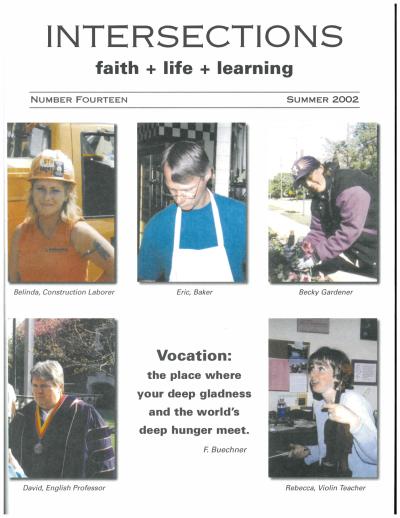 Article
Vocational Discernment: A Comprehensive College Program
Darrell Jodock
No. 14 · Summer 2002
Jodock, whose Gustavus Adolphus was one of twenty colleges to receive a Lilly “Theological Exploration of Vocation” grant in 2000, defines vocation not as occupation but as a self-understanding that nests the self in community. Reading Robert Putnam’s Bowling Alone on the collapse of secondary communities alongside Luther’s ethic of community benefit and five Lutheran principles (graciousness, Christian freedom, community, God active in the world, the theology of the cross), he walks through Gustavus’s three-level design—a definition of vocation open to other faith traditions, “middle principles” drawn from Sharon Parks’s Common Fire, and a long menu of programs coordinated by a new Center for Vocational Reflection—hoping that, in the language of Holocaust studies, graduates will be “resisters” and “rescuers” rather than bystanders.
-
 Reflection
Tom Natalini
Tom Natalini
No. 40 · Fall 2014
Natalini, a Susquehanna University senior raised Lutheran, schooled Mennonite, and seasoned by a meditative encounter in India, reflects on his journey through churchgoing, philosophy, near-Jewish conversion, and Buddhist practice to a stance he calls patience — neither Christian, Jew, Buddhist, seeker, nor “none.”
-
 Editorial
From the Publisher: Introduction and Invitation
Lamont Anthony Wells
No. 57 · Spring 2023
Wells introduces himself as the new Executive Director of NECU, succeeding Rev. Dr. Mark Wilhelm, and frames this Spring issue as a passionate response to the crises facing higher education amid threats to academic freedom and the well-being of educators.
-
 Article
The Vocation of Intersections on its Twentieth Birthday
Jason A. Mahn, Robert D. Haak, Tom Christenson
No. 43 · Spring 2016
The three editors of Intersections — Bob Haak, Jason Mahn, and Tom Christenson (in spirit, following his death in 2013) — trace the twenty-year vocation of the journal itself: its 1996 birth at Capital University; its coming-of-age years of debate over institutional markers, two-kingdoms theology, and Lutheran identity; the ascendancy of “education for vocation” as the central marker of Lutheran higher education; and its ongoing identity in relation to a changing ELCA and to the broader cultural conversation about purpose, wholeness, and the vocation of higher education.
-
 Reflection
Vocation
Matt Peterson
No. 10 · Fall 2000
In a chapel homily, St. Olaf student Matt Peterson quotes former St. Olaf professor Howard Hong’s 1955 Our Church and the World—“the tragedy is that we seem to have lost the full grasp of the Christian vocation”—to argue that vocation, from the Latin vocare, is centrally a call into daily communion with God and into continually becoming Christian, not the title of a successful career marked by GPA, win-loss records, honorary degrees, or net worth. Drawing on Anthony Bloom on prayer that must be lived, he indicts the dread of Monday, the “come hell or high water” demand for production, and the “faith community” that we take on faith.
-
 Article
Engaging the Local Community: Why Bother?
Mary S. Carlsen
No. 27 · Spring 2008
Carlsen traces the often adversarial history of town-gown relations from the medieval universities through the Battle of St. Scholastica Day to the “ivory tower” pattern of American higher education, then argues that Lutheran colleges should engage their local communities for practical, educational, ecological, moral, and theological reasons. Drawing on her work in social work education at St. Olaf and on Ira Harkavy, Ernest Boyer, and the ELCA’s “Our Calling in Education,” she offers a recipe for engagement that is Passionate, Ethical (Needed, Welcomed, Mutual, Long-term, Attentive to diversity, Strengths-based, Respectful), and Reflective.