During the last academic year, Boe Memorial Chapel at St. Olaf College underwent major renovation. The lower level of the chapel had previously housed the religion department, but they had moved to the newly renovated Old Main the previous year. So, we began to envision how this space might become a new hub for student activity. We would call it “The Undercroft.” It would house a very large student lounge and study space. There would be rooms for small and large group meetings. There would be new and necessary “church related” spaces: a new sacristy, new offices, rehearsal space for handbells. And, there would be a prayer and meditation room.
We have a mosque, but it is in a residence hall away from the heart of daily campus activity. The chapel is always open, but it is large and public. A Quaker meeting had been held in an unused office. The meditation group had been using a classroom. It was clear that we needed a space that was specifically designed for prayer and meditation.
I met with a number of religious groups on campus, including a meditation group. Together, we discussed possible paint colors, wall hangings, furniture and furnishings. During the early meetings with this group, they called me “Matt.” The use of first names is common on campus. So, it was not strange for a group of student to sound so informal and personal in their communication. In fact, I understood this to be a sign that we were working together on a common project.
However, as we continued to meet together and as we continued to become closer in our personal relationships, they started to call me “Pastor Matt.” Typically, as we become more familiar with one another, we become less formal in our address. So, a move from “Pastor Matt” to “Matt” would have been expected. But, in this case, the move to a more formal address was telling.
There is no doubt that I am a Lutheran Christian. From my black cleric shirts to my “College Pastor” name badge to my preaching and teaching, I am Christian. This identity did not change when I met with the meditation group. I did not change my language, nor did I water down my faith. But I was also deeply intentional about showing this group of students that as a Lutheran Christian college pastor, I was interested in and supportive of their faith stories. I wanted to work together. When they became aware of how much I respected them and their practice of meditation, I believe they began to more fully appreciate my role on campus as the college pastor. I became “Pastor Matt.”
One month after the official opening of The Undercroft and the prayer and meditation room, the college hosted an awards event. The Meditation Group won the award for “Emerging Organization of the Year.” Dressed in suits and dresses, they came directly from the event to my office to show me their award. They proudly announced, “Pastor Matt, we won!”
It was gratifying to share in their (our?) victory and my work with the meditation group is ongoing. It is our hope that all religious organizations at St. Olaf College would share in the mutual respect that we have enjoyed throughout our experiences together.
-
 Editorial
From the Publisher
Mark Wilhelm
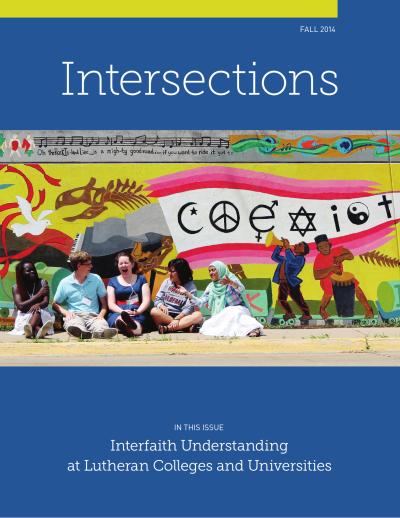
Wilhelm draws a parallel between the rediscovery of vocation and the rediscovery of interfaith understanding in Lutheran higher education, arguing that previously under-emphasized aspects of the Lutheran tradition point us to interfaith work and that an authentic Lutheran college or university will make interfaith understanding a feature of its mission.
-
Editorial
Guest Editorial
Kristen Glass Perez, Richard Priggie
Glass Perez and Priggie introduce the issue by recounting the campus conversations and the June 2014 Interfaith Understanding Conference at Augustana College that gave rise to it, framing the central question, “What does it mean to be Interfaith at a Lutheran College?,” as a living example of the praxis of being a Lutheran college in the twenty-first century.
-
Article
Vocational Re-Formation for a Multi-Religious World
Elizabeth Eaton
ELCA Presiding Bishop Elizabeth Eaton frames vocational formation for a multi-religious world as one of the most significant challenges facing the church and the liberal arts today, calling ELCA colleges and universities to live into Darrell Jodock’s “third path” that is both deeply rooted and dialogical.
-
Article
Why Interfaith Understanding is Integral to the Lutheran Tradition
Jason A. Mahn
Mahn returns to the root of the Lutheran tradition — church, theology, and pedagogy — to argue that interfaith encounter is not the vanishing point of Lutheran identity but central to it, beginning with confession of Luther’s anti-Judaic legacy, working through the typology of exclusivism / inclusivism / pluralism, and showing how the kenotic Christ and the theologian of the cross open Lutherans to authentic encounter with religious others.
-
Article
What it Means to Build the Bridge: Identity and Diversity at ELCA Colleges
Eboo Patel
Through the contrasting stories of two college students — Cassie’s identity relativism and April’s soft fundamentalism — Patel diagnoses Peter Berger’s twin pathologies of modernization and argues that ELCA campuses, anchored in Bonhoeffer and the Lutheran capacity to “have faith without laying claim to certainty,” are uniquely equipped to be places where the light falls: bridges of cooperation that nurture both strong religious identity and benevolence toward others.
-
Reflection
Danya Tazyeen
Danya Tazyeen
Tazyeen, a Pakistani-American Muslim student at Augustana College, reads Qur’an 49:13 — that God made us into peoples and tribes “that you may know one another” — as a charge to break down fear with open dialogue and to see one another as flawed and relatable fellow human beings.
-
Article
Building on a Firm Foundation: ELCA Inter-Religious Relations
Kathryn M. Lohre
Lohre traces the ELCA’s twenty-year arc of inter-religious work — from the 1994 Declaration to the Jewish Community and the Lutheran-Jewish Consultative Panel, through the post-9/11 Lutheran-Muslim Panel and the Shoulder to Shoulder Campaign, to fledgling dialogue with Sikhs and the dharmic traditions — and frames Lutheran inter-religious engagement as the strengthening, not the dilution, of Lutheran vocation.
-
Article
Building an Interfaith Bridge
Belle Michael
Drawing on the holiday of Shavuot, the Book of Ruth, and Martin Buber’s I-Thou, Rabbi Belle Michael picks up Patel’s bridge metaphor and identifies three building blocks for it: experiences with people of different ethnic and religious groups, genuine and long-lasting relationships, and the holy curiosity to ask the questions we are otherwise afraid to ask.
-
Reflection
Gifty Arthur
Gifty Arthur
Reading John 10:3 as a Ghanaian Christian student at Luther College, Arthur reflects on how Luther’s Journey Conversations have deepened her own spirituality precisely by giving room for students to share the personal experiences and beliefs at the center of their own traditions.
-
Article
Journey Toward Pluralism: Reimagining Lutheran Identity in a Changing World
Jacqueline Bussie
Bussie chronicles Concordia College’s Forum on Faith and Life initiative — assessing campus climate, building a President’s Interfaith Advisory Council, and drafting a one-sentence statement that Concordia practices interfaith cooperation “because of” (not “guided by”) its Lutheran identity — to argue that simul justus et peccator thinking equips Lutheran institutions to hold loyalty to tradition and reverence for others together as one piece.
-
Reflection
David Kamins
David Kamins
Kamins, a Jewish student at Muhlenberg College, reads Rabbi Joseph Soloveitchik’s The Lonely Man of Faith alongside his own journey at the Interfaith Understanding conference on the eve of Shavuot, finding in the dual figures of Adam I and Adam II a way to remain firmly grounded in his faith community while going out to learn from those around him.
-
Reflection
Annie Schone
Annie Schone
Schone, raised in a small conservative Central Illinois congregation, recounts how Augustana’s Interfaith Understanding group and Interfaith Youth Core gave her the first chance to befriend Muslim, Unitarian Universalist, and atheist peers, and how she hopes to bring the joy of those friendships back to her home church through the power of storytelling.
-
Article
Journey Conversations
Amy Zalik Larson, Sheila Radford-Hill
Larson and Radford-Hill describe Luther College’s Journey Conversations Project, a four-phase contemplative practice — quiet, listen, speak, respond — rooted in the Lutheran call to be true to one’s own faith while welcoming all faiths or none, and illustrate its fruit through faith journey stories from Luther students Sukeji Mikaya (South Sudan), Habibullah Rezai (Afghanistan), and Gifty Arthur (Ghana).
-
Reflection
Tom Natalini
Tom Natalini
Natalini, a Susquehanna University senior raised Lutheran, schooled Mennonite, and seasoned by a meditative encounter in India, reflects on his journey through churchgoing, philosophy, near-Jewish conversion, and Buddhist practice to a stance he calls patience — neither Christian, Jew, Buddhist, seeker, nor “none.”
-
Article
Well, Well…Plumbing Our Depths, Telling Our Stories
Ann Boaden
Beginning with a college visit that turned into a grieving mother’s confidence about her daughter’s last moments, Boaden uses John 4’s well of living water to argue that an interfaith education worthy of the name requires Lutherans to plumb the depths of their own tradition’s wells — with rituals, stories, and seasons intact — before they can see, respectfully, into the wells from which others drink.
-
 Reflection
VLHE—Wednesday Morning Sacred Pause
Ann Rosendale
No. 62 · Fall 2025
8 min audio
Rosendale draws on Esther 4:14 and the Lutheran practice of holding death and resurrection together — with “and” as the hardest word — to argue that the calling of Lutheran higher education for “just such a time as this” requires us to remember and name out loud that ours are places where God is at work.
-
 Article
Lutheran Tradition: Five Continuing Themes
Walter R. Bouman
No. 2 · Winter 1997
Bouman of Trinity Lutheran Seminary identifies five themes central to the Lutheran theological tradition (understood through Alasdair MacIntyre’s account of tradition as “an historically extended, socially embodied argument”): biblical (a non-oppressive authority for the Bible rooted in the gospel rather than in scholastic inerrancy, against the backdrop of Luther’s 1517 challenge to Tetzel and the post-Enlightenment marginalization of theology); catholic (continuity with the Book of Concord and the three ancient creeds, with Luther’s “Christology from below” recovering a Jewish rather than Hellenistic understanding of God, revived by Tillich, Pannenberg, Forde, and Jenson); evangelical (justification by faith as the answer to mortality’s radical question); sacramental (Word, Eucharist, and Baptism as Christ’s presence from the future of God’s consummated Reign); and world-affirming (creation as gift, vocation as God’s work in every calling, and stewardship of the ecological crisis).
-
 Reflection
Walls: Talk At Gustavus Adolphus College
Elizabeth Baer
No. 5 · Summer 1998
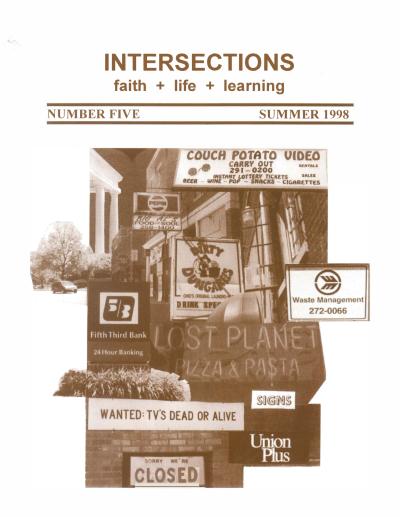
Baer’s September 11, 1997 Gustavus Adolphus chapel homily on Joshua 6 turns from the trumpets to the walls—Robert Frost’s “Mending Walls,” the walls of the Warsaw ghetto in Vladka Meed’s On Both Sides of the Wall and Margaret Zassenhaus’s Walls, the Berlin Wall coming down in 1989—and then to the autobiographical, intertextual discourse of Gustavus chapel itself as a place where misunderstandings come down. An author’s note added after the March 29 F3 tornado reports the closing line (“LET’S MAKE THOSE WALLS COME TUMBLING DOWN”) as eerily prescient: roofs, windows, and 90% of campus trees were lost, but the Chapel walls and the eternal flame in the red glass lantern stood firm.
-
 Response
A Call for Creative Education
Wendy McCredie
No. 3 · Summer 1997
McCredie of Texas Lutheran responds to Reichenbach by reframing the four ideas embedded in his claim that “the entire college community should be knowledgeably committed to the college’s mission”—community, knowledge, commitment, mission—and argues that the Lutheran tradition’s unwillingness to be separate from the world should lead us to educate the public about the Lutheran tradition rather than interrogate prospective employees about their faith. She questions whether agreement on “Christian values” is possible (or even Lutheran), and reads Reichenbach’s “creative education” as the dialectical tension between gospel and law, God’s love and our human limits, that members of communities related to the Lutheran church are uniquely positioned to inhabit.
-
 Article
The Promise and Peril of the Interfaith Classroom
Matthew Maruggi
No. 44 · Fall 2016
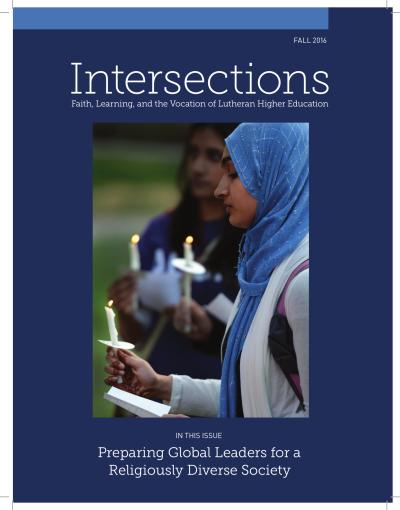
Maruggi draws on his years teaching in the Augsburg religion department to identify three pairs of seeming opposites — dialogue and debate, safety and risk, commonality and particularity — that, held in creative tension, nurture a vibrant interfaith classroom where pluralism is actively engaged rather than merely present.
-
 Editorial
From the Editor
Tom Christenson
No. 20 · Fall 2004
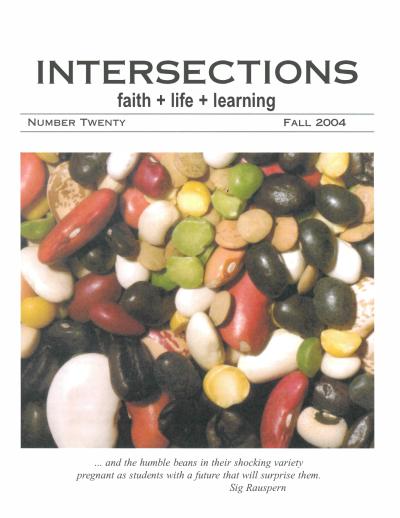
Christenson introduces an issue featuring “young and old, angry and encouraging, prophetic and hopeful” voices unified by the assumption that Christians engaged in thinking and educating will ask hard questions: how to raise concerns about militarism and the new American “imperialism,” what a Lutheran law school will say about training a new generation of attorneys, and what Lutheran colleges communicate to undergrads about vocation. Such faithful criticism, he argues, is part of who Lutheran institutions are.