For me, the most compelling and constructive moment at this past summer’s Vocation of a Lutheran College Conference was also the most challenging.
Lynn Hunnicut was two-thirds the way through her opening introduction to the organizing theme of vocation within Lutheran higher education and its connections with this year’s focus on “civil discourse in a fragmented world.” During a pause for comments and questions, one participant pressed her on what she meant by civil discourse. Was it, the participant wanted to know, merely talk that was deemed to be respectful and polite by those whose power is protected by “respectful” and “polite” (read: carefully controlled and conforming) conversations? When do appeals for civility and civil discourse silence voices that are already repeatedly silenced because they are deemed too angry or unreasonable? Was the “fragmented world” in the conference title meant to implicate minority groups who find solidarity in self-segmentation? Did fragmentation’s alternate naively imply a kind of white, majoritarian space that many mistake for neutral or unified?
These were tough questions. We returned to them throughout the conference and it made for richer, more difficult, more productive exchanges. Looking back now, I admit that I had not realized that “civil discourse,” which had seemed to me a rather innocuous theme, could be spotted by others as un-interrogated and so not-so-innocent after all. I’m learning that one of the most determinative characteristics of the privilege possessed by white, straight, Christian males like me is the inability to see our own privilege, when left to ourselves. I am grateful to the other participants of the conference for enabling me to see how what counts as “civil discourse” can and should be contested—especially by asking who benefits from appeals to it. The no-less contestable title of next summer’s conference—“Beyond Privilege: Engaging Diversity, Inclusion, and Equity” (July 15-17, 2019, see announcement on page 13) promises to pick up where last summer’s conference left off.
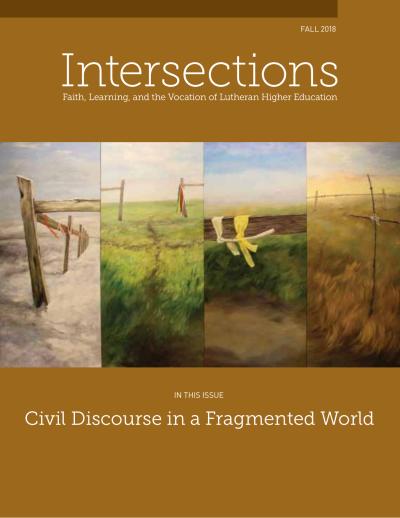
Most of the essays that follow were first presented at the 2018 Vocation of a Lutheran College conference. Some of them emphasize the need to emphatically listen and find common ground in a polarized culture, complete with partisan politics, social media echo-chambers, and the propaganda of “alternative facts.” Others remind us that calls for civility can also become “the sleep-aid of a majority inclined to ignore the violence done in its name” (Newkirk, as cited by Leiseth, below); these authors urge educators to speak truthfully, even when those words sound angry. Together, the essays help us tune up for frank and honest conversations while resisting hateful discourse about divisive issues, as Mark Wilhelm puts it. Even the final essay by Pacific Lutheran University music director Jeffrey Bell-Hanson—which is ostensibly “outside the theme”—might help us get the “pitch” of our discourse right. Hanson, too, connects feelings with facts, passionate performance with responsible truth-telling.
The spring 2019 issue of Intersections will be devoted to the foundational document of NECU: “Rooted and Open: The Common Calling of the Network of ELCA Colleges and Universities.” The editorial board invites reflections on the document; essays about its use among educators, administrators, and board members on our campuses; as well as reviews of other recent publications that help us consider our overlapping institutional vocations. Please contact me if you are willing and able to contribute.
-
 Editorial
From the Publisher
Mark Wilhelm
Wilhelm frames the issue by reflecting on the Letter of James and the Lutheran tradition of “calling a thing what it is” — arguing that the standards of academic discourse, deeply rooted in Lutheran insistence on frankness and honesty alongside concern for the common good, give NECU institutions a solid platform for sustaining honest but not hateful discourse about divisive issues.
-
Article
Vocation and Civil Discourse: Discerning and Defining
Lynn Hunnicutt
Hunnicutt draws on Rabbi Amy Eilberg’s reading of Moses’ calling to identify four features of vocational discernment — attention, wonder, communal consciousness, and humility — and argues that these same qualities are also key aspects of civil discourse, so that forming students for vocational discernment is simultaneously forming them for civility.
-
Article
Polarization, Incivility, and a Need for "Change"
Guy Nave
Nave argues that when Americans demand “change,” they usually mean that “others” need to see things their way — and that meaningful transformative change requires acknowledging the provisional nature of our perspectives, seeking to understand as much as to be understood, and bursting the ideological echo chambers of social media through projects like Clamoring for Change.
-
Article
Putting the Kind Back in Human
Sarah Ciavarri
Drawing on Brené Brown’s research on vulnerability and Edwin Friedman’s family systems theory, Ciavarri distinguishes “kind” from “nice” and argues that courageous, vulnerable, and playful truth-telling — rather than yelling louder or trading pithy memes — is the path back to one another and to our common humanity.
-
Article
It's Time to Rewrite the Rules of Civility
Jon Micheels Leiseth
Leiseth contends that the prevailing rules of civility too often function as the majority’s rules, stifling those facing real harm — and proposes that NECU institutions rewrite civility as “neighboring,” guided by the ELCA’s five values of accompaniment: mutuality, inclusivity, empowerment, sustainability, and vulnerability.
-
Poem
Original Song Lyrics: "Just a Little"
Mike Blair
Lyrics for an original song inspired by biblical images and stories, by Emma Lazarus’ “The New Colossus,” and by the faith, hope, love, and courage of immigrant friends and neighbors — led as a devotion during the 2018 Vocation of a Lutheran College conference.
-
Article
The Musician's Vocation
Jeffrey Bell-Hanson
Bell-Hanson argues that musicians, who exercise profound influence over the emotional flavor of a moment, are called not merely to technical proficiency but to a sense of vocation: understanding their art well enough to use it responsibly, to intend truthfulness rather than manipulation, and to articulate its significance in dialog with other disciplines.
-
 Article
Vocation at Full Stretch: Reflections on Follow Your Bliss and Other Lies about Calling and its Use among College Students
Jason A. Mahn
No. 61 · Spring 2025
43 min audio
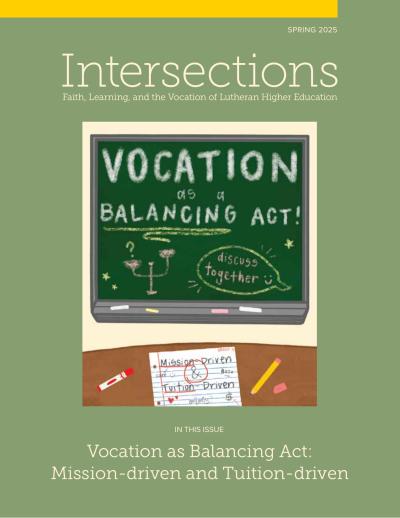
Mahn engages Bonnie Miller-McLemore’s Follow Your Bliss and Other Lies about Calling as required reading in a sophomore religion course, showing how her categories of missed, blocked, conflicted, fractured, unexpected, and relinquished callings empower young adults to perceive embodied, unplanned, and often painful dimensions of life as essential parts of vocation — and help close the gap between mission-driven and tuition-driven realities.
-
 Article
On Recruiting Diverse Students, Rooted in Mission
Eric Rowell, Jason A. Mahn
No. 59 · Spring 2024
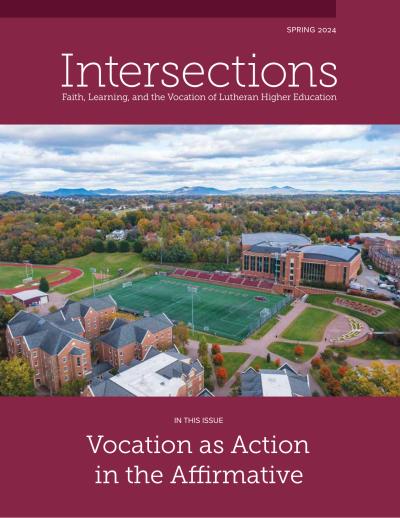
Jason Mahn interviews Eric Rowell, Assistant Director of Admissions and Diversity Outreach at Augustana College, about how recruiting students from a wide variety of backgrounds — rooted in Augustana’s Lutheran commitment to vocation and educating across difference — remains essentially unchanged in the wake of the Supreme Court’s 2023 decisions on affirmative action.
-
 Editorial
From the Outgoing Editor
Jason A. Mahn
No. 55 · Spring 2022
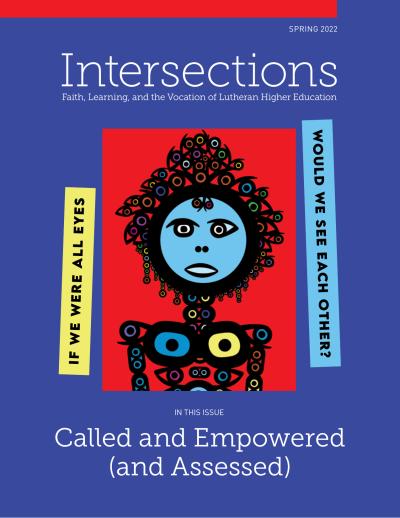
Mahn closes out a decade of editing Intersections, passes the duties to Colleen Windham-Hughes, gives thanks to Mark Wilhelm and Augustana College, and introduces an issue largely drawn from comments by Lutheran faculty, staff, and administrators at the 2022 NetVUE national gathering.
-
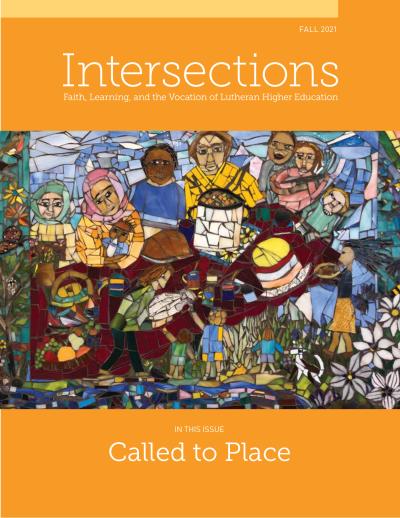 Editorial
From the Editor
Jason A. Mahn
No. 54 · Fall 2021
Mahn introduces the “Called to Place” theme of the 2021 VLHE Conference, arguing that Lutheran higher education’s emphasis on vocation must be grounded in particular geographies and embodied communities — for, as Wallace Stegner put it, “If you don’t know where you are, you don’t know who you are.”
-
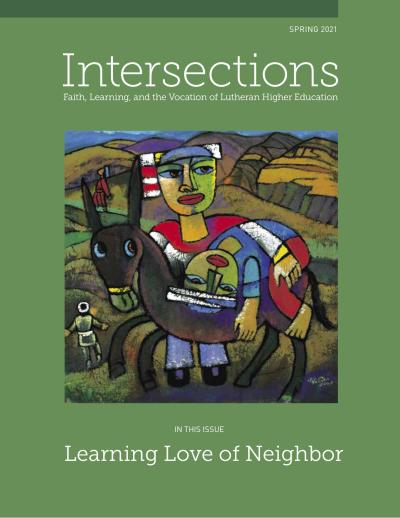 Reflection
Shelter in Place: Reflections from March 22, 2020
Jason A. Mahn
No. 53 · Spring 2021
On the fourth Sunday of Lent in 2020, Mahn meditates on the etymology of “shelter” (from shield) and on an email from a former student in Boston whose mutual-aid organizing models a Lutheran understanding of vocation: the upending of ego by divine love that frees us, finally, to see and serve the neighbor.
-
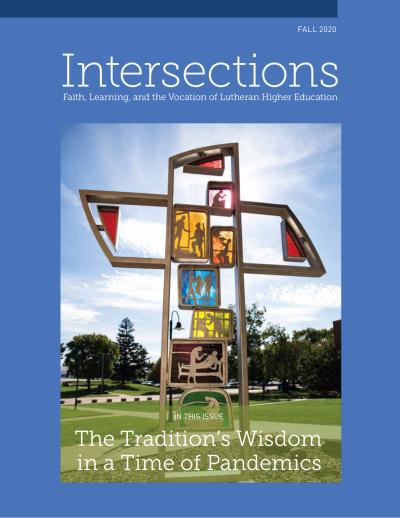 Editorial
From the Editor
Jason A. Mahn
No. 52 · Fall 2020
Mahn narrates a year of crisscrossing pandemics — Covid-19, economic collapse, partisan politics, and the long pandemic of white supremacy revealed anew by the murder of George Floyd — and argues that Lutheran liberal arts schools, by educating for vocation, are uniquely poised to help students respond with character and capable callings.
-
 Editorial
From the Publisher
Mark Wilhelm
No. 37 · Spring 2013
Wilhelm reports that decisions at the February 2013 LECNA and ELCA presidents’ meetings authorized reviews of funding and organizational practices and appointed a working group to draft a presidential statement on what it means to be a college or university of the ELCA, signaling a more substantive future role for the annual presidents’ gathering in shaping the shared identity and common mission of ELCA schools.
-
 Article
Honesty of Mind: On the Uses and Abuses of Socratic Ignorance in Environmental Studies, Religion, and the Classroom
Don Braxton
No. 15 · Winter 2002
Braxton, taking his cue from David James Duncan’s defense of ignorance as a fly-fisher’s most crucial tool and from Socrates’ midwife’s art in the Theaetetus, defends a doctrine of “honesty of mind” resting on four premises—knowledge is constructed, judgments are wagered amid imperfect knowledge, expertise can disable learning, and we are encumbered by other ways of knowing. He field-tests the disposition against three domains: the climate-change and creationism debates in environmental studies, the post-September 11 turn toward religious pluralism (engaging Union Seminary’s Joseph Hough and Hauer and Young’s “three-world” approach to the Bible), and the liberal arts classroom where students “become democrats of the mind” through Reinhold Niebuhr’s balance of conviction and contrition.
-
 Response
Tat for Teat: Ratke Responds
David Ratke
No. 9 · Summer 2000
Ratke, agreeing with much of VonDohlen’s critique but contending that VonDohlen misreads both Luther and the two-realms doctrine, marshals Luther’s To the Christian Nobility, On the Freedom of a Christian, Temporal Authority, Whether Soldiers Too Can Be Saved, and the “Sermon on Keeping Children in School,” along with Walther von Loewenich, to argue that Luther was well aware of structurally differentiated society, made no claim to a monistic epistemology, and intended the two-realms doctrine to combat—not introduce—dualistic bifurcation between sacred and secular. Our identity is “not as either Christian or academic, but as Christian and scholar.”
-
 Editorial
From the Editor
Robert D. Haak
No. 30 · Fall 2009
Haak frames the issue around the question of Lutheran college identity as formed in distinction from some “other,” introducing essays by Witherup on the Joint Declaration, Reuther on Holden Village, Afzaal on Christian-Muslim dialogue, Dovre on the history of Midwestern Lutheran colleges, Radecke on service-learning, and Ratke on Wilhelm Löhe — each making the claim that the “other” is an essential partner in conversation who helps us know who we are and shape who we will become.
-
 Response
Response to Mark Wilhelm: Adopting the Framework of ‘Because’ and ‘Therefore’
Paul C. Pribbenow
No. 56 · Fall 2022
Pribbenow describes how Augsburg University responded to its dramatic demographic transformation (from 18% to nearly 70% BIPOC entering students over sixteen years) by adopting an institutional vocational statement and a simple “because/therefore” framework for translating particular Lutheran theological convictions into institutional programs, policies, and practices.
-
 Editorial
From the Publisher
Lamont Anthony Wells
No. 62 · Fall 2025
5 min audio
Wells frames the issue as a record of the 2025 VLHE Conference at Augsburg under the theme “Ethical Leadership in a Changing World,” arguing that vocation is never solitary but a collective, public witness of ethical formation, theology and care, flourishing and belonging, and leadership rooted in God’s grace.