Building a Third Space in the Age of AI: A Conversation with Dr. Walter Earl Fluker
Intersections No. 62 · Fall 2025
In his talk at this year’s VLHE Conference, Dr. Fluker’s call to “Wake Up Running!” spoke strongly to our vocation as educators to persist in the face of injustice. And his invocation of “third space” called us to something further: a celebration of related embodiment that transcends differences.
That morning, I experienced a serendipitous moment. As with many campuses, Augsburg’s restroom doors double as bulletin boards. On one poster, for the Counseling and Wellness Center, someone had written: “Use character.ai and talk to it like a therapist. Trust me.”
In the last decades, technology has broadened access to education. But “AI” is now being marketed to students as a way to avoid “mistakes” and the stress of awkward conversations. Yet trusting one’s wellbeing to an LLM-based chatbot means entering a hall of mirrors. Trained to mimic and reassure, chatbots can amplify delusions and encourage isolation. Users have experienced psychotic episodes, or developed parasocial emotional attachments to chatbot personas. At the same time, we face a crisis of public trust in education. Small wonder that tech-savvy students turn to the apparent safety of virtual space, the affirming voice of the machine.
As educators, we know that authentic connection with students is vital to our vocation, and also key to students’ wellbeing and academic success. We work hard to cultivate trust in the classroom, a place of constant communication across differences, including those inherent in evaluation of each other’s labor and ideas. But AI companies encourage students to avoid emotional and intellectual labor by pre-aligning their work with statistically-likely examples and uploaded instructor materials. The result is a pre-emptive “flattening,” a deviation towards a (largely Americanized, banal) mean.
Dr. Fluker’s ethos of embodiment, authentic connection, and productive tensions offered a vital alternative to AI’s hall of mirrors. I requested an interview, and Dr. Fluker generously agreed to expand on the “third space” in relation to teaching. Some of our conversation is excerpted below, with the full interview (edited for clarity) available online.
Walter Fluker: I’m excited to talk about what I’m feeling and knowing and trying to work through in my own spirit and mind when I speak about third space. Generally it’s understood in cultural and post-colonial studies as a contested arena, where new forms of meaning, identity, community emerge from binary opposition or fixed categories, like colonizer to colonized.
Black, white, male, female, these binary oppositions, the third space is used as a way of identifying the tension that the binary sets up…which has with it a sense of angst, anxiety and disequilibrium. So the third space is part of that. So how do we get to another space? We’re saying when there is opposition—my view versus your view—how do we have a dialogue that is authentic, that is relational? Third space provides a window into possibilities of having those kinds of conversations and relationships. So I like to think of the third space, and here’s a concise definition, as an in-between or hybrid space where different cultures, identities, perspectives negotiate and hopefully transform in this third space.
It disrupts fixed boundaries and while it disrupts it also creates possibilities for new meanings, practices and relationships. As a theologian and ethicist, it has even more meaning for me. In July at [the VLHE] conference, where I began to talk about the third component, I’d spoken about the gifts or the graces that have been given to the church and other religious bodies of grace-filled empathy, hope-filled resiliency and love-filled justice. I think these are very important values, practices that we will need going into this very precarious present and even more precarious future. We’re at a strange place in history. There may be parallels, yet there are some things that appear to be unparalleled, at least for ways in which we thought about religion, spirituality, and its role in democratic space, life, and practices.
So having said that I borrowed deeply from my mentor Howard Thurman. He was an African-American religious thinker—he didn’t like the term theologian—born at the turn of the 20th century in Daytona Beach, Florida, poverty-stricken. He dealt with all of the terrible atrocities of a segregated society in the deep South, but . . . lived a life that brought him to the pinnacle of what I like to call theological excellence. He was a mystic. He loved nature. As much as he loved people, his deep closest companions, he says, as a child, were the trees and the rivers and the creatures. He lived closely to nature. Not surprising for these kinds of mystics who’ve shown up throughout history, which is important for our conversation on third space.
Thurman poses questions for the possibility of what I refer to as inter-subjective communication. He doesn’t use that language but he uses language like common consciousness, common ground, a fluid center out of which we speak and find the other, and he thought—maybe still thinks—wake up in the other. You can wake up in me.
And if I’m doing this right …I might be able to see the world through your eyes. That for me is grace-filled empathy. So that’s a backdrop for what I’m thinking about with “third component.” Thurman in many ways is a precursor [of] this idea that I see in post-colonial thought, in other places [like] cultural studies…. We now have a bunch of writers, thinkers, who are doing postcolonial theology, especially feminists, queer thought. It’s just incredible the creative work that goes on there.
So [Thurman] tells a story. When he was a young man he rushes to his cousin’s house and his cousin begs him to be quiet and he tiptoes around the house. He peeks and the cousin points to his infant daughter playing with a rattlesnake, and they’re having such a great time. The snake is going back and forth and the baby is laughing and giggling. And he says that is an instance of the third component where things are in relation without threat.
This for Thurman feeds his definitions of love and what I was portraying as love-filled justice. So that justice by itself can be rendered very dangerous. It can be retributive. It can be retaliatory. We’re seeing a lot of that in our culture now. But love-filled justice urges us, almost, I think, requires of us, that we look for this relation that Thurman is pointing to.
So I’m interested in third space, therefore, as the space where we are already situated but it requires work—discipline…. For educators I think there [are] limitless possibilities of placing classrooms, learning experiences, closer to our mother whom I call nature, . . . because I think we’re so torn from her we have forgotten her heartbeat, her adoration of us, her care for us. We’ve forgotten it because we’re in a race that never ends. It’s a race that we cannot even finish. So that’s one.
I have one other: I’m convinced that art is a medium that brings us—aesthetics is probably a better word—that brings us closer to what I’m calling the spiritual. It also has incredible potential for spiritual, ethical, reflection, conversation, living, all of the above. I use a big word for that though because it combines [with] body. I call it somaesthetics. For me, that’s a site of spirituality and ethics.
I’m doing work with hip-hop and rap in this new book that I’m working on. And I use the example of Kendrick Lamar, at the Super Bowl this year where everybody was present, including our President. And Kendrick put on a performance that was prophetic. It was deep ritual. It was a remixing and he used technology and the body and the sound in ways –I recommend that to any listener who may recall that to go back and to see how he signified in our culture the dominance of binaries, and ways in which he created this third space or this third component. I think it’s possible. It will take imagination.
-
 Editorial
From the Publisher
Lamont Anthony Wells
5 min audio
Wells frames the issue as a record of the 2025 VLHE Conference at Augsburg under the theme “Ethical Leadership in a Changing World,” arguing that vocation is never solitary but a collective, public witness of ethical formation, theology and care, flourishing and belonging, and leadership rooted in God’s grace.
-
Editorial
From the Editor
Colleen Windham-Hughes
5 min audio
Windham-Hughes plays on the shared Latin root of “education” and “seduction” (ducere, to lead) to warn against the No-saying seductions of giving up or condemnation, and to call educators to the riskier Yes of showing up to build third-space communities of truth-telling and hope.
-
Article
Wake Up Running! A Call to Ethical Leaders in Quest of Democratic Space
Walter Earl Fluker
44 min audio
Abridged from his VLHE keynote, Fluker draws on Habakkuk and Octavia Butler’s Parable of the Sower to call a new generation of ethical leaders to “wake up running” toward democratic futures, packing their runaway bags with love-filled-justice, grace-filled-empathy, and hope-filled-resiliency for the soul-filled work the moment requires.
-
Article
Ethical Leadership: Rooted, Open, Generative, and Mindful
John Arthur Nunes
25 min audio
As he prepares to teach an Ethical Leadership First Year Seminar at California Lutheran, Nunes organizes his pedagogy around three mutually-reinforcing “turns” — inward, outward, and intellectual — grounded in Luther’s mandatum dei and larvae dei, Bonhoeffer’s estates, and Howard Thurman’s call to hear “the sound of the genuine” in oneself.
-
Article
Ethical Leadership for a Changing World: A Shared Calling from Cradle to Career
Cory Newman, Janelle Rozek Hooper
5 min audio
Hooper and Newman recount how an ELCA Barna survey on early childhood education sparked the realization at VLHE 2025 that ELCA colleges and the 1,200 Lutheran schools and early learning centers share identical challenges — and an untapped potential to form ethical leaders across the full educational continuum from cradle to career.
-
Article
What is Required of You?: Higher Education Leadership in a Moral Key
Paul C. Pribbenow
15 min audio
Drawing on Micah 6:8 and Stephen Carter’s “etiquette of democracy,” Pribbenow describes the three things Augsburg requires of every incoming student — show up, pay attention, and do the work — as a democratic social ethic that prepares students for engaged citizenship in a fractured public life.
-
Article
What Does Ethical Leadership in a Changing World Require?
Kristina Frugé
5 min audio
Frugé argues that ethical leadership in a changing — perhaps ending — world means cultivating trustworthy communities through patient, co-created relationship work, drawing on her experience stewarding the writing community behind Hungry for Hope: Letters to the Church from Young Adults.
-
Article
Fostering Moral Imagination and Inclusivity: The Role of Ethical Leadership in ELCA Colleges and Universities Amid Societal Challenges
Lamont Anthony Wells
12 min audio
Wells argues that “moral imagination” — the capacity to envision ethical alternatives, empathize across difference, and respond creatively to injustice — is the heart of ethical leadership in NECU institutions, and that anchoring leadership in this principle positions Lutheran higher education to cultivate socially responsible citizens.
-
Reflection
VLHE—Wednesday Morning Sacred Pause
Ann Rosendale
8 min audio
Rosendale draws on Esther 4:14 and the Lutheran practice of holding death and resurrection together — with “and” as the hardest word — to argue that the calling of Lutheran higher education for “just such a time as this” requires us to remember and name out loud that ours are places where God is at work.
-
 Editorial
From the Publisher
Arne Selbyg
No. 17 · Summer 2003
Selbyg explains that the four essays in this issue grew out of the first Lutheran Academy of Scholars in Higher Education—a two-week seminar funded by the Lutheran Brotherhood Foundation and the Lilly Endowment, led for its first three years by Dr. Ronald Thiemann of Harvard Divinity School—whose official theme “Finding Our Voice—Christian Faith and Critical Vision” became informally “What’s Faith Got To Do With It?”
-
 Article
Professional Education/Liberal Arts Education: Not a Case of Either-Or but Both-And
Gail Summer
No. 24 · Fall 2006
Summer, Dean of Academic Programs at Lenoir-Rhyne College, traces the historical interweaving of liberal arts and professional education in American higher education (using the rise of engineering as a case study) and argues that the standard “either-or” framing of liberal arts versus professional preparation misreads both. At Lutheran colleges, the “both-and” relationship is shaped by a Lutheran understanding of vocation in which professional programs are integral to, not in tension with, the liberal arts.
-
 Response
Knowing and a Tradition to be Known
Kurt Keljo
No. 1 · Summer 1996
Keljo, University Pastor at Capital, embraces Schwehn’s vocational call but challenges his epistemological framing. We are called to bear witness to the Truth more than to pursue it; truth and power need not be dissociated when power is understood cruciform-ly as love and service; alongside objectivity, a case can be made from the tradition for connected knowing (image of God, idolatry, repentance, Incarnation). Christians offer not a particular epistemology but a foundation for epistemology—a tradition to be known. He closes with James Fowler’s four marks of the “public church”: particularly Christian, prepared for pluralism, balancing intimacy with public engagement, and unafraid of ideological pluralism in confident, nondefensive civility.
-
 Response
On the Outside Looking Out: A Personal and Social Psychological Response
Chuck Huff
No. 2 · Winter 1997
Huff of St. Olaf—a self-described “Metho-Bap-terian” from the South educated at Bob Jones University—offers a personal response to Bouman’s themes (welcoming the rejection of biblical inerrancy, the distinction between gospel and scripture in the homosexuality debate, the gospel-in-the-creeds reading that releases him from Hellenistic conundrums, and the recasting of justification by faith as meaning rather than insurance policy) and a social-psychological response in which a planned study of campus social networks at St. Olaf was discontinued when preliminary interviews revealed that everyone—storied Lutherans, secular faculty, feminists, fundamentalists—felt like outsiders. Continuing the tradition requires constructing a conversation that is thoughtful, fair, inclusive, charitable, focussed, and still true to the tradition.
-
 Editorial
From the Publisher
Arne Selbyg
No. 13 · Winter 2002
Selbyg reports that Executive Director Leonard Schulze has challenged the ELCA Division for Higher Education and Schools to develop a comprehensive communications plan reaching high school students, college students, parents, pastors, and journalists, and invites Intersections readers to review the redesigned elcacolleges.org website, the “FREE STUFF” brochures, the journal’s advertisements in The Lutheran and related publications, Ernie Simmons’ new Augsburg-Fortress book Lutheran Higher Education: An Introduction, and the ELCA video magazine Mosaic—and to send in their own ideas.
-
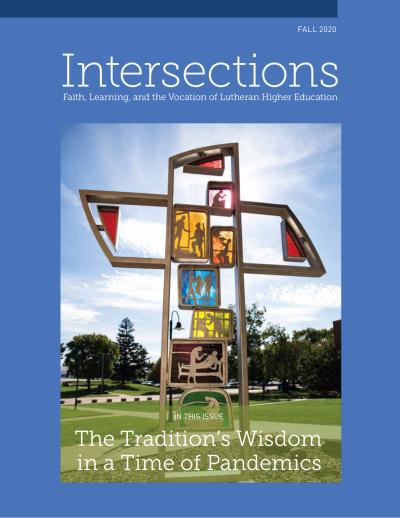 Article
Finding Purpose in Chaos: Reflection In and Beyond the Public Health Classroom
Lena R. Hann
No. 52 · Fall 2020
When the pandemic hit her new public health professionalism course, Hann recalibrated her teaching from the “how” of professional preparation to the “why” of vocational reflection — and recounts how Augustana public health students and alumni found purpose in the chaos through food banks, disaster response, palliative care, and research on health inequities.