The scruffy bass sits in the back row. His long, thick, curly brown hair and unkempt beard stand out among the neatly cut blonds in this Midwestern college choir at a Norwegian Lutheran liberal arts school. Each day he brings a new temperament to the room, ranging from anger to unbridled joy. When I pass Oscar1 in the halls of the music building it’s likely I’ll catch a foul four letter word and the saccharin whiff of an energy drink. But each day he is present—on time and on task. Whenever it’s his turn for daily devotion I hold my breath. Will he evoke the absurdist in us all, forcing a return to decorum? Or will his observation find a profound nugget of truth?
That Tuesday was a tired day. Our Christmas program preparation was behind where it ought to be. Illness was creeping through the ranks, striking singers mute and extracting our collective energy. When Oscar lumbers to take his place in front of the ensemble, his peers are distracted and disquieted. A brief moment of silence washes over the room and the air shifts instantly. All are suddenly aware Oscar can barely speak, his voice breaking as he scrambles for the right words. “I’ve never been so moved as when I’m singing with you guys,” he manages to say. “The only time I’ve felt the power of something greater than me is when we are singing.” With his final Christmas concert imminent, Oscar has faced the realization that a valuable part of his life is nearly completed. An emotional tap, a certain transcendence that comes from singing in choir, singing in this choir, will be gone. Oscar is weeping.
At Waldorf College, the choir has been a spiritual buttress for its members for nearly 100 years. Grown from the seeds planted by F. Melius Christiansen in 1912 at St. Olaf College, the Waldorf Choir is a representative of the American Lutheran choral tradition that links choral singing with an expression of one’s faith through primarily a cappella sacred repertoire. The Waldorf Choir’s longest tenured director, Odvin Hagen, built the choir into a stalwart representative of the faith whose primary mission remains the spreading of the Gospel of Christ through music. At the core of this mission is devotion to the students’ learning and spiritual transformation through music.
Hagen prayed for each student daily and so dedicated his life to them that it was while on a choir tour that he passed away (Farndale). To this day the choir still operates according to five directives he laid out, engraved inside the front cover of the choir Bible:
1. Be tactful.
2. Be helpful.
3. Be hopeful.
4. Be cheerful.
5. Be constant in prayer.
A chief exercise of these edicts is the choir’s daily devotional. Students mine scripture, quotations, and their own experience for a meaningful nugget of Truth. Recently, for Valentine’s Day a student began rehearsal by reading the famous love passage from Paul’s first letter to the Corinthians. Kelly asked the choir to reflect on love—who we love, how we love, and why we love. She asked us if we truly loved one another in this group and challenged us to find significant means to demonstrate it. She reminded us of the “ultimate, sacrificial love given by our Savior,” and then she supported us by saying, “I want you all to know that I love this choir, I love all of you.”
Another memorable devotion also came from 1 Corinthians. Sarah began with an enthusiastic reading of chapter 12 when Paul recounts the necessity and unique function of each member of the body, generating laughter when the eye says to the hand, “I do not need you.” She then beautifully equated each member of the choir as a member of a larger body. Each person has a gift that is so significant that it is fundamentally needed. She told us we were all needed, in terms of the ensemble and its ability to make music well, but also as individuals who mold one another’s lives.
Often times it is the non-scriptural devotions that impress on the students most. Once, a choir member recalled the time she was in line at the pharmacy and an elderly couple in front of her engaged her in conversation. Jenny reported that the topic of the Waldorf Choir came up and the couple gushed to her about how special the group was to them. They attended all our concerts and felt so blessed that they were able to witness young people create overwhelming beauty and share such moving, wonderful music. Jenny shared that she felt that a part of her life had meaning. Her devotional illustrated the way that even chance encounters can force us to scrutinize the spiritual issues that challenge us daily as we determine who we are, how we treat others, and how we carry ourselves in the world.
My students are profoundly touched by music because, as they toil through each piece, they must constantly wrestle with multiple strands of meaning. Choral music has the gift of text which adds a distinct communicative layer on top of notes, rhythms, and intonation. As a choir formed to serve a spiritual mission, we seek to communicate human emotions and the human condition through singing great texts of faith and experience.
Indeed, the bulk of our repertoire is inextricably linked to sacred theology and philosophy. Western choral music grew up under the auspices of the Roman Catholic Church, an institution that nurtured and shaped the genre throughout history. But, in addition to mass settings and psalms of David, we seek to represent other faith traditions, including the great spirituals from the African-American tradition, ancient Hebrew hymns, and most importantly, the chorales of the Lutheran church to which we are wed.
This diverse history of choral music allows my choristers to explore sacred and spiritual ideas within a range of contexts. This year alone, the Waldorf Choir will sing pieces by F. Melius Christiansen from the American Midwest Lutheran tradition, spirituals and gospel works from the African-American traditions, a setting of the Roman Catholic Requiem liturgy by Gabriel Fauré, and settings of sacred texts by composers from the sixteenth through the twenty-first centuries. Each distinct piece offers the students insight into the work’s genesis and its overall meaning.
During our course of study, my students learn that scholars speculate Fauré may have been moved to compose a Requiem in the years following both his parents’ deaths (Buchanan). They discover that Thomas Tallis was riven between two competing faiths, composing music in English for Henry VIII’s Church of England and in Latin for the Roman Catholic faith of his successor, Queen Mary. They also learn about how the elements of musical composition can convey meaning. By singing Mozart, they experience how an exploration in increased harmonic complexity heightens musical and emotional tension, and how, in a piece by the contemporary American composer Eric Whitacre, clusters of notes in a chord of sound can evoke the image of eternal light.
“The message of sacred music forces my students to unearth the profundity of spiritual ideas and the implications of these ideas on themselves and on humankind.”
Our primary function, though, is to explore the personal meaning of the music we sing as a choir. After a tough rehearsal recently, when energy seemed low and students were making simple mistakes, I returned to a piece we had performed with some regularity, a setting of the hymn Abide with Me. As we worked through each verse, the passion that had been evident in previous performances was not present. I stopped and asked each member to reflect on what this song means to him or her and to share responses with one another. After a few moments of chatter, I then went around the choir arbitrarily eliciting their individual responses. The students’ insights were full of depth and self-reflection; they used words such as “hope,” “commitment,” “strength,” “sadness.” Upon restarting the piece, the choir sang more expressively and more musically than when we had started. Each student had made a conscious connection between the notes and words of the music with an embodiment of their spirit.
The message of sacred music forces my students to unearth the profundity of spiritual ideas and the implications of these ideas on themselves and on humankind. For example, few of my choir members, because they are still young adults, have had to confront death and the questions that surround it. Yet, with motivation and self-reflection, they can begin to grasp the anguish of the cries for mercy in the first movement of Gabriel Fauré’s Requiem. They can begin to understand the turmoil faced by someone who has lost a loved one—someone caught between his fearful, timid pleas to the Lord for eternal rest and his angry, frustrated demands for the Lord to listen to his pain. In the end, my students’ musical portrayal of the eternal light of paradise becomes clearer and brighter after they’ve wrestled to express the sorrow, fear, and torment of damnation.
“It is when my students fully grasp what it is they are singing that they develop a sense of why they are singing. This deep understanding of the music, of its context and meaning, brings about transformation.”
We’ve also been learning an African-American spiritual that has challenged the students to contemplate a profound faith in God. The experience of the slave teaches them that despite being horribly treated, humans who were debased, whipped, and tortured based on their skin color could have faith in a better life. For the slave, no matter how awful life on earth could be, there was always hope for a better life in the end. The question then turns to my students: how is it that such devotion can impact their own lives? What does it mean, in the hymn “Praise to the Lord,” for “all that hath life and breath” to come and praise the Lord? By contemplating these questions, they come to comprehend the idea that it is not just me or them but the entirety of creation that can find hope and thanksgiving in a greater power.
It is when my students fully grasp what it is they are singing that they develop a sense of why they are singing. This deep understanding of the music, of its context and meaning, brings about transformation. At times they least often expect it, my students are made aware of the power of the message they communicate. They see something about themselves they haven’t experienced before. And they see in the eyes of the audience the hearts of strangers forever touched.
From the stage, my singers witness tears, smiles, and applause of gratitude. I remind them prior to every concert that we don’t know for whom we are singing. Perhaps the little old lady in the front row has recently lost her mate of fifty years; or the family in the back has just learned that their child is ill; or the young couple off to the side is celebrating their first anniversary. Regardless of how large or how small, each audience is composed of unique individuals whose lives need spiritual nourishment, healing, and celebration. My students’ faith becomes stronger as they stir the audience in this way because they understand the power of the message of the Gospel and how compelling its foundation is to all of human experience. And every night they don their velvet robes, the students will change the life of someone who hears them by sharing the love, hope, and peace found in Christ.
As realization of this power grows, my students find it difficult to reach the end. When their time in choir comes to a close they share with their peers the difference that singing has made in their lives. Through choral music, music of the spirit, my students find their true expressive beings. They learn that they can reach out and transform the lives of their listeners, of those around them, and of themselves through a message of faith. And they discover that singing in such a manner brings great reward and fulfillment and provides meaning to their own lives.
The final song in our concerts actually occurs after the applause has died and the audience makes its way to the exits. As the choir members file off stage after a performance they return in silence to the dressing room, form a circle, and clasp hands. Closing their eyes they sing:
For I am sure that neither death, nor life, nor angels, nor principalities, nor things present, nor things to come, nor powers, nor height nor depth, nor anything else in all creation, will be able to separate us from the love of God in Christ Jesus our Lord. (Romans 8:38-39)
The students affirm that their talent, their work, and their joy are in the service of God. This is a tradition that was implemented within the last ten years. It is a tradition that illustrates that the Waldorf Choir is not a staid institution. Rather, its spiritual life endures through each generation of individuals who stand in its ranks.
End Notes
1. The names of the students in this essay have been changed.
Works Cited
Buchanan, Heather J. and Matthew W. Mehaffey, eds. Teaching Music through Performance in Choir, volume I. Chicago: GIA, 2005.
Farndale, Nancy. Personal Interview. August, 2011.
-
 Editorial
From the Publisher
Mark Wilhelm
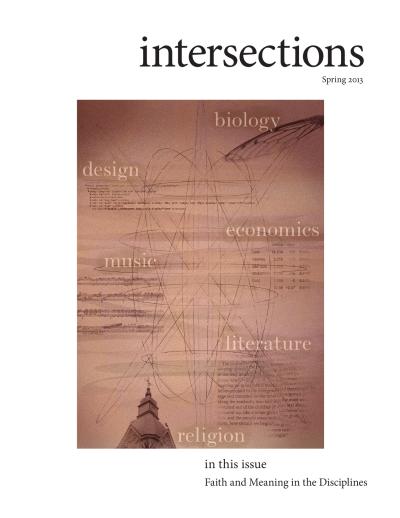
Wilhelm reports that decisions at the February 2013 LECNA and ELCA presidents’ meetings authorized reviews of funding and organizational practices and appointed a working group to draft a presidential statement on what it means to be a college or university of the ELCA, signaling a more substantive future role for the annual presidents’ gathering in shaping the shared identity and common mission of ELCA schools.
-
Editorial
From the Editor
Jason A. Mahn
Mahn introduces the issue’s six essays as parallel attempts—from poetry, economics, choral music, biology, religion, and Lutheran higher education—to resist our culture’s fact-value split, and uses Augustana’s Fritiof Fryxell, a 1922 biology and English graduate who began teaching just as the Scopes Trial ignited, to illustrate how church-related colleges have long held faith and disciplinary inquiry together.
-
Article
Valuing Poetry
Allison Wee
Writing from California Lutheran University as “value” in higher education collapses into “can it get you a job?”, Wee makes a case for poetry as a life-saving discipline. Drawing on William Carlos Williams, Shakespeare, the Psalms, Wordsworth, Pattiann Rogers, Mary Oliver, and her own Environmental Literature assignment that sends students outside for an hour of attentive stillness, she argues that the poet’s skill of translation cultivates the close attention, fresh perspective, and immaterial dimensions of life her students need most.
-
Article
Calling Economists
Lynn Hunnicutt
Reading Luther’s Whether Soldiers, Too, Can Be Saved alongside Adam Smith’s Theory of Moral Sentiments and Wealth of Nations, Hunnicutt asks whether economists, too, can be saved—and whether economics can host a serious conversation about vocation. She traces her own move from Utah State to Pacific Lutheran University and its Wild Hope Center for Vocation, and turns to Deirdre McCloskey and George DeMartino as economists whose work makes room for vocation and the common good within the discipline.
-
Article
Living Biology
Stephanie Fuhr
Fuhr recounts how a one-credit Becoming Biologists course at Augustana College was rebuilt around the biological worldview after a student flagged John Janovy Jr.’s argument that values are legitimate tools in biology. Drawing also on Stephen Jay Gould’s The Mismeasure of Man, she argues that visions and values—not skills alone—inspire a life’s work in science and provide the foundation for lifetime engagement in the work of biology.
-
Article
Professing Religion
John D. Barbour
Barbour reflects on the vocation of a Professor of Religion at St. Olaf College, asking when and how a teacher should disclose personal faith in the classroom. Drawing on his graduate teachers Anthony C. Yu and Langdon Gilkey, and on Augustine’s Confessions, Dorothy Day, Malcolm X, C. S. Lewis, and Kathleen Norris, he argues that teaching autobiography invites teaching autobiographically—and that professing religion is finally a matter of how one believes, not just what.
-
Article
A Lutheran Dialectical Model for Higher Education
Ernest L. Simmons
Drawing on “The Freedom of a Christian,” simul justus et peccator, Richard Hughes, Joseph Sittler, Martha Nussbaum, and Tom Christenson, Simmons argues that the Lutheran tradition informs an open, dialectical educational model that holds Christian and academic freedom together. He locates vocation at the intersection of the practical (why are you here?) and the existential (why are you here?) and proposes Lutheran higher education as education for self-transcendence and leadership Soli Deo Gloria.
-
 Poem
Poem
Emily Dickinson in Columbus, Ohio
Caitlin McHugh
No. 17 · Summer 2003
McHugh imagines Emily Dickinson waking up on a COTA bus to find “the world had ended, and her violets were gone forever,” then escaping the crowd to wander High Street, taste “actual brewed liquor,” quit “the act of reclusive-drama queen-ghost,” and finally smash a bouquet of violets when she realizes that “Beauty had not stopped for her death, but crawled bravely onward.”
-
 Article
"Faithful Nones" and the Importance of a Rooted and Open Pedagogy
John Eggen
No. 49 · Spring 2019
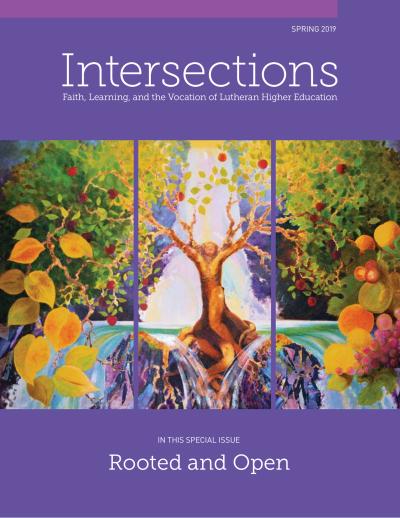
Drawing on a student survey from his D.Min. thesis at Midland University, Eggen identifies a distinctive subset of religious “nones” — the “faithful nones” — who reject institutional religion yet retain substantive beliefs and practices, and argues that the non-binary, third-path pedagogy commended by Rooted and Open is uniquely positioned to engage a generation that has disambiguated faith, religion, and spirituality.
-
 Article
Access, Accessibility, & Change: A Call for Trustworthy Leadership in Higher Education
Emma Jones
No. 60 · Fall 2024
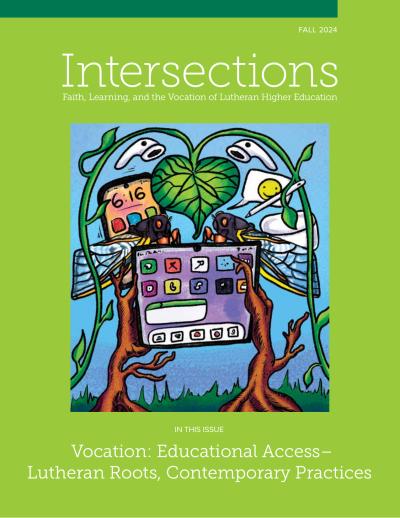
Jones surveys the converging pressures on higher education — cost, the enrollment cliff, shifting demographics, and declining public confidence — and uses Reichheld and Dunlap’s four factors of trust (transparency, capability, reliability, humanity) to call campus leaders to rebuild trustworthy leadership from the inside out.
-
 Article
A New Image for an Ancient Call: Lutheran Higher Education Amidst Pandemics Today
Caryn Riswold
No. 52 · Fall 2020
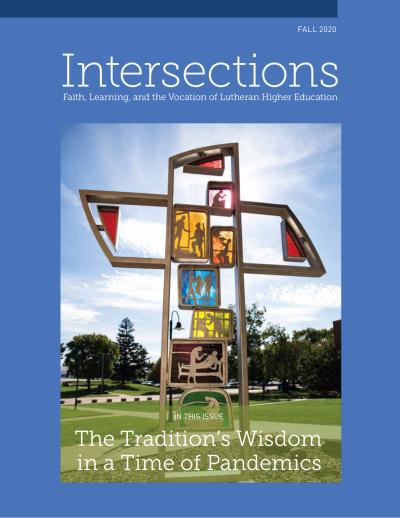
Pairing Wartburg’s Lebenskreuz sculpture with the Matthew 25 acts of mercy and the commitments of Rooted and Open, Riswold reads the calls to feed the hungry, welcome the stranger, and care for the sick as urgent summons for Lutheran higher education in a year of overlapping pandemics — and as a call to dismantle the structures that produced them.
-
 Article
Hope in the Face of Ecological Decline
Jason Peters
No. 32 · Spring 2010
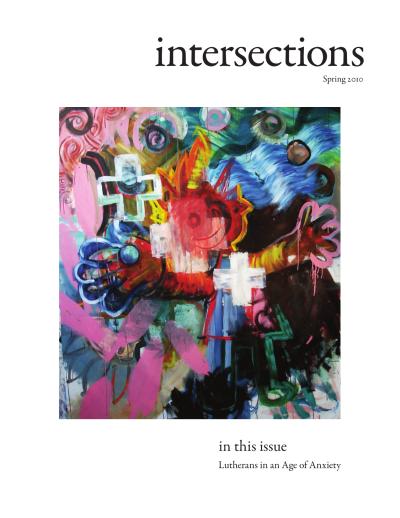
Peters reads our ecological crisis—a campus “Birth Control Tree,” feminized fish, population, climate, water, and soil—through Alexander Pope, William Blake, Søren Kierkegaard, and C. S. Lewis’s The Abolition of Man, and argues that the modern project of mastering nature has made despair (the unconscious form Kierkegaard named) our condition. He calls for three reorientations: practical (assigning value to domestic arts and place over disciplinary specialization), philosophical (dismantling the Baconian/Machiavellian/Cartesian project of control), and theological (recovering the Church’s rejection of Gnosticism so that grace comes to us by means of nature, not in contempt of it).
-
 Editorial
From the Publisher
Mark Wilhelm
No. 48 · Fall 2018
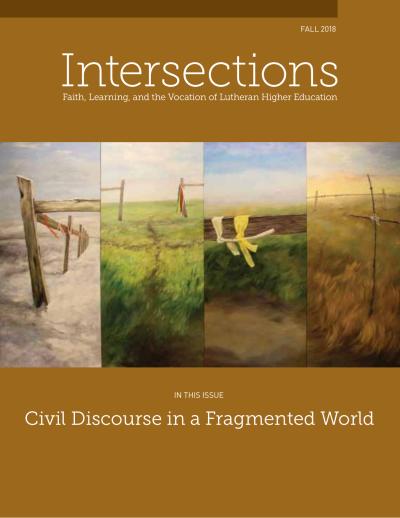
Wilhelm frames the issue by reflecting on the Letter of James and the Lutheran tradition of “calling a thing what it is” — arguing that the standards of academic discourse, deeply rooted in Lutheran insistence on frankness and honesty alongside concern for the common good, give NECU institutions a solid platform for sustaining honest but not hateful discourse about divisive issues.