How do we put the kind back in human? How do we move forward into living with generosity as a spiritual practice, with open hearts and open hands when—in our country—fear, polarization, and cynicism tell us to close ourselves off except to those who believe, think, behave, vote, and perhaps worship like us? How do we break habitual one-liners on social media and judgments (whether spoken or unspoken) such as: “If you are a Christian you couldn’t possibly have voted for such-and-such a candidate”?
We need to prioritize our ability actually to listen with intent to understand, with intent to honor the other as being created in the image of God, with intent to construct something that in mutually beneficial based on core values. Yelling louder and coming up with pithy memes is simply more of the same. Right now the last thing we need is more of the same.
To put the kind back in human is how we will find our common humanity. Let me differentiate: I’m not using kind and nice interchangeably. Some of us were raised with the advice that Thumper (in Bambi) received from his mother, “If you can’t say anything nice, don’t say anything at all.” And I happen to live in Minnesota, with its reputation for “Minnesota nice.” Don’t get me wrong—I’m all for politeness, respect, and civility, but “nice” has been used as a way to avoid challenging conversations, as a way to support the status quo; nice can even become passive-aggressive. Sometimes the truth that needs to be spoken isn’t nice to hear. Recently I’ve been working on becoming “Minnesota kind.”
Brené Brown, a grounded theory researcher, has some helpful insights for us. For the last 14 years, she has listened to people’s stories of struggle, courage, shame, and vulnerability. She studies the human condition by starting with lived experiences. I love that she starts with story because those of us in Christian churches also teach through story; we even know ourselves as co-creators in God’s story. At this point, Dr. Brown has over 200,000 pieces of data. I have facilitated her research for the past six years. Over and over again I see how this research makes people feel known and seen because Brené is naming their realty in ways that they recognize.
And so, what, according to this research, stops us from putting the kind back in human?
Vulnerability
Brown defines vulnerability as “risk, emotional exposure, and uncertainty.” Anything we do that is courageous involves risk, emotional exposure, and uncertainty. When we are vulnerable and own a truth that may not conform to majority culture, we know we will be judged. When we risk saying, “I need help; I don’t understand,” we are open to being wounded.
Many of us tell ourselves that we will have hard conversations about race, religion, immigration, debt reduction, or our own family histories only when we’re better prepared, when we’ve got all our facts straight, or after we’ve studied the topic more. In part, we believe that if we had all this organized, then having hard conversations would not be hard or uncomfortable or jarring. We believe that we could achieve a noble outcome without ever really changing:
without having to say, “I have white privilege and that shapes my biases,”
without having to say, “what you just said is giving me pause to re-think my view,”
without having to say, “this conversation is really hard for me and in the past when I’ve tried to talk about these things, I haven’t felt safe to express my perspective so just showing up here is a huge ask of me.”
And yet, the truth remains that vulnerability is the path back to each other. And God created us for each other. When I risk a bit with you, and you risk a bit with me, we now trust each other a bit more and are more deeply connected. We’ve seen God in each other.
Brown teaches this: “When we stop caring about what people think, we lose our capacity for connection. When we become defined by what people think, we lose our willingness to be vulnerable.”
Courageous and Playful Truth-telling
I have volunteered with an organization called Better Angels, whose mission it is to de-polarize the United States through highly facilitated conversations between republicans and democrats. Last fall, on a rainy evening, a group gathered to engage in these conversations; the event was open to the public to watch, and the Minneapolis/St. Paul Star Tribune newspaper sent a reporter and photographer. Through a series of questions and exercises, participants were asked to reflect on and critique their own political party. Everyone was asked the question, “What don’t you like about your party?” The initial answers were about smaller policy issues, but eventually a woman said, “I don’t hold the same view on abortion as my party and I feel like I can’t say that—that there is no place within the party for me to say that.”
What do I most profoundly remember from that night? Of course, it is this woman speaking her courageous truth.
But there is another side to courageous truth telling, and it gets us back to the issue of kindness. I believe that God created us to play, to laugh, to create, to have moments of collective joy together. Jesus even prayed at the Last Supper that his followers would have joy!
“When any system—whether it be a family, a business, a faith community, a country, or a college—is anxious, playfulness is a way to stay connected through the conflict.”
Many of us often think we will do those things only after we’ve done the big things, when we have time. That isn’t getting us where we want to go. Instead, Dr. Stuart Brown, who studies play, writes, “The opposite of play is not work—the opposite of play is depression.” If you’ve worked in higher education for a number of years, have you seen the rate of depression among students increase? The opposite of play is depression.
According to family systems theorist Edwin Friedman, when any system—whether it be a family, a business, a faith community, a country, or a college—is anxious, playfulness is a way to stay connected through the conflict. When there is anxiety, we become serious to protect ourselves because it feels less exposed. But vulnerability is how we share our common humanity.
How would your world change if you played, connected, dwelt in joy and kindness more? And how would that change our world?
Works Cited
Brown, Brené. Daring Greatly: How the Courage to be Vulnerable Transforms the Way We Live, Love, Parent, and Lead. New York: Penguin, 2012.
Brown, Stuart and Christopher Vaughan. Play: How It Shapes the Brain, Opens the Imagination, and Invigorates the Soul. New York: Penguin, 2009.
Friedman, Edwin. Generation to Generation: Family Process in Church and Synagogue. New York: Guildford, 2011.
-
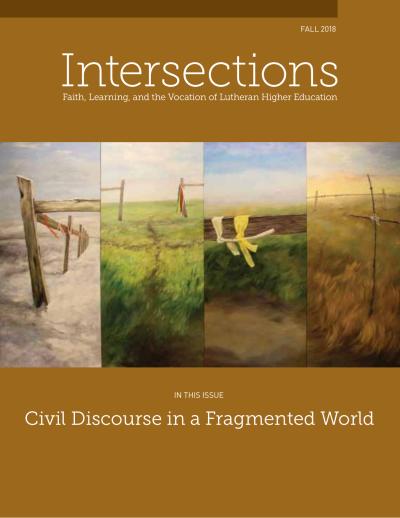 Editorial
From the Publisher
Mark Wilhelm
Wilhelm frames the issue by reflecting on the Letter of James and the Lutheran tradition of “calling a thing what it is” — arguing that the standards of academic discourse, deeply rooted in Lutheran insistence on frankness and honesty alongside concern for the common good, give NECU institutions a solid platform for sustaining honest but not hateful discourse about divisive issues.
-
Editorial
From the Editor
Jason A. Mahn
Mahn recounts how a participant’s probing questions at the 2018 Vocation of a Lutheran College Conference turned “civil discourse” from an innocuous theme into a contested one — and previews essays that variously urge listening and common ground, or speaking truthfully even when those words sound angry.
-
Article
Vocation and Civil Discourse: Discerning and Defining
Lynn Hunnicutt
Hunnicutt draws on Rabbi Amy Eilberg’s reading of Moses’ calling to identify four features of vocational discernment — attention, wonder, communal consciousness, and humility — and argues that these same qualities are also key aspects of civil discourse, so that forming students for vocational discernment is simultaneously forming them for civility.
-
Article
Polarization, Incivility, and a Need for "Change"
Guy Nave
Nave argues that when Americans demand “change,” they usually mean that “others” need to see things their way — and that meaningful transformative change requires acknowledging the provisional nature of our perspectives, seeking to understand as much as to be understood, and bursting the ideological echo chambers of social media through projects like Clamoring for Change.
-
Article
It's Time to Rewrite the Rules of Civility
Jon Micheels Leiseth
Leiseth contends that the prevailing rules of civility too often function as the majority’s rules, stifling those facing real harm — and proposes that NECU institutions rewrite civility as “neighboring,” guided by the ELCA’s five values of accompaniment: mutuality, inclusivity, empowerment, sustainability, and vulnerability.
-
Poem
Original Song Lyrics: "Just a Little"
Mike Blair
Lyrics for an original song inspired by biblical images and stories, by Emma Lazarus’ “The New Colossus,” and by the faith, hope, love, and courage of immigrant friends and neighbors — led as a devotion during the 2018 Vocation of a Lutheran College conference.
-
Article
The Musician's Vocation
Jeffrey Bell-Hanson
Bell-Hanson argues that musicians, who exercise profound influence over the emotional flavor of a moment, are called not merely to technical proficiency but to a sense of vocation: understanding their art well enough to use it responsibly, to intend truthfulness rather than manipulation, and to articulate its significance in dialog with other disciplines.
-
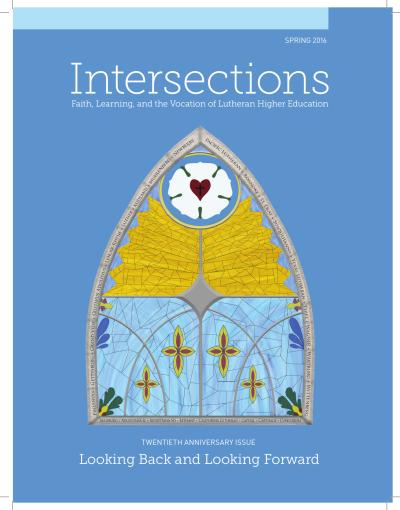 Article
Distinctive Lutheran Contributions to the Conversation about Vocation
Kathryn A. Kleinhans
No. 43 · Spring 2016
Kleinhans surveys the recent resurgence of vocation talk in American higher education — from Frederick Buechner’s widely quoted definition to Lilly Endowment’s PTEV grants and the CIC’s NetVUE Scholarly Resources Project — and uses her chapter in At This Time and In This Place: Vocation and Higher Education to highlight distinctively Lutheran emphases: vocation grounded in creation rather than redemption, the given-ness of multiple simultaneous callings, and a frank acknowledgment of the constraints and “dark side” of vocation.
-
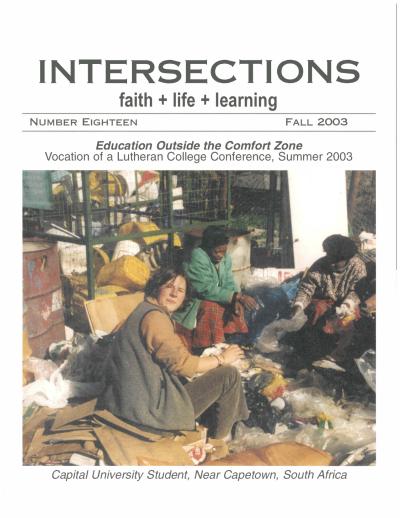 Article
The Search for a Just Peace in a Globalized World
Munib A. Younan
No. 18 · Fall 2003
Younan, Lutheran Bishop in Jerusalem, grounds Palestinian Christian identity in Incarnation theology and a Lutheran theology of grace and the cross, then surveys the Evangelical movement’s nineteenth-century legacy in the Middle East—the 1864 Arabic Bible, ELCJ schools, women’s ordination, and the Middle East Council of Churches. Engaging Edward Said’s critique of Samuel Huntington, he calls for international and local mutual-recognition agreements (including the Jerusalem Lutheran-Anglican agreement and a Lutheran-Reformed agreement in the Middle East), four marks of interfaith dialogue, and a sharp distinction between Lutheran “Evangelical” identity and the Dispensationalist evangelistic Right whose Israel-Palestine scenarios he names a heresy. He closes by proposing concrete scholarship, faculty exchange, and sabbatical partnerships between U.S. Lutheran colleges and the ELCJ’s churches, schools, and Dar al-Kalima Lutheran Academy.
-
 Article
The Quest Of The Historical Jesus: Problem & Promise
Robert W. Funk
No. 5 · Summer 1998
Funk, founder of the Jesus Seminar, frames the quest as the search for reliable data amid twenty-two ancient gospels and as a confrontation among three “parties”—the Jesus Party, the Apostolic Party, and the Bible Party. He surveys the Seminar’s 1985–1998 work (The Five Gospels, The Acts of Jesus, the color-coded reports), defends the synoptics over John, the priority of Mark, the Sayings Gospel Q and the Gospel of Thomas, and argues that a recovered Jesus—a teacher of a trust ethic, celebration, a kingdom without social barriers, a society without brokers, without cult rituals—may serve as catalyst for a sweeping third-millennium reformation that purges the “clogged arteries” of institutional Christianity.
-
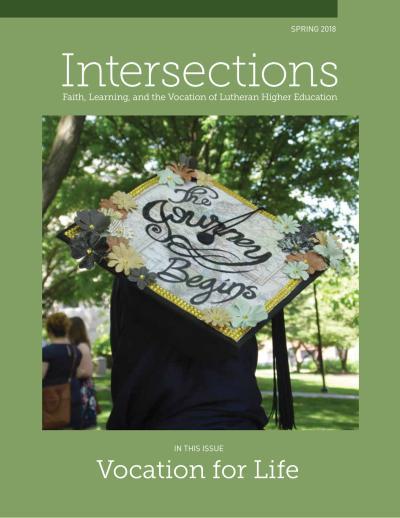 Article
Vocation and Dharma throughout Life's Stages: A Hindu Perspective
Vidya Thirumurthy
No. 47 · Spring 2018
Thirumurthy traces her own attempt as a Hindu faculty member at Pacific Lutheran University to grasp the Lutheran concept of vocation, finding in the Bhagavad Gita’s teaching on dharma — duty fulfilled without expectation of reward — an equivalent that, like vocation, varies across the four stages of life and calls individuals to transform others through selfless service.
-
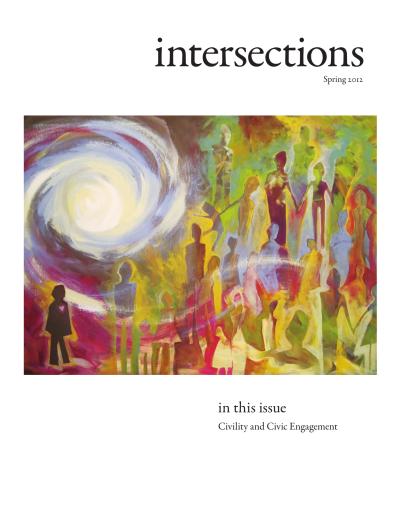 Editorial
From the Editor
Jason A. Mahn
No. 35 · Spring 2012
Mahn introduces five essays from the 2011 Vocation of a Lutheran College Conference at Augsburg, framing how Torvend, Anderson, Svennungsen, Tunheim, and Pribbenow press Lutheran colleges to turn outward—recovering the public character of Luther’s gospel, forming students for moral deliberation, investing in the infrastructure of civic renewal, and pursuing justice and education “off the main road.”
-
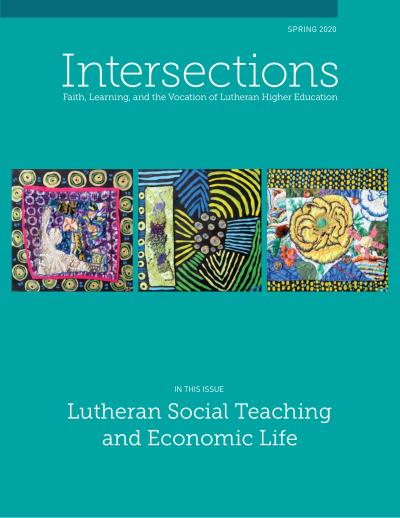 Article
Business as Usual? Marketing, God, and the Limits of Christian Callings
Emily Beth Hill
No. 51 · Spring 2020
Hill, a former corporate marketing consultant turned theologian, returns to Luther’s claim that no vocation is more holy than another — and uses Luther’s Large Catechism definition of God to argue that the modern practice of branding intentionally redirects the love and worship of human beings toward capital, raising the question of whether Christian neighbor-love places limits on what professions Christians should pursue.