On March 31, 2003, soon after the invasion of Iraq, the News Hour on PBS began running a segment listing the American military (and some civilian) personnel killed there each week. The brief profiles appeared on the screen one by one in silence. The decision not to include music was made by anchor and managing editor, Jim Lehrer. He wanted to keep these segments purely about remembering those who had lost their lives, and to avoid any political statement (Getler).
In a society so accustomed to cinematic production values, and in which other high-profile news organizations had produced similar segments with an underlay of soaring, inspirational music, the choice made by Lehrer at the News Hour stands out. To have chosen a musical soundtrack for that moment of reflection on those lost in war would have been to suggest to the viewers how they should think and feel about them. Especially during a war surrounded by public controversy, the reactions of people to such losses are complicated and unpredictable. In making this choice, Lehrer not only showed respect for his viewers, but also at least an intuitive understanding of the power of music to shape emotional perceptions, and of the importance of those perceptions in shaping a sense of the truth.
That music provides emotional cues that help shape how we see events and objects is not a revelation. We have a lucrative entertainment industry that demonstrates the principle with every new film or computer game. The concept of song itself is premised on the idea of enhancing the power of text with music. Yet the News Hour anecdote, by its negative example, strikingly illustrates the power of music to provide such cues about real world events.
Articulating Art
Ironically, discussions among musicians indicating a similar depth of thought about how their art is used seem relatively rare. This observation is not meant to suggest that musicians don’t deeply feel that what they do is important. However, some musicians, along with artists of all kinds, have expressed doubt about the need for, and even the wisdom of, such discussions. For them, talking or writing about their art often seems, at best, beside the point. To offer comment beyond the expression embodied in the work itself would be to make it less effective (Farago). For some, there may simply be a sense that to become mired in examination and discussion of the product of their self-expression would blunt the passion that drives it. Their objections are not without merit. Words can circumscribe a musical experience in the same way that music can circumscribe what should be a solemn and personal reflection, like an accounting of the casualties of war.
“For some, there may simply be a sense that to become mired in examination and discussion of the product of their self-expression would blunt the passion that drives it.”
This reluctance is, to some extent, baked into the history of the discipline. The earliest institutions created to educate musicians treated it as a craft for which artisans were to be trained. These training programs did not arise within the great universities that were the traditional homes to intellectual pursuits. Accordingly, the teaching mostly took the form of skill-based training.
In the nineteenth century, even as a new level of intellectual discourse flowered among musicians, other factors began to discourage such reflection. The status of composers and performers was being elevated from artisan to artist. The musical profession increasingly gave rise to a cult of personality, and a corresponding mystique began to develop around the art itself. This, in turn, led to the belief that music was an entirely unique form of human expression that would not easily yield to examination or description by linguistic means.
This history leaves the academic musical establishment today in a somewhat awkward position. Musicians were invited into the university in the last century—particularly in the United States. However, they have yet to find a comfortable role in the intellectual life of the academy. This discomfort often manifests as difficulty in engaging in the sort of introspection necessary in the search for a sense of vocation. Such introspection would not be aimed at producing the sort of superficial commentary shared with audiences at a performance, often focused on details of context and biography. Rather it would encourage dialog across disciplines that could advance the creation of a musical hermeneutic.
What (and Whom) is Music For?
While it is certainly the case that committed, experienced musicians understand at least intuitively that their art offers a unique way of knowing and sharing important truths, a sense of vocation calls them to something more. It requires that they strive to understand ever more clearly how the art they practice meets the needs they are called to address. For this, they need a more robust vocabulary and more encouragement.
Musicians are most often driven by passion for the performance at hand. That passion is surely a good thing. We are often told that to be successful in life we must pursue that about which we are passionate, or, as the late Joseph Campbell was fond of saying, “follow your bliss” (Campbell 120).1 Yet pursuing passion is not necessarily synonymous with vocation. One is called to a sense of vocation. Being called implies the involvement of another who is doing the calling. Whatever one names the caller—a deity, the quiet, inner voice of conscience, a sense of empathy and compassion, or perhaps a desire simply to be useful to one’s peers—is less important than that it is other-focused. It is born of a sense of relationship to one’s fellow travelers (Christensen 49).
“Pursuing passion is not necessarily synonymous with vocation.”
There should be little doubt that the musician’s passionate impulse for self-expression is, at its core, a desire to share some essential significance. But just as passion alone does not define vocation, that sharing cannot be the only concern of a musician following a sense of vocation. She must also be concerned about the effect of that sharing on the listener, or community of listeners.
The issue posed here is not unlike those faced in other disciplines. In an interview in 1945, Robert Oppenheimer reflected on the intellectual curiosity that drove him and others in their pursuit of a workable atomic weapon:
If you are a scientist, you believe that it is good to find out how the world works. When you see something that is technically sweet you go ahead and do it and you argue about what to do with it only after you have had your technical success. That’s the way it was with the atomic bomb. (Hijiya 128-29)
Oppenheimer maintained to the end of his life that he had no regrets about the use of atomic weapons at the end of the Second World War. However, his growing ambivalence about the role he played in creating them eventually led to his humiliating forced removal from government service (Hijiya 135-36).
It is hard to imagine the work of a musician having consequences of similar magnitude. Indeed, many people likely think of the art mostly as a pleasant distraction or accompaniment. Even so, history is replete with cases of the work of musicians being co-opted for nefarious ends, be they political, religious, or utilitarian. The Nazis’ preference for Wagner’s music as an emblem of their brand, the common use of religious music by colonial powers as an aid in imposing alien cultures on native populations, and the blasting of loud music into prison cells to soften up subjects for interrogation are all dramatic examples of consequences likely unintended by the original artists. We live in an age of easy digital storage and reproduction of sound. Short of copyright protections, there is little that composers or recording artists can do about how subsequent generations use the “products” of their labors. They can, however, practice their art in ways that are consistent with their own understanding of its significance for others. When their efforts are preserved beyond a single, ephemeral performance, they can document their intentions well enough to inoculate at least their reputations against the damage that might be done by misappropriation. But first, they must clearly understand its potential for misuse, and must learn to be articulate about their intentions in ways that will not compromise the work’s inherent eloquence.
Meaning and the Musician’s Mandate
As observed above, music doesn’t need words to be meaningful, and words can unnecessarily circumscribe a listener’s experience of music. Even teaching music or training musicians can be done to a certain degree without language. That said, the more complex or multi-layered music is, the more likely words are to be of help in plumbing those depths. Like any studied discipline, those who seek to fully understand the art form need to occasionally stand outside of it as observers and contemplate the nature of its significance. To do that in community with others requires the ability to describe it. Traditionally this sort of description has been a challenge for, and has often been resisted by, musicians.
“The more complex or multi-layered music is, the more likely words are to be of help in plumbing those depths.”
Igor Stravinsky was famously reluctant to say anything about the meaning or significance of his music, preferring instead to focus his attention on the demands it made on performers. In 1957, when asked for his response to W. H. Auden’s characterization of music as “a virtual image of our experience as temporal, with its double aspect of recurrence and becoming,” Stravinsky replied:
If music is to me an “image of our experience of living as temporal” (and however unverifiable, I suppose it is), my saying so is the result of a reflection, and as such is independent of music itself. But this kind of thinking about music is a different vocation altogether for me: I cannot do anything with it as a truth, and my mind is a doing one... (Stravinsky 18-19)
Aaron Copland, unlike Stravinsky, was willing to try to help listeners become more informed, better dialog partners. In What to Listen for in Music, the composer wrote about three planes in which we listen: the sensuous plane, the expressive plane, and the purely musical plane (Copland 10-16). In his relatively brief discussion of the expressive plane, he encapsulates his notion of the nature of musical expression by saying that his answer to the question of whether or not music means anything would be, “yes,” but his answer to the question, “Can you state in so many words what the meaning is,” would be, “No” (Copland 12). Yet he does acknowledge the ability of music to impart “general concepts,” saying, “Music expresses, at different moments, serenity or exuberance, regret or triumph, fury or delight. It expresses each of these moods, and many others, in a numberless variety of subtle shadings and differences” (Copland 13).
For the most part, the rest of Copland’s book deals with the third, or purely musical plane, including concepts and mechanics of musical form, timbre, etc. He exhorts the listener to learn about and attend more to these technical aspects of the art. Ironically, when he turns briefly to the role and responsibility of musicians, he urges them not to be preoccupied with technical matters to the exclusion of the expressive content:
Professional musicians...are, if anything, too conscious of the mere notes themselves. They often fall into the error of becoming so engrossed with their arpeggios and staccatos that they forget the deeper aspects of the music they are performing. (Copland 16)
One implication of Copland’s exhortation, viewed through the prism of a Lutheran sense of vocation, might be that the musician owes the listener more than just a technically proficient, stylistically correct, or virtuosic performance. The musician’s mandate is to embrace some meaningful interpretation of the music and imbue her performance with as much of it as her facility allows. Despite the composer’s admonition, his own lack of clarity about the significance of musical expression demonstrates the likely root of the musician’s difficulty in fulfilling that mandate.
“The musician owes the listener more than just a technically proficient, stylistically correct, or virtuosic performance. The musician’s mandate is to embrace some meaningful interpretation of the music and imbue her performance with as much of it as her facility allows.”
Writing in 1944, only a few years after Copland, Eliot Carter commented on what he viewed as the deplorable state of scholarship among musicians in the academy when he charged that “music departments are too often staffed by professionals with little capacity to see their subject in a broader light than the teaching of special technic [sic] demand, who tend to be less articulate than their academic colleagues.” He characterized the typical modus operandi in music schools as the teaching of “skill without appeal to reason,” and as style without historical or philosophical context (Carter 12).
As every musician knows, no skill can be developed without significant practice, including intellectual skills. If musicians hope to engage in a dialog with those in other disciplines about the human significance of what they do or the truth they pursue (as Carter seemed to advocate), they must know how to articulate something important about it in ways that others will understand. This sort of translation can be a burdensome problem in any discipline, but it may be particularly difficult for musicians because of their habits of mind.
Careers and Callings
As Copland suggested, musicians tend to focus on the technical and musical challenges immediately before them, and, by economic necessity, on the longer-range challenges of building a career. Measures of success and professionalism seem most often defined by technical ability, dependability within an ensemble, expressive imagination, showmanship, and collegiality.2 While not exhaustive, this list helps explain the pragmatic frame of mind with which many musical performers approach their craft. While musicologists have turned their focus in recent decades more to the cultural significance of music, in-depth conversations among performing musicians about the implications of their individual work for a listener or a community are rare.3 Moreover, the basic professional training that most musicians receive up through the undergraduate level (and often beyond) is shaped mostly by this pragmatic performance orientation.
It has not been my intention to suggest in the foregoing that musicians are soulless, unfeeling, technical automatons. On the contrary, the motivation for most musicians is the satisfaction they find in musical self-expression. This rich and valuable sense of play resonates with Stravinsky’s characterization of his mind as a “doing mind” (Stravinsky 19). Naturally many musicians share his preference for doing over reflection. However, this preference is likely learned, not inherent, and is a by-product of the way musicians are trained. Often, the more accomplished and serious a young musician becomes, the easier it is to deal with the “how” of music making rather than the “what,” its substance.
My own musical journey may be typical. What began as a titillation of the ear when I was a young child led to a playful fascination with the sounds that I could make at my family’s old upright Chickering. As I developed an ease and comfort with musical materials I also developed a restless desire to be able to express more with this language. I had not yet received, nor had been jaded by, the intensive, methodical training characteristic of the conservatory. My innocence left me free to think more about the substance of self-expression, but less well-equipped to execute it.
“As musicians move into the professional world, they often face an increasing commoditization of their work that discourages such exploration.”
Once I began my university training I discovered the seductive comfort of the daily practice routine. The repetitive exercises designed to perfect my technique became my raison d’être. They presented challenges, but success was easy to measure. Moreover, they generally prepared me for playing in the ensembles to which I had been assigned. If I was improving my performance on those exercises, I could feel that I was doing my part as a musician.
When I faced graduation, I also faced a crisis. I realized that I had, those four years, been largely relying on teachers and conductors to shape the content of my music making. At that moment, I found myself metaphorically at the center of the stage, alone, able to speak, but with little to say.
James Jordan, in The Musician’s Soul, the first of three books exploring what he would call the spiritual side of music making, returns throughout to the theme of authenticity and honesty; of learning to know oneself and expressing musically only what comes from that deep well of self-awareness. His work has received mixed reactions. One reviewer, James Moyer, while favorably disposed to the book, also acknowledges that “these are rather deep thoughts, which many musicians do not care to confront” (Moyer 82). In fact, music students are seldom asked to confront those issues. Further, as musicians move into the professional world, they often face an increasing commoditization of their work that discourages such exploration.
Thinking, Feeling, and the Musical Intellect
Two years ago, the opportunity to explore the nature of the musician’s vocation came to me in the context of a year-long dialog with colleagues in other disciplines. I was prompted to consider the big question that my discipline addresses. Perhaps a clearer way of stating this challenge would be to ask how music contributes to the aggregate human knowledge, or to understanding its acquisition. An answer will hopefully show ways in which my discipline intersects with or complements others in this pursuit.
At the core of this challenge is music’s unique mode of expression. Any discussion of it must, in part, be undertaken with borrowed, and predictably imprecise, terminology. So, musicians have tended to throw up their hands in frustration and go back to the practice room. Add to this the tendency in our profession—and our culture—to celebrate feats of great technical achievement, and a need to explain the content of the art can seem unimportant enough to justify the time and effort.
In pursuing a clearer understanding of the nature and significance of music, musicians would be helped by the long history of such discussion among philosophers and aestheticians. This history shows an evolution of ideas from those of the ancient Greeks, who understood music as resonant with certain qualities of human beings as well as the universe of which they were a part. For Martin Luther and Philippe Melanchthon, that resonance became a more dynamic and useful resource–a pathway for moral persuasion akin to oratory. As such, it was given a place in their new school curriculum. For the first time musical education went beyond the narrow model of training practiced in the conservatories and choir schools. With the Enlightenment came a clearer sense that music, as a dynamic and ephemeral process, went hand in hand with the increasingly dynamic view of human psychology and emotions. In the mid-twentieth century, Suzanne K. Langer wrote that “works of art are projections of ‘felt life,’ as Henry James called it, into spatial, temporal, and poetic structures. They are images of feeling, that formulate it for our cognition” (Langer 25). She goes further by defining relationships between specific artistic forms and the various dimensions of human experience, noting that the medium of music is virtual time, but that music can, and often does, through its play in virtual time, create a secondary sense of motion through space (Langer 37-38).
Recent advances in neuroscience have opened exciting new opportunities to test this philosophical speculation with empirical research into the human response to music. In her book Deeper Than Reason: Emotion and its Role in Literature, Music, and Art, Jenefer Robinson discusses various theories about the nature of emotions in light of evolving research. She concludes that, “Emotion is a process that unfolds, as the situation is appraised and reappraised, and as continuous feedback occurs” (Robinson 76). With regard specifically to music, she says, “Music, like emotion, is a process, and so it is peculiarly well suited to express not only particular emotional states but also blends of emotion, conflicts between emotions, ambiguous emotions, and the way one emotion transforms into another” (Robinson 293). The landscape of the musical intellect is therefore one that stretches across an intersection between the realms of thought and feeling.
“Musicians potentially exercise a profound influence over the emotional flavor of a moment, which can then become deeply meaningful for a listener.”
It is becoming clearer that human perception and thought is profoundly shaped by our emotional states. It would seem to follow that musicians potentially exercise a profound influence over the emotional flavor of a moment, which can then become deeply meaningful for a listener. Therefore, any response to that moment can be shaped in part by the musician’s efforts. It’s not necessary to attribute some Jedi-like mind control to the musician to accept this point. One need only search one’s own experience with music to find examples.
Truthful Music Making
Discernment of vocation for an individual can simply mean embracing the valuable work to which one is called. However, the meaning of vocation in a disciplinary context means defining how this work is valuable to humankind. In making that determination for music, the answer would appear to have two layers. First, the musician seeks to help reveal the truth of a thing by facilitating the contemplation of how that thing feels, either on her own or within a community of listeners. Second, those who study music, its mechanisms, its rhetoric, its history, and its varied forms, seek validation for the connection between the musician’s efforts and the pursuit of truth.
The second part of this statement acknowledges the possibility that a musician’s efforts can be more or less effective. It also poses the possibility that musicians, rather than finding truth, can obscure or distort it either by what they do or by what they choose not to do. Herein lies the nub of the musician’s sense of vocation. It is not enough to have effective control of musical materials and technique. It is also incumbent on the musician to understand the emotional cues she produces and to intend truthfulness, not simply manipulation.
No musician, the present author included, would deny the importance of a sense of play, and of making intuitive musical choices in the moment. It does not seem too extreme to suggest, however, that musicians should recognize the potential for their choices, intuitive or conscious, to influence the emotional lenses through which they and their listeners perceive associated ideas or events. Further, that recognition should carry with it some obligation to exercise judgment about the possible effects of those choices. What is suggested here is not a change in how musicians make music, only that they approach it more mindfully.
During the discussions that preceded the writing of this essay, a colleague described the questions she was facing in preparing for a public talk at an occasion commemorating a particular set of events in American frontier history. The evening would include not only her perspectives as an historian, but also remarks by a celebrity involved in the making of a film on the subject. While the film told the story from one perspective, there was much that my colleague could share—and felt obliged to share—that would not necessarily harmonize with that perspective. She was faced with choices about what she should share through the lens of her discipline, and about what she should remain unspoken, given the occasion.
My colleague’s duty as an historian is not the issue I am concerned with. The obligation of the artists who made the film is. Whenever artists become involved in relating historic episodes they can create narratives that would not, in many respects, be supported by a more sober examination of documentable facts. In the same way, a composer who creates a score for such a film has a significant responsibility for shaping the emotional flavor of that retelling of history. Arguably, even the musicians who record the score share some degree of responsibility.
Perhaps an interesting question to ask about this scenario is this: Whose resources bring us closer to understanding the maximal truth about this historic event? Is it the historian, carefully sifting through her stack of documents to find the most likely path to the truth? Or is it the filmmaker, with her carefully constructed narrative flow, and the soundtrack that swells and recedes at strategic points? It seems clear that both can help lead us to the clearest sense of the truth, but only if each is informed by the other.
What should future generations understand about the events that shape our social and political lives today? When the histories of the Black Lives Matter movement or the March for Our Lives are recounted, it’s possible—even likely—that a movie soundtrack or an opera or a song will be just as influential as police reports, jury findings, and first-hand accounts. Whatever emotional landscape these artistic expressions attribute to these events may be even more impactful than the facts themselves.
“When the histories of the Black Lives Matter movement or the March for Our Lives are recounted, it’s possible—even likely—that a movie soundtrack or an opera or a song will be just as influential as police reports, jury findings, and first-hand accounts.”
The question for the musician who is asked to contribute to such work would be whether she understands the potential power of her art well enough to use it in a measured and responsible way, as the historian uses her factual resources in telling the truth about these stories. Will she grasp the necessity of being thoroughly informed by the historian’s work in creating her interpretation of the emotional landscape? Or will she simply craft a score that will push certain emotional buttons according to her own intuition? Once the score is written, will the musicians who record it share some sense of the importance of the nuanced choices made by the composer so that their performance doesn’t suggest something unintended? Even though too many musicians seem reluctant or ill-equipped to undertake a serious discussion about this sort of potential significance, there are many musicians who seem to grasp that potential. They demonstrate that understanding best when they confront controversy with their music.
Art and Advocacy
We needn’t look far for examples of high profile musicians who have used their art, or the credibility they have earned through it, to advance a cause that they believe to serve the common good. Some court considerable controversy or display remarkable courage in doing so. Yo-Yo Ma’s Silk Road Project, an effort build unity through our diversity, Paul Winter’s environmental advocacy, and Daniel Barenboim’s collaboration with Edward Said to create the West-Eastern Divan Orchestra all come to mind. Sister Souljah’s combination of provocation onstage and community action offstage would seem to be a vivid demonstration of someone dedicated to comforting the afflicted and afflicting the comfortable.
These and many other admirable examples aside, there are daily choices within the career of any musician—including amateurs—that may or may not harmonize with their own beliefs. These choices may not be recognized as significant, either because they fail to think through the consequences of lending their voices or industry to an event, product, or cause, or because they underestimate their potential influence.
Musicians, along with everyone in our society, are today facing injustices that have long gone unseen by too many. We bear a lack of diversity and sustainability in our profession, in some cases to an even greater degree than is true of society. Too often our sense of professionalism, so tightly focused on quality of performance, has ill-equipped us with the habits of mind to confront these issues and to understand how our art can support what we know as human beings to be right.
“We musicians must eventually stop to think about the content of that poetry and the context in which it will be heard, and ask, to what end?”
Given the demanding nature of public performance and the professional consequences of doing it badly, the near-obsession on the part of musicians with virtuosity and technical detail is perhaps understandable. One who has not mastered a language cannot use it to spin poetry. Nevertheless, though it takes time away from our arpeggios and staccatos, we musicians must eventually stop to think about the content of that poetry and the context in which it will be heard, and ask, to what end? Our ability to think about vocation deeply and meaningfully will depend on this question becoming one of our habits of mind.
For those of us who teach, it is time to recognize that we have created excellent curricula for helping our students develop professional careers, but not necessarily vocational commitments. This moment, for our society, seems like a time for all hands on deck. A profession that potentially wields so much power over how things are perceived should not be less than fully intentional about how it uses that power.
Endnotes
1. To be clear, Campbell does not invoke a sense of calling in describing this way of finding one’s path in life, but he does say that following your bliss may “put you on a kind of track that has been there all the while.” This suggests that following one’s own bliss might also entail following the call of another.
2. “Expressive imagination,” in the context of this list, is a quality of performance that displays a musician’s sense of play in shaping musical lines and phrases. It can reflect a mindful engagement with a deeper significance, or it can be largely intuitive, rooted in stylistic models with which the performer is familiar.
3. Of course, musicologists can also be performers and vice-versa. Nevertheless, the rampant specialization within academia in general applies to the musical discipline, and these specializations have a different focus in their training.
Works Cited
Campbell, Joseph and Bill Moyers. The Power of Myth. New York: Doubleday, 1988.
Carter, Eliot. “Music as a Liberal Art.” Modern Music: A Quarterly Review 22 (Nov.-Dec.1944): 12-16.
Christensen, Tom. The Gift and Task of Lutheran Higher Education. Minneapolis: Augsburg Fortress, 2004.
Copland, Aaron. What to Listen for in Music. New York: McGraw Hill, 1939.
Farago, Jason. “Robert Mapplethorpe: Beyond Controversy.” Oct. 21, 2014. BBC-Culture. Accessed 15 September 2018, www.bbc.com/culture/story/20140425-mapplethorpe-shock-of-the-nude.
Getler, Michael. “Here, In Silence, Are Eight More.” Jan. 6, 2006. PBS Ombudsman. Accessed 15 September, www.pbs.org/ombudsman/2006/01/here_in_silence_are_eight_more.html.
Hijiya, James. “The ‘Gita’ of J. Robert Oppenheimer.” Proceedings of the American Philosophical Society. 144.2 (June 2000): 123-67.
Langer, Suzanne K. Problems of Art. New York: Charles Scribner’s Sons, 1957.
Moyer, James D. “Review of The Musician’s Soul.” The Choral Journal 40.4 (1999): 81-82.
Robinson, Jenefer. Deeper Than Reason: Emotion and its Role in Music, Literature, and Art. Oxford University Press, 2005.
Stravinsky, Igor and Robert Kraft. Conversations with Igor Stravinsky. Los Angeles: University of California Press, 1958.
-
 Editorial
From the Publisher
Mark Wilhelm
Wilhelm frames the issue by reflecting on the Letter of James and the Lutheran tradition of “calling a thing what it is” — arguing that the standards of academic discourse, deeply rooted in Lutheran insistence on frankness and honesty alongside concern for the common good, give NECU institutions a solid platform for sustaining honest but not hateful discourse about divisive issues.
-
Editorial
From the Editor
Jason A. Mahn
Mahn recounts how a participant’s probing questions at the 2018 Vocation of a Lutheran College Conference turned “civil discourse” from an innocuous theme into a contested one — and previews essays that variously urge listening and common ground, or speaking truthfully even when those words sound angry.
-
Article
Vocation and Civil Discourse: Discerning and Defining
Lynn Hunnicutt
Hunnicutt draws on Rabbi Amy Eilberg’s reading of Moses’ calling to identify four features of vocational discernment — attention, wonder, communal consciousness, and humility — and argues that these same qualities are also key aspects of civil discourse, so that forming students for vocational discernment is simultaneously forming them for civility.
-
Article
Polarization, Incivility, and a Need for "Change"
Guy Nave
Nave argues that when Americans demand “change,” they usually mean that “others” need to see things their way — and that meaningful transformative change requires acknowledging the provisional nature of our perspectives, seeking to understand as much as to be understood, and bursting the ideological echo chambers of social media through projects like Clamoring for Change.
-
Article
Putting the Kind Back in Human
Sarah Ciavarri
Drawing on Brené Brown’s research on vulnerability and Edwin Friedman’s family systems theory, Ciavarri distinguishes “kind” from “nice” and argues that courageous, vulnerable, and playful truth-telling — rather than yelling louder or trading pithy memes — is the path back to one another and to our common humanity.
-
Article
It's Time to Rewrite the Rules of Civility
Jon Micheels Leiseth
Leiseth contends that the prevailing rules of civility too often function as the majority’s rules, stifling those facing real harm — and proposes that NECU institutions rewrite civility as “neighboring,” guided by the ELCA’s five values of accompaniment: mutuality, inclusivity, empowerment, sustainability, and vulnerability.
-
Poem
Original Song Lyrics: "Just a Little"
Mike Blair
Lyrics for an original song inspired by biblical images and stories, by Emma Lazarus’ “The New Colossus,” and by the faith, hope, love, and courage of immigrant friends and neighbors — led as a devotion during the 2018 Vocation of a Lutheran College conference.
-
 Editorial
Maintaining Our Lutheran Identity: A Source of Strength
Lamont Anthony Wells
No. 58 · Fall 2023
Wells reflects on the well-being of staff, faculty, and administration in Lutheran higher education across four pillars — rest, creativity and innovation, religious diversity and pluralism, and the preservation of Lutheran identity — and addresses the painful reality of Finlandia University’s closure as a reminder of the network’s shared mission.
-
 Article
Where Disruption and Vocation Meet: One Path Toward Teaching Reproductive Justice in Challenging Times
Lena R. Hann
No. 57 · Spring 2023
Hann recounts how a missed math class in her first college term led her into volunteer work at a feminist abortion clinic and ultimately a career in public health, and describes how she designed and taught a Reproductive Justice immersive term course at Augustana College through the disruptions of COVID-19, George Floyd’s murder, and the Dobbs decision.
-
 Article
No Child Left Behind Meets Philip Melanchthon: A Reflective Conversation
Kathy Book
No. 26 · Fall 2007
Inspired by Tim Lull’s My Conversations with Martin Luther, Book imagines an interview with Philip Melanchthon in the cobblestone courtyard of the University of Wittenberg, in which the Praeceptor Germaniae reflects on his pedagogy (Socratic questioning, brevity and example, declamations, repetition, and interdisciplinary connections), his graded curriculum from primer to university, and his collaboration with Luther on the responsibility of community, parents, and government for the education of all children — and finds his vision strikingly resonant with the No Child Left Behind legislation of 2006.
-
 Editorial
From the Publisher
Mark Wilhelm
No. 31 · Winter 2010
Wilhelm traces his decades-long enthusiasm for the Lutheran doctrine of vocation from his St. Olaf days reading Luther’s Open Letter to the German Nobility, notes Parker Palmer’s lecture-circuit ministry and Mark C. Taylor’s reflections on calling, and argues that ELCA colleges should claim vocation as the defining mark of Lutheran higher education—yet warns that vocation risks becoming “the program du jour” rather than a permanent hallmark.
-
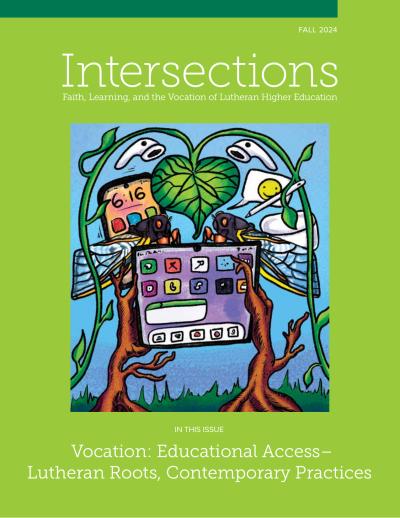 Editorial
From the Editor
Colleen Windham-Hughes
No. 60 · Fall 2024
Windham-Hughes welcomes newcomers and seasoned colleagues to the conversation, lifts up Mary Elise Lowe’s three Lutheran “whys” for educational access, and commends Rev. Jen Rude’s “Sacred Pause” practice as a way to humanize one another and make opening access both easier and more joyful.
-
 Article
You Don't Seem Angry: Methodological Confessions Of A Lutheran Lay-Woman
L. DeAne Lagerquist
No. 5 · Summer 1998
Lagerquist, opening from a colleague’s 1981 observation about her M.A. thesis on four female abolitionists, traces her path from feminist historian and battered women’s shelter advocate through the University of Chicago’s obsession with method to a more self-conscious account of her own. The method grows out of four Lutheran themes—original sin (caution and humility), the eighth commandment against bearing false witness (generosity and forgiveness), the neighbor as “little Christ” (cooperative interpretation), and vocation (interpretation as calling, located alongside feeding the hungry and visiting the lonely)—and shapes her ongoing work on a history of Lutherans in the United States with a plot about learning to live with diversity.