IF ONE WERE TO VIEW a map of North America that presented concentrations of Lutherans with the demographer’s red dots (no political symbolism intended), it would be possible to trace a red line that runs from eastern Pennsylvania through Ohio into northern Illinois with one branch then entering Iowa and another running into Wisconsin, through Minnesota, and ending in the Dakotas. Of course, there are Lutherans and Lutheran schools throughout the nation, from Southern California to Maine, from Alaska to Florida, but the heaviest concentration runs through that northern tier of the country, which follows earlier patterns of German and Scandinavian immigration.
For those of us who labor in the western reaches of the continent, the Rocky Mountain range that runs from southern Alaska into Mexico separates us not only geographically but also culturally from the more established centers of Lutherans and Lutheran schools manifested by the red demographic line that runs westerly from Pennsylvania and then stops, almost abruptly, at the Little Missouri River as it meanders along the border between North Dakota and Montana. Indeed, in the geographical imagination of my relatives who live in Virginia, Wisconsin, and Minnesota, we are “out there,” way out there, in what religious leaders of all stripes continue to consider “mission” territory.
Regional context shaping perceptions of Lutheran education
I offer this brief prelude on North American geography and the demography of religious density because I want to claim that regional cultures throughout North America both shape the experience of religion and present a series of challenges to those who serve in church-sponsored schools and colleges. As a native Washingtonian raised in the West, who spent half my life in the Upper Midwest before returning to the West and Pacific Lutheran University, my observation of cultural practices and culturally formed expectations of religion has been confirmed, challenged, and expanded by the recent works of the Lilly-sponsored series, Religion by Region, organized by the Greenberg Center for the Study of Religion and Public Life at Trinity College in Hartford.1 To say the least, both reflection on experience and patient study can reveal that distinctive regional cultures shape the conditions in which education takes place and in which education and statements on education are received.
To the first point, then: regional culture shapes the conditions in which Lutheran-sponsored education takes place.
The Pacific Northwest
My colleagues and I labor in that physical space between the Olympic mountain range to the west and the Cascade Range to the east. We live close to the deep bay of the Puget Sound, among the evergreens made verdant by the gentle rain and mild sun. We work in a distinctive and diverse natural ecology where the lush green fern grows next to the towering cedar; where the waters, filled with orca, salmon, and oyster, ebb and flow next to mountains filled with volcanic fire; where the rhododendrons flower next to the native dogwood. Our climate is so mild that most of our homes, schools, and churches don’t know what an air-conditioner looks like, a practice unthinkable east of the Rockies where the intensity of winter’s chill is balanced by summer’s heat and humidity. Indeed, since Lewis and Clark first mapped the “territory” (since the “Northwest,” then, was Minnesota), most people have been attracted to the region simply because of its astonishing beauty rather than its educational, religious, or cultural promise. Consequently, it would seem impossible for any college or university in the region today to attract students if it lacked a vigorous program in Environmental Studies. Indeed, the first course I taught at Pacific Lutheran University was on the “Theology of Nature,” one among the numerous offerings in the Religion Department and the University that attend to the natural ecology of the region and the strong but currently contested cultural value attached to this sense of place.
We also labor in another “ecology,” one that I would suggest is shaped, in part, by the first and natural one, that is, a distinctive human or cultural ecology that has been alive in this region since the early nineteenth century when immigrants began to make their way to the western reaches of the continent. Seeking to escape, yes, to leave behind the seemingly entrenched social stratification of the eastern seaboard and the communal sensibilities of Midwestern farming communities, trappers, fortune seekers, the adventurous, and the deeply independent made their way to this “last” place at the edge of the continent. Suspicious of established authorities and institutions, of government, religion, and education, of history and “tradition,” those who settled in the Pacific Northwest, who imprinted the region with a unique “cultural coding,” and those who continue to wander into this region, have nourished a cultural ethos marked by a fierce individuality rather than a cooperative spirit. Unlike those who were raised and educated within the Populist inheritance of the Upper Midwest—and experienced or experience church, school, and government working hand in hand—those who labor in a region such as ours, marked by a skepticism of “organized” religion and anything but the most pragmatic of educational programs, cannot take for granted for one second the cultural support for religion and church-sponsored education alive in other regions of the nation (Killen; Killen and Silk 2004:9–20, 169–184; Szasz).
Our predecessors were drawn to the Pacific Northwest by trees, mountains, and water, that is, timber, minerals, and fishing with the dream of quick economic gain. And now, computers and cyberspace, a world of disembodied communication, continue to attract a new generation of immigrants to a cultural ecology where the last thing just about anyone wants is a stable community in which they are known, known deeply. Indeed, logging, fishing, and mining—extraction industries that created a transient sense of work—seemed to have indelibly imprinted this highly mobile culture in which, today, almost every student at Pacific Lutheran University (if not elsewhere) imagines that he or she will have to move from job to job, frequently and quickly, if they are to survive and succeed as the social networks their parents and grandparents took for granted, from a previously benevolent government, seem to be withering away.
In the Northwest, the future of Christianity, or, at least, the deeply theological, sacramentally rooted, and socially engaged forms of Christianity, remains an open question. Indeed, in the Evergreen Empire, less than a third of the population claims any affiliation with a community of faith, and, when such affiliation is noted, it runs the gamut from Anglican to Zoroastrian and everything else in between.2 In the Pacific Northwest, less than half that third—that is, around 15 percent of the total population, that 15 percent made up of Roman Catholics, mainline Protestants, and Reform Jews—value and support higher education as a requirement for their clergy and as a laudable goal for their children.3 In what is arguably a pre-Christian milieu, since neither Christianity nor any other religion has ever dominated the cultural landscape of the region, there is little if any cultural support for the practice of religion and for religiously-sponsored schools and universities. Indeed, the mantra—“I’m spiritual but not religious”—falls from the lips as if it were a cultural norm. From Anchorage to Eugene, the voice of the skeptic and the shrug of the indifferent constitute the many who, when asked if they claim any religious affiliation at all, simply answer: NONE, none whatsoever (Killen and Silk 41–43).
To be sure, then, we do not teach in Philadelphia, saturated with Catholicism, Swedish or German Lutheranism, and colonial history. We do not labor in St. Paul and Minneapolis, brimming with Scandinavian Lutherans or those trying to escape the pleasant confinement of Lake Woebegone. We do not count ourselves among those who view the church or the academy through the lens of a denominational bureaucracy in which most people take for granted the “Lutheran” pedigree of their coworkers. We work in what looks like a post-Christian world that, if truth be told, is becoming the western world: a world that has more in common with Rome, Alexandria, and Jerusalem in the first century than Paris and its great medieval university, or Wittenberg and its small early modern university, or the American Midwest in the nineteenth century when so many Lutheran colleges sprang to wondrous life.
Lutherans in the Northwest
In the Pacific Northwest, there are 186,000 ELCA Lutherans, that is, 1.9 percent of the total population, a statistically insignificant number (Killen and Silk 33–35). That Lutherans have been able to create and sustain one of the largest universities in the ELCA system and promote a smaller college in the foothills east of Seattle is, I would claim, nigh unto miraculous given (1) the cultural antipathy toward established religion and liberal arts education, (2) the recurring and volatile swings in economic fortunes that influence benevolent giving, and (3) the steady growth of conservative evangelical and fundamentalist groups who view Lutherans as ripe for conversion and their schools as dangerous places to send their children (Nordquist 1986; Nordquist 1990). That a small number of Lutherans in the Northwest have been able to create and sustain a vigorous network of social services in the face of dwindling governmental support for the most vulnerable citizens is a testament, I would claim, to the Lutheran charism, the gift, of linking robust, critical learning with service to real human need. Indeed, it is no surprise to me that the region with the smallest percentage of religious participation also claims the highest levels of child malnutrition and food insecurity. Were it not for Lutheran and Catholic Community Services that together represent only 13.2 percent of the total population, we would experience a level of impoverished hunger that could rival Third World nations.4
This is to say that in the midst of a regional culture marked by aggressive levels of individualism, suspicion of religion, low levels of religious participation, and skepticism about educational institutions that highlight the meaning and moral dimensions of learning for the common good, it takes hard work to participate regularly in religious communities and to support religiously-sponsored institutions such as schools, universities, hospitals, shelters, and food distribution centers. Perhaps to Lutherans, who cherish the unmerited graciousness of God, the juxtaposition of “religion” next to “hard work” may seem, at first, unwise if not ill-founded. Yet ask any university admissions counselor, religion professor, campus minister, or culturally observant pastor in our neck of the woods, and they will tell you: absent any cultural or ethnic support for established religions and liberal arts education, only heroic labor and imaginative and adaptive strategies have sustained the educational, pastoral, and social service initiatives that rest at the heart of the Lutheran charism.
Pacific Lutheran University
Indeed, the University my colleagues and I represent at this conference is a microcosm of the regional culture. We can boast (albeit modestly in Northwestern fashion) of an astonishingly gifted faculty, deeply committed to teaching, scholarship, and service. Many, nonetheless, know little about the middle name of the university and, some consider it an obstacle in student recruitment and an annoying thorn in their resolutely a-religious flesh. Given the fact that a large number of faculty recruited in the last fifteen years have little familiarity with Lutheran higher education (much less Lutheran theology, history, or practice), it can come as a surprise that what many of them take for granted as “secular” qualities of higher education—academic freedom, resolute questioning of the status quo, the sanctity of one’s conscience, an egalitarian community of scholars—were first promoted among the early Lutheran and Christian humanist professors who insisted that medieval education for the elite be made available to the many.5
Many of our students and faculty have no experience of a “faith that seeks understanding” or a community of faith that actually welcomes the troubling questions raised by the academy or clergy that do not fear raising such troubling questions in preaching and teaching (even when such questions might jeopardize the new idolatry of keeping the pews filled at any cost). Given this fact, it should come as no surprise that we are faced with the difficult but necessary task of communicating the richness and complexity of the Lutheran charism as it shapes higher education in a language accessible to the listener.
To the second point, then: regional cultures shaping the conditions in which educational statements are received.
Receiving Lutheran educational statements in a regional culture
In my first year at Pacific Lutheran University, I was invited to a number of gatherings focused on new faculty orientation. At one of these meetings, I was seated next to a professor born and raised in India, with a PhD from an American university, who had lived in this country for about seven years. The topic for the evening was “Lutheran higher education,” a discussion led by an administrator who happened to be a Lutheran pastor. As the impressive Power Point presentation came to life on the screen, the presenter spoke about the “two kingdoms,” God’s right hand and God’s left hand, secular righteousness and the righteousness of a Christian, dialectical theology and paradox, the incarnation, and Luther’s redefinition of vocation; that is, many of the same themes found in Part 2 of the draft document under consideration at this conference. As slide after slide went up on the screen, I gazed around the room at the increasingly glazed expressions on the participants’ faces. I thought to myself: Oh boy, we’re losing this crowd in the one chance the university possesses to make a first and persuasive presentation on Lutheran higher education. At the end of the talk, the Indian professor turned to me, knowing that I was a new member in the religion department, and said in all seriousness: “Excuse me, but I don’t understand: the Lutheran god has two hands, a right hand and a left hand?” In that moment, it dawned on me that this Hindu colleague knew something about Shiva, the creator and destroyer who possesses many hands. Would not the “Lutheran god” look impotent compared to mighty Shiva? He went on to ask: “Where can you see these hands? How do you find these hands? And what do hands and kingdoms matter in teaching business or economics or biology?”
Communicating Lutheran wisdom in the None Zone
Thus, my first point: regardless of what we intend to communicate, people will receive that communication in light of their own experience. To say the least, it was unclear at this faculty gathering that the presenter was speaking in metaphor, what we know to be the building block of all complex thought. But more significantly, what became clear is what so many of us encounter in the classroom every day: the dynamic between what is communicated (on the one hand) and what is received by the listener (on the other hand). The medievals spoke of this dynamic in the chaotic phrase, “quid quid recepitur recepientes,” what is received is received according to the capacities of the recipient. What the writers of “Our Calling in Education” (Task Force on Education 2004) might consider normative Lutheran views of higher education may be received in the manner intended by Lutheran seminary faculty, professors of Lutheran history or theology, and those who are familiar with the language of Lutheranism. Yet I am not convinced that the faculty and administrative staff of our university would be able to receive and use such a document as a source of discussion about the Lutheran character of higher education since it seems to assume an almost exclusively Lutheran audience.6 Now, perhaps, ecclesial statements need to be focused exclusively on the ecclesial community receiving the statement. My concern is that a document written, in part, for a college and university system in which the minority of professors and administrators claim a Lutheran identity will need to be “translated” once again, if it is to be received and used by the intended audience.
I say this because the challenge we encounter in our regional context, as well as in many of the church’s colleges, is the desire to welcome people into Lutheran higher education without requiring them to be Lutheran or adept at “Lutheran language.” Indeed, this is a critical pedagogical issue in a culture that is marked by increasing religious pluralism, the collapse of impermeable boundaries between denominations, and the public captivity of Christianity by the Religious Right. In other words: How does one communicate Lutheran wisdom regarding education in a language that is neither biblical nor confessional yet deeply Lutheran? Is it even possible? It is this question that compels me to introduce my students to the work of Paul Tillich who, in the face of much opposition and ridicule from some Lutheran and Protestant theologians, attempted this very act of translation in an idiom that could speak to mid-twentieth century North America culture (Tillich 1951–1964). It was his attempt to communicate, for instance, through the disciplines of psychology, history, natural science, art, theology, political science, philosophy, and education that, I would claim, can serve as a model—but only as a model—for Lutherans to communicate their wisdom in a religiously pluralistic, secular, and contested cultural context.7
The document rightfully notes the “loss of confidence in” and, I would add, the marginalization of “the intellectual and moral claims of the Christian faith” in the larger cultural context. This is not due, however, simply to increasing secularization, but also to the failure of mainline Protestant communities, their pastoral leaders, and their schools to articulate their vision and communicate their wisdom in categories other than those that were vitally alive in the sixteenth century.
You see, I am not arguing for a simple or simpler explanation of great Lutheran ideas about education as if one needed to dumb down “church speech” for the great unwashed, as if writing teams needed to create a new “catechism” on education or any other topic for that matter. Rather, I am suggesting that philosophers, scientists, artists, theologians, economists, psychologists, and musicians, for instance, probe the deep meanings of the Lutheran core insights around education and communicate those insights in an idiom that can be received by those who may enjoy teaching or studying at a Lutheran college but will never become Lutheran.
Introducing students to the mystery of humanity or educating them in the faith?
Second, when the draft document speaks of higher education, it recognizes that student bodies are composed of “Lutherans, Christians of other traditions, [and] people of other religions, or no religion” (Task Force on Education 65). That would be a fairly accurate appraisal of the pluralism many of us encounter in the classroom and the faculty house dining room on a regular basis. In this context, mention is made of the need to teach Bible, theology, and ethics “in ways that respect a diverse student body.” Yet very quickly the document notes that one of the primary purposes of Lutheran higher education is to “educate in the faith.” This goal is underscored when the document notes that “Lutheran colleges have the challenge of engaging students with the intellectual heritage of the Christian faith” and “strengthen[ing] the faith of their Christian students” (65). Perhaps such goals seem perfectly normal in a college that counts a large percentage of faculty and students who identify themselves as Lutheran. I ask: How will this play in a university whose faculty and students view “the faith” within a range of responses that extend from outright disdain to utter indifference to benign or admiring tolerance to strong commitments?
As a professor of the history of Christianity who teaches courses on the Christian Tradition, Lutheran Christianity, and Luther, I believe that I engage my students in the “intellectual heritage of the Christian faith” and, as a social historian, something more than the history of ideas. As a human being, I draw upon a rich theological tradition that is sacramentally grounded and socially engaged, but I don’t think my purpose is to “educate students in the faith,” in Christianity or the Lutheran form of Christianity as if I were a pastor or catechist.8 Between the conservative evangelical students who expect me to do nothing more than affirm their passionately held assumptions about religion and the many students anxious about taking a course in religion because they fear I will force my own version on them, I can bring a measure of engaging scholarly objectivity that will infuriate some and awaken deep interest in others. If, in the course of their studies, students are challenged to move beyond the psychological stage of needing or requiring an external authority (e.g., parent or ecclesial leader) to confirm the faith of their childhood, so much the better.9 If this means that our students move from Ricoeur’s first naiveté into the world of critical self-consciousness and all the attendant relativism such a necessary movement entails, so be it. Lutherans and Lutheran schools do not need any more pastors, bishops, teachers, administrators, or professors who simply repeat the core insights of Lutheran theology. Rather, Lutheran schools need administrators and faculty who can imagine how those insights might or might not respond to the questions being asked in the world today or the critical point in human history that now confronts us. The question my students ask in light of the formative events of their lives—the global events of September 11 and the seemingly intransigent conflict in Iraq—is not Luther’s question: Where can I find a gracious God? Rather it is this: Will there be a future in which we can flourish? That question, it would seem to me, asks us to consider the virtue of hope in terms most realistic. This does not eliminate the virtue of faith so dear to Luther and Lutherans or the virtue of charity. It does suggest a shift in priorities.
Preparing students to be "good" citizens or agents of reform?
Thus, to my third point. When my Norwegian, Danish, and English grandparents immigrated to Oregon and Washington in the late nineteenth and early twentieth century, they arrived by train and horse-drawn wagon. They came as farmers and tree-toppers who read from the Bible, sang from the hymnbook, and knew the catechism by heart. What had begun in a small and relatively unknown German university town in the sixteenth century was found surprisingly alive four hundred years later and thousands of miles away in the farming communities of the lush Willamette Valley and the hill country of central Washington. They imbibed the great American dream of seeing their children and their grandchildren survive and flourish in this new land guided by a provident presence, hard work, and a Lutheran education. They could readily assent to the draft document’s claim that “Lutheran colleges aim to prepare people for their vocations as family members, workers, citizens of their country and of the world and members of churches” (Task Force on Education 65).
In the course of their lives, however, the world shifted dramatically and fearfully under their feet. Traveling westward and settling into ethnic communities centered on church and school, they never could have imagined at the beginning of the twentieth century that humans beings would hold in their hands by the end of the century what virtually all previous generations had believed was a divine power: the ability to destroy human life throughout the planet, this destruction now made possible with invention of weapons of mass destruction by German and American scientists. As people who tilled the fields and labored in the immense forests of the Northwest, they had no idea in their young lives that their grandchildren would be faced with a startling and unthinkable scenario: a planet so terribly poisoned by the wealthy few that the future of earth’s viability would become an open question.
From the upper campus of Pacific Lutheran University, it is possible to see one of the largest army bases in the country, whence soldiers depart regularly for Afghanistan and Iraq. In the classroom we hear, on a daily basis, the sound of Air Force cargo planes and fighter jets landing and taking off at McChord Field. In less than forty minutes, one can drive to the Trident naval base, its submarines filled with missiles. We know that while the leader of Iraq could have never launched any kind of missile that would have reached the Eastern seaboard, much less the Rocky Mountains or the Puget Sound, we do know, from the many maps produced in The New York Times, that we are located within striking range of North Korea.
Many of us know these things and yet we go about our daily work: preparing for class, going to baseball games, paying bills, picking up children at school, or slogging through committee work. “Others will deal with these problems,” we may think. But we would be naive to assume that this previously unimagined moment in human history is simply one more thing to take in stride as we walk into the classroom, grade papers, or attend a chapel service. In the face of profound social anxiety and the possibility of widespread destruction, it seems to me that only the privileged imagine that they will be protected by their privilege or by the promise of a blissful eternity if things don’t work out in the world today.
In this context, both religion and education can serve many purposes. Each can be used as an anesthesia to blunt one’s senses to the suffering alive in the world. Each can be used as a compensatory and comforting psychological mechanism when faced with unfulfilled ambitions and personal loss. And each can be accommodated to the quantification of success so pervasive in American culture. Thus, it is not surprising that college presidents and synodical bishops, admission directors, and parish pastors are counting numbers and studying demographic charts these days as if they were seasoned sociologists. When religion and education are imagined primarily as supporting the social fabric and affirming the status quo—“preparing people to be family members, good citizens, and church members”—they all too easily become captive to the prevailing cultural ethos that will allow religion and education a sociological function yet deny them a prophetic political or economic one. If you don’t believe me, ask Lynn Cheney why she constructed and advertised a blacklist of college and university professors who publicly opposed the conflict in Iraq, many of whom are numbered among the faculty of Lutheran colleges and universities.
While Fortress Press is publishing a bevy of studies on Bonhoeffer, the educator, pastor, and martyr, it is not clear to me that we have yet fully learned from the experience of the German church and German higher education during the previous century, both of which forgot, tragically, the critical “re-forming” instincts that gave birth to Lutheran churches and Lutheran universities. This is to argue that the colleges and universities of the church, with their concentration of scholarly expertise and moral commitment, are capable of forming students in far more than “good citizenship and church membership.” If we cannot imagine them as centers of vigorous public engagement that hold together the “deconstructive,” critical voice that calls the status quo into question and the “reconstructive” visionary voice that imagines a more gracious and just alternative to the troubling world in which we live, then why not pull the plug and let these schools become centers for middle-class camaraderie in which people are more concerned about Lutheran choir competitions than global economic competition?
Or say it this way. I profess that one of the most energizing legacies of the Lutheran commitment to higher education rests in two “freedoms” that asked to be held in tension: (1) the freedom to call into question the accepted norms and practices of a society that can lead to intellectual, emotional, relational, economic, and political diminishment, and (2) the freedom to seek and shape a life in common with others that is clearly attentive to the deeply moral nature of learning for the good of others. This is to say that at the heart of the Lutheran charism in higher education rests the freedom to question one’s own and one’s culture’s assumptions about this world and the freedom to construct and affirm, again and again throughout life, a purposeful commitment to this world rather than (what I witness in some faculty colleagues) a cynical withdrawal from its failures and tensions. If this is what “vocation” might mean—welcoming the voice of the scholar as cultural prophet committed to life in this world now and the requisite protection of that voice from political or ecclesial, popular or corporate censorship—then we are on good ground to imagine that the colleges and universities of the church will be able to prepare students to engage the powers that shape their world even when such engagement might lead to marginalization and apparent loss.
Conclusion
But, this should come as no surprise to anyone who is familiar with the Christian story or the Lutheran interpretation of that story. For at the heart of that ancient narrative one encounters a Jewish prophet who called into question the political, economic, and religious powers of a global empire with an alternative vision that issued forth from a gracious and just God. That public witness, rooted in the imaginative capacity to reinterpret the law and prophets in a new context, led to the charge of sedition against the state and a terrible, humiliating public death. Why and how that deeply reforming project was tamed and domesticated by his followers needs to be discussed elsewhere. That it has not been forgotten and, as the witness of Luther makes clear, is filled with vital energy and transcendent promise could make even the most skeptical citizen of the “None Zone,” or any zone, pay attention to a university community where the future of life on this earth is its abiding passion.
Endnotes
1. A preview to the entire series, edited by Mark Silk and Andrew Walsh, can be viewed online.
2. See Table 1.2, “Number of Adherents in the Pacific Northwest by Religious Family,” in Killen and Silk, 29.
3. Eastern Orthodox, Roman Catholic, Episcopalian, Lutheran, Presbyterian U.S.A., UCC, United Methodist, American Baptist, Christians (Disciples), Mennonite, and some groups of African American Protestants.
4. See “Even PLU Students Can Go Hungry: Research Looks Into How to Help,” in Scene 35:2 (Winter 2004): 8–9, concerning my research with Matthew Tabor on hunger in the Pacific Northwest, funded by a Kelmer Roe Fellowship in the Humanities; Torvend 2005.
5. See Torvend 2003. This is one attempt to communicate a Lutheran vision of education to first-year students in a language that is rooted in a biblical, confessional, and theological framework yet prescinds from using terms and concepts that would be alien to students from diverse backgrounds.
6. In the last two years, Pacific Lutheran University’s Center for Religion, Cultures, and Society in the Western United States has sponsored study groups of Washington and Oregon ELCA and LCMS clergy, all of whom report the critical need to communicate Lutheran wisdom in a “language” that can be “received” by persons who are unfamiliar with the biblical, confessional, and theological languages of the Lutheran tradition.
7. Here I am referring to the collection of essays in Tillich 1959 that suggests, in the very discussion of culture, language, philosophy, religion, art, psychoanalysis, science, and education, a way to discover and articulate the deep meanings of the “languages” and “practices” of a particular religious tradition such as Lutheranism.
8. While the religion or theology departments in some Lutheran colleges retain curricula that correspond to a “preseminary” offering of courses and consider one of their chief responsibilities the cultivation and preparation of future candidates for the ordained ministry, others have responded, through modulation in their curricular offerings, to student desire to pursue graduate studies in religion or theology as well as interdisciplinary studies.
9. See Parks 2000. This text is read by faculty and administrators engaged in the Lilly-funded, five-year, “Wild Hope” project on discerning “vocation in a Lutheran university” at Pacific Lutheran University. Parks makes cautious reference to the work of Erickson and Fowler on stages of psycho-moral and faith development in young adults.
Works Cited
“Even PLU Students Can Go Hungry: Research Looks Into How to Help.” Scene 35:2 (Winter, 2004).
Killen, Patricia O’Connell. “The Religious Geography of the Pacific Northwest.” Word & World 24.3 (Summer 2004): 269–78.
Killen, Patricia O’Connell, and Mark Silk, eds. Religion & Public Life in the Pacific Northwest: The None Zone. Walnut Creek, CA: AltaMira Press, 2004.
Nordquist, Philip. “Lutherans in the West and Northwest.” New Partners, Old Roots. Ed. Heidi Emerson. Tacoma: J&D Printing, 1986. 3–18.
Nordquist, Philip. Educating for Service: A History of Pacific Lutheran University. Tacoma: Pacific Lutheran UP, 1990.
Parks, Sharon Daloz. Big Questions, Worthy Dreams: Mentoring Young Adults in Their Search for Meaning, Purpose, and Faith. San Francisco: Jossey-Bass, 2000.
Szasz, Ferenc. Religion in the Modern American West. Tucson: U of Arizona P, 2000.
Task Force on Education. “Our Calling in Education: A Lutheran Study.” Chicago: Evangelical Lutheran Church in America, 2004.
Tillich, Paul. Systematic Theology. 3 vols. Chicago: U of Chicago P, 1951–1964.
Tillich, Paul. Theology of Culture. Ed. Robert Kimball. New York: Oxford UP, 1959.
Torvend, Samuel. “Five Free Gifts for Your Journey at Pacific Lutheran University.” September 2002, 2003.
Torvend, Samuel. “Luther’s Early Thought on Social Welfare.” A Lutheran Vocation: Philip A. Nordquist and the Study of History at Pacific Lutheran University. Eds. Robert Ericksen and Michael Halvorson. Tacoma: Pacific Lutheran UP, 2005.
-
 Editorial
From the Publisher
Arne Selbyg
Selbyg features articles based on presentations at the 2005 Vocation of a Lutheran College conference focused on the upcoming ELCA Social Statement on Education, and urges members of the ELCA higher-education community to download the first draft (“Our Calling in Education”) from the ELCA website and submit feedback to the Task Force on Education before the October 15 deadline. He worries that the sexuality social statement on a 2009 timeline will draw more attention than the education statement, but reminds readers that, for Martin Luther and for those who work in Lutheran higher education, education is as important as sex.
-
Editorial
From the Editor
Robert D. Haak
Haak previews the issue’s four essays by Marcia Bunge, Paul Dovre, Samuel Torvend, and Cheryl Budlong — each engaging the ELCA Task Force on Education’s study document and first draft of the social statement on Lutheran education — and invites readers to bring their distinctive voices as professional educators at Lutheran institutions into the conversation before the October 15 deadline. He also invites submissions to Intersections and directs readers to LauraOMelia@augustana.edu to be added to the direct mailing list.
-
Article
"Our Calling in Education": Working Together to Generate a Strong Social Statement on Public Schools, Lutheran Schools and Colleges, and the Faith Formation of Children and Young People
Marcia Bunge
Bunge, Professor of Theology and Humanities at Christ College, Valparaiso University, makes two claims about the ELCA’s forthcoming social statement on education: first, that it should be built on a robust Lutheran understanding of vocation, addressing four common misconceptions (vocation as occupation, as self-fulfillment, as ordained ministry, and as “vo-tech”) and recovering the breadth of Luther’s teaching; and second, that the statement should narrow its focus to three urgent areas affecting children and young people — public schools, Lutheran schools and colleges, and faith formation — rather than addressing the full lifespan of education in equal depth.
-
Article
The Lutheran Calling in Education: Context and Prospect
Paul J. Dovre
Dovre, President Emeritus of Concordia College and co-chair of the ELCA Task Force on Education, undertakes three tasks: focusing on the current social context (young people’s spiritual lives, the state of mainline denominations, the family map, schools, communities, and higher education); reflecting on why Lutherans care about education (creation in God’s image, vocation, Luther’s legacy, the priesthood of all believers, civic righteousness, and hope); and considering the prospects and possibilities for addressing the calling (biblical, confessional, theological, and pedagogical legacies; the renewal of apostolic ministry, the Christian-college renaissance, K–12 reform, and the congregational education explosion).
-
Article
"Our Calling in Education": An Educator's Perspective
Cheryl Budlong
Budlong, Professor of Education at Wartburg College, asks educators to reexamine their ‘mental models’ of what education itself means in light of the rapidly expanding literature on how young people learn. Drawing on Malcolm Gladwell, Eric Jensen, Ruby Payne, Judith Harris, Robert Slavin, and the AACTE’s Leading a Profession retrospective on the AACTE agenda 1980–2005, she calls on Lutheran educators to articulate vocation intentionally in their classrooms and to ground curricular and pedagogical reform in Wartburg’s focus on Discovering our Calling.
-
 Article
"Greed is an Unbelieving Scoundrel": The Common Good as Commitment to Social Justice
Samuel Torvend
No. 42 · Fall 2015
Torvend uses his Lutheran Heritage course at Pacific Lutheran University to ask what “the common good” might mean concretely — fresh air, clean water, food, shelter, healthcare — and traces the early Lutheran reform of literacy and social welfare to argue that the first gift of Lutheran education is the capacity to question the status quo and to push beyond charity into the pursuit of social justice.
-
 Article
Critical Engagement in Public Life: Listening to Luther's Troubling Questions
Samuel Torvend
No. 35 · Spring 2012
Torvend narrates the medieval “spiritual/temporal” division and the neo-platonic devaluation of the body that shaped the world into which Luther was born, then traces the disruptive questions Paul’s letters provoked in Luther: about indulgences, the two estates, vocation, and the public reach of baptism. He argues that Luther’s reform — expressed in Kirchenordnungen, social welfare reform, public schools, and writings on lobbyists, usury, and monopolies — carries a “genetic encoding” of public engagement that Lutheran colleges should reclaim against the temptations of holy apathy and Christian nationalism.
-
 Article
Welfare of the City and Why Lutherans Care about Education
L. DeAne Lagerquist
No. 38 · Fall 2013
Lagerquist takes readers on a historical tour from sixteenth-century Saxony through the founding decades of Lutheran higher education in the United States to the present day, recovering Luther’s “gift economy” alongside Lewis Hyde and Oswald Bayer as a counter to the market logic that increasingly governs American higher education. She offers four propositions on vocation and commodification and proposes that Lutheran institutional vocation is to accept and pass along the gifts that come to our schools for the well-being of students, neighbors, and the world.
-
 Article
A River Runs Through It: CLU as a Church-Related University
A. Joseph Everson
No. 12 · Summer 2001
Everson borrows Norman Maclean’s A River Runs Through It and the small creek that flows through California Lutheran University’s Kingsman Park as images for the quiet stream of Christian tradition on campus, describes the dialectic of faith and reason (with a “Lord of Life” student congregation, two required religion courses, and a voluntary Wednesday chapel) as the “theology of paradox” that runs from Luther’s simul justus et peccator through Richard Solberg and Richard Hughes, and names six commitments that constitute the CLU ethos—academic freedom (Jeremiah 29:7 and John 8:32), vocation, service (Amos and Habitat for Humanity), grace and graciousness (Portia’s “quality of mercy” speech from The Merchant of Venice), diversity, and reverence (Proverbs 9 as awe and wonder).
-
 Response
"Whose Future?" or "Social Justice and the Lutheran Academy?"
Marsha Heck
No. 1 · Summer 1996
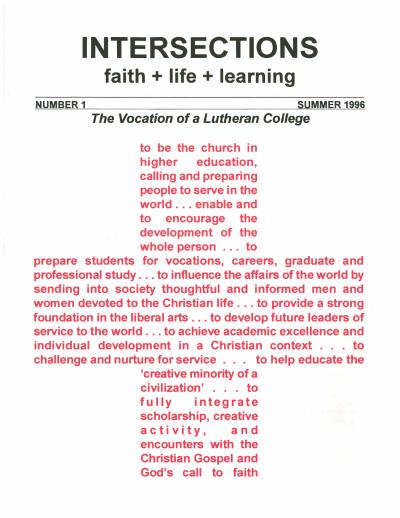
Heck argues that the future of Lutheran higher education lies less in defining Lutheran distinctiveness than in moral action grounded in face-to-face relationships with others. Drawing on David Lotz’s two-kingdoms theology of citizenship, Ernest Simmons’s relational reading of Luther, Arthur Preisinger’s indictment of the German Lutheran misreading of two kingdoms during the Third Reich, Starla Stensaas of Dana College, and Paulo Freire’s dialectic of empowerment, she calls Lutheran colleges to integrate moral reflection with moral action—to move students’ muscles against what is not true as well as to feel truths in their bones.
-
 Editorial
From the Publisher
Mark Wilhelm
No. 29 · Spring 2009
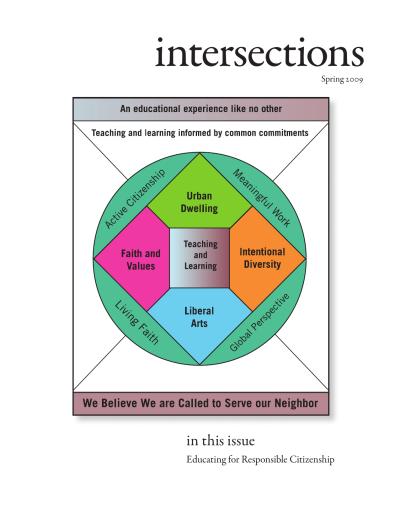
Wilhelm introduces essays from the 2008 Vocation of a Lutheran College Conference held at Luther College under the theme “Educating for Responsible Citizenship,” previewing contributions from Paul Pribbenow on dual citizenship at Augsburg, Wanda Deifelt on Luther College’s engagement with civic vocation, Jose Marichal on the promise and peril of digital citizenship, and Arne Selbyg on his three experiences of being educated for citizenship.
-
 Article
Vocation and Civil Discourse: Discerning and Defining
Lynn Hunnicutt
No. 48 · Fall 2018
Hunnicutt draws on Rabbi Amy Eilberg’s reading of Moses’ calling to identify four features of vocational discernment — attention, wonder, communal consciousness, and humility — and argues that these same qualities are also key aspects of civil discourse, so that forming students for vocational discernment is simultaneously forming them for civility.
-
 Editorial
From the Publisher
Arne Selbyg
No. 8 · Winter 2000
Selbyg reflects on the origins of Intersections—begun out of concern that the philosophy and theology behind Lutheran higher education could be lost to retirements and other preoccupations—and credits Paul Dovre of Concordia and Robert Sorensen of the ELCA Division for Higher Education and Schools as key figures behind the resumption of the debate. He points to three recent books (Ernest Simmons’s Lutheran Higher Education, Paul Contino and David Morgan’s The Lutheran Reader, and Pamela Schwandt’s Called to Serve) and to the new Lutheran Academy for Scholars in Higher Education, and previews the next “Vocation of a Lutheran College” conference at Dana College in August on what differentiates Lutheran colleges within American higher education.