A year from now, Lutherans around the world will commemorate the 500 year anniversary of the birth of the Reformation, marked by Martin Luther’s 95 Theses in 1517. But today, faculty, staff, and administrators within Lutheran higher education commemorate a lesser-known milestone.
The summer of 2016 marks 20 years since Intersections was first printed at Capital University and distributed among the (then) 28 ELCA colleges and universities. As the journal’s second editor, Bob Haak, would later say, it was “born in the twinkle of an idea” in the mind of the founding editor, Tom Christenson. Tom would edit the journal for almost a decade; Bob would take over for another half decade before inviting me to carry the work forward.
Intersections, along with the annual Vocation of a Lutheran College conference, was conceived as a way to sustain an open-ended conversation about the nature and mission of Lutheran colleges or universities after they ceased to be a places that (mostly) Lutherans went to be educated by (mostly) Lutherans. Thousands have attended the summer conference, learning about the Lutheran intellectual tradition that undergirds our residential colleges and education for vocation therein. Hundreds have contributed articles, essays, book reviews, reports, poems, and homilies to Intersections—sometimes celebrating our work or arguing with one another, often asking deep and important questions about how best to educate students for lives of responsible service, purpose, and meaning.
The first essay of this special anniversary edition comes to terms with the 20 year-old conversation called Intersections. It is co-authored by the three editors, past and present, although Tom’s name is listed “in spirit.” Tom passed away in 2013, but his spirit certainly lives on in this journal. The essay quotes from his editorials frequently and could not have been written without him.
I am delighted that the other authors of this issue agreed to write for this special anniversary issue. Mark Wilhelm has given a version of his essay as the opening address of the Vocation conference in recent years. In it, he explains why and how education for vocation has emerged as the sine qua non of Lutheran higher education. Florence Amamoto contributed to the first issue of Intersections in 1996; here she looks back to that essay and the dance between Lutheran identity and racial and religious diversity that she has witnessed (and helped choreograph) at Gustavus and beyond. Kit Kleinhans positions Lutheran conceptions among other recent scholarship on vocation. Her essay suggests that, while teacher-scholars contributing to Intersections often debate with one another, their work also helps direct broader conversations about holistic education and service to the common good. Kristen Glass Perez then “moves forward by looking back” as she suggests that the attention given to vocation over the past decades should also be given to interfaith understanding in the decades to come. Finally, Ernie Simmons takes into account a number of initiatives in Lutheran higher education before making one more irreplaceable proposal: We ought to help students become “sustainability leaders” in a world whose climate and environment has been drastically altered by human consumption and waste.
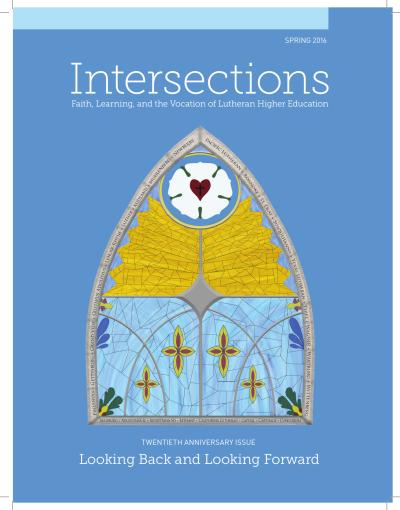
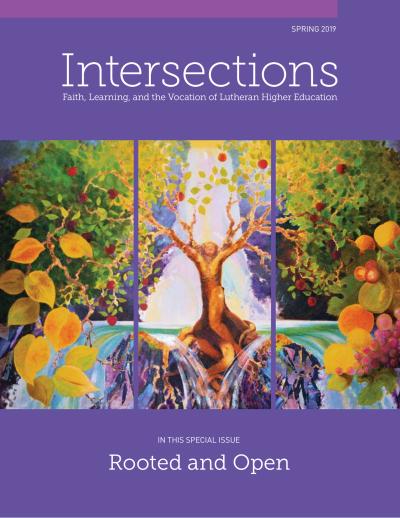
I close by thanking Augustana junior Eileen Ruppel for designing the wonderful cover of this special edition, and Augustana graduate Kaity Lindgren (‘16) for her diligence, insightfulness, and care while serving as the editorial assistant. Eileen and Kaity are extremely professional and wise, even though they are hardly older than this journal.
-
 Editorial
From the Publisher
Mark Wilhelm
Wilhelm announces the new Network of ELCA Colleges and Universities — established in 2015 and convened for its first Board of Directors meeting in February 2016 — as a missional collaboration between the churchwide organization and the twenty-six ELCA colleges and universities, replacing former churchwide units lost to budget reductions and offering a stronger, more viable vision of Lutheran higher education.
-
Article
The Vocation of Intersections on its Twentieth Birthday
Jason A. Mahn, Robert D. Haak, Tom Christenson
The three editors of Intersections — Bob Haak, Jason Mahn, and Tom Christenson (in spirit, following his death in 2013) — trace the twenty-year vocation of the journal itself: its 1996 birth at Capital University; its coming-of-age years of debate over institutional markers, two-kingdoms theology, and Lutheran identity; the ascendancy of “education for vocation” as the central marker of Lutheran higher education; and its ongoing identity in relation to a changing ELCA and to the broader cultural conversation about purpose, wholeness, and the vocation of higher education.
-
Article
The Vocation Movement in Lutheran Higher Education
Mark Wilhelm
Wilhelm offers a brief history of the “vocation movement” in ELCA higher education, arguing that it arose as Lutheran leaders moved beyond institutional markers (percentages of Lutheran students, faculty, and board members) and the collapse of ethnic, separatist Lutheranism to re-ground their schools’ identity in a 500-year-old intellectual tradition that educates the whole person for vocation and the common good — an educational ideal open to persons of any religious or non-religious conviction.
-
Article
Diversity and Dialogue: Twenty Years and Counting
Florence D. Amamoto
Twenty years after her essay “Diversity and Dialogue” in the first issue of Intersections, Amamoto returns to Gustavus Adolphus College to reflect on what has changed and what has not: rising numbers of students of color and international students, faculty turnover and increased publication pressures, the disappearance of the Center for Vocational Reflection, and the renewed importance of articulating Gustavus’s Swedish Lutheran heritage and inclusive sense of community in a tuition-dependent, cost-cutting environment.
-
Article
Distinctive Lutheran Contributions to the Conversation about Vocation
Kathryn A. Kleinhans
Kleinhans surveys the recent resurgence of vocation talk in American higher education — from Frederick Buechner’s widely quoted definition to Lilly Endowment’s PTEV grants and the CIC’s NetVUE Scholarly Resources Project — and uses her chapter in At This Time and In This Place: Vocation and Higher Education to highlight distinctively Lutheran emphases: vocation grounded in creation rather than redemption, the given-ness of multiple simultaneous callings, and a frank acknowledgment of the constraints and “dark side” of vocation.
-
Article
Moving Forward by Looking Back: Lutheran Vocation as Foundation for Interfaith Ministry
Kristen Glass Perez
Recounting how Augustana students mentored her into the role of presider at a campus vigil following the 2012 Sikh Temple of Wisconsin shooting, Glass Perez proposes that interfaith understanding become a mode of praxis for the twenty-first century Lutheran college. Drawing on Engaging Others, Knowing Ourselves and Interfaith Youth Core’s leadership practices, she urges ELCA schools to develop a common language linking interfaith engagement to vocational exploration and to the wider mission of the church.
-
Article
Semper Reformanda: Lutheran Higher Education in the Anthropocene
Ernest L. Simmons
Simmons enumerates the ELCA initiatives over the past twenty years that have helped Lutheran higher education retrieve a Christian understanding of vocation, then argues that the looming reality of human-caused climate change — the geological epoch of the Anthropocene — now requires Lutheran liberal arts education to prepare students for “planetary citizenship” as sustainability leaders, drawing on the classical Trivium, Luther’s panentheism, and a quantum-physics-inflected theology of divine entanglement and hope.
-
 Article
Vocation at Full Stretch: Reflections on Follow Your Bliss and Other Lies about Calling and its Use among College Students
Jason A. Mahn
No. 61 · Spring 2025
43 min audio
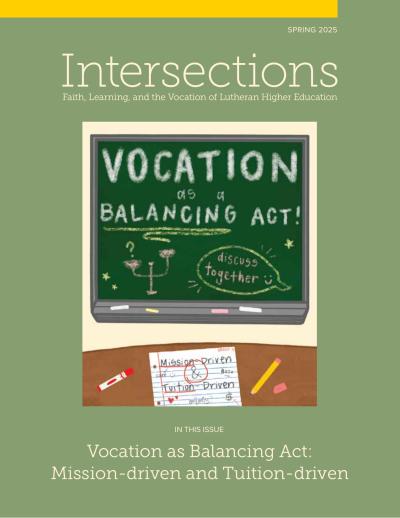
Mahn engages Bonnie Miller-McLemore’s Follow Your Bliss and Other Lies about Calling as required reading in a sophomore religion course, showing how her categories of missed, blocked, conflicted, fractured, unexpected, and relinquished callings empower young adults to perceive embodied, unplanned, and often painful dimensions of life as essential parts of vocation — and help close the gap between mission-driven and tuition-driven realities.
-
 Article
On Recruiting Diverse Students, Rooted in Mission
Eric Rowell, Jason A. Mahn
No. 59 · Spring 2024
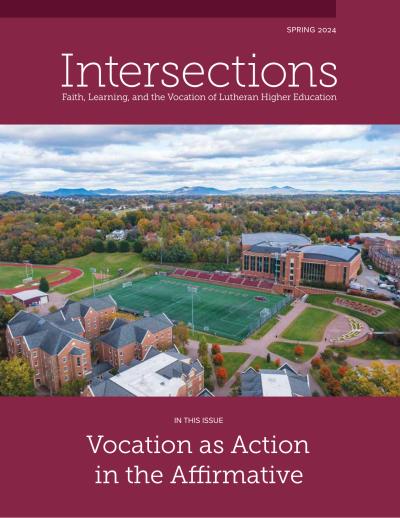
Jason Mahn interviews Eric Rowell, Assistant Director of Admissions and Diversity Outreach at Augustana College, about how recruiting students from a wide variety of backgrounds — rooted in Augustana’s Lutheran commitment to vocation and educating across difference — remains essentially unchanged in the wake of the Supreme Court’s 2023 decisions on affirmative action.
-
 Editorial
From the Outgoing Editor
Jason A. Mahn
No. 55 · Spring 2022
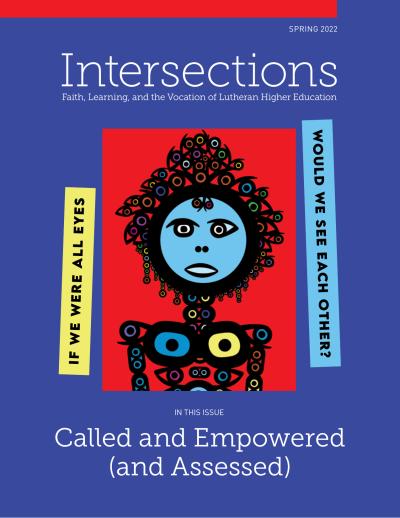
Mahn closes out a decade of editing Intersections, passes the duties to Colleen Windham-Hughes, gives thanks to Mark Wilhelm and Augustana College, and introduces an issue largely drawn from comments by Lutheran faculty, staff, and administrators at the 2022 NetVUE national gathering.
-
 Editorial
From the Editor
Jason A. Mahn
No. 54 · Fall 2021
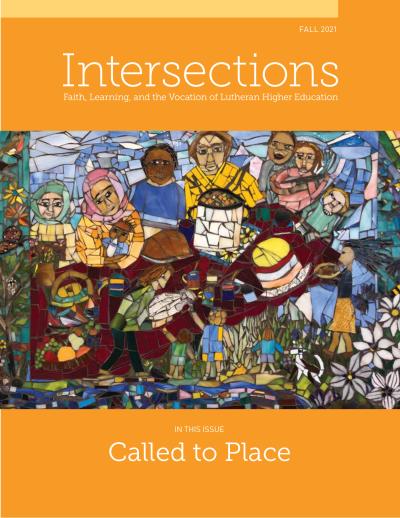
Mahn introduces the “Called to Place” theme of the 2021 VLHE Conference, arguing that Lutheran higher education’s emphasis on vocation must be grounded in particular geographies and embodied communities — for, as Wallace Stegner put it, “If you don’t know where you are, you don’t know who you are.”
-
 Reflection
Shelter in Place: Reflections from March 22, 2020
Jason A. Mahn
No. 53 · Spring 2021
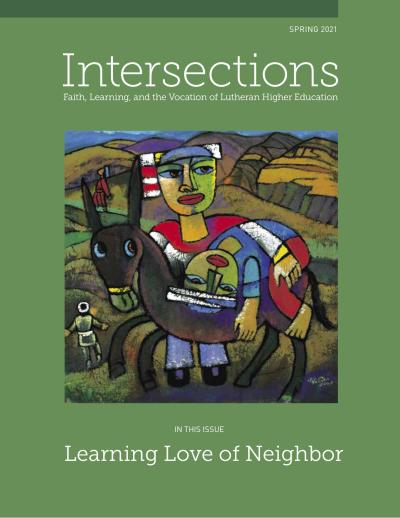
On the fourth Sunday of Lent in 2020, Mahn meditates on the etymology of “shelter” (from shield) and on an email from a former student in Boston whose mutual-aid organizing models a Lutheran understanding of vocation: the upending of ego by divine love that frees us, finally, to see and serve the neighbor.
-
 Editorial
From the Editor
Jason A. Mahn
No. 52 · Fall 2020
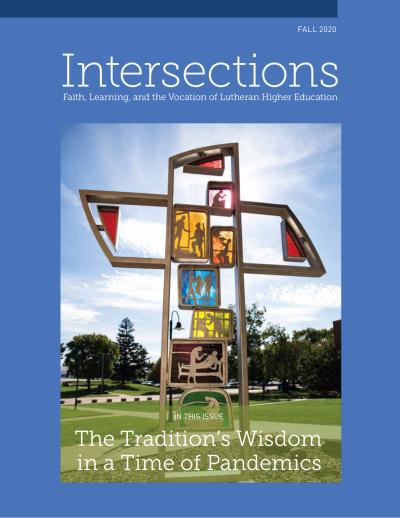
Mahn narrates a year of crisscrossing pandemics — Covid-19, economic collapse, partisan politics, and the long pandemic of white supremacy revealed anew by the murder of George Floyd — and argues that Lutheran liberal arts schools, by educating for vocation, are uniquely poised to help students respond with character and capable callings.
-
 Article
Sexuality over the Lifespan—Social Trends Pose Moral Dilemmas for Communities of Faith
Adina Nack
No. 22 · Spring 2006
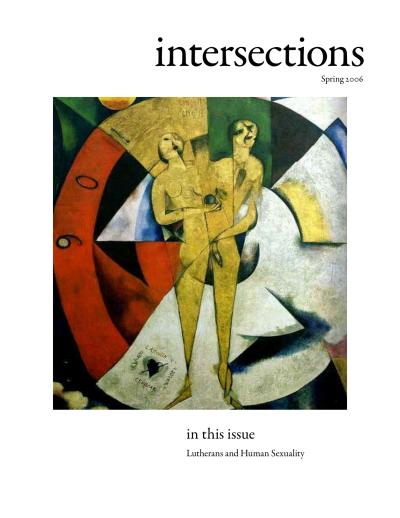
Nack, a sociologist who presented to the ELCA Task Force for Studies on Sexuality, surveys empirical research on three life-stages flagged by the Task Force as particularly contested—premarital sexuality among adolescents and young adults, sexuality after divorce and within single parenting, and sexuality in late adulthood. Drawing on the Alan Guttmacher Institute, the Office of the Surgeon General, AARP, National Council on the Aging, and the World Health Organization’s 2002 definition of sexual health, she closes each section with questions about the church’s role in education, blessing of committed nonmarital relationships, and dismantling stereotypes about aging and sexuality.
-
 Article
The Identity, Mission, Vision, and Goals of a Lutheran College vis a vis Bacon's "Of Studies" and Newman's "The Idea of a University"
Cora Lazor, Mary Theresa Hall
No. 15 · Winter 2002
Hall, an Associate Professor of English at Thiel, and Lazor, a Thiel junior and 2002 ELCA Division for Higher Education summer intern, read Thiel College’s Statements of Identity, Mission, Vision, and Goals alongside Sir Francis Bacon’s “Of Studies” (1625) and John Henry Cardinal Newman’s The Idea of a University (engaging Azade Seyhan’s May 2002 PMLA essay along the way). They argue that Bacon’s “Read…to weigh and consider” and Newman’s defense of liberal over technical training underwrite Thiel’s new Writing-Intensive Course requirement, its ten institutional objectives, and its commitment to “service to society” in the Judeo-Christian tradition.
-
 Article
In a Diverse Society, Why Should Lutheran Colleges/Universities Claim their Theological Roots?
Darrell Jodock
No. 49 · Spring 2019
Jodock develops his “third path” account of the Lutheran college — neither sectarian nor non-sectarian but both rooted and open — analogizing the college to a bridge whose deck of daily activities rests on pillars of shared educational priorities, which in turn rest on theological footings; he then answers six common objections to claiming Lutheran roots and explains why those footings still matter.
-
 Editorial
From the Editor
Tom Christenson
No. 7 · Summer 1999
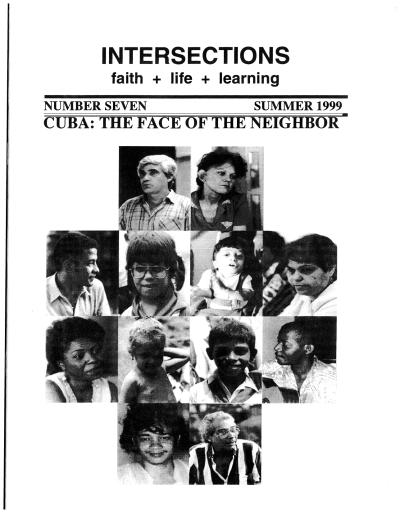
Christenson introduces the issue’s contents—papers from the 1998 Vocation conference by Cheryl Ney and Robert Scholz, a response by Jennifer Sacher Wiley, an interview with four Capital University faculty about Cuba, a meditation by St. Olaf senior Erik Haaland, and the journal’s first letter to the editor—and commends the Mount Mary College volume Wagering on Transcendence as a model of a faculty community sustained by Friday-afternoon conversation over a glass of wine.
-
 Article
Affirming, Entrusting, and Acting: A Baptismal Grounding of Affirmative Action in Lutheran Higher Education
Peter Carlson Schattauer
No. 60 · Fall 2024
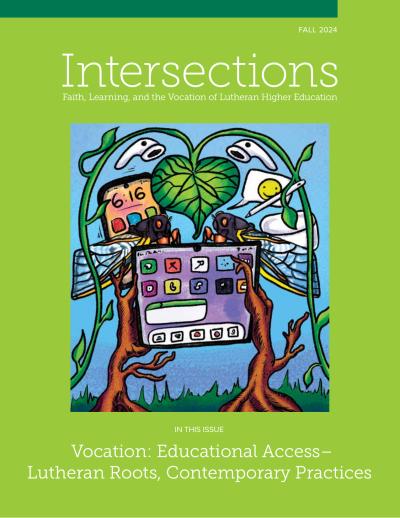
Schattauer draws on the Lutheran baptism liturgy — where the gathered assembly publicly affirms what it is for and is entrusted with responsibilities for justice and peace — to argue that NECU institutions create truly inclusive communities by affirming commitments, naming responsibilities, and acting in ways that embody both.
-
 Article
A Fifth Teat on a Cow: The Irrelevance of the Lutheran Doctrine of the Two Kingdoms for Academic Life
Richard VonDohlen
No. 9 · Summer 2000
VonDohlen, responding to Richard Hughes, Carol LaHurd, David Ratke, Philip Nordquist, and Robert Benne, argues that the Lutheran doctrine of the two kingdoms as commonly deployed in recent discussions of Lutheran higher education rests on a faulty sociology (taking Luther’s sixteenth-century structure for our highly differentiated society) and an epistemological monism (assuming a single neutral reason against the pluralism described by Alasdair MacIntyre and others), making it anti-intellectual, hostile to interdisciplinary dialogue and Christian social ethics, and ultimately as a defense of theology’s relevance about as useful as “a fifth teat on a cow.” Drawing on his experience on the Catawba Valley Hospice Ethics Committee, his Dutch Reformed and dispensationalist background, and the ELCA social statement “Sufficient, Sustainable Livelihood for All,” he calls for an “intellectually ecumenical” dialogue between Lutherans and non-Lutherans willing to take each other’s paradigms seriously.