Distinctive Lutheran Contributions to the Conversation about Vocation
Intersections No. 43 · Spring 2016
Martin Luther has long been credited—and rightly so—with expanding the narrow, ecclesial understanding of vocation associated with the medieval Catholic church into a broader view of vocation as God’s call for all people within the context of their daily lives and responsibilities. For Luther, the human vocation, or calling, included not just one’s work but one’s roles within the areas of family life, religious life, and civic life. Luther’s understanding of vocation is so significant that theologian Jürgen Moltmann identifies vocation as “the third great insight of the Lutheran Reformation,” after Word and sacrament (186). But, to ask the perennial Lutheran question, what does this mean? Or, to speak more colloquially, so what?
Over the years, the breadth of Luther’s understanding of vocation was diminished. Later theologians, particularly in Reformed traditions (those coming out of the Calvinist tradition), equated vocation primarily with productive work, thus excluding other major areas of human life from the category of vocation. Some interpreted the “particular calling” of the individual as an expression of the more “general calling” to faith in Christ, thus limiting vocation to Christians. By the twentieth century, the concept of vocation had become largely secularized, with the term “vocational” designating work that required technical training in contrast with the professions, which required genuine education.
Reviving Vocation
In recent years, two things have helped shape the conversation about vocation in the United States. The first is the widely quoted description of vocation penned by Presbyterian pastor and author Frederick Buechner: “the place God calls you to is the place where your deep gladness and the world’s deep hunger meet” (119).
The second is Lilly Endowment’s Programs for the Theological Exploration of Vocation (PTEV). Over the course of a decade, Lilly Endowment Inc. gave grants totaling over $218 million to 88 private, church-related colleges and universities. Lilly Endowment did not attempt to promote a uniform understanding of vocation. Rather, it encouraged each institution to define and explore vocation within its own context, informed by its own theological and historical identity.
The good news resulting from these two things is a noticeable resurgence of a rich language of vocation. However, much of the conversation about vocation has been shaped by a somewhat generalized emphasis on finding meaning and purpose in one’s work. This is valuable, to be sure. But a recovery of the distinctive characteristics of the deeper Lutheran understanding of vocation has much to offer—and not just for Lutherans!
“Much of the conversation about vocation has been shaped by a somewhat generalized emphasis on finding meaning and purpose in one’s work. This is valuable, to be sure. But a recovery of the distinctive characteristics of the deeper Lutheran understanding of vocation has much to offer—and not just for Lutherans!”
What are those distinctive characteristics? For Luther:
- All human work is equally valued, not only specifically religious work.
- The purpose of human work is not primarily to please God but to serve the neighbor.
- All of us have multiple vocations—over a lifetime, of course, but also within multiple dimensions of human life at the same time.
- The call to live faithfully in service of the neighbor is not limited to Christians but is part of God’s intent for the whole creation.
Following the conclusion of the vocation grants made directly to colleges and universities, Lilly Endowment provided financial support to the Council of Independent Colleges (CIC) for the establishment of an entity called NetVUE, the Network for Vocation in Undergraduate Education. NetVUE’s purpose is to continue the conversation about vocation in undergraduate education and to expand the conversation well beyond those institutions that had received Lilly PTEV grants.
In 2013, NetVUE launched a Scholarly Resources Project in order to develop and publish resources related specifically to vocation in undergraduate education. A series of three books is envisioned, with the first volume exploring the theology and practice of vocation and higher education in general, the second volume focusing on vocation in the disciplines, including pre-professional areas of study, and the third volume focusing on vocation from an interfaith perspective. For each volume, scholars were invited into a yearlong project of study, conversation, and writing.
I was privileged to be a participant in the first round of the NetVUE Scholarly Resources Project, which resulted in the publication of At This Time and In This Place: Vocation and Higher Education, edited by David S. Cunningham. The process was both intentional and intense. The 13 participants met together on three separate occasions over the span of a year. Prior to our first meeting, we were asked to read three books on vocation. We discussed themes and questions arising from what we had read and from our own work. By the end of the week, we had sketched the outline of a book, detailing the contribution each of us thought we could make. Six months later, we met to discuss rough drafts. After another six months, we met to discuss revised drafts. We asked questions that helped each other clarify our writing, and we identified connections among the themes of the various chapters. The book is organized in four parts: Part One: Vocation in the Current Cultural Context; Part Two: The Contours of Vocation; Part Three: Vocation and Virtue; and Part Four: Vocational Discernment Beyond the Classroom.
I was pleased by the invitation from Jason Mahn, Intersections editor, to call your attention to At This Time and In This Place and to commend its use in our colleges and universities. As a whole, the book explores vocation both theologically and practically, engaging the perspectives and responsibilities of both faculty and staff in institutions of higher education. It flows well when read as a whole, but individual chapters can also be lifted up for fruitful conversation among specific constituents.
Scholarship on Vocation through a Lutheran Lens
My own chapter, “Places of Responsibility: Educating for Multiple Callings in Multiple Communities,” draws on Martin Luther and on Dietrich Bonhoeffer to develop some distinctive Lutheran emphases for the conversation about vocation in the context of higher education. Far from summarizing my chapter or the book as a whole, I here highlight several themes from my chapter and point to other chapters that illustrate or develop these themes.
Creation and Universality
One of the distinctive elements of Luther’s understanding of vocation is that he grounds it in the doctrine of creation rather than the doctrine of redemption, as is more typical in other theological traditions. It is certainly the case that faith can strengthen and guide Christians in living out their various callings in life. Among Lutherans, this is often described as one’s baptismal vocation. Yet for Luther, our callings within the dimensions of family, economic, and civic life are part of God’s creative design. Humans operate within God’s multi-faceted creation as God’s stewards, working in and through the created world for the benefit of others. For Luther, this is simply part of how God has created the world to work, and thus it applies to all human creatures, regardless of whether they recognize God as the source of this calling.
“Regardless of the labels our students espouse or eschew, the broad Lutheran understanding of vocation is a way of engaging all of our students with questions of meaning and purpose in life.”
This Lutheran understanding of vocation within the context of creaturely existence offers our colleges, universities, and campus ministries an important base from which to reach out to students of other religions or students with no religion at all. We can state without hesitation that all people have callings, not only Christians. All people are called to lives of responsible service within the realms of family, economic, and civic life.
While most of our ELCA colleges and universities were founded to educate members of the founding religious and/or ethnic community, today our campuses are characterized by a wide diversity of students. We have students of all faiths and none. Among the “nones,” there are students who are actively asking religious and spiritual questions apart from any organized religious community as well as those who dismiss religious and spiritual concerns as irrelevant.
Regardless of the labels our students espouse or eschew, the broad Lutheran understanding of vocation is a way of engaging all of our students with questions of meaning and purpose in life. As our students choose majors and prepare for future occupations or professions, we have an opening to talk about what author Sharon Daloz Parks has termed “big questions, worthy dreams.” The notion of vocation as how we steward life on our shared planetary home is a way of challenging our students to locate meaning and purpose outside themselves and their immediate environs.
Several chapters in At This Time and In This Place explore the structure of call narratives in ways that can open up vocational discernment with young adults apart from a shared religious belief. In “Stories of Call: From Dramatic Phenomena to Changed Lives,” Charles Pinches of the University of Scranton identifies common characteristics of call experiences. Too often we focus on the dramatic or even supernatural aspects of call narratives. Pinches helpfully redirects our attention to characteristics of the call experience that can be cultivated in our students and ourselves—characteristics like attentiveness and responsiveness.
In “‘Who’s There?’: The Dramatic Role of the ‘Caller’ in Vocational Discernment,” David Cunningham of Hope College explores the logic that a call implies a caller. Using examples from theater, he explores call as an enacted conversation. Regardless of whether one identifies the caller as God, the existence of a dialogical relationship between called and caller serves to locate the call outside the individual self alone.
In “Vocation and Story: Narrating Self and World,” Doug Henry of Baylor University examines the themes of some of the literary and cinematic narratives of our day (e.g., George R.R. Martin’s Game of Thrones and J.R.R. Tolkein’s Lord of the Rings). Such epics offer framing narratives within which young people can locate the micronarratives of their own lives. But what values do these narratives espouse? Do they convey worldviews dominated by optimism or cynicism? Do they reward self-interest or foster community? How do we, as educators, help our students navigate among these competing narratives?
The creation stories of the major world religions were first told and recorded to help communities make sense of their existence from a larger perspective. Even students who reject the notion of a god tell stories to make sense of their lives. An understanding of vocation rooted in our common human identity and shared human responsibility can be a resource to help our students tell better stories.
The Given-ness of Multiple Callings
My chapter title signals another distinctive aspect of the Lutheran understanding of vocation: the insistence that we all have multiple callings, not just over the course of a lifetime. We have multiple callings—multiple “places of responsibility”—because we participate simultaneously in multiple communities.
Buechner’s popular description of vocation as “the place where your deep gladness and the world’s deep hunger meet” is rich, but it carries the implication that vocational discernment is about finding one’s personal “sweet spot.” It can also foster a perspective that one stands somehow outside of vocation until one identifies and takes up one’s calling.
While Luther affirmed human freedom to make choices within the framework of our earthly lives and relationships, much about his understanding of vocation in his own context was simply a given. For Luther, all people have callings within the areas of family/household, religious community, and civil society. (Later Lutherans distinguished the workplace as a fourth area, although Luther himself understood economic work as part of one’s household responsibilities.)
In the realm of family, I may choose whether and whom to marry and whether to have children. However, my relationships as daughter, granddaughter, and sister are simply given—and existed long before I was aware of them. Having chosen to marry, my relationships as daughter-in-law and sister-in-law came as givens with my choice of spouse. At issue is not whether I am called to these relationships but how I live faithfully within these callings, even (and especially when) they conflict. How do I love the neighbors who are given to me within these family relationships? Luther’s understanding of vocation in service of neighbor reminds me that I am called to do so for their own sake, regardless of whether it contributes to “my deep gladness.”
This recognition of the given-ness of our vocations within our individual contexts calls our attention to vocation as a present reality, not a future one. This emphasis is particularly important for the work we do as educators. Much of the marketing of higher education, in tune with the consumer expectations of students and their parents, focuses on the future: What does a college or university education prepare you to do? What kinds of jobs does a particular course of study open for you? As real as those future callings will one day be for our students, many of us challenge our students to recognize and embrace the reality that one of their primary vocations here and now is the vocation of student. Education is more than a means to an economic end.
“As real as those future callings will one day be for our students, many of us challenge our students to recognize and embrace the reality that one of their primary vocations here and now is the vocation of student.”
The Lutheran recognition of the simultaneity of multiple callings is also a challenge to educators. If we take seriously our own call to educate “the whole student,” we are challenged to recognize that our students’ callings outside the classroom also have value. Many students struggle between the demands of school and family. In my experience, this is particularly so for first-generation college students. Much as we rightly call our students to take seriously their present calling as students, we need to recognize that their legitimate callings as son or daughter, sibling, etc. do not cease for the years they are enrolled in college or university. Insisting that academic coursework trumps all other obligations is neither helpful nor likely to be effective.
The developmental task for our students is to learn how to negotiate these overlapping and conflicting responsibilities in new ways as their life circumstances change. As educators committed to a broad understanding of vocation, we have the opportunity to support them in this work.
Several chapters in At This Time and In This Place engage the competing claims of the multiple communities to which our students belong. In “Commitment and Community: The Virtue of Loyalty and Vocational Discernment,” Hannah Schell of Monmouth College draws on American philosopher Josiah Royce’s understanding of loyalty as a virtue. Using Greek life as one example, Schell explores the tensions that can arise between loyalty to self and loyalty to community. She also addresses the challenge of helping students reflect critically on those groups or causes that may not be worthy of their loyalty.
In “Rituals, Contests, and Images: Vocational Discernment beyond the Classroom,” Quincy Brown, former Vice President for Spiritual Life and Church Relations at LaGrange College, also considers co-curricular activities as a locus for vocational exploration. Studies have shown that student athletes are less likely than other students to have participated in distinct vocational discernment programs. Brown looks at athletic participation itself as an arena within which values can be formed and mentoring communities can be developed and strengthened. He does not shy away from naming problems such as alcohol abuse. Instead of washing our hands of campus “bad boys” and their behavior, he challenges us to offer our students an alternative vision of a good and meaningful life.
Recognizing the legitimacy of the multiple callings that our students are negotiating should also heighten our appreciation for the role of non-faculty educators in the process of vocational discernment. Student life personnel, coaches, counselors, and student employment supervisors also influence how well our students navigate the challenges of their college years. We fulfill our own callings as educators more faithfully and serve our students more effectively when we collaborate across the line separating faculty and staff.
Simultaneously Called and Constrained
In other writing on the Lutheran understanding of vocation, I explored what some colleagues have described as “the dark side” of vocation (see Kleinhans). When all of our roles and responsibilities are seen as divinely authorized callings, the opportunities for failure and guilt are compounded. From a theological perspective, we need to acknowledge the damage that sin inflicts on and in our vocations and to recognize the judgment of the law.
In “Vocational Discernment: A Pedagogy of Humanization,” Caryn Riswold of Illinois College (the other Lutheran contributor to the volume) names the challenge that dehumanizing systems of racism, sexism, heterosexism, and classism pose to vocation and to our work as educators. The call to steward God’s creation and to serve our neighbors is mightily hindered by the realities of structural sinfulness, which defends privilege at the expense of the other. Teaching our students to name and work towards dismantling these systems of oppression is challenging; our students value independence and choice so highly that they resist the claim that they are captive participants in systems outside their control.
Bill Cavanaugh of DePaul University also takes up the challenge of constraints in a chapter titled: “Actually, You Can’t Be Anything You Want (And It’s a Good Thing, Too).” Cavanaugh argues that engaging matters of vocation well can be an importance corrective to the consumer-driven “tyranny of choice.”
An Invitation
I have tried here to provide readers of Intersections with a tasting menu. It is my hope that this has whetted your appetite to read and discuss the volume with your colleagues. While vocation is currently experiencing a resurgence in the discourse of higher education, the distinctive Lutheran understanding of vocation in which our institutions are rooted has much to offer the conversation. Join in!
Works Cited
Buechner, Frederick. Wishful Thinking: A Theological ABC. San Francisco: HarperSanFrancisco, 1993.
Cunningham, David S., ed. At This Time and In This Place: Vocation and Higher Education. Oxford: Oxford UP, 2015.
Kleinhans, Kathryn. “The Work of a Christian: Vocation in Lutheran Perspective.” Word & World 25.4 (Fall 2005): 394-402.
Moltmann, Jürgen. “Reformation and Revolution.” Martin Luther and the Modern Mind. Ed. Manfred Hoffmann. Toronto Studies in Theology, vol. 22. Lewiston: Edwin Mellen, 1985.
Parks, Sharon Daloz. Big Questions, Worthy Dreams: Mentoring Emerging Adults in Their Search for Meaning, Purpose, and Faith. 2nd ed. San Francisco: Jossey-Bass, 2011.
-
 Editorial
From the Publisher
Mark Wilhelm
Wilhelm announces the new Network of ELCA Colleges and Universities — established in 2015 and convened for its first Board of Directors meeting in February 2016 — as a missional collaboration between the churchwide organization and the twenty-six ELCA colleges and universities, replacing former churchwide units lost to budget reductions and offering a stronger, more viable vision of Lutheran higher education.
-
Editorial
From the Editor
Jason A. Mahn
Mahn introduces the twentieth anniversary issue of Intersections, recalling its 1996 birth at Capital University “in the twinkle of an idea” in the mind of founding editor Tom Christenson, and previewing essays by Wilhelm, Amamoto, Kleinhans, Glass Perez, and Simmons that together look back at twenty years of the journal and forward to its work in the decades to come.
-
Article
The Vocation of Intersections on its Twentieth Birthday
Jason A. Mahn, Robert D. Haak, Tom Christenson
The three editors of Intersections — Bob Haak, Jason Mahn, and Tom Christenson (in spirit, following his death in 2013) — trace the twenty-year vocation of the journal itself: its 1996 birth at Capital University; its coming-of-age years of debate over institutional markers, two-kingdoms theology, and Lutheran identity; the ascendancy of “education for vocation” as the central marker of Lutheran higher education; and its ongoing identity in relation to a changing ELCA and to the broader cultural conversation about purpose, wholeness, and the vocation of higher education.
-
Article
The Vocation Movement in Lutheran Higher Education
Mark Wilhelm
Wilhelm offers a brief history of the “vocation movement” in ELCA higher education, arguing that it arose as Lutheran leaders moved beyond institutional markers (percentages of Lutheran students, faculty, and board members) and the collapse of ethnic, separatist Lutheranism to re-ground their schools’ identity in a 500-year-old intellectual tradition that educates the whole person for vocation and the common good — an educational ideal open to persons of any religious or non-religious conviction.
-
Article
Diversity and Dialogue: Twenty Years and Counting
Florence D. Amamoto
Twenty years after her essay “Diversity and Dialogue” in the first issue of Intersections, Amamoto returns to Gustavus Adolphus College to reflect on what has changed and what has not: rising numbers of students of color and international students, faculty turnover and increased publication pressures, the disappearance of the Center for Vocational Reflection, and the renewed importance of articulating Gustavus’s Swedish Lutheran heritage and inclusive sense of community in a tuition-dependent, cost-cutting environment.
-
Article
Moving Forward by Looking Back: Lutheran Vocation as Foundation for Interfaith Ministry
Kristen Glass Perez
Recounting how Augustana students mentored her into the role of presider at a campus vigil following the 2012 Sikh Temple of Wisconsin shooting, Glass Perez proposes that interfaith understanding become a mode of praxis for the twenty-first century Lutheran college. Drawing on Engaging Others, Knowing Ourselves and Interfaith Youth Core’s leadership practices, she urges ELCA schools to develop a common language linking interfaith engagement to vocational exploration and to the wider mission of the church.
-
Article
Semper Reformanda: Lutheran Higher Education in the Anthropocene
Ernest L. Simmons
Simmons enumerates the ELCA initiatives over the past twenty years that have helped Lutheran higher education retrieve a Christian understanding of vocation, then argues that the looming reality of human-caused climate change — the geological epoch of the Anthropocene — now requires Lutheran liberal arts education to prepare students for “planetary citizenship” as sustainability leaders, drawing on the classical Trivium, Luther’s panentheism, and a quantum-physics-inflected theology of divine entanglement and hope.
-
 Article
Why Martin Luther and the Reformation Matter 500 Years Later
Kathryn A. Kleinhans
No. 46 · Fall 2017
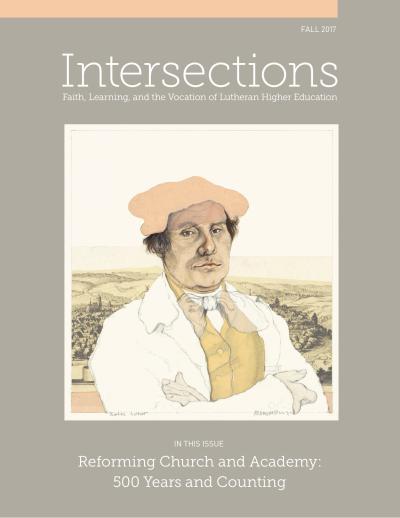
Adapted from a 2017 address to Wartburg College’s entering class, Kleinhans surveys Luther’s lasting impact in vocation, education, social service, and the necessary work of repentance — closing with the Lutheran World Federation’s Windhoek assembly and the Reformation World Exhibition’s call to live reform forward into the next 500 years.
-
 Article
Lutheran Heritage Across the Curriculum: Reflections from a Faculty/Staff Development Seminar
Cynthia Bane, Fred Waldstein, Kathryn A. Kleinhans, Penni Pier
No. 26 · Fall 2007
Four Wartburg College colleagues share fruits of the 2006 Lilly-funded “Discovering and Claiming Our Callings” faculty/staff development seminar in Wittenberg, Eisenach, and Neuendettelsau. Kleinhans frames the curriculum and books used; Bane (psychology) finds Lutheran convictions about the value of humans, the affirmation of creation, and the universality of sin congruent with her discipline; Pier (communication arts) reads Luther as a model of dialectical rhetoric that gives educators permission to challenge students with uncomfortable ideas; and Waldstein (political science) reflects on the paradox of humility and self-confidence in Luther and on the Luther-Melanchthon collaboration as a model for the seminar group’s own work.
-
 Article
Dual Citizenship: Reflections on Educating Citizens at Augsburg College
Paul C. Pribbenow
No. 29 · Spring 2009
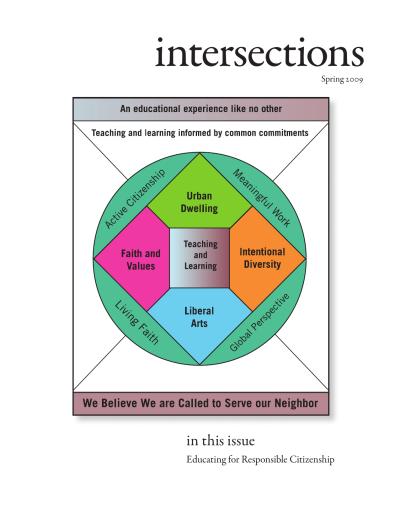
Pribbenow argues that the vocation of Augsburg College is to educate “dual citizens”—those able to live within the messiness of common work rather than resolve every tension once and for all. Drawing on John Courtney Murray on democracy as “the intersection of conspiracies,” Bill Moyers, Jean Bethke Elshtain, Stephen Carter, and the Augsburg vision statement “We believe we are called to serve our neighbor,” he names four common commitments and five principles of civic education that ground Augsburg’s incarnational mission in its city neighborhood.
-
 Book Review
The Prophetic Vocation and the Nature(s) of College: Reimagining College with Jim Farrell
Peder Jothen
No. 39 · Spring 2014
Jothen reads the late Jim Farrell’s The Nature of College as a prophetic critique of the dual nature(s) of college—its socio-cultural “normal” and its ecological habitat—and argues that Farrell’s call to model an “Anthropocene Responsibility” resonates with the prophetic dimension of Lutheran higher education. He proposes a re-imagined “About St. Olaf” that names vocation, ecological dependence, and personal involvement as the operative goods of college.
-
 Editorial
From the Editor
Tom Christenson
No. 13 · Winter 2002
Christenson previews a varied issue—Darrell Jodock’s Bernhardson inaugural lecture, Ernie Simmons’ Valparaiso conference talk on student/parent attitudes, two South Africa travel pieces by Brian Wallace and Corin Wesner, and reviews of Richard Hughes’s and Robert Benne’s recent books—and tells the story of “the church lady from hell,” a mid-fifties returning student who condemned everyone in the class with “God and I think…,” to ask what a religious tradition without a sense of humor would look like.
-
 Editorial
From the Editor
Jason A. Mahn
No. 41 · Spring 2015
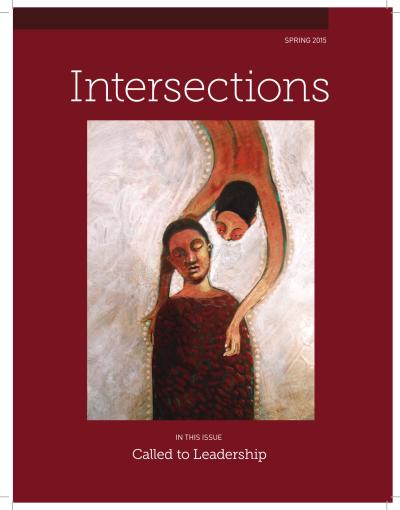
Mahn introduces the “Called to Leadership” issue by worrying that training for leadership has become so ubiquitous in higher education as to be nearly meaningless, and recovers Luther’s sense of leadership as service — a calling to be a “slave” whose learning, power, and wisdom belong to the unlearned, the oppressed, and the foolish — as the shared mission of Lutheran colleges to train servant-leaders.
-
 Article
Rooted and Open as Resource for Expanding Opportunities on Your Own Campus
Katherine A. Tunheim, Marcia Bunge
No. 49 · Spring 2019
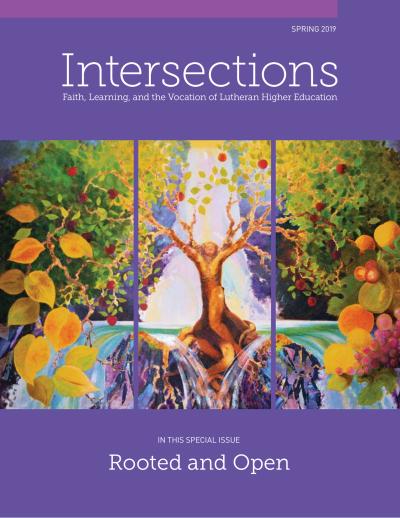
Bunge and Tunheim describe how Gustavus Adolphus College has paired Rooted and Open with its own companion volume Rooted in Heritage, Open to the World — in board workshops, new-faculty orientation, and classroom assignments — and survey several Network-wide opportunities (the Vocation of a Lutheran College Conference, the LECNA Fellows Program, the Association of Lutheran College Faculties, the Tuition Exchange Program, and international partnerships) that give the common calling tangible institutional form.
-
 Article
Assessing Self-Assessment Instruments at Finlandia University
René Johnson
No. 55 · Spring 2022
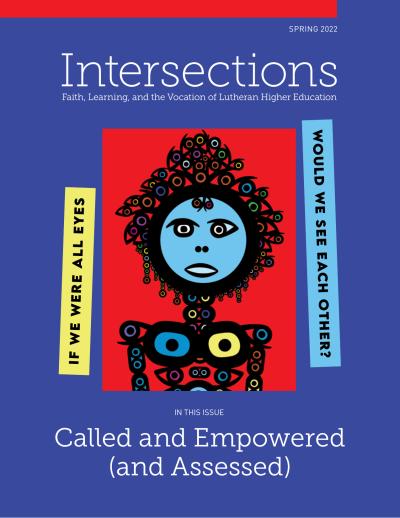
Johnson surveys three self-assessment instruments presented at the NetVUE conference — PathwayU at Colorado State, the Intercultural Development Inventory at Friends University, and Mark Savickas’s Career Construction Counseling Manual at Union College — and describes Finlandia’s use of the CliftonStrengths© assessment to link students’ personhood to “behaviors that benefit the community.”