"I believe that God has created me together with all that exists."
- Martin Luther, Small Catechism
"A constituency able and willing to fight for the long-term human prospect must be educated into existence."
- David Orr, Earth in Mind
Identity is a process, not a possession.1 It is always under- going dynamic change because of conditions in space and time. Traditions and institutions are no exception. Luther and Melanchthon understood this well. That is why one of the watch phrases of the Reformation was Semper Reformanda—to always be reforming—whether that be in the church, society, or education. Change, then, is not something to be mourned or simply obstructed but rather embraced so that a trajectory may be channeled and developed in consonance with tradition. This has been the challenge and opportunity to be found in Lutheran higher education, especially over the last twenty years. While acknowledging the changes in society, learning styles, administrative structures, and faculty preparation, the ELCA has also been intentionally involved in supporting programs to reform the Lutheran expression of higher education alongside all the other changes in higher education. This effort has not simply been a retrieval or repristination process, for that would ignore the intrinsic changes of our time. Rather, Lutheran higher education has brought current academic life into dialogical interaction with the Lutheran tradition. Among such interaction has been an intentional effort to interpret higher education as prepara- tion for the expression of vocation in the context of Christian freedom. It has been an effort to differentiate vocation from vocational training and to place career preparation within the wider context of service to society, world, and self.
This essay begins by briefly enumerating the initiatives that the ELCA has undertaken over the last twenty years to retrieve the Christian understanding of vocation in higher education. It then turns to the future and the directions that Lutheran higher education might (must?) take in the coming decades. Indeed, Lutheran higher education has been reforming, as the following sections will bear out. It must continue to do so if it is to have any constructive contributions to make to our rapidly changing world. Our focus question will be: “In what ways should Lutheran higher education on vocation be revised to include the fact that we are living in a natural world massively impacted by human behavior?” The contention of this article is that Lutheran liberal arts education should become environmental and sustainability education in addition to education in whatever major a student selects. Through the theological and ethical explo- ration of vocation, Lutheran colleges and universities can help prepare students to become sustainability leaders in the critical areas of society, ethics, ecology, and economics. They must do so in a geological age in which the climate and environment are dominated by human influence and control—an epoch that geologists call the Anthropocene.
In what ways should Lutheran higher education on vocation be revised to include the fact that we are living in a natural world massively impacted by human behavior?
Re-Rooting Lutheran Higher Ed
Starting in the early 1990s, Dr. Robert Sorenson and later Dr. Leonard Schultz, Executive Directors of the Division for Higher Education and Schools, and Dr. Jim Unglaube, Director of Higher Education in the ELCA, began a series of initiatives to address the retirement of a major segment of college faculty who had entered teaching during the sixties. By and large these persons had been the pillars of the college’s identity and spokespersons for the church-related tradition of the college, and they were now leaving. An intentional effort was needed, therefore, to help educate the new ranks of faculty, administration, and staff into the tradition. Over the next several years, and with the additional encouragement of presidents Dr. Paul Dovre of Concordia College and Dr. Mel George of St. Olaf College, a number of nationwide programs were launched to address this need. These initiatives included:
The Vocation of a Lutheran College Conference. This annual summer conference helped introduce new faculty and administrative staff to the Lutheran tradition in higher education. It continues to the present, meeting in recent years at Augsburg College, Minneapolis.
Lutheran Academy of Scholars Summer Seminar. Patterned after NEH summer seminars, these two week summer seminars (typically at Harvard University and chaired by Ron Thiemann), assisted faculty in connecting faith and learning in their respective academic fields and in producing publishable articles and books. (Because of budget and other considerations, this program was discontinued in 2012.)
Intersections. The establishment of the present journal encouraged reflection on Lutheran higher education and disseminated informative essays on conference and additional themes.
Other scholarship on Lutheran Higher Education. Among others, two books directly sought to lift up the intellectual tradition informing Lutheran colleges and universities. Lutheran Higher Education: An Introduction, by Ernest Simmons (Augsburg Fortress, 1998), provided historical, theological, and pedagogical background of the Lutheran tradition of higher education to assist faculty, board members, and other interested parties. The Gift and Task of Lutheran Higher Education, by Tom Christenson (Augsburg Fortress, 2004), addressed issues of why a college or university should be “Lutheran” and what the continued robustness of Lutheran higher education has to contribute to the church and broader public arena.2
Faith and Learning Centers. Many colleges, starting with Concordia College in Moorhead, Minnesota, with the Dovre Center for Faith and Learning, established faculty/staff development centers to direct mentoring programs as well as research and writing projects, conferences, heritage travel seminars, and workshops in faith and learning in order to stimulate campus wide discussions on vocation.
Lilly Endowment Grants. Large grants from the Lilly Endowment critically assisted many ELCA campuses in their “Exploration of Vocation.” These significant grants raised awareness, discussion, and preparation for and reflection on vocation, the impacts of which continue to this day.
Thrivent Fellows for Administrative Leadership. Begun in 2002 under the leadership of Paul Dovre with spon- sorship by the ELCA Council of College Presidents and financial support by Lutheran Brotherhood/Thrivent, this week long training seminar informed future academic administrators about academic management within the context of Lutheran higher education. There are now over 150 fellows serving in a variety of roles and places.
What we have seen over the last twenty years, then, is a concerted effort to bring the richness of the Lutheran tradition to bear on the changing circumstances of higher education. Such changes have only accelerated with globalization, dispersed learning, social media and other new technologies, increased assessment, changing demo- graphics, and economic realities. One change, however, is so significant that it threatens to subsume and render insig- nificant all these other changes, as well as the concerted efforts of Lutheran colleges and universities to respond to them creatively and collaboratively. I have in mind the potentially catastrophic environmental changes that human societies are and will be facing with ever greater intensity.
One change, however, is so significant that it threatens to subsume and render insignificant all these other changes, as well as the concerted efforts of Lutheran colleges and universities to respond to them creatively and collaboratively.
Repurposing the Liberal Arts and Lutheran Learning
Several of the world’s leading geologists and climatologists coauthored “The Anthropocene: Conceptual and Historical Perspectives.” It begins thus: “The human imprint on the global environment has now become so large and active that it rivals some of the great forces of Nature in its impact on the functioning of the Earth System” (842). The article assesses the appropriateness of naming our current geological epoch the “Anthropocene” to signify such human impact. The anthropological is now having as much impact on the planet as the geological and meteorological. The planet is no longer dark at night, just one indication of global human impact. Our focus question: “In what ways should Lutheran higher education on vocation be revised to include the fact that we are living in a natural world massively impacted by human behavior?” can now be broken down into two more explicit questions: “What is the role of liberal arts education in such a changed context?” and “What resources in the Lutheran tradition can contribute to preparing our students to become effective sustainability leaders?” Let us turn to the first question.
What is the role of liberal arts education in such a changed context?
Here I think re-envisagement of the classical purpose of liberal arts education will serve us well. In the Greek city- state the purpose of such education was to prepare a person for thoughtful and responsible citizenship in the polis. This meant having knowledge of the fundamental “liberating” arts of Grammar, Logic, and Rhetoric, which during the middle ages became known as the Trivium, literally, “where the three roads meet.” Whereas grammar teaches the mechanics of language, logic is the “mechanics” of deliberation and analysis as well as the process of identifying erroneous arguments. Rhetoric is the application of language in order to persuade the listener or the reader. While the Trivium is later supplemented by the Quadrivium of arithmetic, geometry, music and astronomy, for our purposes these three basic “liberating arts” are the most important.
One need only look at the recent dissembling discussions of climate change to see the importance of these three arts. To be able to name something clearly and to ferret out the illogical and fallacious arguments that have been made are survival skills for society, especially today. We have to prepare our students to be able to critique and dismantle such obstructionist thinking and call out the powers that have a vested interest in promoting such arguments. In their book Merchants of Doubt, Naomi Oreskes and Erik Conway indicate that by supporting fringe scientific research, the energy industry has engaged in the same tactics of sowing uncertainty about climate change that the cigarette industry did for decades concerning the carcinogenic character of cigarette smoking and nicotine addiction. As horrible as the loss of life from smoking is, it is still on an individual basis. Climate change, however, is not. Whole cultures and nations are at stake as well as the viability of human civi- lization itself. We no longer have time for such distracting and fallacious arguments. We must prepare our students to think clearly and critically in order to cut through obfuscation and disinformation as well as to creatively formulate viable responses. We must enable them to communicate clearly, effectively and persuasively in their social context. Along with grammar and logic, the art of rhetoric is as needed today as in the ancient polis. All this is to say that a liberal arts education is one of the best educations to prepare students for sustainability leadership in the coming decades. As the liberating arts were once used to prepare persons for citizenship in the Greek polis, we must now prepare our students for citizenship on the planet, that is, for planetary citizenship. We turn now to the second question:
“What resources in the Lutheran tradition can contribute to preparing our students to become effective sustainability leaders?”
For Luther the purpose of education was to preserve the Gospel and equip the priesthood of all believers for vocations of serving others within the world. Today this understanding of vocation must be enlarged to also include the natural environment. In the first article of his Small Catechism, Luther observed, “I believe that God has created me together with all that exists.” Luther understood our own experi- ence of createdness to be our most intimate experience of creation and a window onto all the rest. He had a deep love for creation and often referred to the divine presence within it—ourselves included—as larvae Dei, the masks of God.
For Luther, God is present in, with, under, and through the natural world. The world is full of God and God fills it, yet God is not limited or circumscribed by it. In essence, this is a panentheistic position where God is in the world but more than the world. Such an understanding provides an excellent theological foundation for the development of an ecological and sustainable understanding of vocation on our campuses. While much of the Lutheran ecclesial tradition tended has to emphasize Christology in regard to justification and human salvation (particularly during the period of Lutheran Scholasticism), Luther himself also saw the justifying grace of God as acting to restore nature and the nature-human relationship. Humans stand before God (Coram Deo) by grace through faith and before humanity and the world (Coram Hominibus and Coram Mundo) through loving service, making one’s faith active in love as St. Paul enjoins in Galatians 5:6. Just as human relationships are subject to distortion, as persons become incurvatus in se (curved in upon them- selves), so too can humanity’s relation with nature become so distorted. Human attitudes toward nature have too often been to see it merely as a natural resource for human use. This curves nature into our own sinful self-preoccupation and promotion of self.
As the liberating arts were once used to prepare persons for citizenship in the Greek polis, we must now prepare our students for citizenship on the planet, that is, for planetary citizenship.
Fast forward a couple hundred years: From the beginning of the Enlightenment through most of the twentieth century it was common to speak of a separation between fact and value, science and religion, nature and history. Nature, as object, had no intrinsic development but was understood through scientific analysis as an objective, value-free inquiry where both human and religious purpose were considered to be irrelevant. History, on the other hand, was the realm of subjective human purpose and religious value in which civilizations rose and fell, charting their course in domi- nating an impersonal world. While there are many scholars today who still affirm such a separation, many if not most have come to understand it as a false dichotomy. In Exiles from Eden, Mark Schwhen discusses what Parker Palmer perceives as the Enlightenment scheme of “objectivism.” Palmer observes that epistemologies (ways of knowing) have moral trajectories; they are not morally neutral but morally directive (Schwehn 25). Ways of knowing neces- sarily include ways of valuing, and so a complete separation of fact and value is not possible. The challenge today is to retain the achievements of objective reflection without perpetuating its limitations. Nature need not be defined simply as “natural resources” for human use but rather as having its own intrinsic integrity.
Religion has a particular view of the world; it is not limited so “subjective” value. On the other side, science requires values for the consideration of its applications. History would not exist without nature; nature itself has a history. In Earth in the Balance, Albert Gore asserts that humanity has always connected history to nature through technology and its impact upon the surrounding environment. Many civilizations have fallen because of the environmental destruction they wreaked upon their supporting nature (see also Diamond).Technology is a prime example of the intentional connecting of fact and value. The values intrinsic in scientific research are given embodied expression through technological application (Ferre). Today we see this with unprecedented clarity. With this clarity comes an increased responsibility to reconnect fact and value and steward the relation. Such a reconnection would go a long way toward preparing for sustainability leadership.
Divine Entanglement and Hope
When one studies the scholarly literature on the diverse changes taking place during our time, it is easy to become apocalyptic and feel that we may be living in the “final days” when nothing can be done. Such belief is stultifying and undermines the very will to change that is necessary for human and planetary survival. Make no mistake, the planet and some form of nature will go on for billions of years to come. The question is whether that will be with or without human presence. The planet has already existed far longer without humanity than it has with it and, given human impact, some suggest that it may be better off without it. If we succeed in making the planet uninhabitable for our species as well as many others, will that have demonstrated that the great brain was not a positive survival charac- teristic? In the face of such negativity one needs to find a basis for hope that can inspire constructive and creative change. One of the gifts of Christian faith is hope in the face of suffering and death. Environmental education must be supplemented with religious and ethical education that provides hope in the face of impending cultural and clima- tological change. Fostering hope and feasible practical responses will provide a foundation for our graduates to become sustainability leaders in their future communities.
It is precisely here that I think theology has a global role to play. I will speak briefly from the Christian, trinitarian understanding of the nature of God, but other theistic and nontheistic traditions have critical roles to play in their respective geographies and cultures.
Within a Christian framework, human hope, along with salvation, ultimately rests upon the grace of God alone. This places human response and action in a transcen- dent context which does not rely entirely upon human motivation. Indeed, as I have argued in my recent book, The Entangled Trinity: Quantum Physics and Theology, God is “entangled” with creation in general and humanity in particular through the work of Christ and the animating power of the Holy Spirit. In quantum physics, research has demonstrated that two particles (such as paired photons) are entangled once they have interacted. When one is measured the condition of the other is immedi- ately known. Particles are still connected at the level of the quantum vacuum no matter how far apart they are separated in the physical universe. This means that at a deep, ontological level there is interrelationality and connectivity throughout the universe. Appropriating this understanding for theology affirms that God is inter- related to everything in the cosmos and that there is a reciprocity of affect. What we do affects God as well as God affecting us. We are in a reciprocal, if unequal, ontological relationship with God. The divine is present in everything (radically immanent) and everything is present in the divine, while God still transcends it—thus the “panentheism” described above. Theologically, Luther would affirm such a dynamic, interdependent relation- ship. This entangled intimacy can be the ground for hope. It provides a more inclusive vision as well as animated action for constructive change.
Particles are still connected at the level of the quantum vacuum no matter how far apart they are separated in the physical universe. This means that at a deep, ontological level there is interrelationality and connectivity throughout the universe.
Conclusion
Our students come to us formed by mass media merchan- dizing, social media patterning, and material consumption and waste. Our contemporary society encourages a person to be preoccupied with the self and the satisfaction of its desires. To be liberated from such a condition is one of the main objectives of a liberal arts education. Only with a changed vision can we begin to talk about a viable foundation for a sustainable future. It is in light of what might be that one can become empowered to challenge and change what is. The green grace of creation intersects the red grace of redemption upon the wood of the cross, making possible the blue grace of hope in the Spirit. We need a grace from beyond the self to reform the self and provide both forgiveness and hope. Judgment is easy and cynicism breeds self-defeat. What is needed is reconciliation that motivates beyond the despair and hopelessness that inevitably result when coming to terms with one’s own responsibility for destructive actions. We are becoming aware of our collective environmental responsibility and now need forgiving, motivational grace to transcend self-interest for constructive change.
The Christian tradition, among others, can provide such grace-filled hope that can sustain one in the face of enormous challenges. As Viktor Frankl observed in his classic work, Man’s Search for Meaning, “Everything can be taken from a man but one thing: the last of human freedoms—to choose one’s attitude in any given set of circumstances, to choose one’s own way” (66). Lutheran higher education must foster a realistic but hopeful attitude towards the future and the systemic changes that we are all facing. Accordingly, environmental education for sustain- ability must be supplemented with religious and ethical education that provides hope in the face of impending cultural and climatological change. As the quote by David Orr at the beginning of this article states, we must “educate into existence” leaders for sustainability that can undertake this task with grace and hope as well as knowledge and conviction (Orr 126). Lutheran liberal arts education— a tradition founded on change and encouraging continued reform—is up to such a task if we undertake it as educators and administrators. Fostering hope and feasible practical responses, Lutheran higher education could provide a foundation for our graduates to become sustainability leaders in their future communities and engage the challenges of the twenty-first century, the epoch of the Anthropocene. This would be education semper reformanda!
Endnotes
Some of the material in this essay was published as “Lutheran Education in the Anthropocene,” in Dialog: A Journal of Theology, 55.1 (March 2016): 2-5, and in “Liberal Arts for Sustainability: Lutheran Higher Education in the Anthropocene,” in Eco-Reformation: Grace and Hope for a Planet in Peril, ed. Jim Martin-Schramm and Lisa Dahill (Eugene, OR: Wipf and Stock, forthcoming Fall, 2016).
The editor and publisher of Intersections are also planning to publish a book collecting some of the most influential essays appearing in the journal over the past 20 years. (Forthcoming from Lutheran University Press, 2016.)
Works Cited
Diamond, Jared. Collapse: How Societies Choose to Fail or Succeed. Revised Ed. New York: Penguin, 2011.
Ferre, Frederick. Hellfire and Lightening Rods. Maryknoll: Orbis, 1994.
Frankl, Viktor. Man’s Search for Meaning. Boston: Beacon, 2006. Gore, Albert. Earth in the Balance. New York: Houghton Mifflin, 1992.
Luther, Martin. “That These Words of Christ—This is my Body, etc., Still Stand Firm against the Fanatics.” Luther’s Works. Philadelphia: Muhlenberg, 1961. 37-59.
Oreskes, Naomi and Erik Conway. Merchants of Doubt. New York: Bloomsbury, 2010.
Orr, David W. Earth in Mind: On Education, Environment, and the Human Prospect. 10th Anniversary ed. Washington D.C.: Island, 2004.
Schwhen, Mark R. Exiles from Eden: Religion and the Academic Vocation in America. Oxford: Oxford UP, 1993.
Simmons, Ernest. The Entangled Trinity: Quantum Physics and Theology. Minneapolis: Fortress, 2014.
Steffen, Will, et al. “The Anthropocene: Conceptual and Historical Perspectives.” Philosophical Transactions of the Royal Society A 369.1938 (2011): 842-867.
-
 Editorial
From the Publisher
Mark Wilhelm
Wilhelm announces the new Network of ELCA Colleges and Universities — established in 2015 and convened for its first Board of Directors meeting in February 2016 — as a missional collaboration between the churchwide organization and the twenty-six ELCA colleges and universities, replacing former churchwide units lost to budget reductions and offering a stronger, more viable vision of Lutheran higher education.
-
Editorial
From the Editor
Jason A. Mahn
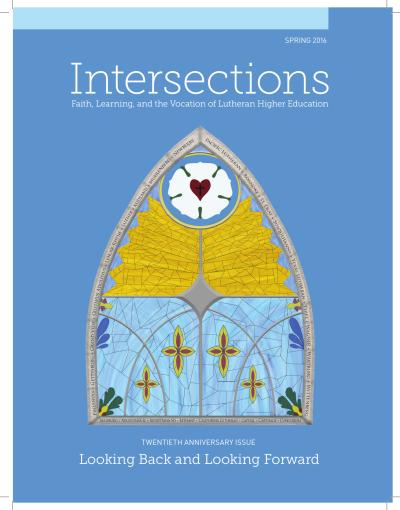
Mahn introduces the twentieth anniversary issue of Intersections, recalling its 1996 birth at Capital University “in the twinkle of an idea” in the mind of founding editor Tom Christenson, and previewing essays by Wilhelm, Amamoto, Kleinhans, Glass Perez, and Simmons that together look back at twenty years of the journal and forward to its work in the decades to come.
-
Article
The Vocation of Intersections on its Twentieth Birthday
Jason A. Mahn, Robert D. Haak, Tom Christenson
The three editors of Intersections — Bob Haak, Jason Mahn, and Tom Christenson (in spirit, following his death in 2013) — trace the twenty-year vocation of the journal itself: its 1996 birth at Capital University; its coming-of-age years of debate over institutional markers, two-kingdoms theology, and Lutheran identity; the ascendancy of “education for vocation” as the central marker of Lutheran higher education; and its ongoing identity in relation to a changing ELCA and to the broader cultural conversation about purpose, wholeness, and the vocation of higher education.
-
Article
The Vocation Movement in Lutheran Higher Education
Mark Wilhelm
Wilhelm offers a brief history of the “vocation movement” in ELCA higher education, arguing that it arose as Lutheran leaders moved beyond institutional markers (percentages of Lutheran students, faculty, and board members) and the collapse of ethnic, separatist Lutheranism to re-ground their schools’ identity in a 500-year-old intellectual tradition that educates the whole person for vocation and the common good — an educational ideal open to persons of any religious or non-religious conviction.
-
Article
Diversity and Dialogue: Twenty Years and Counting
Florence D. Amamoto
Twenty years after her essay “Diversity and Dialogue” in the first issue of Intersections, Amamoto returns to Gustavus Adolphus College to reflect on what has changed and what has not: rising numbers of students of color and international students, faculty turnover and increased publication pressures, the disappearance of the Center for Vocational Reflection, and the renewed importance of articulating Gustavus’s Swedish Lutheran heritage and inclusive sense of community in a tuition-dependent, cost-cutting environment.
-
Article
Distinctive Lutheran Contributions to the Conversation about Vocation
Kathryn A. Kleinhans
Kleinhans surveys the recent resurgence of vocation talk in American higher education — from Frederick Buechner’s widely quoted definition to Lilly Endowment’s PTEV grants and the CIC’s NetVUE Scholarly Resources Project — and uses her chapter in At This Time and In This Place: Vocation and Higher Education to highlight distinctively Lutheran emphases: vocation grounded in creation rather than redemption, the given-ness of multiple simultaneous callings, and a frank acknowledgment of the constraints and “dark side” of vocation.
-
Article
Moving Forward by Looking Back: Lutheran Vocation as Foundation for Interfaith Ministry
Kristen Glass Perez
Recounting how Augustana students mentored her into the role of presider at a campus vigil following the 2012 Sikh Temple of Wisconsin shooting, Glass Perez proposes that interfaith understanding become a mode of praxis for the twenty-first century Lutheran college. Drawing on Engaging Others, Knowing Ourselves and Interfaith Youth Core’s leadership practices, she urges ELCA schools to develop a common language linking interfaith engagement to vocational exploration and to the wider mission of the church.
-
 Editorial
Guest Editorial: Moral Deliberation in NECU Classrooms
Ernest L. Simmons
No. 51 · Spring 2020
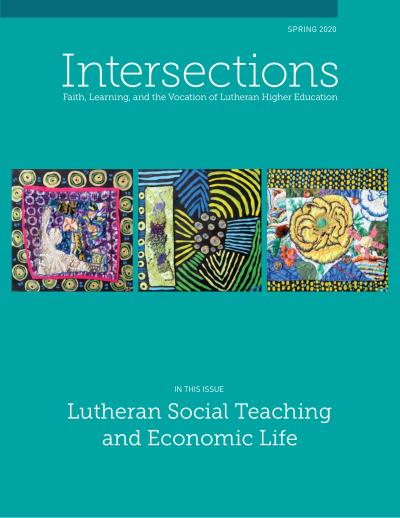
Simmons introduces the guiding question of the NECU working group: could the ELCA’s twelve social statements and thirteen social messages — expressions of Lutheran social teaching originally formulated for congregational use — turn campuses into “academic communities of moral deliberation”?
-
 Article
A Lutheran Dialectical Model for Higher Education
Ernest L. Simmons
No. 37 · Spring 2013
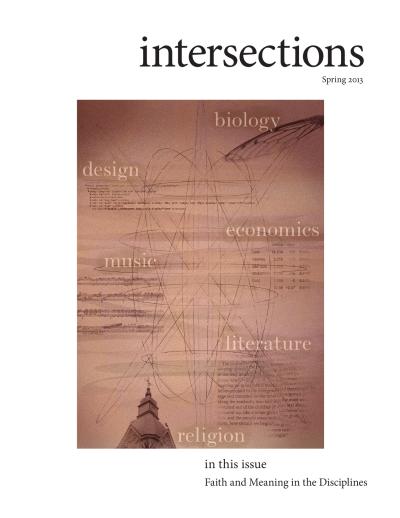
Drawing on “The Freedom of a Christian,” simul justus et peccator, Richard Hughes, Joseph Sittler, Martha Nussbaum, and Tom Christenson, Simmons argues that the Lutheran tradition informs an open, dialectical educational model that holds Christian and academic freedom together. He locates vocation at the intersection of the practical (why are you here?) and the existential (why are you here?) and proposes Lutheran higher education as education for self-transcendence and leadership Soli Deo Gloria.
-
 Article
Lutheran Higher Education and the Public Intellectual
Ernest L. Simmons
No. 26 · Fall 2007
Simmons argues that college faculty and administrators are, like it or not, public intellectuals, and that Lutheran higher education’s dialectical understanding of Christ and culture is well suited to support four functions of the public intellectual: articulating constructive critique of received social explanation (especially the “collage identity” described by Renate Schacht); presenting a transcendent theological perspective through the theology of the cross that takes seriously God’s hiddeness, the presence of ambiguity, and the reality of suffering; pursuing the common good amid the demise of the “commons” through H. Richard Niebuhr’s “Christ and Culture in Paradox”; and educating for citizenship through Christian vocation by connecting the practical and existential dimensions of the question “Why are you here?”
-
 Article
The Lutheran Theological Tradition and Recruiting Lutheran Students
Ernest L. Simmons
No. 13 · Winter 2002
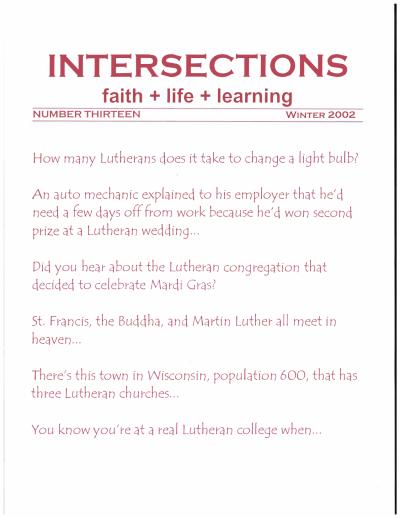
Simmons opens with an Abraham-and-Isaac “Windows 98” joke to illustrate the dialectic of faith and learning, then argues that in a new market era of limited religious background, intentional mission and marketing go together. Drawing on Levine and Cureton’s When Hope and Fear Collide for the Millennial Generation born in 1982 and Tom Beaudoin’s Virtual Faith for their GenX parents, he reads “Reclaiming Lutheran Students” survey results showing 86% strong community at ELCA colleges versus 54% at flagship publics and 61% alumni mentoring versus 39%. He then develops three areas where the Lutheran tradition uniquely equips its colleges—community, mentoring and vocation, and the integration of faith and values—using Luther’s “two kingdoms” image of the “Left Hand” (reason) and “Right Hand” (faith) of God, with academic freedom as a product of Ahlstrom’s “Critical Current” in the tradition, and closes with three challenges: recruiting and retaining mentoring faculty, educating church leaders, and reaching potential students and parents.
-
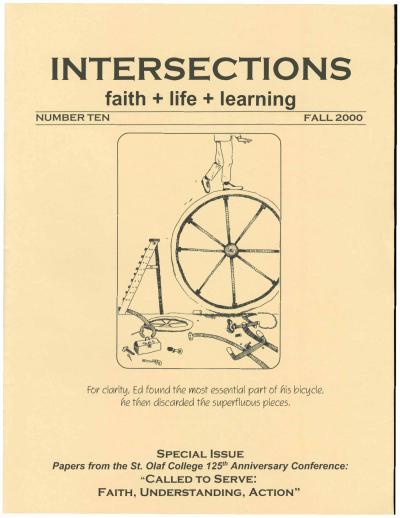 Editorial
From the Editor
Tom Christenson
No. 10 · Fall 2000
Christenson recommends the St. Olaf 125th-anniversary volume Called to Serve—edited by Pamela Schwandt with Gary de Krey and L. DeAne Lagerquist—particularly Walter Sundberg’s “What Does It Mean To be Lutheran?” and Darrell Jodock’s “The Lutheran Tradition and the Liberal Arts College.” He notes that the volume’s biographical sketches of Lars Boe, F. Melius Christiansen, Ole Rolvaag, Emil Ellingson, Agnes Larson, John Berntsen, Arne Flaten, and Howard and Edna Hong show, against an outsourcing age, that the life of an institution like St. Olaf is the committed life of the people who work there.
-
 Reflection
Confessions of a Collaborator
Chuck Huff
No. 3 · Summer 1997
Huff of St. Olaf offers a tongue-in-cheek public confession of his lifelong sin of collaboration—from elementary-school reports on dinosaurs and Cliff notes on Faulkner, through high-school algebra and college group projects, to borrowed syllabi, group work imposed on resentful students, tutorials, independent studies on every form of self-reliance, and circulated drafts. Even this confession was collaborated on, and (he confesses) he enjoyed it.
-
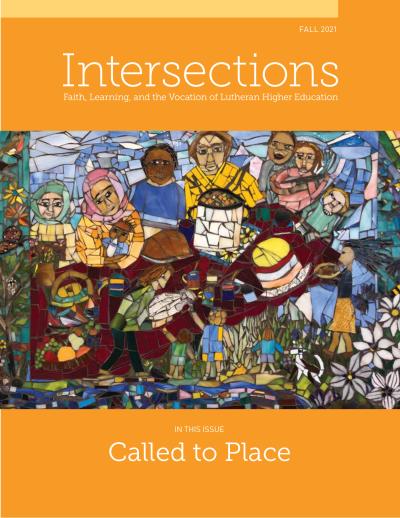 Article
Return to Purpose: Learning in an Age of Collapse
Ahmed Afzaal
No. 54 · Fall 2021
Afzaal argues that the cascading crises facing higher education are not temporary glitches but symptoms of planetary and civilizational collapse — and that colleges must embrace “double-loop” learning and return to a shared sense of purpose if they are to help humanity descend gradually rather than catastrophically.
-
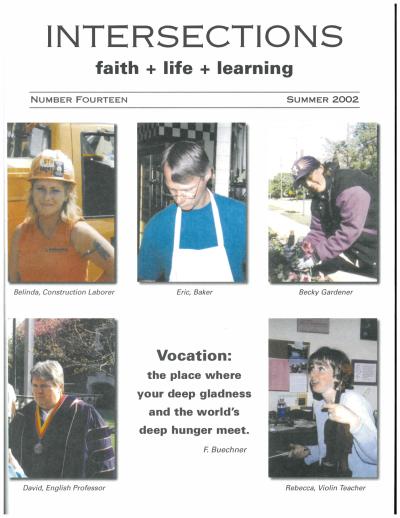 Article
Renewing a Sense of Vocation at Lutheran Colleges and Universities: Insights from a Project at Valparaiso University
Marcia Bunge
No. 14 · Summer 2002
Bunge, director of the process for writing Valparaiso’s nearly two-million-dollar Lilly grant on the Theological Exploration of Vocation, argues that contemporary culture’s reduction of vocation to either paid work or self-fulfillment requires Lutheran institutions to renew attention to a rich theological concept rooted in Luther’s expansion of vocation beyond the priesthood. She outlines eight low-cost “doorways”—caring adults, prayer, worship leadership, music and the arts, service, cross-cultural experience, church camps and wilderness, study and reflection—and describes Valparaiso’s two-program structure: a Campus-Wide Program weaving vocation into Freshman Core Courses and chapel life, and a Church Vocations Program for students considering full-time ministry. She closes with four troubling questions for any institution carrying out such a grant: what faith traditions can learn from one another, how to involve parents, whether faculty and staff have space to reflect on their own vocations, and whether daily institutional practices—family policies, treatment of low-paid staff, environmental responsibility, obligations to the wider community—actually reflect a commitment to love of neighbor.
-
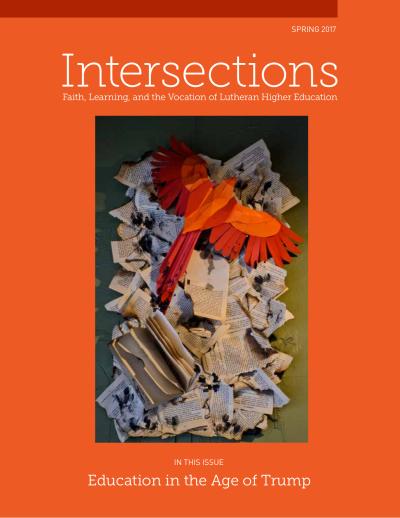 Article
Religion in the Age of Trump
Daniel A. Morris
No. 45 · Spring 2017
Morris reads the 81% evangelical vote for Donald Trump through two historical theses: that evangelicals’ once-coherent story about Godly participation in political life has fallen apart, and that their long-running tendency to exclude others — once aimed at Black Americans and Catholics — has now turned decisively against Muslims. He argues that scholars of religion and politics have a responsibility to tell these stories well, and that appeals to classroom objectivity can no longer be a luxury.
-
 Editorial
From the Editor
Tom Christenson
No. 2 · Winter 1997
Christenson opens with an invitation for reader submissions to balance the conference-paper format of the first two issues, then asks how college and universities can turn students positively toward learning. Drawing on Aristotle’s claim that study is loved for its own sake (which students greet with disbelieving laughter) and Neil Postman’s The End of Education, he argues that students lack narratives within which learning makes sense and proposes four Lutheran mega-narratives—stewardship of creation, the freedom of the Christian, the sacramental presence of the transcendent in the concrete and ordinary, and vocation—that could inspire learning at the 28 ELCA colleges and universities.