This article presents a brief history of the movement to urge colleges and universities related to the Evangelical Lutheran Church in America (ELCA) to view their identity and mission through the lens offered by the concept of vocation. It argues that the vocation movement arose as Lutheran higher education leaders re-discovered a wisdom about higher education within the concept of vocation as expressed by the Lutheran intellectual tradition. This re-discovery enabled leaders to articulate a rationale for educating students to live meaningful, purposeful lives dedicated to the common good.
As a result of the vocation movement, reclaiming education for vocation has become the hallmark of ELCA higher education.
Changing Conditions in Lutheran Higher Education
Reclaiming vocation as the hallmark of higher education in the Lutheran tradition occurred in the context of a larger, decades-long conversation in the United States about the aims and purposes of church-related higher education. Within that larger conversation, discussions in Lutheran higher education circles about the concept of vocation developed into a movement intent on re-grounding Lutheran higher education in the rich intellectual tradition of the Lutheran community. The vocation movement accomplished this goal by using Martin Luther’s theology of vocation to derive the aims and purposes of higher education from a Lutheran viewpoint.
The movement arose to answer a very practical question: “In what sense is a college Lutheran if it no longer means being a college almost exclusively populated by Lutherans?” This question was asked with increasing frequency as the percentage of faculty, administrators, and especially students who were personally members of the Lutheran community noticeably declined. The decline grew steadily over the course of the twentieth century, and it occurred dramatically at some institutions during the last quarter of that century, where the presence of Lutherans dropped below 10 percent.
This transition accompanied the ending of Lutheran ethnic separatism, a separatism from mainstream America that had defined Lutheran colleges and all other aspects of the Lutheran community well into the early twentieth century. Ethnic separatism had also meant defacto that Lutheran colleges were operated by Lutherans for the service of Lutheran students. The vocation movement cannot be understood unless one realizes it was a response to the collapse of a living ethnic culture at all Lutheran colleges that had separated them from the general American public. That is, it was not just a response to a decline in the numbers of Lutherans at schools founded by the Lutheran community. The decline in Lutherans present on Lutheran campuses was the direct result of the collapse of ethnic, separatist Lutheranism.
“The movement arose to answer a very practical question: ‘In what sense is a college Lutheran if it no longer means being a college almost exclusively populated by Lutherans?’”
During the eighteenth, nineteenth, and early twentieth centuries, Lutheranism in America had been an ethnic, separatist culture serving various branches of German-American and Scandinavian-American communities. These communities were significantly separated from mainstream American society by linguistic and cultural divides, in addition to religious ones. This reality of cultural, linguistic, and religious separatism was so thoroughly true that Sydney Ahlstrom, the great historian of American Christianity who taught at Yale University in the third quarter of the twentieth century and who was himself a Lutheran and an active participant in the early years of the vocation movement, labeled Lutheranism a “countervailing religion” in his acclaimed book, A Religious History of the American People (515-26). With the label “countervailing,” Ahlstrom underscored that Lutherans, Lutheranism, and its institutions—including its colleges—spent their initial existence in America set apart from and counter to mainstream American society. For Lutheran colleges, being ethnic, separatist institutions meant that they only served Lutherans, the members of their ethnic tribe, even though Lutheran colleges were formally open to the larger community and some outside of the Lutheran orbit participated in them from the beginning.
All this changed slowly during the twentieth century, and with increasing rapidity in its second half, as the Lutheran community and its institutions steadily entered mainstream American culture. This meant that its institutions, especially its institutions of higher education, were actively opened to non-Lutherans, not only for the admission of students from other backgrounds, but also to the academic subject matter and research interests of others. Lutheran scholars had always engaged the wider European-American academic community, but during the twentieth century Lutheran schools that would one day be part of the ELCA and their faculties became more deeply engaged in the mainstream of that larger academic community and in making scholarly—and hiring—decisions in concert with those who had once been outsiders to ethnic, separatist Lutheran higher education. This willingness to engage the mainstream academic community is shown in the trend among our schools during the twentieth century to join higher education accrediting bodies that expanded in the late nineteenth and early twentieth centuries in order to differentiate serious academic communities from lesser schools and programs of study, particularly the so-called Bible colleges.
The transition also meant that Lutheran students no longer felt restricted to the schools birthed by their communities. Young adult Lutherans who, in a prior generation, would have never considered attending a college outside of their community, began to accept admission to other colleges and universities—from flagship public universities to the Ivy League in the second half of the twentieth century. The shift in practices among Lutheran students occurred within a larger break-down of the barriers of ethnic separatism and prejudice—indeed, legalized institutional racism—that had prevailed in American culture and had prevented many persons from attending colleges outside of their community. This change was most publicly debated and made visible during the third quarter of the twentieth century by the opening of Harvard College to Jewish Americans and by ending the segregation of African Americans into black-only colleges.
“Lutherans began to leave their own ethnic separatism behind, even as Lutheran schools increasingly opened their doors to others.”
In that larger milieu, Lutherans began to leave their own ethnic separatism behind, even as Lutheran schools increasingly opened their doors to others. As a result, the campuses of Lutheran colleges and universities were increasingly populated by persons—students, faculty, and administrators—who were not Lutherans, while Lutherans were often studying and working at non-Lutheran schools. Other economic and social factors, such as a growing professoriate trained in common programs of graduate education, also drove these changes, but addressing these factors is beyond the scope this of essay.
The increased presence of non-Lutherans among students, faculty and administrators compelled the leaders of Lutheran institutions to ask—as noted above—how a college was Lutheran if it was not a college primarily operated by Lutherans for the benefit of Lutherans. The question never arose, of course, when Lutheran colleges functioned as ethnic, separatist institutions; they were simply institutions of the Lutheran community. But what made them Lutheran if they were no longer defined de facto by a primary—and nearly exclusive—mission to serve Lutherans?
The initial answer to this question focused on institutional markers to define a Lutheran college. Governance documents at Lutheran colleges and universities began to specify arrangements that had historically been assumed, such as specifying that the president must be a Lutheran. (In its original iteration, bylaws typically specified that the president had to be Lutheran clergy.) Constitutions mandated that certain percentages of governance board members had to be Lutherans or even Lutheran clergy. Admission practices reflected what we would today call affirmative action in favor of Lutheran students, such as the practice of reserving certain scholarships for Lutherans. Hiring practices for faculty and administrators strove to maintain a significant, albeit typically indeterminate, presence of Lutherans on campus.
The creation and policing of institutional markers such as these was the initial response to the questions arising from the opening of our schools to many non-Lutheran students, faculty and administrators. A Lutheran college or university was Lutheran if it maintained these types of institutional markers.
No formal, collective decision by Lutheran schools or by church leadership mandated the use of such institutional factors to definitively identify a Lutheran school. In the face of declining numbers of Lutherans at Lutheran schools, the practice represented an all-too-easy capitulation to the American cultural assumption that an institution exists to serve its founding community and promote its parochial interests.
Americans, and seemingly people everywhere, believe that a religious college cannot be a genuinely a religious college—such as an authentically Lutheran college or university—unless it is parochial in its practices. They also assume that institutional markers are needed in order for school to be properly Lutheran. These cultural assumptions about the necessarily parochial orientation of a religious college also insist that the only alternative for a school is to be secular. As Professor Darrell Jodock has taught us through his essays and presentations, most people cannot accept that a third option is available, namely, the existence of a college or university grounded in a religious tradition that does not exist to serve parochial interests (5-6). Hence, Lutheran leaders assumed that they had to ensure a college or university met parochial standards if significant numbers of non-Lutherans were also involved in the school. Institutional markers demonstrated that the necessary standards for Lutheran parochial interests were being met when parochial standards were no longer culturally enforced de facto by a nearly exclusive population Lutherans on campus.
In the 1970s, many leaders at our schools began to question the adequacy of institutional markers as the way of defining Lutheran higher education. A search began for a more authentically Lutheran perspective on the mission of higher education that was not rooted in parochial assumptions or norms.
Reclaiming Education for Vocation
The search for a more authentic core and definition for Lutheran higher education is what I have called the vocation movement. Institutional matters, including matters of governance and administration, obviously remain important for our common work. All of your schools, for example, have some type of constitutional connection to the ELCA. Service to students, scholars, and the mission of the ELCA also remain important. But the vocation movement asserts that our common identity as Lutheran schools is based in something else. The vocation movement says that a missional commitment to education for vocation is—and should be acknowledged as—the defining mark of higher education in the ELCA. The complexities of institutional issues and other aspects of the relationship between the ELCA and its colleges and universities will always be with us, but the vocation movement points us rightly to an educational ideal as the defining marker of Lutheran higher education.
“The complexities of institutional issues and other aspects of the relationship between the ELCA and its colleges and universities will always be with us, but the vocation movement points us rightly to an educational ideal as the defining marker of Lutheran higher education.”
What is the ideal of education rooted in the concept of vocation and how is this derived from the Lutheran intellectual tradition? Here I can only offer a short summary. The doctrine of vocation is the Lutheran tradition’s label for living life as God intends, namely, living lives that are purposeful, worthy, and open to considering the needs of others as well as one’s own and therefore having value both in the eyes of humanity and of God. Lutheran theology teaches that people need not spend their lives trying to curry God’s favor because the good news or gospel of Jesus Christ proclaims that God freely accepts persons as they are. Instead of seeking to find or impress God, to be religious is to respond to God’s invitation and call to follow Jesus, that is, people are to serve rather than be served, living lives—like Jesus—that serve others and contribute to the common good or, in traditional Lutheran discourse, “serve the neighbor.” The word vocation, of course, means calling, and Lutherans believe they are called by God to live lives of service. One way to serve the neighbor is to make opportunities for excellent higher education available to people of good will, enabling them to also pursue a meaningful life that contributes to the common good through whatever work they undertake. Persons of good will may not and need not affirm with the Lutheran tradition that God in Christ is the one who calls people to lead such lives, but from whatever religious or ethical motivation, all persons of good will can engage in education for vocation at Lutheran schools.
“Persons of good will may not and need not affirm with the Lutheran tradition that God in Christ is the one who calls people to lead such lives, but from whatever religious or ethical motivation, all persons of good will can engage in education for vocation at Lutheran schools.”
Gaining consensus about the educational ideal of education for vocation has not been easy, nor has it been achieved among ELCA-related schools. Education for vocation can be a “hard sell.” Significant opposition remains to building the public identity of ELCA higher education around the concept of vocation. This is true even at the many institutions which have embraced vocational reflection as an important programmatic aspect of their schools’ mission.
Those who object to the vocation movement and its concomitant reaffirmation of the Lutheran identity of their schools are not unreasonable. America is rife with examples of religious authority acting to interfere with a school’s free exercise of its mission. Hardly a month passes without The Chronicle of Higher Education reporting another silly move in religiously-affiliated higher education, such as the action at a small college in Indiana reported in early July 2015 to limit the teaching of evolution, bringing with that limitation a curtailment of academic freedom. Religious authority has also been a source of more sophisticated attacks against self-determination by the academy, such as the Council for Christian Colleges and Universities effort to seek exemption from gay rights protections. All too often it seems that the role of religion in American higher education is negative and sectarian, intruding on academic freedom, and substituting other ends for an authentic educational mission. Critics of the vocation movement ask, “Why should the Lutheran tradition and the vocation movement be any different?”
“All too often it seems that the role of religion in American higher education is negative and sectarian, intruding on academic freedom, and substituting other ends for an authentic educational mission.”
Despite the challenges, I remain optimistic that the Lutheran ideal of higher education as defined by the vocation movement will find acceptance over time. Our generation has the chance to reclaim one of the great Western educational traditions by remembering the ideal of education for vocation and the Lutheran notion of a third way for non-sectarian, but authentically religious, higher education. In doing so, we will be remembering and reclaiming one of the foundational movements that produced our North Atlantic academy and the idea of the academy’s unfettered freedom to explore the world and engage in teaching and learning. This essay cannot explore the links between Lutheranism and our contemporary North Atlantic academy. Suffice it to say that Lutheran leaders created the influential German educational system in the sixteenth century, and their heirs were directly involved in creating the University of Berlin and the modern research university model in the nineteenth century.
This Lutheran academic tradition, although distorted through decades of ethnic, separatist existence and now not infrequently hidden to many at our schools, continues to reside in the culture of ELCA schools and inform their core commitments. Perhaps the post-modernism sensibility that all persons, communities, and institutions are formed by a particular history and genealogy will make it possible for our generation to reclaim, reaffirm, and overtly practice the great Lutheran intellectual tradition in which ELCA colleges and universities stand.
In doing so, we will be affirming that Lutheran colleges and universities are not defined by their support for an ethnic culture or by their adherence to a check-list of institutional practices or markers, such as mandating minimal standards for Lutheran enrollment. Nor are they Lutheran schools because schooling provides a platform for promoting parochial Lutheran interests. They are Lutheran because they stand in a 500-year-old intellectual tradition that educates for vocation, an education of the whole person, prepared to contribute to the common good. Providing education for vocation to all persons of good will, whatever their personal religious—or non-religious—convictions is educational excellence in the Lutheran tradition. It is the vocation of a Lutheran college.
Works Cited
Ahlstrom, Sydney E. A Religious History of the American People. 2nd ed. Princeton: Princeton UP, 2004.
Jodock, Darrell. “Vocation of the Lutheran College and Religious Diversity.” Intersections 33 (Spring 2011): 3-12.
-
 Editorial
From the Publisher
Mark Wilhelm
Wilhelm announces the new Network of ELCA Colleges and Universities — established in 2015 and convened for its first Board of Directors meeting in February 2016 — as a missional collaboration between the churchwide organization and the twenty-six ELCA colleges and universities, replacing former churchwide units lost to budget reductions and offering a stronger, more viable vision of Lutheran higher education.
-
Editorial
From the Editor
Jason A. Mahn
Mahn introduces the twentieth anniversary issue of Intersections, recalling its 1996 birth at Capital University “in the twinkle of an idea” in the mind of founding editor Tom Christenson, and previewing essays by Wilhelm, Amamoto, Kleinhans, Glass Perez, and Simmons that together look back at twenty years of the journal and forward to its work in the decades to come.
-
Article
The Vocation of Intersections on its Twentieth Birthday
Jason A. Mahn, Robert D. Haak, Tom Christenson
The three editors of Intersections — Bob Haak, Jason Mahn, and Tom Christenson (in spirit, following his death in 2013) — trace the twenty-year vocation of the journal itself: its 1996 birth at Capital University; its coming-of-age years of debate over institutional markers, two-kingdoms theology, and Lutheran identity; the ascendancy of “education for vocation” as the central marker of Lutheran higher education; and its ongoing identity in relation to a changing ELCA and to the broader cultural conversation about purpose, wholeness, and the vocation of higher education.
-
Article
Diversity and Dialogue: Twenty Years and Counting
Florence D. Amamoto
Twenty years after her essay “Diversity and Dialogue” in the first issue of Intersections, Amamoto returns to Gustavus Adolphus College to reflect on what has changed and what has not: rising numbers of students of color and international students, faculty turnover and increased publication pressures, the disappearance of the Center for Vocational Reflection, and the renewed importance of articulating Gustavus’s Swedish Lutheran heritage and inclusive sense of community in a tuition-dependent, cost-cutting environment.
-
Article
Distinctive Lutheran Contributions to the Conversation about Vocation
Kathryn A. Kleinhans
Kleinhans surveys the recent resurgence of vocation talk in American higher education — from Frederick Buechner’s widely quoted definition to Lilly Endowment’s PTEV grants and the CIC’s NetVUE Scholarly Resources Project — and uses her chapter in At This Time and In This Place: Vocation and Higher Education to highlight distinctively Lutheran emphases: vocation grounded in creation rather than redemption, the given-ness of multiple simultaneous callings, and a frank acknowledgment of the constraints and “dark side” of vocation.
-
Article
Moving Forward by Looking Back: Lutheran Vocation as Foundation for Interfaith Ministry
Kristen Glass Perez
Recounting how Augustana students mentored her into the role of presider at a campus vigil following the 2012 Sikh Temple of Wisconsin shooting, Glass Perez proposes that interfaith understanding become a mode of praxis for the twenty-first century Lutheran college. Drawing on Engaging Others, Knowing Ourselves and Interfaith Youth Core’s leadership practices, she urges ELCA schools to develop a common language linking interfaith engagement to vocational exploration and to the wider mission of the church.
-
Article
Semper Reformanda: Lutheran Higher Education in the Anthropocene
Ernest L. Simmons
Simmons enumerates the ELCA initiatives over the past twenty years that have helped Lutheran higher education retrieve a Christian understanding of vocation, then argues that the looming reality of human-caused climate change — the geological epoch of the Anthropocene — now requires Lutheran liberal arts education to prepare students for “planetary citizenship” as sustainability leaders, drawing on the classical Trivium, Luther’s panentheism, and a quantum-physics-inflected theology of divine entanglement and hope.
-
 Article
Why All This Talk About Understanding the Mission of NECU Member Institutions as a Vocation?
Mark Wilhelm
No. 56 · Fall 2022
In his valedictory keynote, retiring NECU Executive Director Mark Wilhelm argues that Lutheran higher education is, properly understood, vocation-based education — outlining four core practices recovered over the past fifty years and naming the constructive and corrective work still to be done, including a fuller embrace of DEIJ and of the diverse vocations of NECU’s 27 institutions.
-
 Editorial
From the Publisher
Mark Wilhelm
No. 55 · Spring 2022
Wilhelm announces his planned retirement on January 31, 2023, after serving as the founding executive director of the Network of ELCA Colleges and Universities, and gives thanks for the privilege of helping NECU articulate a shared vision for Lutheran higher education in twenty-first-century North America.
-
 Editorial
From the Publisher
Mark Wilhelm
No. 53 · Spring 2021
Wilhelm reflects on an NPR report of teenagers’ pandemic diaries and the fraught Christian history of struggling to live out Jesus’s ethic of love, framing the issue as a record of NECU institutions working out how to act for the common good through the pandemic of 2020–2021.
-
 Editorial
From the Publisher
Mark Wilhelm
No. 52 · Fall 2020
Wilhelm argues that the “hackneyed” expressions of higher education — “you are not just a number,” “the college experience,” “risen to the challenge” — tell the simple truth about NECU institutions even as the Covid-19 pandemic has pushed budgets, employees, and campus life to the breaking point.
-
 Editorial
From the Publisher
Mark Wilhelm
No. 51 · Spring 2020
Wilhelm frames the issue by tracing how Lutheran educational ideals — once a primary source of contemporary higher education — were masked in the United States, and introduces a NECU initiative that uses the case of business ethics to explore Lutheran social teaching as an academic resource.
-
 Editorial
From the Publisher
Mark Wilhelm
No. 50 · Fall 2019
Wilhelm frames the issue by noting that a federal court’s vindication of Harvard’s race-conscious admissions process is a win for higher education’s commitments to diversity, equity, and inclusion — and argues that for Lutheran higher education, the commitment to diversity is an old and foundational claim, rooted in Christianity’s openness to all and reflected in the four diverse gospels of the New Testament.
-
 Article
Ivory Tower or Holy Mountain? Faith and Academic Freedom
Nicholas Wolterstorff
No. 11 · Spring 2001
Wolterstorff defines infringement of academic freedom as impairing a faculty member’s standing on account of the ideological content of her position, argues that academic freedom (like free speech) is “duly qualified” rather than absolute, and offers eight considerations bearing on religiously based institutions: Weber’s differentiation of Wissenschaft, religious pluralism within a liberal polity, the vitality of American civil society, a decentralized educational system, the “holistic” character of much American religion, the post-Kuhnian collapse of classical foundationalism and of the “generically human” academy, the fact that ideas matter, and the personhood violated by infringement (the desecration of an image of God). He concludes that the private sector offers wider academic freedom than the public, that religious qualifications are not inherently inappropriate (any more than St. John’s Great Books commitment), but that religiously based colleges too often apply them unjustly—arbitrarily, secretly, without recourse—and that the AAUP’s best service is model codes of procedure.
-
 Article
Academic Vocation: What the Lutheran University has to Offer
Wendy McCredie
No. 19 · Summer 2004
Writing as a practicing Lutheran, a trained literary scholar, and the associate director for interpretation at the ELCA churchwide office, McCredie articulates a vocation for ELCA colleges and universities grounded in the dialogical tension Gilbert Meilaender names between “bonds of particular love” and “a love which is open to every neighbor.” Drawing on Berube and Nelson, Marsden, Pelikan, Schwehn, Toulmin, Simmons, Hughes, MacIntyre, and Wolterstorff, she argues that Lutheran tradition resists both the easy separation and the collapse of sacred and secular, that human reason errs while God’s grace makes action possible, and that listening to the marginalized and to those outside the tradition is itself a theology of the cross enacted in classroom and collegial life.
-
 Editorial
From the Editor
Tom Christenson
No. 5 · Summer 1998
Christenson introduces the issue as an illustration of the diversity of interests Intersections aims for, surveys the contents (Lagerquist on method, Mori on art and ritual, Baer on falling walls, Bergendoff as memorial, Funk and Powell in dialogue), urges readers to send in “your good stuff,” asks for distribution feedback, and closes with a sabbatical-year reading list—Kieran Egan, Robert Coles, Daniel Kemmis, David W. Gill, Sallie McFague, Roger Scruton, E.M. Adams, Freeman Dyson, Colamosca and Wolman, Gribbin and Goodwin, van Wyk, Wislawa Szymborska, and Flannery O’Connor.
-
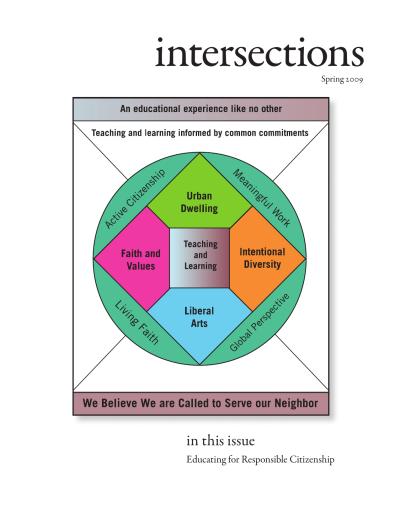 Article
Students in the Cloud: Creating Digital Citizens
Jose Marichal
No. 29 · Spring 2009
Marichal weighs the utopian and dystopian views of the “networked information economy,” drawing on Yochai Benkler, Manuel Castells, Henry Jenkins, Cass Sunstein, Robert Putnam, Nicholas Carr, and Andrew Keen to chart the promise and peril of life “in the cloud,” and proposes Aristotle’s intellectual virtue of phronesis—developed through Hubert Dreyfus’s five stages of skill acquisition—as the goal of digital citizenship for college faculty and their students.
-
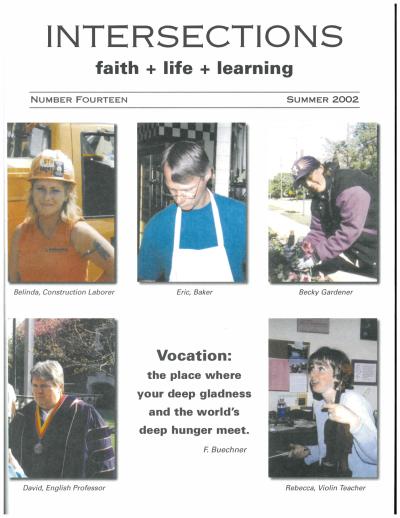 Article
Vocational Discernment: A Comprehensive College Program
Darrell Jodock
No. 14 · Summer 2002
Jodock, whose Gustavus Adolphus was one of twenty colleges to receive a Lilly “Theological Exploration of Vocation” grant in 2000, defines vocation not as occupation but as a self-understanding that nests the self in community. Reading Robert Putnam’s Bowling Alone on the collapse of secondary communities alongside Luther’s ethic of community benefit and five Lutheran principles (graciousness, Christian freedom, community, God active in the world, the theology of the cross), he walks through Gustavus’s three-level design—a definition of vocation open to other faith traditions, “middle principles” drawn from Sharon Parks’s Common Fire, and a long menu of programs coordinated by a new Center for Vocational Reflection—hoping that, in the language of Holocaust studies, graduates will be “resisters” and “rescuers” rather than bystanders.
-
Book Review
Unconventional Wisdom and Talking about God: A Review of Beckstrom’s Leading Lutheran Higher Education in a Secular Age
Ann Rosendale
No. 53 · Spring 2021
Rosendale reviews Brian Beckstrom’s Leading Lutheran Higher Education in a Secular Age, recommending its diagnosis of the gap between espoused and perceived Lutheran identity at ELCA schools and its prescription—Trinitarian Missiological Ecclesiology and a campus-wide willingness to talk explicitly about God.