Assessing the Value of Liberal Arts: A Review of The Evidence Liberal Arts Needs, by Richard A. Detweiler
Intersections No. 55 · Spring 2022
As is no doubt true for most of you, I spend many an hour these days speaking with prospective students and their parents about the decision about where their child should go to college.
I have slides on the screen as they walk in. One asks the question, “What is this college thing all about?” You would anticipate (incorrectly) that families who are about to spend a significant amount of money and considerable time over the next few years on a college education would have a fairly articulate idea of what those resources and time where for. What are they “buying” for their time and effort? Too often, they are not able to articulate that answer very clearly. The most common reason for college given is “to get a good job” (cf. Chan and Cruzvergara 6). I talk with them as a representative of the college who should be able to answer that question with some confidence, even if they can’t.
The next slide on the screen gives an overview of what I think education at Augustana College is about. It reads Explore → Reflect → Transform. This understanding of education is clearly informed by a long conversation with the Lutheran concept of vocation, a conversation that many readers of Intersections have been a part of for many years.
But both of these conceptions of the purpose of a college education—to get a job, to transform your life—lead to a difficult question. How will we know when we have succeeded? Most of us recognize that simply “getting a job” is way too minimalistic an outcome to be useful. And if that is all it’s about, there are easier and cheaper ways to accomplish the goal. Alternatively, if the goal is transformation, the question might well be: “transformation into what?”
We have spent a lot of years, a lot of words, a lot of effort to define the answer to these questions. Lutheran colleges have used the designation vocation as a very productive and important shorthand for what our answers would look like. This journal has been an important voice in those conversations.
Once these questions of purpose have been addressed, a second question becomes important. How do we know if and when we’ve done it? Some might argue that what happens at Lutheran colleges and universities is so ineffable that it cannot be measured. But this begs the question. How do we (or the students, or their parents, or donors—you can add to the list) know if we are being successful?
Richard A. Detweiler, former president of the Great Lakes Colleges Association and Hartwick College, tries to approach these questions from a new direction, one that is worthy of considerable conversation. While he is speaking from the point of view of liberal arts colleges broadly conceived, his approach is a relevant conversation partner for Lutheran higher education institutions as a subset of this group.
There are two problems with pursuing answers to the questions raised above. What counts as evidence for an answer? It might seem obvious that the statements by liberal arts colleges about their missions must be the answer to the question about the purpose of a liberal arts institution. And testimony from graduates of these institutions about their effectiveness surely must be the answer to this second question about assessment and evidence. But both of these “obvious” answers are problematic.
In the first case, anyone who has surveyed even briefly the words of mission statements of colleges and universities will not be surprised by the conclusion that there is no common understanding articulated by liberal arts colleges about “what we do.” Rather than adding to the plethora of existing statements of the purposes of education, Detweiler reviewed the history of the philosophy of education and then analyzed over 240 statements of four-year colleges. This led to a grouping of six categories of goal statements that he believes fairly represents the goals of a liberal arts education.
These goals are summarized as:
A Life of Consequence by being a
- Leader
- Civic Altruist
A Life of Inquiry by
- Continued Learning
- Cultural Involvement
A life of Accomplishment by living a
- Fulfilled Life
- Personally Successful Life
Detweiler then proceeds to a similar analysis of the content and context of liberal arts institutions. He finds that there are three components to each:
Content:
- “Nonvocational” (i.e. studies that are not primarily pre-professional or career-oriented)1
- Span of Study
- Development of Intellectual Skills
Context:
- Engaging Pedagogy
- Development of Larger Perspectives
- Authentically Involving the Learning Community
These few cryptic words are explicated in somewhat more detail. But it is tempting to respond, “Well, our program is much more complex and nuanced than this!” No doubt that is true of all of our programs. But these categories, because they cross over the large number of program descriptions, provide a rough but useful definition not of the fine points of liberal arts education but of fixed pillars in the landscape that can be useful guides.
Detweiler summarizes his conclusion:
It is clear that the why of education in the tradition of the liberal arts—its purpose—has been consistent since its inception. Its purpose has been, and continues to be, the higher, common good. The what of liberal arts education—its content—has always been about foundational preparation for life impact, including the nonvocational development of ways of thinking and an understanding of the span of human knowledge. … How this education is experienced—the educational context—has consistently involved pedagogy, people of different backgrounds and life experiences, and a personally engaging educational community. (93-94)
If these words mark the “what we do” of liberal arts education, how can we get a handle on the “how do we know if we have succeeded” question? How do the content and context of liberal arts education relate to the goals?
Detweiler interviewed more than 1000 students who had graduated from colleges of all types, not only from liberal arts colleges. Information that was gleaned from these interviews determined the types of adult behaviors that characterized the goals of liberal arts education. Detweiler then looked for evidence of these behaviors in graduates of all sorts of institutions. In this way he was able to determine whether graduation from liberal arts colleges exhibiting the content and context determined above made significant differences in the behavior of graduates at various stages of life.
The results of this work are striking. For all goals, students who graduated from self-defined liberal arts colleges achieved a significantly higher likelihood of having achieved all three broad goals. That is, graduates of liberal arts colleges had a significantly higher likelihood of leading a life of consequence by being and leader and civic altruist, of leading a life of inquiry by continued learning and cultural involvement, and of leading a life of accomplishment by living a fulfilled and personally successful life. The analysis was sophisticated enough that Detweiler was able to determine which content and context elements resulted in the most significant achievement of individual goals. The overall conclusion is that “… the available evidence suggests that liberal arts educational experiences indeed have a real impact on the way that people live the rest of their lives…. an education in the tradition of the liberal arts contributes to adult life impact and success” (186).2
While this is surely good news for the educators at NECU institutions for whom this journal is intended, Detweiler does not speak directly to the current understanding and use of vocation within the Lutheran colleges and does not specifically apply his results to this group. Maybe it is enough that we share in the good outcomes of the broad range of liberal arts colleges. But it also seems that this study invites us into a further conversation.
Questions that could be the topic for further consideration include the following:
- Are the goals, content, and context of liberal arts institutions that Detweiler examines also characteristic of Lutheran colleges? Or are we outliers in some respects?
- Are there similar common characteristics of our schools that are distinct from the broader landscape of liberal arts institutions? Should there be? What might those be? How would we determine if these are in fact “common” to us?
- Does the methodology Detweiler developed point a way forward to answering these questions?
- How do we as individual schools and as a network compare to other liberal arts colleges using Detweiler’s methodology? If we do better (i.e. our graduates have a higher chance of reaching the goals), why is that? What contributes to our success? And if are students are not as successful, why is that? And how can we improve? Detweiler’s study provides specific guidance on which practices most significantly influence which outcomes. Can we make use of that information in structuring our campuses toward certain outcomes?
- What other questions should we be asking?
These are the sorts of conversations that have always marked a Lutheran college or university. The Vocation of Lutheran Higher Education summer gatherings provide a fertile venue for such conversations. I would hope that we make use of this moment to refine and further our understanding.
Endnotes
1. Detweiler clearly is not using “vocation” here in a nuanced Lutheran sense but rather as studies leading to “a particular job or profession” (Detweiler 82).
2. Detweiler is to be thanked for not simply presenting conclusions, but for providing definitions of his methods/terminology and giving the data on which these conclusions are based. Because of this, those more skilled in this area than I are able to query his methods and interpretation to contest, correct, or expand his conclusions.
Works Cited
Chan, Andy and Christine Cruzvergara. “Outcomes and Metrics that Matter: Embedding Career Services at Higher Education’s Core.” Handshake. Accessed 1 April 2022, tinyurl.com/2uumbk92
Detweiler, Richard A. The Evidence Liberal Arts Needs: Lives of Consequence, Inquiry, and Accomplishment. The MIT Press, 2021.
-
 Editorial
From the Publisher
Mark Wilhelm
Wilhelm announces his planned retirement on January 31, 2023, after serving as the founding executive director of the Network of ELCA Colleges and Universities, and gives thanks for the privilege of helping NECU articulate a shared vision for Lutheran higher education in twenty-first-century North America.
-
Editorial
From the Outgoing Editor
Jason A. Mahn
Mahn closes out a decade of editing Intersections, passes the duties to Colleen Windham-Hughes, gives thanks to Mark Wilhelm and Augustana College, and introduces an issue largely drawn from comments by Lutheran faculty, staff, and administrators at the 2022 NetVUE national gathering.
-
Editorial
From the Incoming Editor
Colleen Windham-Hughes
Windham-Hughes introduces herself as incoming editor by reclaiming the root of assess — “to sit by” — and committing to the question “What does this mean?” as she sits with readers in the worth of our work and the universality of vocation.
-
Institutional Focus
Building a Developmental Framework for Vocational Reflection at Thiel College
Brian Riddle, Greg Q. Butcher, Liza Anne Schaef
Riddle, Schaef, and Butcher describe how a NetVUE Program Development Grant enabled Thiel College to build “the Tomcat Way” — a four-year developmental framework with personal, social, academic, and professional domains and four phases (Explore, Envision, Belong and Lead, Launch) — that now guides every aspect of the student experience.
-
Article
Assessing Self-Assessment Instruments at Finlandia University
René Johnson
Johnson surveys three self-assessment instruments presented at the NetVUE conference — PathwayU at Colorado State, the Intercultural Development Inventory at Friends University, and Mark Savickas’s Career Construction Counseling Manual at Union College — and describes Finlandia’s use of the CliftonStrengths© assessment to link students’ personhood to “behaviors that benefit the community.”
-
Institutional Focus
Pivoting to Imaginative Programming in the Midst of the Pandemic at Bethany College
Arminta Fox
Fox recounts how Bethany College’s NetVUE Program Development Grant — originally designed around service-learning trips — was reimagined under COVID-19 into a guest-speaker model that tripled student participation and opened new vocational possibilities through the close, personal stories of alumni, alums-turned-volunteers, and community partners.
-
Institutional Focus
Serving and Building Community at Concordia College
Larry Papenfuss
Papenfuss, director of the Dovre Center for Faith and Learning, frames eight ways Concordia College serves the world by building community — from quality teaching and liberating liberal learning to interfaith cooperation and modeling “diversity with particularity” as a Lutheran “third path” institution.
-
Institutional Focus
Sharing the Gift of Vocation at (and beyond) Augsburg University
Paul C. Pribbenow
Pribbenow, drawing on a 2022 NetVUE panel with Dorothy Bass and Jodi Porter, considers how the gift of vocation forged with undergraduates can be extended — beyond undergraduate campuses to graduate students, faculty, and staff; across the vocational lifespan from high schoolers to alumni navigating the “gig economy”; and into accompaniment of faith communities through Augsburg’s Riverside Innovation Hub.
-
 Article
The Vocation of Intersections on its Twentieth Birthday
Jason A. Mahn, Robert D. Haak, Tom Christenson
No. 43 · Spring 2016
The three editors of Intersections — Bob Haak, Jason Mahn, and Tom Christenson (in spirit, following his death in 2013) — trace the twenty-year vocation of the journal itself: its 1996 birth at Capital University; its coming-of-age years of debate over institutional markers, two-kingdoms theology, and Lutheran identity; the ascendancy of “education for vocation” as the central marker of Lutheran higher education; and its ongoing identity in relation to a changing ELCA and to the broader cultural conversation about purpose, wholeness, and the vocation of higher education.
-
 Editorial
From the Outgoing and Incoming Editors
Jason A. Mahn, Robert D. Haak
No. 34 · Fall 2011
Outgoing editor Robert D. Haak reflects on a six-year run inheriting Intersections from founder Tom Christenson, the “powerful voices” that have driven the conversation (Dovre, Jodock, Christenson, Simmons, Morgan, Olsen, Wilhelm) and the newer ones now entering (Mahn, Bussie); incoming editor Jason A. Mahn, picked up from the airport in Bob’s pickup truck five years ago, names central issues that “Lutherans on Faith and Learning” engages and previews essays by Dovre, Jodock, McDonald, Hill, Turnbull, and Jodock again.
-
 Editorial
From the Editor
Robert D. Haak
No. 33 · Spring 2011
Haak frames the issue by asking how Lutheran colleges and universities understand the changing landscape of religious identification on their campuses, and argues that Lutheran theological commitments — including the work of the Spirit and the Incarnation — call institutions to create places where the voice of “the other” is heard and valued.
-
 Article
Called to Serve
Robert D. Haak
No. 31 · Winter 2010
Haak describes Augustana’s Center for Vocational Reflection (CVR) and its threefold framework of skills/gifts/talents, passions/values, and needs of the community. He surveys the CVR’s Working with Faith group, seminary visits, spiritual companioning, Servant Leader Internships, international travel reflection, and the major Senior Inquiry curriculum revision—then reports the lessons learned at Augustana: that multiple exposures matter more than any single program, that the language of vocation works even for non-religious students, that student-initiated ideas (like Erin Blecha’s Athletes Giving Back) often succeed most, and that the CVR will soon merge into a new Community Engagement Center.
-
 Editorial
From the Editor
Robert D. Haak
No. 30 · Fall 2009
Haak frames the issue around the question of Lutheran college identity as formed in distinction from some “other,” introducing essays by Witherup on the Joint Declaration, Reuther on Holden Village, Afzaal on Christian-Muslim dialogue, Dovre on the history of Midwestern Lutheran colleges, Radecke on service-learning, and Ratke on Wilhelm Löhe — each making the claim that the “other” is an essential partner in conversation who helps us know who we are and shape who we will become.
-
 Editorial
From the Editor
Robert D. Haak
No. 29 · Spring 2009
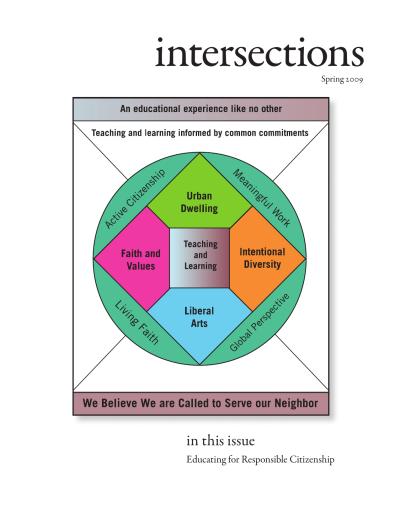
Haak frames the issue’s essays around the question of Lutheran colleges and the role of citizen, noting H. Richard Niebuhr’s typology in Christ and Culture and Luther’s own complex understanding of Christian and state, and offers a fitting farewell to Arne Selbyg with Mike Blair’s tribute song “A Fine Norwegian.”
-
 Response
Of Imaginary Cows and a White Toy Sheep: The Freedom of a Christian College
Ryan La Hurd
No. 6 · Winter 1999
La Hurd, president of Lenoir-Rhyne and a former Thiel English professor and Augsburg academic dean, responds to Christenson by insisting (with Robert Kegan’s story of Tommy’s imaginary cattle farm) that a college is composed of people but is not itself a person, and so cannot share in Luther’s freedom of the Christian. Drawing on Benedict Anderson’s Imagined Communities, Lewis Hyde’s The Gift, George Marsden, Mark Schwehn, Jacques Barzun, and the Pew Higher Education Roundtable, he distinguishes the “imagined college” (the gift-economy realm of teaching and the alma mater) from the “real college” (the commodity-economy realm of fund-raising, deferred maintenance, and federal aid reconciliation that does not have such freedom)—and ends with Pablo Neruda’s “Childhood and Poetry” and the marvelous white toy sheep offered through a hole in a fence.
-
 Reflection
Saving Minds
Lake Lambert
No. 28 · Fall 2008
In a sermon preached in the Castle Church in Wittenberg during Wartburg College’s 2006 faculty and staff development seminar, Lambert names two sins of the mind—coveting and mental sloth (in both its rigid refusal to think and its mindless relativism)—and, drawing on Luther’s Large Catechism and Martin Luther King, Jr.’s “A Tough Mind and a Tender Heart,” calls Christians to receive the wisdom that comes when faith puts knowledge into action, sustained by the hope of the resurrection.
-
 Article
Lutheran Higher Education in the Land of Anxiety
Jon Micheels Leiseth
No. 47 · Spring 2018
Leiseth, returning to Concordia from work with the ELCA’s Young Adults in Global Mission in Southern Africa, draws on Bessel van der Kolk and Babette Rothschild to argue that pervasive student anxiety functions as low-grade trauma that hijacks the storytelling at the heart of vocational discernment — and explores embodied, breath-based practices that might help students reclaim their stories.
-
 Article
Through Truth to Freedom—by Way of Reconciliation
Paul C. Pribbenow
No. 52 · Fall 2020
Reflecting on Augsburg’s 150th-anniversary motto “Through truth to freedom,” Pribbenow argues that in a season of three pandemics — pandemic illness, economic collapse, and the racial sin laid bare by the murder of George Floyd — higher education’s most authentic work is to educate for truth and freedom by way of confession and reconciliation.
-
 Response
Feeling at Home: Dimensions of Faculty Life
Jane Hokanson Hawks
No. 2 · Winter 1997
Hawks of Midland Lutheran College responds to Bouman by reflecting on her path from a Lutheran childhood through the BSN at St. Olaf and thirteen years at four non-church-related institutions to her present home at Midland, where teaching at a Lutheran institution finally feels “right.” Bouman’s framing of the five themes as the Lutheran argument about what it means to be human helped her ad-hoc committee articulate the spiritual role in Midland’s new faculty mentoring program (recently funded by the Lilly Foundation), and grounds her work as a nurse educator confronting the daily humanness of grief, joy, ethical dilemmas, and care across cultural and religious difference.
-
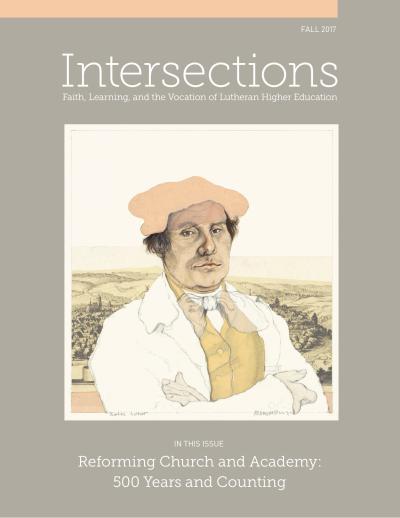 Article
Reforming Lutheran Higher Education: Ecclesiological Reflection and Theological Leadership
Brian Beckstrom
No. 46 · Fall 2017
Beckstrom diagnoses an “identity crisis” at ELCA colleges and universities rooted in inherited Enlightenment assumptions and a thin functional ecclesiology, and proposes that a Trinitarian, perichoretic understanding of God offers an ecclesiological foundation that holds together unity and diversity in a pluralistic, post-Christian context.