Walter Bouman’s essay, “What is the Lutheran Tradition?”, speaks particularly to the question of Lutheran identity. Implicit in his argument is the fact that identity - being able to articulate what is unique or distinct about the Lutheran tradition - is important if the Lutheran affiliation of colleges is to be meaningful now and in the future. Bouman begins by offering Alasdair MacIntyre’s definition of tradition as “an historically extended, socially embodied argument.” This definition suggests that a living tradition embodies “continuities of conflict.” Bouman then goes on to offer five theological themes from a historical perspective, which he sees as the core arguments comprising the Lutheran tradition; the Lutheran tradition as Biblical, Catholic, Evangelical, Sacramental and World-Affirming.
Luther’s proposed curriculum, which included training in biblical languages, emphasized an individual’s ability to reason over the authority of the ruling church bodies.
In addressing the question of identity with a view to history, Bouman places emphasis on something we all know well on a personal level, that continuity with the past is the key element of present and future self-definition. The reason I know I am the same individual that I was years prior is because of the story I tell about myself. Similarly, if there is to be any pride or even identity in calling a college Lutheran (and not just a nominal or financial association) it must begin with an understanding of the past that creates continuity with where we are now and where we hope to be in the future. Bouman offers his five themes as the substance of the inner-Lutheran argument and leaves it to us to carry on the tradition by continuing to discuss and elaborate on them. Furthermore, he challenges us to recognize the Lutheran tradition as one voice amid larger arguments such as the Christian tradition and the argument over what it means to be human.
In our response, we would like to do as Bouman suggests and recognize Lutheranism as one voice within the larger argument of what compromises good higher education. Similar to Bouman’s historical perspective on his five themes, we point out that this Lutheran voice has a continuity with the past that can be drawn on to provide a sense of identity for our colleges and their place within the larger academy. We offer a brief glance at one historical event which has been important to our thoughts in the search for Lutheran academia and which offers useful perspectives to the discussion of higher education. This event is Luther’s curriculum reform at Wittenberg University. The reform is an interesting place to begin addressing the Lutheran voice in higher education.
As a professor at Wittenberg University, Luther spent several years formulating and fighting for changes in the curriculum. Luther was unsatisfied with the methodology of medieval scholasticism, which emphasized the dictation of doctrine and authority of the church institution over a student’s own direct engagement with the biblical text. Inspired by certain humanistic principles, Luther adopted a position which challenged this method and the then current curriculum at Wittenberg. He proposed that the university begin to introduce lectures on classical authors and offer, for the first time, instruction in Greek and Hebrew language. This training provided the students with the skills they needed to encounter the scriptures themselves and to ponder important theological questions. In the spring of 1518, only months after the ‘posting’ of his 95 theses, Luther’s reforms were actually instituted.
The nature of these reforms was vitally linked to Luther’s own theological development. His conception of justification by faith and his assertion that no one person or body of persons had the authority to dictate for all the true interpretation of holy scripture formed a foundation for his approach to theological education. These notions gave the students at Wittenberg the awesome responsibility, or even obligation, to read and interpret the biblical text. It forcefully asserted the primacy of the biblical text and acknowledged God’s gift of revelation. Certainly, in the classroom and pulpit, Luther argued for his own interpretation of scripture and his legacy provides evidence that he did so persuasively. However, his curriculum reforms and the premises upon which they were founded tell us that he did not believe his understanding to be the only valuable one. His teachings were not intended to replace a student’s own engagement with scripture.
To be sure, the motives and results of Luther’s reforms present a complex picture which can be viewed from many different angles. In thinking about our philosophy of higher education, it is the spirit of these reforms that we have found most useful and which may be helpful in the search for Lutheran academia. As Luther proposed to give the students at Wittenberg the skills they needed to engage the biblical text, we believe that we also have a responsibility to provide students with every possible tool for understanding and drawing conclusions in our respective fields. In the classroom, we do not hesitate to offer students our own interpretations of a certain topic and we encourage students to practice the important skill of arguing their perspective in a persuasive manner. However, in the spirit of Luther’s reform, we find it imperative to acknowledge that our understanding is neither the ultimate authority nor the final word on a matter. The presentation of an instructor’s perspective cannot replace a student’s own engagement with the relevant subject matter. With respect to Lutheranism, “Our challenge is to give the tradition life in the context of the academy and allow it to rub up against the disciplines and epistemologies of the modern world.” (Keljo, p.14) This implies that we trust in the authority of the Christian gospels and believe that the value of Lutheran tradition will stand on its own merit if students are made aware of it.
We do not mean that colleges should make courses in Luther mandatory for all, but that in some way... students and staff should become familiar with the events that shaped the tradition and its relationship to the academy.
Luther’s curriculum reform and our reflection on it is only one small part of the Lutheran voice in the argument over good higher education. In mentioning this example, we hope concerning Luther and Lutheranism to students and staff to emphasize that the simple presentation of issues will go a long way toward establishing meaning in the Lutheran affiliation of colleges and creating the dialog which is the life of the tradition itself. We do not mean that colleges should make courses in Luther mandatory for all, but that in some way (through lectures, reading in the freshmen curriculum or introductory sessions for new professors) students and staff should become familiar with the events that shaped the tradition and its relationship to the academy. Regardless of how individuals choose to embrace the tradition, it is important to recognize that when they come to a Lutheran school (by choice or chance) the Lutheran tradition becomes, at least in some way, part of their life and they become part of the Lutheran tradition.
Being at a Lutheran college, we suggest, means that the Lutheran voice will be represented more frequently in larger discussion, by a faculty member or student who feels the perspective may have something important to offer to a given discussion. It is in this context that students and faculty members will take themes and historical reflection like those offered by Bouman and carry them into intra-Lutheran dialogue and dialogue where Lutheranism is one voice in a larger discussion. The tradition will naturally evolve with the currents of the present and the future.
From a historical perspective, Bouman sought to convince us that the Lutheran tradition is distinctive. For him, Lutheranism is not to be characterized by any one trait but by many traits whose significance has been discussed and debated over the course of time. In a similar way, we suggest that there is a uniquely Lutheran voice in the argument over good higher education. In offering the example of Luther’s curriculum reform, we hope to encourage discussion on the history of Lutheranism and the academy and how that history is relevant to the present identity of the Lutheran college.
-
 Editorial
From the Publisher
James M. Unglaube
Unglaube reports on the second annual Vocation of a Lutheran College conference of August 1996, where Walter Bouman of Trinity Lutheran Seminary addressed “What is Lutheran; What is the Lutheran Tradition” (biblical, catholic, evangelical, sacramental, world-affirming—the world “received, enjoyed, served as God’s Gift”). He previews presentations by Wendy McCredie of Texas Lutheran and Baird Tipson of Wittenberg on how the Lutheran tradition is embodied in its colleges, and Bob Vogel’s challenge in “Coherence—And Now what?” that the tradition comes to life in how faculty give expression to their beliefs and values in the classroom and with colleagues.
-
Editorial
From the Editor
Tom Christenson
Christenson opens with an invitation for reader submissions to balance the conference-paper format of the first two issues, then asks how college and universities can turn students positively toward learning. Drawing on Aristotle’s claim that study is loved for its own sake (which students greet with disbelieving laughter) and Neil Postman’s The End of Education, he argues that students lack narratives within which learning makes sense and proposes four Lutheran mega-narratives—stewardship of creation, the freedom of the Christian, the sacramental presence of the transcendent in the concrete and ordinary, and vocation—that could inspire learning at the 28 ELCA colleges and universities.
-
Article
Lutheran Tradition: Five Continuing Themes
Walter R. Bouman
Bouman of Trinity Lutheran Seminary identifies five themes central to the Lutheran theological tradition (understood through Alasdair MacIntyre’s account of tradition as “an historically extended, socially embodied argument”): biblical (a non-oppressive authority for the Bible rooted in the gospel rather than in scholastic inerrancy, against the backdrop of Luther’s 1517 challenge to Tetzel and the post-Enlightenment marginalization of theology); catholic (continuity with the Book of Concord and the three ancient creeds, with Luther’s “Christology from below” recovering a Jewish rather than Hellenistic understanding of God, revived by Tillich, Pannenberg, Forde, and Jenson); evangelical (justification by faith as the answer to mortality’s radical question); sacramental (Word, Eucharist, and Baptism as Christ’s presence from the future of God’s consummated Reign); and world-affirming (creation as gift, vocation as God’s work in every calling, and stewardship of the ecological crisis).
-
Response
“My Wife, We Have Not Come to the End of All Our Trials, but a Measureless Labor Yet”: The Lutheran Argument in Colleges
Steven Paulson
Paulson of Concordia College responds to Bouman by invoking Penelope’s unreasonable patience for Odysseus and asking whether Bouman’s five “principles” deliver the “continuities of conflict” that MacIntyre’s account of a living tradition demands. He argues that the proper Lutheran “continuity of conflict” is the praxis of proclamation—Christ crucified as “a stumbling block to Jews and folly to Gentiles”—which is given outside the institution’s walls and which colleges and universities, as socially embodied arguments, “can’t like” because it places truth beyond their control. The Lutheran problem, he concludes, is not the Enlightenment or Post-Modernism but the “old Adam,” the Odysseus still unsure of his identity.
-
Response
Feeling at Home: Dimensions of Faculty Life
Jane Hokanson Hawks
Hawks of Midland Lutheran College responds to Bouman by reflecting on her path from a Lutheran childhood through the BSN at St. Olaf and thirteen years at four non-church-related institutions to her present home at Midland, where teaching at a Lutheran institution finally feels “right.” Bouman’s framing of the five themes as the Lutheran argument about what it means to be human helped her ad-hoc committee articulate the spiritual role in Midland’s new faculty mentoring program (recently funded by the Lilly Foundation), and grounds her work as a nurse educator confronting the daily humanness of grief, joy, ethical dilemmas, and care across cultural and religious difference.
-
Response
“You Shall Know the Truth, and the Truth Will Set You Free”: A Scientist’s Response
Ben Huddle
Huddle of Roanoke College proposes adding a sixth theme to Bouman’s five—the scientific method—as a tool for knowing the Truth not available to Luther but central to twentieth- and twenty-first-century learning. Diagramming the continuous cycle of observations, laws, theories, and predictions, he argues that scientists must be ethical and that scholars in other fields must understand the scientific method (lest environmentalists ignore the Second Law of Thermodynamics). A Lutheran college, he concludes, should treasure both the religious and the scientific tradition: stifling either loses meaning or significance, and the Lutheran tradition is therefore biblical, catholic, evangelical, sacramental, scientific, and world-affirming.
-
Response
On the Outside Looking Out: A Personal and Social Psychological Response
Chuck Huff
Huff of St. Olaf—a self-described “Metho-Bap-terian” from the South educated at Bob Jones University—offers a personal response to Bouman’s themes (welcoming the rejection of biblical inerrancy, the distinction between gospel and scripture in the homosexuality debate, the gospel-in-the-creeds reading that releases him from Hellenistic conundrums, and the recasting of justification by faith as meaning rather than insurance policy) and a social-psychological response in which a planned study of campus social networks at St. Olaf was discontinued when preliminary interviews revealed that everyone—storied Lutherans, secular faculty, feminists, fundamentalists—felt like outsiders. Continuing the tradition requires constructing a conversation that is thoughtful, fair, inclusive, charitable, focussed, and still true to the tradition.
-
Poem
Two Poems: The Advent Carol / The Madonna of Dohany Street
Brian Forry Wallace
Two poems by Brian Forry Wallace of Capital University: “The Advent Carol,” a litany of the babies who were not adored—the Jewish baby shot with a Luger, the Black child hanged from a tree, the female messiah tossed into a river, the Tutsi infant cut by machetes, the Japanese newborn incinerated by atom bombs, the Chinese baby crushed by Japanese bombs, the aborted Mary’s child—ending with the baby “whom we do not understand, cannot feed, whom we kill”; and “The Madonna of Dohany Street,” on a Holocaust photograph in a Budapest museum of a dead mother and her dead Christ-child daughter in the former ghetto, in which annunciation, nativity, adoration, and crucifixion are seen together in a single instant.
-
Institutional Focus
Embodying the Tradition: The Case of Wittenberg University
Baird Tipson
Tipson, President of Wittenberg University, locates Wittenberg in the “American” strain of Ohio Lutheranism founded in 1845 under Ezra Keller (a Pennsylvania College and Gettysburg Seminary graduate and disciple of Samuel Simon Schmucker), with English-language preaching, financial support from the pan-Protestant New England Society, Presbyterians on the Board, and an Episcopalian teaching Latin. He names two ongoing challenges—remaining authentically Lutheran while welcoming a pluralistic student body (just under a quarter are Lutheran in a primary service area that is 5% Lutheran), and making the tradition clear and compelling to non-Lutheran or lukewarm Lutheran students—and presents the five things every Wittenberg graduate should be able to do (respond to the human condition; recognize, define, and solve problems; develop a sense of vocation; assume servant-leadership; take moral responsibility) as authentic expressions of the Gospel and of the university’s ELCA relationship.
-
 Article
The Value of Evoking Vocation and the Vocation of Evoking Value
Mark Schwehn
No. 38 · Fall 2013
Schwehn answers Michael Staton’s call to “disaggregate” the components of a college degree by insisting that Lutheran education is integral and whole. Working through Bruce Kimball’s history of liberal education, Cardinal Newman, and Leon Kass on Athens and Jerusalem, he argues that Lutherans should defend liberal learning on instrumental grounds and offers the figure of the “local genius”—exemplified by his Valparaiso colleague John Strietelmeier—as the form of human excellence that Lutheran colleges uniquely cultivate.
-
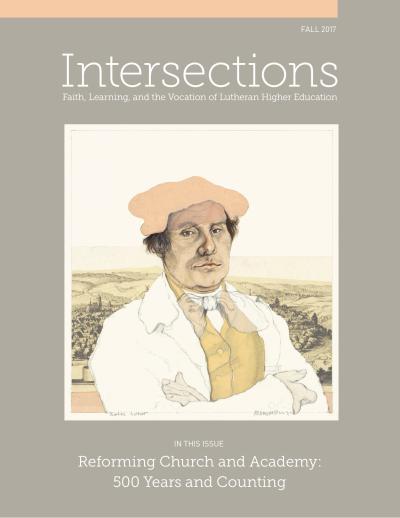 Article
Luther's Sutra: An Indian, Subaltern (Dalit) Perspective
Surekha Nelavala
No. 46 · Fall 2017
Nelavala traces how Luther’s “sutra” — grace alone, faith alone, scripture alone, Christ alone — reached the mud hut of her Dalit grandparents in rural India, transforming three generations, and then reads the parable of the vineyard laborers from a subaltern perspective in which grace for all is the heart of God’s alternative kingdom.
-
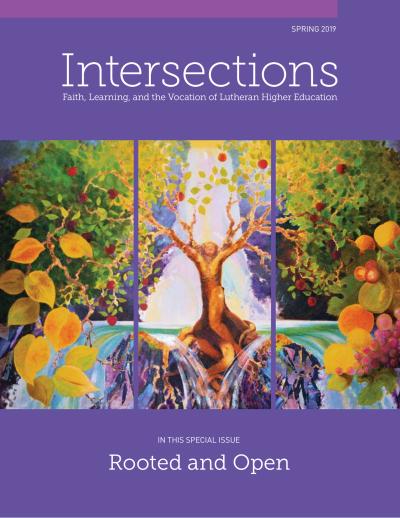 Institutional Focus
About the Cover and Artist
No. 49 · Spring 2019
Kristen Gilje, a Bellingham, Washington artist who spent nine years as Artist in Residence at Holden Village, recounts the “Tree of Life” she painted for the Holden Village 1999 summer theme and the unexpected interpretation Lapidary Fred offered of Yggdrasol, Prometheus, the Druid Tree Spirit, and the crucifix all at once.
-
 Article
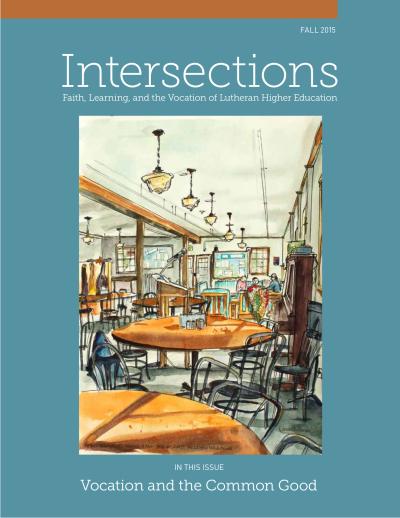
Attentional Commons and the Common Good: Technology and Higher Education
Amy Weldon
No. 42 · Fall 2015
Weldon argues that the electronic devices our students (and we) reach for are designed to monetize attention and fragment the very capacities — tolerance for complexity, sustained focus, real conversation — that build lives of meaning and service to the common good. Drawing on Crawford, Lanier, Arendt, and Palmer, she sketches practical tech-mindfulness for the small-college classroom as a defense of the “attentional commons.”
-
 Article
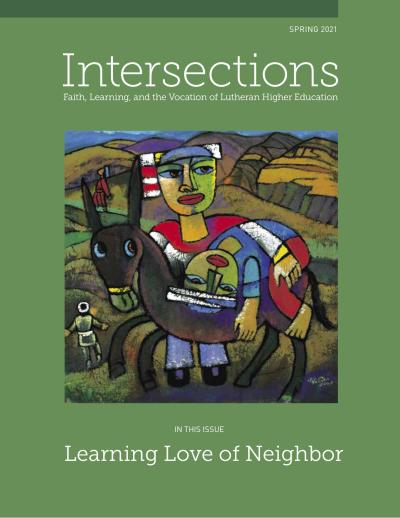
(Re)Defining Vocation: Gladly Challenging a Vocational Giant
Andrew Tucker
No. 53 · Spring 2021
Tucker challenges Frederick Buechner’s famous definition of vocation as “where your deep gladness and the world’s deep hunger meet,” arguing that gladness reflects a privileged perspective and proposing instead that vocation be defined as “any meaningful, life-giving work you do for the world.”
-
 Article
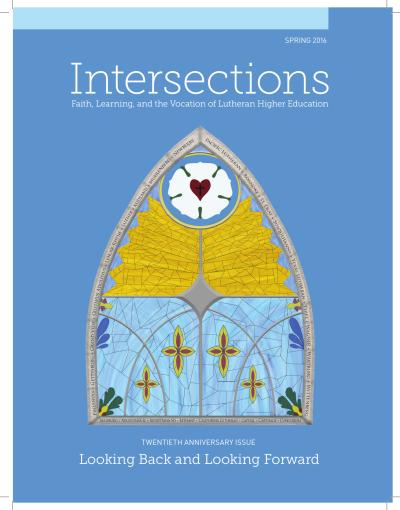
Diversity and Dialogue: Twenty Years and Counting
Florence D. Amamoto
No. 43 · Spring 2016
Twenty years after her essay “Diversity and Dialogue” in the first issue of Intersections, Amamoto returns to Gustavus Adolphus College to reflect on what has changed and what has not: rising numbers of students of color and international students, faculty turnover and increased publication pressures, the disappearance of the Center for Vocational Reflection, and the renewed importance of articulating Gustavus’s Swedish Lutheran heritage and inclusive sense of community in a tuition-dependent, cost-cutting environment.