Several years ago, I was attending a gathering in Minneapolis called “Jesus Radicals” for the first time. As far as I could tell, I was one of the very few participants who did not have dreadlocks, who had never dumpster-dived, and who did not blend into the anarchic-vegan punk scene of that area of Minneapolis. Participants spoke of Christian discipleship as thoroughly countercultural, at least until the powers of domination submit to God’s way of peace. This was radical stuff, as the name of the gathering implied.
The name of this conference, “Interfaith Understanding,” perhaps seems less radical. Don’t let that fool you. We are here to fundamentally rethink very standard, seemingly “normal” ways of making sense of the different religious traditions that we practice as they intersect with the Lutheran tradition that we share by virtue of teaching and mentoring, of learning and being formed, within our 26 ELCA colleges and universities. Some will assume that claiming one’s institutional identity as Christian or Lutheran necessarily dampers diversity and prohibits interfaith cooperation, or inversely, that cultivating interfaith cooperation depends on secularizing the context of that work. These assumptions must be called into question in order to develop institutional perspectives that are both committed to their religious traditions and hospitable to others. Indeed, we must reconsider the very idea that identity and hospitality, commitment and openness, are counter forces that must be balanced somehow—as if the more robustly Lutheran means the less engaged with and challenged by the traditions of others, and vice-versa. Perhaps identity and openness are more like two sides of the same coin. Or better, perhaps they are connected like cultivating one’s own Buddha-nature depends on cultivating nonattachment to that nature. Such re-thinking is indeed radical stuff.
In this essay, I return to the root or radix (from which we get radical) of the Lutheran tradition to show how interfaith encounter, understanding, and cooperation are integral to it. By the “Lutheran tradition” I mean three things. We can speak of Lutheranism as a church or denomination, where membership is typically considered incompatible with membership elsewhere. Lutheran theology is a broader designation; it refers to a 500 year old reform movement within the church catholic (lowercase c)—a grouping of particular and distinctive (but not absolutely unique) ways of encountering God in light of Jesus and of cultivating Christian faithfulness and human flourishing. Finally, we can speak of Lutheran higher education, a designation that can and should remain irreducible to the other two without thereby meaning anything and everything. Lutheran education or Lutheran pedagogy has its own particularity—it is a distinctive approach to educating whole persons in mind, body and spirit with the goal of fulfilling one’s calling by responding to the deep needs of the world. How does interfaith understanding and action crisscross with these three spheres of the Lutheran church, Lutheran theology, and Lutheran education? How might interfaith engagement be seen not as the vanishing point—a last receding concentric circle—of Lutheran identity but something central to Lutheranism from its inception?
“How does interfaith understanding and action crisscross with these three spheres of the Lutheran church, Lutheran theology, and Lutheran education?”
Lutheranism as Church
As I write of how Lutheranism pushes people beyond their fold to recognize God in other peoples and to work together toward the common good, I am painfully aware of Martin Luther’s dramatic shortcomings when it came to understanding and working with people of other religions. The sixteenth century reformer had only a cursory knowledge of “the Turks” (as he called Muslims south and east of Saxony), and he displayed a good deal of ambivalence about them. On the one hand, the expanding Ottoman Empire extended much more religious tolerance than did the church from which Luther was dissenting, and Luther knew it; he wondered whether the Sultan might not become a tactical ally. He also writes, in a sort of double-critique, that “a smart Turk makes a better ruler than a dumb Christian” (Spitz 330). On the other hand, Luther could describe a “clash of civilizations” between the Christian West and Turks from the East with enough good-versus-evil imagery as to make Samuel Huntington blush. When Luther pens his famous “A Mighty Fortress is Our God” around 1527, it was probably first used as a battle song to inspire soldiers to rise up against those encroaching Muslims (Merriman 101). When in the fourth verse Luther writes, “Were they to take our house, goods, honor, child, or spouse, though life be wrenched away, they cannot win the day. The kingdom’s ours forever,” the “they” may in fact be Muslims and the “kingdom” over which they battle may in fact be Western Europe, even if the song also refers to other forces and powers, both visible and invisible, then and today.
Luther’s anxieties about and caricatures of other traditions gets more treacherous when it comes to Judaism. As is well known, Luther had hoped that once his own evangelical reforms did away with “papist” distortions, Jewish people would finally see that their own Hebrew scriptures pointed toward their fulfillment in the Gospel, and thus would start lining up for Christian baptism. Early in his career, he writes “That Jesus was Born a Jew” (1523), condemning the fear-tactics and baptism by sword used by earlier Christians and encouraging his contemporaries to “treat the Jews in a brotherly manner.” They are the “blood relatives” of Jesus, insists Luther; we Gentile Christians are only “aliens and in-laws” (200-201).
When, despite Luther’s soft-sell, most Jews continued to politely decline the invitation to convert, Luther became outraged. Writing “On the Jews and Their Lies” twenty years later (1543), Luther mounts a violent invective against the Jews. Where earlier he called Jews the blood relatives of Jesus, he now calls them poisoners, ritual murderers, and parasites. In his last sermon, delivered just days before his death, Luther calls for the expulsion of Jews from Germany altogether. Luckily, the influence of these invectives was not very great in Luther’s time. Yet German Nazis did not need such texts waiting to be picked up and used for ideological justification 400 years after the fact. Luther’s writings have not only led to deep anti-Judaism, the defamation of Jews on theological grounds, but have also been appropriated in support of anti-Semitic racist ideology, scapegoating, fear-mongering, and murder.
“The confession of Lutheran complicity in the stereotyping and scapegoating of others must be the starting place for any candid commitment to interfaith understanding and cooperation.”
I say this first of all simply to be honest and to name the elephant in the room whenever one speaks of the Lutheran tradition and interfaith cooperation. I also say it because the confession of Lutheran complicity in the stereotyping and scapegoating of others must be the starting place for any candid commitment to interfaith understanding and cooperation.
In this light, one of the most significant contributions Lutherans have made to interfaith is the statement on Lutheran-Jewish relations that the Church Council of the Evangelical Lutheran Church in America adopted in 1994. This document underscores the importance of Luther’s central confession of faith:
Honoring [Luther’s] name in our own, we recall his bold stand for truth, his earthy and sublime words of wisdom, and above all his witness to God’s saving Word. Luther proclaimed a gospel for people as we really are… (ELCA)
But at this point, as Lutherans confess God’s saving Word and sufficient Grace, they also confess their sin, how that “grace [must reach] our deepest shames and address the most tragic truths.” The document continues:
In the spirit of that truth-telling, we who bear his name and heritage must with pain acknowledge also Luther’s anti-Judaic diatribes and the violent recommendations of his later writings against the Jews…. [W]e reject this violent invective, and yet more do we express our deep and abiding sorrow over its tragic effects on subsequent generations….Grieving the complicity of our own tradition within this history of hatred, moreover, we express our urgent desire to live out our faith in Jesus Christ with love and respect for the Jewish people. We recognize in anti-Semitism a contradiction and an affront to the Gospel, a violation of our hope and calling… (ELCA)
Confession of sin is central to Lutheran identity—Lutherans typically don’t start worship without it. So, too, with interfaith encounter. Such confession—of what we have done badly and failed to do altogether—is one of the gifts that Lutherans bring to the table when meeting our brothers and sisters from other traditions. Kathryn Lohre’s essay that follows describes other foundations upon which ELCA interfaith relations build.
Philosophical Interlude
As I transition from speaking of the Lutheran church to Lutheran theology, I want first to rehearse some fairly well-worn categories for interpreting and regarding different religions. As far as I can tell, these categories were invented, or at least formalized, with the publication in 1987 of The Myth of Christian Uniqueness. In the Introduction, the editors lay out a typology that has structured interfaith understanding since. They write of the “exclusivist” position, the understanding that one’s own religion has a monopoly on truth or is the only road to salvation. The line between my way of true faith and devotion and those heretical and idolatrous beliefs and practices over there is clear and stark. The editors then describe a second, “inclusivist” position, comprised of the idea that while my religion has the fullest manifestation of truth or gives it proper name, other traditions also glimpse this truth and designate it with their own analogous terms. In many ways this mindset remains more open to listening to and learning from others; still, it remains supremely confident that Christ, for example, is the full and final revelation of God; other traditions are affirmed only insofar as they resonate with that final truth.
Third and finally, we get the position called “pluralism.” We should emphasize with Diana Eck that pluralism is distinct from the sheer fact of religious plurality or diversity (Eck 191). It entails an interpretation of that diversity and an affirmation of multiple religions for contributing to an understanding of God (or “the Ultimate,” or “the Real”) or for joining in efforts for social justice. The editors of The Myth of Christian Uniqueness describe the passage from inclusivism to pluralism as crossing the Rubicon towards recognizing the independent validity of other religious approaches (Hick and Knitter viii). Even more suggestive is this earlier imagery: Going from inclusivism—where it is still my tradition that provides the norms and sets the terms of inclusivity—to pluralism is like going from a Ptolemaic understanding of the universe to a Copernican model, where each of our traditions is but circling around something that is beyond the sphere of each (Hick 133-47).
Now, this typology of exclusivism, inclusivism, and pluralism can be incredibly helpful for reminding religious folks that God is not contained within any of their traditions, that God (or Buddha-nature, or Dharma, or “the Real”) always transcends the terms and stories that we have for Her (or Him, or It). According to a famous Jataka Tale of Buddhism, we should not confuse the finger that points to the moon for the moon itself. Each tradition points to the truth, but none of them contains it.
“Once one understands that all religions are like planets circling around the same sun, are like different paths leading up the same mountain, one has just portrayed them as essentially or functionally equivalent, as versions of the same kind of thing.”
At the same time, however, the categories are limited and sometimes unhelpful (compare Heim and Legenhausen). To start with, notice the way that the account of plurality that you find in the pluralist position subtly relegates religions into different versions of the same thing. Once one understands that all religions are like planets circling around the same sun, are like different paths leading up the same mountain, one has just portrayed them as essentially or functionally equivalent, as versions of the same kind of thing. “Salvation,” “enlightenment,” “moksha” and “paradise” get relegated to specific versions of a more abstract and overarching “final end.” “Yahweh,” “the Triune God,”’ “Allah,” and “Dharma,” all become different ways to describe “the Ultimate” or “the Real.” At worst, then, differences can appear so shallow and unimportant that the traditions begin to resemble brand names—you prefer your New Age iPhone and I’m still clinging to my Doctrinal Blackberry but either gets the job done and the wiring is about the same once we peel off the plastic.
Ironically, then, “pluralism” as a category can undercut the plurality it is meant to affirm. Related to this problem is this: many self-proclaimed pluralists end up introducing a philosophical framework that is meant to mediate differences between religious “frameworks,” but simply adds an additional framework in need of mediation. To return to our earlier metaphor, we could say that the Ptolemaic model of the universe is also just a model of, an earthly perspective on, the universe—itself no more heliocentric than other perspectives. Or again: Seeing that each tradition’s finger only points to the moon gets one no closer to standing on the moon. In fact you can only indicate that truth with yet another finger that points to the fingers pointing, and so on.
Let me go at the difficulty related to pluralism as a category in a different way by suggesting that it answers a problem that may not in fact be our most pressing one. Certainly the tactics of “othering” employed by the exclusivist—her proclivity to stereotype, scapegoat, and even demonize those outside her own fold—have been and are a major concern of Christianity, in particular, with its too-long history of baptism under duress, of pogroms, and of “holy wars.” But does that too-clear understanding that I possess absolute truth and you do not characterize the majority of Christians in this time and place? According to a well-known National Study on Youth and Religion, the vast majority of teenagers who call themselves Christian actually have little to no idea what Christianity entails aside from the idea that they are supposed to be nice and that God will reward and protect them if they are. Propounding a religion more accurately called “Moralistic, Therapeutic, Deism” these Christian kids believe in a pretty hand-off God, an ethereal Big Daddy in the sky, who just wants them to be good, which often means nonjudgmental, and, most of all, to be happy. (Smith and Denton 118-71).
The researches make clear that this is not just a teenager problem; youth have been thoroughly schooled into this indeterminate faith through the equally abstract “religiosity” of their parents (191). Perhaps then an overly-stark separation of me and my tradition from you and yours is not the primary obstacle to interfaith understanding today. Perhaps the primary challenge is how to recognize and cultivate difference in the first place—to notice that you and I see the world differently, and that these differences are good.
I’m not trying to suggest that, as a response to relativism, we should concentrate first on cultivating one’s native religious identity and then move on to encountering difference if we have some extra time. In his beautiful book, Acts of Faith, Eboo Patel writes of trying to get interfaith cooperation among youth off the ground in Chicago by meeting with synagogue, mosque, and church leaders. The repeated response he heard was this: “We barely have enough time to teach our kids about their own religion… It’s just not a high enough priority to spend that precious time exposing them to others” (164). That again is the sort of zero-sum thinking that understands difference as a threat to identity rather than the two arising together. Patel’s Interfaith Youth Core gracefully cuts through this perceived dilemma of priorities by showing how understanding other religions and one’s own each happen “better together.” What I am trying to warn against here is that “pluralism,” when made an “-ism,” when regarded as a final position and answer, might enable our many moralistic-therapeutic-deists to settle too quickly for shallow relativism, skirting the difficult and rewarding work of interfaith exchange and action.
One final qualification about these philosophical categories before returning to Luther: Notice the way that positioning “inclusivism” along a spectrum spanning from the narrowest forms of “exclusivism” to the widest embrace of “pluralism” tends to reduce it to a kind of halfway house position. To the pluralist, it looks not as good as pluralism but a whole lot better than exclusion. To the critic of pluralism, inclusivism seems like a happy medium—not as closed-minded as the exclusivists but also not as abstract and all-accommodating as the pluralists—like Goldilocks preferring the middle bed: not too hard, not soft. I happen to think that describing inclusivism in this way actually obscures the unique set of challenges that arise when people understand other religions as being analogues or shadows of their own. These challenges are especially prevalent in traditions that share histories and texts—as when Christianity interprets Judaism as having part of its full truth, or when Islam thinks in a similar way about the other “religions of the book.”
This is the specific problem of supersessionism—the idea that one’s faith, as newer and more complete, surpasses and supplants that which has gone before (see Soulen 1-12; Wyschogrod 183-84). Notice that the problem of supersessionism is not the problem of relegating the other as completely “other,” as strange and unique, but rather the temptation to include her under terms that are really my own. Perhaps then Luther’s first, seemingly more benign interpretation of Jews as “almost Christian” was just as mistaken and dangerous as his final, exclusivist rant when they claimed their own uniqueness. If inclusivism can be toxic, and history shows that it can, then the remedy must come by underscoring differences and by keeping them from becoming divisive by cultivating gratitude and even holy wonder for them. I want now to show how some core themes in Luther’s theology help cultivate such gratitude and wonder for the particularity and uniqueness of our traditions.
“If inclusivism can be toxic, and history shows that it can, then the remedy must come by underscoring differences and by keeping them from becoming divisive by cultivating gratitude and even holy wonder for them.”
Lutheranism as Theology
First things first: The Lutheran emphasis on justification by grace through faith apart from the work of the law is about Christian identity, about who humans are as they stand before a God made known in Christ and before their neighbors in need. It is important to say this because so much popular religious sentiment takes “justification” and “grace” as things that get you other things, as an admission ticket for eternal life. For Luther, justification—being made right in the gracious eyes of God—is not the way one gets to salvation. It is salvation.
The way that Luther and Lutherans speak of salvation (including justification or righteousness, grace, faith, and freedom) matters for how they regard Christian identity as it relates to the identity of others. We could say that justification is about encountering others and that such encounters necessarily stem from justification—at least for Christians. Being justified by grace through faith matters because “my” graced identity is never truly mine as a security and possession. Rather, I am graced with my identity as loved, healed, and capable of service only insofar as I receive it, share it, and have it drawn out by others. It is only before others—the capital O Other and then other others—that I become the one I am.
Now, Lutherans are rather good at witnessing to the necessary relationship with God and God’s unmerited grace in determining their Christian identities. One is justified before God, by God’s loving regard, or not at all. But they should remember, too, that for Luther Christian righteousness and freedom are “secured” only insofar as they are lived out before other human beings, regardless of whether those others share Christian understandings. Early in the reforming movement Luther writes of “Two Kinds of Righteousness” (1519) and, a year later, of two kinds of freedom in “The Freedom of a Christian” (1520). First is the righteousness “instilled from without,” whereby Christ “is entirely ours with all his benefits” (“Righteousness” 297-98) and where we are entirely freed from having to construct our own holiness. The second is the Christian’s “proper righteousness” which comprises “that manner of life spent profitably in good works” (299) and the freedom for humble service to any and every neighbor in need (“Freedom” 364-73). Once God’s gift of righteousness becomes “ours” in faith, we can and should be willing to grasp it less tightly, so to speak. In Luther’s words, once a person hears Christ the Bridegroom declare “I am yours,” and she answers, “I am yours,” “Then the soul no longer seeks to be righteous in and for itself, but it has Christ as its righteousness and therefore seeks only the welfare of others” (“Righteousness” 30). Having been opened to the self-giving Christ, the Christian almost ineluctably passes on whatever he or she can in order to meet the needs of others.
Luther imagined that Christian “encounters” with others happened primarily by serving them. In imagining interfaith engagement, we must of course imagine more reciprocal, symmetrical exchanges as all participants “come to the table” with their own stories and gifts as well as their needs and receptivity. But note just how constitutive standing before other humans, open both to their need and to their gifts, is for Christian righteousness and freedom, according to Luther. It is not as if Christians become fully Christian and then happen to share that identity (and a little bit of time and money) with others or decide to keep it to themselves, afraid that they’ll lose it with too much openness. Rather, becoming open to the other—to God and other others—is what Christian identity is all about. The Christian becomes properly righteous only when that righteousness is lived out before others. The Christian becomes fully free only when freely binding herself or himself to others in service for the common good. Or, somewhat anachronistically, we could say that Lutherans become fully Lutheran only as they participate in dialogue and service for and with people who are not.
“Becoming open to the other—to God and other others—is what Christian identity is all about.”
The subtext for these early Lutheran texts is the “Christ hymn,” a bit of verse probably sung or recited by the earliest Christians, which Paul quotes in Philippians 2. Paul there beckons fellow Christians in Philippi to look to the interests of others above and beyond their own, and to “have the same mind in you” that was in Christ Jesus,
who, though he was in the form of God,
did not regard equality with God
as something to be exploited,
but emptied himself,
taking the form of a slave,
being born in human likeness.
And being found in human form,
he humbled himself
and became obedient to the point of death—
even death on a cross. (Phil.2:6-8)
In this so-called kenotic or self-emptying Christ, Christians have an example of one who resists clinging to the identity he has through equality with God. Christ chooses instead to humble himself, receiving his identity through friendship, solidarity, and communion with those who are radically—radically—“other.” Christians pattern their lives after this kenotic Christ when they, too, meet religious others in all their otherness not despite being Christian but because they are Christian and in order to be more fully Christian.
Recalling those philosophical terms, I want also to show how Luther’s framework might couple seemingly exclusivist claims with openness to honest interfaith exchange. Early in his career, Luther distinguished theologians of glory, whom he critiqued for having all-too-cozy understandings of God, from theologians of the cross—those who rightly know and serve the God revealed through the suffering of Jesus. In his famous Heidelberg Disputation (1518), Luther puts it this way: “A theologian of glory calls evil good and good evil. A theologian of the cross calls the thing what it actually is.” Luther then explains:
This is clear: He [the theologian of glory] who does not know Christ does not know God hidden in suffering. Therefore he prefers works to suffering, glow to the cross, strength to weakness, wisdom to folly, and, in general, good to evil. These [however] are the people whom the apostle calls “enemies of the cross of Christ” [Phil. 3:18], for they hate the cross and suffering and love works and the glory of works… [But] God can be found only in suffering and the cross… (“Heidelberg Disputation,” Thesis 21, my emphasis)
Certainly these are exclusivist claims, including a clear distinction between “the friends of the cross” and “enemies of the cross of Christ.” To claim that God can be found only in suffering and the cross is enough to make almost any non-Christian uncomfortable. Muslims and others with an understanding of the absolute indivisibility and impassibility of God may here downright cringe. But we should be careful to note what exactly Luther’s exclusivist claims exclude. The theologian of glory is one who looks around to whatever has value in our dominant society and projects them onto God: God is like the power of domination—only stronger. God is like a kingly authority—only more unquestionable. God is like the Unmoved Mover—only more invulnerable. It is over-and-against these seemingly obvious, self-assured, and typically ideological understanding of “the divine” (in other words, ones that function to secure our own power and authority) that Luther posits the God who freely discloses God’s self in the most unusual places—in a barn in Bethlehem and on a cross outside Jerusalem. Luther thus underscores the particularity and peculiarity of a God who fully reveals God’s self in such unlikely places and the necessary peculiarity of Christians who follow this God.
How might particular and seemingly exclusivist claims such as these help foster authentic interfaith encounter? First, theologians of the cross—if they take this peculiar self-revelation of God seriously—are formed to see God in unlikely places. The One revealed “outside the camp” (Hebrews 13:13) is utterly free to be revealed outside Christian circles as well. Christians will be ready to find God in unusual places, and so enter into interfaith exchange with eyes wide open.
“Theologians of the cross are formed to see God in unlikely places.”
Second, embracing their own scandalous particularity, Christians allow space for others to inhabit their own stubborn particularity. Without a sense of the tradition’s particularity and limits, without ample witness to a God who eludes their own grasp, theologians of glory are bound to mistake their particular glimpse of God with full and final comprehension. When others can’t or won’t see it the same way, they will get exasperated, as Luther himself became with the unconverted Jews around him. A theologian of the cross, by contrast, knows the limits of her sight of God. Or, to put it positively: Appreciating the fact that her God is strangely, wonder-fully revealed in this peculiar way, she allows space for other revelations, each of which are no more graspable and incontestable—and no less wonderful—than her own.
Lutheranism as Pedagogy
We turn finally from the Lutheran church and Lutheran theology to our Lutheran colleges and universities. How do they—how might they—provide the place and space for interfaith encounter, understanding, and shared service for the common good? I will name three more gifts (and tasks) that Lutheran higher education brings to interfaith understanding.
1. Religious Formation and Interfaith
Many who write about the distinctive third path (Jodock 5-6) or set of charisms (Stortz 9-15) characterizing Lutheran higher education today connect the best of its pedagogy to Luther’s proclivity toward “both/and” thinking, toward abiding tensions or even paradoxes. Luther wrote that “a Christian is perfectly free lord of all, subject to none” and that “a Christian is a perfectly dutiful servant of all, subject to none” (“Freedom” 344). A person before the law is bound to sin and yet wholly responsible for doing the sin that does her. And perhaps most paradoxical of all, a person before the redeeming God is “simultaneously sinner and saint”—not half and half, but entirely sinful and yet entirely virtuous in the eyes of God. Embodying this tensive outlook in new ways, Lutheran colleges and universities become places where the reforming tradition is empathically taught and yet also places where academic freedom still reigns supreme. They are places that honor the scientific method and empirical research and yet also address questions of ultimate meanings, purpose, and value.
“Colleges and universities of the Lutheran Church are assuming the role of the Christian faith formation of young people in unprecedented ways, and yet this is best done not prior to or instead of encountering people of other faiths, but by facing them in conversation and joining them in pursuing justice.”
One more tension intrinsic to Lutheran education is this: Colleges and universities of the Lutheran Church are assuming the role of the Christian faith formation of young people in unprecedented ways, and yet this is best done not prior to or instead of encountering people of other faiths, but by facing them in conversation and joining them in pursuing justice. Certainly there was a time when first year students arrived on our campuses already well catechized in their faith tradition. Nowadays, college has become the place of many students’ first serious formative encounter with the meaning and values of the Christian faith. We must now help them not only critically reflect on their faith, but also to grow into it. The question then becomes: Does teaching other faith traditions, does fostering conversation and joint service projects among students of different religions, do even some experiments in interfaith worship foster or undermine the faith formation of a college student?
I am convinced by the work of Eboo Patel and the Interfaith Youth Core, Dianna Eck and the Pluralism Project, and by my own experiences with Augustana students that a person comes to know and embody her own tradition more fully and gracefully when working with others as they embody theirs.
2. Suspicion and Trust
The second gift that Lutheran higher education brings to interfaith work is its institutional willingness to straddle the sometime ambiguous line between the academic study of religion and more personal and pastoral approaches to religious faith and meaning. All of our colleges have both religion departments and chaplaincy offices, centers for vocational reflection, and the like. While a distinction between these curricular and extra- and co-curricular offices is needed and helpful, I would guess that only in rare cases has the distinction become an absolute divide. Our campus pastors teach the Christian tradition and other traditions as they lead Christians, Jews, Muslims, “whateverists,” and seekers into deeper lives of meaning and conviction. Our religion professors, too, though they may need to clarify that courses in religion are not the same as Sunday school, do help students name their burning questions and sometimes walk them across the hot coals. Our campus pastors disabuse students of uncritical faith, and our professors often model ways of remaining faithful to the tradition they are critiquing. On both sides of the curricular/co-curricular distinction, then, Christianity and other religions are both criticized and claimed, investigated and entrusted.
This distinctive ability to treat religion with both a hermeneutic (or interpretative lens) of suspicion and a hermeneutic of trust stems directly from the Lutheran Reformation as a re-forming tradition. Unlike some other reformers, Lutherans did not want to do away with 1600 years of Christian history in order to start from scratch. Rather, they critiqued the church as faithful members of it. Yet unlike those ecclesial powers that resisted every reform, Luther and Lutherans were not and are not afraid to name all the ways that the church they love falls into idolatry and perpetuates ideology. One of the deep mores of Lutheran education is this ability to critique the faith that you love—precisely because you love it.
“One of the deep mores of Lutheran education is this ability to critique the faith that you love—precisely because you love it.”
If Lutherans are called to call their own tradition into question so that they can inhabit it more fully, then conversations with people of other religions provide the primary vehicle for them to do so. Unlike empty skepticism or something that we assume to be “purely secular reason,” the differing beliefs, practices, and abiding virtues of other faiths provide the footing, so to speak, as Christian step back and forth from their own, just as the committed Christian provides the opportunity for the Hindu or Jew to reconsider and re-inhabit her or his own faith. Learning about Avalokitesvara, the Bodhisattva of Compassion, from the committed Mahayana Buddhist might help a Christian consider whether his own self-sacrificial love hasn’t been too self-serving, a round-about strategy to get into heaven. Listening to the committed Muslim speak of God’s radical oneness and transcendence might help the Christian consider whether her Christ doesn’t look too much like the Buddy Christ from the satirical film Dogma. Finally, even listening to the committed atheist—or even the sophomoric atheist who has read his first bit of Nietzsche and goes around proclaiming to his churchy friends that “God is dead”—even this one might help the Christian consider how her own tradition might repeat the same truth in a different register. Yes, God is dead—fully revealed in the cross of Christ—and yet still ruling the world with that vulnerable, suffering love.
3. Vocation
Finally, then, we come to sine qua non of Lutheran education—namely, that education is not primarily a financial investment, a privileged cultivation of the life of the mind, or access to upward mobility, but the development of and reflection on one’s giftedness so that one can capably respond to God’s calling and the deep needs of the world. In shortest form: Lutheran education is education as and for vocation.
Now, when Lutheran theologians are talking among themselves (that’s a party for you!), it matters where one places understandings of vocation within Lutheran intellectual schemata. Most assert that to answer God’s call belongs to what Lutherans call a first use of the law, the law as applicable to all and as guiding civil society toward a semblance of peace and order. I happen to think that Luther’s language of calling is best understood as a second use of the Gospel, as that second form that grace and righteousness take when put into play among the neighbors and strangers and enemies that Christians are called to love. I think, in other words, that for Christians living out one’s calling should take a deeply Christological shape as they begin to have the same mind in them that was in Christ Jesus. But note well—even if vocation properly construed is decidedly Christian in name and shape for the Christian, the enactment of it can be shared by many folds of religious and non-religious types. Thus, while Christians come to humble service because their Lord humbly serves, they shouldn’t be surprised to find Jews engaged in the same service, who come in the spirit of the Jewish prayer tikkum olam—from the hope that by doing small acts that contribute to God’s ongoing creation humans can “heal the world” (Largen 235-37). And they shouldn’t be surprised to find Muslims so engaged, perhaps responding to the Qur’an’s exhortation to believers to “strive in the way of God with a service worthy of Him” (Qur’an 22:78). When Buddhists participate in shared service with the Heart Sutra on their lips, or when lovers of the Bhagavad Gita come with intentions to act for good simply and purely, “without attachment to the fruits of their actions,” Christians, again, should not be surprised.
We can thank national leaders of interfaith work for underscoring the importance of moving beyond dialogue alone and actually acting together, across religious boundaries, to combat poverty, bigotry, injustice, and environmental degradation. The colleges and universities of the ELCA will continue to train their religious and nonreligious students to come to this work expecting to see their own and other lives transformed. We will continue to train Christian students to look for Christ hidden in those they serve and in those that they serve beside. But we need also to provide the institutional support—places to gather, time to reflect, even curriculums to be followed—that enable diverse people to better hear and respond to their callings. Lutheran educators have a particular yet versatile understanding of vocation, of radical, cooperative service for a needy world. Let that, too, become what draws many together as peoples of God and healers of a broken, and redeemable, world.
Works Cited
Eck, Diana L. Encountering God: A Spiritual Journey from Bozeman to Banaras. Boston: Beacon, 2003.
ELCA (Evangelical Lutheran Church in America). “Declaration of the Evangelical Lutheran Church in North America to the Jewish Community.” 1994. Accessed 1 August 2014, http://download.elca.org/ELCA%20Resource%20Repository/Declaration_Of_The_ELCA_To_The_Jewish_Community.pdf
Gregory, Brad S, The Unintended Reformation: How a Religious Revolution Secularized Society. Cambridge: Harvard, 2012.
Heim, S. Mark. Salvations: Truth and Difference in Religion. Maryknoll, NY: Orbis, 1995.
Hick, John. God and the Universe of Faiths. Oxford: Oneworld, 1973.
Hick, John and Paul F. Knitter, eds. The Myth of Christian Uniqueness: Toward a Pluralist Theology of Religions. Maryknoll, NY: Orbis, 1987.
Huntington, Samuel P. “The Clash of Civilizations.” Foreign Affairs (Summer 1993): 22-49.
Jodock, Darrell. “Vocation of the Lutheran College and Religious Diversity.” Intersections 33 (Spring 2011): 5-12.
Legenhausen, Muhammad. Islam and Religious Pluralism. London: Al-Hoda, 1999.
Largen, Kristen Johnston. Finding God Among our Neighbors: An Interfaith Systematic Theology. Minneapolis: Fortress, 2013.
Luther, Martin. “The Freedom of a Christian,” Luther’s Works (American Edition), volume 31. Philadelphia: Muhlenberg, 1957.
—. “Heidelberg Disputation,” Luther’s Works (American Edition), volume 31. Philadelphia: Muhlenberg, 1957.
—. “That Jesus Christ was Born a Jew.” Luther’s Works (American Edition), volume 45. Philadelphia: Muhlenberg, 1962.
—. “On the Jews and Their Lies,” Luther’s Works (American Edition), volume 47. Philadelphia: Fortress, 1971.
—. “Two Kinds of Righteousness,” Luther’s Works (American Edition), volume 31. Philadelphia: Muhlenberg, 1957.
Merriman, John. A History of Modern Europe: From the Renaissance to the Age of Napoleon 1. 3rd ed. New York: W. W. Norton, 2010.
Patel, Eboo. Acts of Faith: The Story of an American Muslim, the Struggle for the Soul of a Generation. Boston: Beacon, 2007.
Soulen, R. Kendall. The God of Israel and Christian Theology. Minneapolis: Fortress, 1996.
Smith, Christian with Melinda Lundquist Denton. Soul Searching: The Religious and Spiritual Lives of American Teenagers. New York: Oxford, 2005.
Spitz, Lewis W. The Protestant Reformation 1517-1559. New York: Harper and Row, 1985.
Stortz, Martha E. “Practicing Hope: The Charisms of Lutheran Higher Education.” Intersections 32 (Spring 2010): 9-15.
Wyschogrod, Michael. Abraham’s Promise: Judaism and Jewish-Christian Relations. Ed. R. Kendall Soulen. Grand Rapids, MI: Eerdmans, 2004.
-
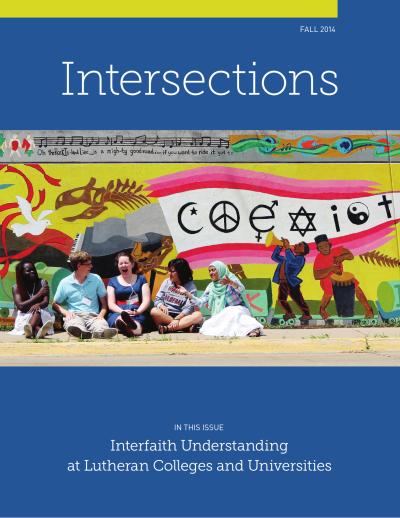 Editorial
From the Publisher
Mark Wilhelm
Wilhelm draws a parallel between the rediscovery of vocation and the rediscovery of interfaith understanding in Lutheran higher education, arguing that previously under-emphasized aspects of the Lutheran tradition point us to interfaith work and that an authentic Lutheran college or university will make interfaith understanding a feature of its mission.
-
Editorial
Guest Editorial
Kristen Glass Perez, Richard Priggie
Glass Perez and Priggie introduce the issue by recounting the campus conversations and the June 2014 Interfaith Understanding Conference at Augustana College that gave rise to it, framing the central question, “What does it mean to be Interfaith at a Lutheran College?,” as a living example of the praxis of being a Lutheran college in the twenty-first century.
-
Article
Vocational Re-Formation for a Multi-Religious World
Elizabeth Eaton
ELCA Presiding Bishop Elizabeth Eaton frames vocational formation for a multi-religious world as one of the most significant challenges facing the church and the liberal arts today, calling ELCA colleges and universities to live into Darrell Jodock’s “third path” that is both deeply rooted and dialogical.
-
Article
What it Means to Build the Bridge: Identity and Diversity at ELCA Colleges
Eboo Patel
Through the contrasting stories of two college students — Cassie’s identity relativism and April’s soft fundamentalism — Patel diagnoses Peter Berger’s twin pathologies of modernization and argues that ELCA campuses, anchored in Bonhoeffer and the Lutheran capacity to “have faith without laying claim to certainty,” are uniquely equipped to be places where the light falls: bridges of cooperation that nurture both strong religious identity and benevolence toward others.
-
Reflection
Danya Tazyeen
Danya Tazyeen
Tazyeen, a Pakistani-American Muslim student at Augustana College, reads Qur’an 49:13 — that God made us into peoples and tribes “that you may know one another” — as a charge to break down fear with open dialogue and to see one another as flawed and relatable fellow human beings.
-
Article
Building on a Firm Foundation: ELCA Inter-Religious Relations
Kathryn M. Lohre
Lohre traces the ELCA’s twenty-year arc of inter-religious work — from the 1994 Declaration to the Jewish Community and the Lutheran-Jewish Consultative Panel, through the post-9/11 Lutheran-Muslim Panel and the Shoulder to Shoulder Campaign, to fledgling dialogue with Sikhs and the dharmic traditions — and frames Lutheran inter-religious engagement as the strengthening, not the dilution, of Lutheran vocation.
-
Article
Building an Interfaith Bridge
Belle Michael
Drawing on the holiday of Shavuot, the Book of Ruth, and Martin Buber’s I-Thou, Rabbi Belle Michael picks up Patel’s bridge metaphor and identifies three building blocks for it: experiences with people of different ethnic and religious groups, genuine and long-lasting relationships, and the holy curiosity to ask the questions we are otherwise afraid to ask.
-
Reflection
Gifty Arthur
Gifty Arthur
Reading John 10:3 as a Ghanaian Christian student at Luther College, Arthur reflects on how Luther’s Journey Conversations have deepened her own spirituality precisely by giving room for students to share the personal experiences and beliefs at the center of their own traditions.
-
Article
Journey Toward Pluralism: Reimagining Lutheran Identity in a Changing World
Jacqueline Bussie
Bussie chronicles Concordia College’s Forum on Faith and Life initiative — assessing campus climate, building a President’s Interfaith Advisory Council, and drafting a one-sentence statement that Concordia practices interfaith cooperation “because of” (not “guided by”) its Lutheran identity — to argue that simul justus et peccator thinking equips Lutheran institutions to hold loyalty to tradition and reverence for others together as one piece.
-
Reflection
David Kamins
David Kamins
Kamins, a Jewish student at Muhlenberg College, reads Rabbi Joseph Soloveitchik’s The Lonely Man of Faith alongside his own journey at the Interfaith Understanding conference on the eve of Shavuot, finding in the dual figures of Adam I and Adam II a way to remain firmly grounded in his faith community while going out to learn from those around him.
-
Article
What's in a Name?
Matthew J. Marohl
St. Olaf College Pastor Matt Marohl tells the story of designing The Undercroft’s prayer and meditation room with a campus meditation group whose members began as “Matt” and ended — as their mutual respect grew — calling him “Pastor Matt,” a counterintuitive movement toward a more formal address that signals what intentional Lutheran-Christian hospitality looks like in practice.
-
Reflection
Annie Schone
Annie Schone
Schone, raised in a small conservative Central Illinois congregation, recounts how Augustana’s Interfaith Understanding group and Interfaith Youth Core gave her the first chance to befriend Muslim, Unitarian Universalist, and atheist peers, and how she hopes to bring the joy of those friendships back to her home church through the power of storytelling.
-
Article
Journey Conversations
Amy Zalik Larson, Sheila Radford-Hill
Larson and Radford-Hill describe Luther College’s Journey Conversations Project, a four-phase contemplative practice — quiet, listen, speak, respond — rooted in the Lutheran call to be true to one’s own faith while welcoming all faiths or none, and illustrate its fruit through faith journey stories from Luther students Sukeji Mikaya (South Sudan), Habibullah Rezai (Afghanistan), and Gifty Arthur (Ghana).
-
Reflection
Tom Natalini
Tom Natalini
Natalini, a Susquehanna University senior raised Lutheran, schooled Mennonite, and seasoned by a meditative encounter in India, reflects on his journey through churchgoing, philosophy, near-Jewish conversion, and Buddhist practice to a stance he calls patience — neither Christian, Jew, Buddhist, seeker, nor “none.”
-
Article
Well, Well…Plumbing Our Depths, Telling Our Stories
Ann Boaden
Beginning with a college visit that turned into a grieving mother’s confidence about her daughter’s last moments, Boaden uses John 4’s well of living water to argue that an interfaith education worthy of the name requires Lutherans to plumb the depths of their own tradition’s wells — with rituals, stories, and seasons intact — before they can see, respectfully, into the wells from which others drink.
-
 Article
Vocation at Full Stretch: Reflections on Follow Your Bliss and Other Lies about Calling and its Use among College Students
Jason A. Mahn
No. 61 · Spring 2025
43 min audio
Mahn engages Bonnie Miller-McLemore’s Follow Your Bliss and Other Lies about Calling as required reading in a sophomore religion course, showing how her categories of missed, blocked, conflicted, fractured, unexpected, and relinquished callings empower young adults to perceive embodied, unplanned, and often painful dimensions of life as essential parts of vocation — and help close the gap between mission-driven and tuition-driven realities.
-
 Article
On Recruiting Diverse Students, Rooted in Mission
Eric Rowell, Jason A. Mahn
No. 59 · Spring 2024
Jason Mahn interviews Eric Rowell, Assistant Director of Admissions and Diversity Outreach at Augustana College, about how recruiting students from a wide variety of backgrounds — rooted in Augustana’s Lutheran commitment to vocation and educating across difference — remains essentially unchanged in the wake of the Supreme Court’s 2023 decisions on affirmative action.
-
 Editorial
From the Outgoing Editor
Jason A. Mahn
No. 55 · Spring 2022
Mahn closes out a decade of editing Intersections, passes the duties to Colleen Windham-Hughes, gives thanks to Mark Wilhelm and Augustana College, and introduces an issue largely drawn from comments by Lutheran faculty, staff, and administrators at the 2022 NetVUE national gathering.
-
 Editorial
From the Editor
Jason A. Mahn
No. 54 · Fall 2021
Mahn introduces the “Called to Place” theme of the 2021 VLHE Conference, arguing that Lutheran higher education’s emphasis on vocation must be grounded in particular geographies and embodied communities — for, as Wallace Stegner put it, “If you don’t know where you are, you don’t know who you are.”
-
 Reflection
Shelter in Place: Reflections from March 22, 2020
Jason A. Mahn
No. 53 · Spring 2021
On the fourth Sunday of Lent in 2020, Mahn meditates on the etymology of “shelter” (from shield) and on an email from a former student in Boston whose mutual-aid organizing models a Lutheran understanding of vocation: the upending of ego by divine love that frees us, finally, to see and serve the neighbor.
-
 Editorial
From the Editor
Jason A. Mahn
No. 52 · Fall 2020
Mahn narrates a year of crisscrossing pandemics — Covid-19, economic collapse, partisan politics, and the long pandemic of white supremacy revealed anew by the murder of George Floyd — and argues that Lutheran liberal arts schools, by educating for vocation, are uniquely poised to help students respond with character and capable callings.
-
 Article
Conciliatory and Queer: The Radical Love of Lutheran Higher Education
Kiki Kosnick, Sharon Varallo
No. 50 · Fall 2019
Kosnick and Varallo reflect in conversation on how Augustana’s Five Faith Commitments and its conciliatory ecumenical roots in the Augsburg Confession have given them — a non-binary queer first-generation faculty member and a twenty-one-year veteran — the “street cred” to act on radical love, build bridges to imprisoned and non-binary communities, and discover that Augustana is welcoming not despite the fact that it is Lutheran, but because of it.
-
 Article
The Divide Within (Not Between) Liberal Arts and Professional Education
Lake Lambert
No. 24 · Fall 2006
Lambert, then Board of Regents Chair in Ethics at Wartburg College and Project Director for the “Discovering and Claiming our Callings Initiative,” argues that the real divide in higher education runs not between the liberal arts and the professions but within each — between teaching that forms students for callings and teaching that merely transmits content or credential. He calls Lutheran colleges to recover, across both liberal arts and professional disciplines, a shared commitment to vocational formation grounded in the Lutheran tradition.
-
Editorial
From the Publisher
Lamont Anthony Wells
No. 61 · Spring 2025
5 min audio
Wells introduces So That All May Belong: Lutheran Roots for Diversity, Equity, Inclusion, and Justice as a theological and institutional articulation of NECU’s commitments, and previews four accompanying essays that frame vocation as a societal responsibility rooted in justice and not solely an individual pursuit.
-
 Article
Reflections on Our Shared Commitments
Mark S. Hanson
No. 25 · Spring 2007
Originally delivered to the Lutheran Educational Conference of North America in March 2007, Hanson’s address describes the ELCA as “an ecology of interdependent ecosystems” and locates the church’s relationship to its twenty-eight colleges and universities in a shared mission rather than in older anxieties about church-relatedness. Drawing on Wittenberg’s Lutheran Identity Study, Augustana’s “Five Faith Commitments,” Pamela Jolicoeur’s Concordia address, W. Robert Connor on “big questions,” Joseph Sittler on grace, Walter Brueggemann on fear, Jonathan Strandjord on being “other-wise,” and Cynthia Moe-Lobeda’s Public Church for the Life of the World, he names four marks of shared mission: communities of free inquiry, encouragement of religious expression in a diverse society, education for the common good, and the formation of leaders for church and religious communities worldwide.
-
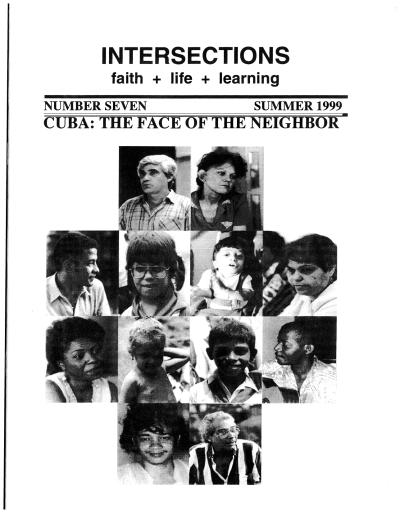 Editorial
From the Editor
Tom Christenson
No. 7 · Summer 1999
Christenson introduces the issue’s contents—papers from the 1998 Vocation conference by Cheryl Ney and Robert Scholz, a response by Jennifer Sacher Wiley, an interview with four Capital University faculty about Cuba, a meditation by St. Olaf senior Erik Haaland, and the journal’s first letter to the editor—and commends the Mount Mary College volume Wagering on Transcendence as a model of a faculty community sustained by Friday-afternoon conversation over a glass of wine.
-
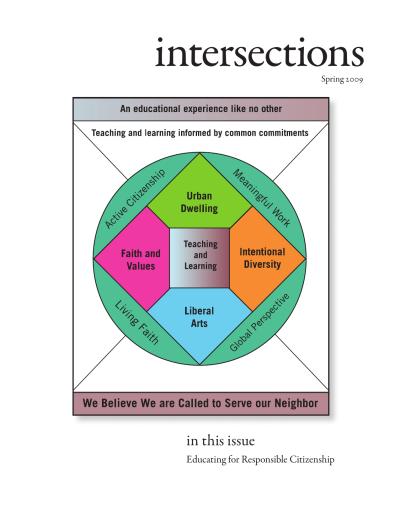 Article
Seeking the Common Good: Lutheran Contributions to Global Citizenship
Wanda Deifelt
No. 29 · Spring 2009
Deifelt draws on Luther’s account of neighborly love in “The Freedom of a Christian” and on his Two Kingdoms theology to argue that a Lutheran ethics of care fosters a sense of responsibility, accountability, and compassion that broadens citizenship beyond rights and virtues. Engaging William Galston’s typology of civic virtues, Sylvia Walby on women’s citizenship, Serene Jones on communitarianism, and Manuel Castells on globalization, she proposes that Lutheran theology equips the church to educate for transformative participation in world affairs.