Building a Developmental Framework for Vocational Reflection at Thiel College
Intersections No. 55 · Spring 2022
Over the past five years, Thiel College has been exploring how its rootedness in the Lutheran tradition translates to student care and success in today’s pluralistic society. As a member of the Network for Vocation in Undergraduate Education (NetVUE), we are among a movement of undergraduate colleges asking how we can serve all members of our campuses through our deepest held values and inspired by our institutions’ faith traditions. Support from a NetVUE Program Development Grant provided time and resources that allowed us to ask specific questions about our educational philosophy and delivery. To initiate this work, we held focus groups, examined existing programs, and questioned long-standing structures to determine if our “way” of serving our students needed an update. The resulting product of this introspection, the Tomcat Way, a four-year developmental framework for vocational reflection, now guides all aspects of the student experience at Thiel.
Founded in 1866 by Rev. William J. Passavant, with a generous gift from Louis and Barbara Thiel, Thiel has a beautiful campus overlooking the Shenango River valley in Greenville, Pennsylvania. At the center of campus is an historic walkway that connects the upper and lower campuses. Climbing between a multigenerational procession of maple and oak trees, “Brother Martin’s Walk” intersects with a second main artery that conveys students between Greenville Hall and the Academic Center, two buildings that represent the center of our academic life. Thiel’s most cherished tradition is to lead new students along this path to their first opening convocation. In four short years, they will make their way up Brother Martin’s Walk again as they journey back to Thiel’s Passavant Auditorium to receive their diploma at commencement. This symbolic journey, and the physical walkway, became the central image of the Tomcat Way.
Initial support from NetVUE provided for a series of reading groups, which engaged faculty and staff around issues of finding meaning and purpose through academic work and the Theil community. In the 2019-20 academic year, the college intentionally connected our campus pastor with our director of career development, with a charge to create a pathway for vocational exploration. With the NetVUE grant, we created a committee consisting of the associate academic dean for student success, the associate dean for diversity and inclusion, and a diverse group of staff and faculty to begin conversations about what vocation might mean for our students. By the end of the academic year, we formed a developmental plan for students to engage and think about meaning and purpose in their academic and co-curricular experiences, during and beyond their time at the college.
“We formed a developmental plan for students to engage and think about meaning and purpose in their academic and co-curricular experiences, during and beyond their time at the college.”
Domains of the Framework
Early in the process, we decided to borrow from Luther’s deep reflection on vocation, which provides meaningful calls for all people, not simply for those engaged in religious vocations. Faculty members on the team helped bridge these theological and philosophical concepts with work by Marcia Baxter Magolda and other developmental psychologists. To that end, we identified four domains of the student experience that underlie the framework for vocational reflection: personal, social, academic, and professional.
In the personal domain, we are concerned with the students’ internal life and their capacity for growth of personal relationships. This involves taking an honest inventory of their passions and strengths, including their ability to confidently make their own decisions and think critically about their world.
In the social domain, we ask questions about the students’ capacity to find and appreciate friend and colleague groups, work together in clubs and in academic projects, and to see themselves as part of a diverse and engaged community of learning both on the campus and in the local community.
Under the academic domain, we encourage students to think about themselves as scholars and to gain confidence in their skills and abilities. They develop capacity for academic study rooted in their dreams and passions as they take what they learn in their coursework and apply it to the real world.
Finally, the professional domain focuses on enhancing the capacity of our students to be self-reflective as they prepare to enter graduate school or launch their careers. This involves intentional reflection about how their experiences at Thiel can help guide and prepare them to achieve their future goals.
Phases of the Tomcat Way
The above four domains demark the areas of student experience that are touched by vocational reflection. We know, however, that students typically engage different domains at different moments in their four-year college journey. We felt it was important to examine the holistic lives of our students and attempt to align points in their development with each phase of our model. The result was four identified phases of the Tomcat Way, through which Theil students are called and empowered to explore, envision, belong and lead, and then launch into their rest of their vocational lives.
Explore
Starting at summer orientation prior to the first-year, we encourage students to explore. Such exploration is quite literal insofar as they get to know their new campus and the surrounding community. We also encourage students to seek answers to the question, Who am I as a college student? We do so through active exploration of different academic departments and co-curricular opportunities across the four domains described above.
We ask them to set goals for their first semester. They revisit those goals in their first-year seminar and later through advising conversations prior to spring registration. Academic advisors are trained to ask more than transactional questions (e.g. when do you want to take English?); they engage students where they are developmentally. Questions in this phase help us understand how students are connecting to the institution and with their peers as they begin discerning their values and beliefs:
- What interest you?
- Have you made new friends?
- What is going well this semester?
Envision
In the second phase, students are asked to consider the question: Who am I in context? They begin to develop confidence in their major area of study, and are encouraged to invest in their passions and interests as a way to draw them deeper into their academic and co-curricular involvement. Students begin to envision the opportunities available to them and what they hope to accomplish before graduation (for example internships, research, or study abroad).
Students have the opportunity to participate in an off campus retreat where they identify their strengths, work together in groups, set goals, and engage in activities related to leadership. Academic advisors support students as they solidify their academic major and consider minors. Advisors also foster conversations that explore purpose and meaning in the chosen field and help students consider:
- What about your major interests you and why?
- How well do your skills fit with your aspirations?
- What additional courses or activities might bring you joy?
- How do your academic and professional goals relate to your values and beliefs?
“Students have the opportunity to participate in an off campus retreat where they identify their strengths, work together in groups, set goals, and engage in activities related to leadership.”
Belong and Lead
By the third phase, we expect students to have committed to departments, student groups, and other communities through which they find meaning. This belonging is more than simply declaring a major or participating in a club. Rather, we want students to take a deep dive into their academic discipline(s) and take on leadership roles in communities they consider important. We ask students to reflect on how their passions align with acquired skills.
When gaps are identified, we encourage further academic, social, or professional development through on-campus student employment, internships, and other high-impact practices (HIPs). Each of these includes reflection with a supervisor or mentor, which guides students to consider if the experience matches their long-term goals for careers and lives of meaning and purpose. In this way, students are encouraged to see connections between their values and beliefs and community engagement. We help student ask and respond to questions such as:
- Is the academic and vocational path you are on realistic?
- How do you contribute to the campus community?
- How does your involvement on campus help you prepare for future, meaningful work?
Launch
As students prepare for graduation, we help them navigate the answer to the question: How do I apply what I have learned? Throughout their college experience, students will have engaged with career development center and the utilize the Tomcat Way Four Year Career Success Guide, helping them successfully navigate their vocational and career journey in partnership with faculty, staff, and campus ministry. As students complete capstone projects, research, theses, and other projects and reflect on their experience with them, they acquire more skills and become more ready to graduate. As students “launch” toward graduate school or work, they consolidate confidence in their knowledge, skills, and abilities. They understand that knowledge gained though curricular and co-curricular experiences has prepared them to leverage opportunities that may arise. They have the courage and confidence to contribute meaningfully to the world and be leaders in their places of work and in their communities. Academic advisors continue to encourage students to navigate the end of their college journey and prepare for their next step with questions such as:
- What steps are you taking to prepare for life after graduation?
- How do you see yourself fitting in and contributing to the world after graduation?
- How do you understand your sense of meaning and purpose?
Challenges and Lessons Learned
At multiple points over the past few years, our organizing committee and various sub-groups have struggled with conflicting approaches to address programmatic needs. While NetVUE resources provided essential support for the initial lifting of new programs (such as the sophomore retreat), we were always mindful of the need to build sustainable structures. In some cases, this required new funds or shifting of budget lines to support Tomcat Way initiatives. More frequently, we sought to build intentional connections between existing programs and offices. In many instances simply providing language that served as connective tissue helped students, faculty, and staff see how experiences in one area of campus could complement another. This also avoided the need to add more to the already overflowing plates of many of our faculty and staff. Finally, it had the benefit of helping older students communicate value to younger students, which in turn built “buy-in.” A senior may not discuss a “launch” activity in the terms of the Tomcat Way, but they could readily relate how a business seminar series was a transformational experience to them.
A second area we continue to struggle with is ensuring that all students have equitable access to the Tomcat Way. A central goal has always been to build a framework that ensures students experience the full benefit of the model. We sought to remove barriers to participation by developing programing that was largely free of additional costs to participating students. However, we also encountered reluctance among students to engage in new experiences and programs. Some of this behavior is certainly attributable to COVID-necessitated changes in campus life. For example, over the 2020-21 academic year, multiple events were planned and then canceled or significantly scaled back to accommodate viral outbreaks or CDC/public health mandated mitigation policies. This caused many students to simply get out of the habit of attending anything—a trend that has carried over to 2021-22.
We also experienced reluctance to engage from some target populations, including athletes, first-generation students, and minorities. To address these obstacles, this spring we collaborated with the Organization for Black Collegians (OBC) and our coordinator for diversity, equity, and inclusion on a leadership training workshop. We have also made more intentional outreach efforts to athletic coaches and specific teams with the goal of holding similar workshops. These will focus on teambuilding and leadership, which essentially connects the structure and goals of a given team with the language of the Tomcat Way. Our hope is that such programing will help expand opportunities for students to connect with the Tomcat Way through multiple influencers, rather than just through academic or career-based programing.
“Our hope is that such programing will help expand opportunities for students to connect with the Tomcat Way through multiple influencers, rather than just through academic or career-based programing.”
Our experience over the last two years has greatly helped the Thiel community better understand our Lutheran traditions and heritage. The momentum of this work will also help us communicate the concept of vocation to all students, regardless of their own faith traditions, in a manner that encourages intentional vocational reflection. As we help all Thiel students follow the Tomcat Way to their individual destinations, we are confident that they will be prepared for careers and lives of meaning and purpose.
Works Cited
Baxter Magolda, Marcia. “Developing Self-Authorship in Young Adult Life.” Journal of College Student Development 38.2 (March/April 1998): 143-56.
-
 Editorial
From the Publisher
Mark Wilhelm
Wilhelm announces his planned retirement on January 31, 2023, after serving as the founding executive director of the Network of ELCA Colleges and Universities, and gives thanks for the privilege of helping NECU articulate a shared vision for Lutheran higher education in twenty-first-century North America.
-
Editorial
From the Outgoing Editor
Jason A. Mahn
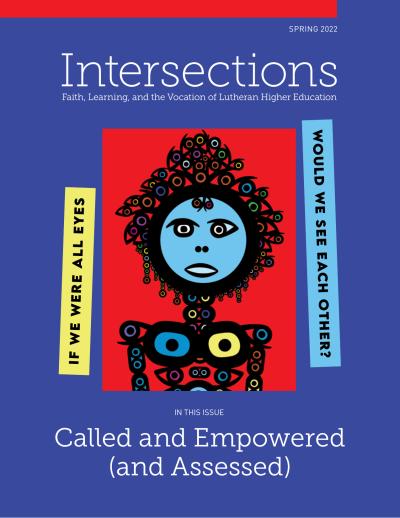
Mahn closes out a decade of editing Intersections, passes the duties to Colleen Windham-Hughes, gives thanks to Mark Wilhelm and Augustana College, and introduces an issue largely drawn from comments by Lutheran faculty, staff, and administrators at the 2022 NetVUE national gathering.
-
Editorial
From the Incoming Editor
Colleen Windham-Hughes
Windham-Hughes introduces herself as incoming editor by reclaiming the root of assess — “to sit by” — and committing to the question “What does this mean?” as she sits with readers in the worth of our work and the universality of vocation.
-
Article
Assessing Self-Assessment Instruments at Finlandia University
René Johnson
Johnson surveys three self-assessment instruments presented at the NetVUE conference — PathwayU at Colorado State, the Intercultural Development Inventory at Friends University, and Mark Savickas’s Career Construction Counseling Manual at Union College — and describes Finlandia’s use of the CliftonStrengths© assessment to link students’ personhood to “behaviors that benefit the community.”
-
Institutional Focus
Pivoting to Imaginative Programming in the Midst of the Pandemic at Bethany College
Arminta Fox
Fox recounts how Bethany College’s NetVUE Program Development Grant — originally designed around service-learning trips — was reimagined under COVID-19 into a guest-speaker model that tripled student participation and opened new vocational possibilities through the close, personal stories of alumni, alums-turned-volunteers, and community partners.
-
Institutional Focus
Serving and Building Community at Concordia College
Larry Papenfuss
Papenfuss, director of the Dovre Center for Faith and Learning, frames eight ways Concordia College serves the world by building community — from quality teaching and liberating liberal learning to interfaith cooperation and modeling “diversity with particularity” as a Lutheran “third path” institution.
-
Institutional Focus
Sharing the Gift of Vocation at (and beyond) Augsburg University
Paul C. Pribbenow
Pribbenow, drawing on a 2022 NetVUE panel with Dorothy Bass and Jodi Porter, considers how the gift of vocation forged with undergraduates can be extended — beyond undergraduate campuses to graduate students, faculty, and staff; across the vocational lifespan from high schoolers to alumni navigating the “gig economy”; and into accompaniment of faith communities through Augsburg’s Riverside Innovation Hub.
-
Book Review
Assessing the Value of Liberal Arts: A Review of The Evidence Liberal Arts Needs, by Richard A. Detweiler
Robert D. Haak
Haak reviews Richard A. Detweiler’s The Evidence Liberal Arts Needs, in which the former president of the Great Lakes Colleges Association analyzes 240 college mission statements and interviews more than 1,000 graduates to argue that liberal arts educational experiences have a measurable impact on adult lives of consequence, inquiry, and accomplishment — and invites NECU institutions into a further conversation about how Detweiler’s methodology applies to Lutheran higher education.
-
 Reflection
Saving Minds
Lake Lambert
No. 28 · Fall 2008
In a sermon preached in the Castle Church in Wittenberg during Wartburg College’s 2006 faculty and staff development seminar, Lambert names two sins of the mind—coveting and mental sloth (in both its rigid refusal to think and its mindless relativism)—and, drawing on Luther’s Large Catechism and Martin Luther King, Jr.’s “A Tough Mind and a Tender Heart,” calls Christians to receive the wisdom that comes when faith puts knowledge into action, sustained by the hope of the resurrection.
-
 Response
“You Shall Know the Truth, and the Truth Will Set You Free”: A Scientist’s Response
Ben Huddle
No. 2 · Winter 1997
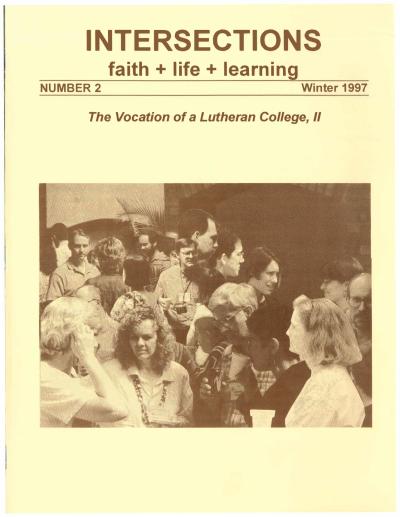
Huddle of Roanoke College proposes adding a sixth theme to Bouman’s five—the scientific method—as a tool for knowing the Truth not available to Luther but central to twentieth- and twenty-first-century learning. Diagramming the continuous cycle of observations, laws, theories, and predictions, he argues that scientists must be ethical and that scholars in other fields must understand the scientific method (lest environmentalists ignore the Second Law of Thermodynamics). A Lutheran college, he concludes, should treasure both the religious and the scientific tradition: stifling either loses meaning or significance, and the Lutheran tradition is therefore biblical, catholic, evangelical, sacramental, scientific, and world-affirming.
-
 Article
The Responsible Professional: Vocation and Economic Life
Martha E. Stortz, Tom Morgan
No. 51 · Spring 2020
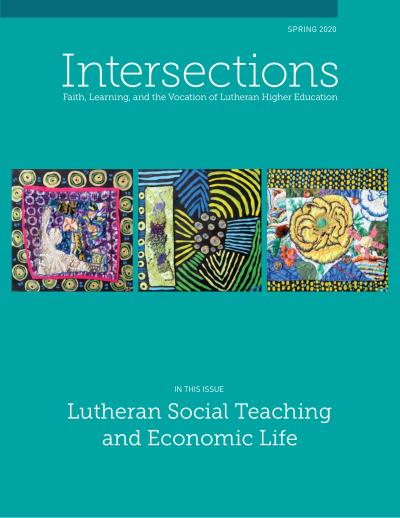
Stortz and Morgan argue that the “value-added” of Lutheran higher education is a responsibility ethic — one that frames the professional as a first responder “called and empowered to serve the neighbor so that all may flourish” — and unpack the four criteria of the 1999 ELCA social statement Sufficient, Sustainable Livelihood for All as a framework for economic deliberation.
-
Article
Lutheran Tradition: Five Continuing Themes
Walter R. Bouman
No. 2 · Winter 1997
Bouman of Trinity Lutheran Seminary identifies five themes central to the Lutheran theological tradition (understood through Alasdair MacIntyre’s account of tradition as “an historically extended, socially embodied argument”): biblical (a non-oppressive authority for the Bible rooted in the gospel rather than in scholastic inerrancy, against the backdrop of Luther’s 1517 challenge to Tetzel and the post-Enlightenment marginalization of theology); catholic (continuity with the Book of Concord and the three ancient creeds, with Luther’s “Christology from below” recovering a Jewish rather than Hellenistic understanding of God, revived by Tillich, Pannenberg, Forde, and Jenson); evangelical (justification by faith as the answer to mortality’s radical question); sacramental (Word, Eucharist, and Baptism as Christ’s presence from the future of God’s consummated Reign); and world-affirming (creation as gift, vocation as God’s work in every calling, and stewardship of the ecological crisis).
-
 Article
Engaging the Local Community: Why Bother?
Mary S. Carlsen
No. 27 · Spring 2008
Carlsen traces the often adversarial history of town-gown relations from the medieval universities through the Battle of St. Scholastica Day to the “ivory tower” pattern of American higher education, then argues that Lutheran colleges should engage their local communities for practical, educational, ecological, moral, and theological reasons. Drawing on her work in social work education at St. Olaf and on Ira Harkavy, Ernest Boyer, and the ELCA’s “Our Calling in Education,” she offers a recipe for engagement that is Passionate, Ethical (Needed, Welcomed, Mutual, Long-term, Attentive to diversity, Strengths-based, Respectful), and Reflective.
-
 Article
Community-Based Research as Engaged Citizenship
James Paul Old
No. 63 · Spring 2026
6 min audio
Old argues that genuine citizenship requires more than charitable gestures — it demands long-term, reciprocal community partnerships — and describes how Valparaiso’s Community Research and Service Center embodies that vision even amid the financial pressures threatening such programs.