Part of the mission of higher education that is rooted in the Christian traditions is to help students awaken to an experience of living that is beyond the sense of “Is this all there is” and, paradoxically, to one of seeing and understanding the simple and ordinary wonder in what is, probably is, maybe is, and in questions of why it isn’t. Considering the topic of vocation in our arena of education, is there a slight turn-of-the-prism that could further help us tap into vocation as the fascinating as well as holy ordinary drama and journey that it is?
According to Iain McGilchrist, humanity, especially in the Western world, but increasingly all around the world, has come to prioritize seeing through micro lenses that offer insulated silos of understanding. While humanity has benefited from micro lenses, such as specializations developed in science, economics, humanities, and the arts, a micro approach limits our understanding of the interconnectedness of life and our life stories, individually and collectively, presently and historically.
Instead, McGilchrist claims we should begin with macro views, wide perspectives that make it possible to grasp how life and life events are connected, then attend to the details at the micro, narrower focus level, where we drill into skill development, subject learning, disciplinary functions, issues, and tasks. More so, after the details are attended to, he directs us to return to a broad, comprehensive, integrated focus, made that much more credible and richer because of the research, work and practice carried out at the micro level. What are beginning macro perspectives on vocation that can help us grasp the holy and holistic significance of each journey, and our collective journey together in these times (McGilchrist)?
We find evidence of pushing against siloed perspectives in higher education, as in inter-discipline studies, department project collaborations, plenary presentations where multiple disciplines are represented, and president advisory councils populated by wide, diverse representation. This is not to slight in any way the necessary work of specialization, but to advocate for the need to bridge specifics with other perspectives so to enrich the dialogue and our understandings, holding singularity under a wide umbrella. We might ask, “How would Homer, Confucius, Plato, Teresa of Ávila, Martin Luther, an Alaska Native leader, Nelson Mandela, Jane Goodall, ‘Captain Kirk,’ or a journalist refugee from any number of oppressive nation states begin to express the drama of a wide perspective vocation story today, mindful of how we got to where we are (or think we are) and where we might be going?
Story is drama because there is tension and conflict wrestling for resolution. Our lives are drama because life is at its core tension, working for resolution, which only leads to another tension, another valley to cross, mountain to climb, meal to cook, problem to solve, river to appreciate, and child to love. Just learning to stand up and walk is a match against gravity, an early phase of a long adventure. However, without tension there is no becoming. Even trees need the wind to gain strength and resiliency. Certainly, the backdrop story of the Passion of Christ’s life, death, and resurrection is a drama-tension against and within which we interpret and re-interpret our lives again-and-again. Familiar with its archetypal plot, we interpret our experience of life through it, drawing forth meaning from the juxtaposition.
Today, meaning communicated through many national epic stories is being challenged. In the United States, these include traditional stories of Christopher Columbus, the founding fathers, and the way U.S. history is told in general. Many stories are being stretched to include more perspectives and questions. Because underlying conflicts were hidden or buried within status-quo-stories and were never resolved, tensions festered untold without the light of day. So, now, we are wrestling with the long shadow of having enslaved human beings who were instrumental in the building of a nation and its wealth, as well as on land grabs, broken treaties, and policies that brought to near extinction native populations. We are working our way back to a wider story so we might go forward. There are oppressive corollaries for how we have told the story of Earth.
The wide perspective includes great accomplishments, heroic deeds, beauty, and marvel, and collective achievements that make us wonder how we did it, like building the James Webb Telescope that is capturing infra-red-light images from the edges of time. Today, we are reaping benefits and tragedies from an Enlightenment mindset that stretches across a few centuries. Advances in technology and science, increased standards of living for many, as well as provided a path toward climate warming and the growing gap between the very wealthy and people caught in poverty (Phan).
How do we hold the drama of our lives within a large plot, even if we interpret that plot as a moving one, one that needs to be tended and re-interpreted afresh by each generation? Now, however, there is a clock that is ticking. Our collective drama, like a Greek tragedy, has us in the amphitheater, where together we empathize and weep for the protagonists, both a suffering planet and its struggling humanity. Weeping is a good sign. Does it stir the heart? Does this put a particular twist to vocation stories today?
Works Cited
McGilchrist, Iain. The Master and His Emissary: The Divided Brain and the Making of the Western World. Yale University Press, 2009, expanded edition 2018. See his two volume texts, The Matter with Things. Perspective Press, 2021.
Phan, Sam. “Wealth Gap Widening for more than 70% of Global Population, Researchers Find.” The Guardian. 22 January 2020. Web. 2 July 2022.
-
 Editorial
From the Editor: Why All This Talk About Vocation?
Colleen Windham-Hughes
Windham-Hughes introduces the Fall 2022 issue built around Mark Wilhelm’s keynote “Why all this talk about vocation?” and previews five panel responses, two first-time conference reflections, and companion pieces on Womanist theology — framing vocation as a call not to privilege but to constructive and corrective work that undoes unjust systems.
-
Article
Why All This Talk About Understanding the Mission of NECU Member Institutions as a Vocation?
Mark Wilhelm
In his valedictory keynote, retiring NECU Executive Director Mark Wilhelm argues that Lutheran higher education is, properly understood, vocation-based education — outlining four core practices recovered over the past fifty years and naming the constructive and corrective work still to be done, including a fuller embrace of DEIJ and of the diverse vocations of NECU’s 27 institutions.
-
Response
Response to Mark Wilhelm: Vocation, Mission and Privilege
Marit Trelstad
Trelstad affirms Wilhelm’s claim that vocation is the foundational shared mission of Lutheran higher education rather than one program among many, and presses the critique that calls to “vocational reflection” can mask privilege — arguing that an intersectional lens shows vocational discernment is in fact a matter of survival and flourishing for students from marginalized communities.
-
Response
Response to Mark Wilhelm: DEI, Great; DWS (Dismantling White Supremacy), Even Better
Vic Thasiah
Thasiah argues that if Lutheran colleges and universities want to live out their commitment to the flourishing of all, DEI is good but DWS — dismantling white supremacy — is even better, and offers three Lutheran sensibilities (suspicion of self-righteousness, the decolonial shockwave of the cross, and critical thinking that can still register awe) that can make DWS a core practice of higher education.
-
Response
Response to Mark Wilhelm: Distinguishing Between Identity and Vocation
Andrew Tucker
Tucker proposes that NECU’s next most faithful step is to faithfully and effectively differentiate vocations and identities — arguing that identity is who you are, vocation is what you do, and that recognizing the plurality of both helps Lutheran institutions name which work is theirs to take up and which is good work that belongs to someone else.
-
Response
Response to Mark Wilhelm: Adopting the Framework of ‘Because’ and ‘Therefore’
Paul C. Pribbenow
Pribbenow describes how Augsburg University responded to its dramatic demographic transformation (from 18% to nearly 70% BIPOC entering students over sixteen years) by adopting an institutional vocational statement and a simple “because/therefore” framework for translating particular Lutheran theological convictions into institutional programs, policies, and practices.
-
Article
Work Works
Julius Crump
Crump argues that in an era of class-stratified careerism and the “ruins of neoliberalism,” commencement-speech rhetoric about heroic vocation will not resuscitate vocation — instead, professors embodying vulnerability, extemporaneity, and contemporaneity in the classroom can show students that consistent work, embodied as service to others, is itself worthy.
-
Reflection
Why All This Talk About Vocation?
Madyson Ray
Ray, a junior at Midland University and the only student attendee at the 2022 conference, reflects on four workshops — on teaching womanist thought, on supporting student-athletes, on resistance to the word “vocation,” and on vocational reflection — and brings home concrete ideas including a women’s-history scavenger hunt and semester-long vocational reflections.
-
Institutional Focus
LibGuide: Introduction to Womanist Theology
Elli Cucksey
Cucksey, the head librarian at Trinity Lutheran Seminary, recounts how Beverly Wallace’s Introduction to Womanist Theology class — the first offering of the ELCA Seminaries’ Womanist Theology Initiative — led her to build a publicly available LibGuide that amplifies Black women’s voices and gathers the resources of the course for future students.
-
Article
Doing the Work One’s Soul Must Have
Beverly Wallace, Yolanda M. Norton
Norton and Wallace describe the Womanist Experiential Learning Initiative — including the Beyoncé Mass, study-abroad partnerships in Portugal, Brazil, and Ghana, and the Black Girl Magic Academy for teenage girls — as a way of centering Black women’s voices in theological education and doing, as Katie Geneva Cannon put it, “the work…that one’s soul must have.”
-
 Editorial
From the Publisher
Mark Wilhelm
No. 55 · Spring 2022
Wilhelm announces his planned retirement on January 31, 2023, after serving as the founding executive director of the Network of ELCA Colleges and Universities, and gives thanks for the privilege of helping NECU articulate a shared vision for Lutheran higher education in twenty-first-century North America.
-
 Editorial
From the Publisher
Arne Selbyg
No. 12 · Summer 2001
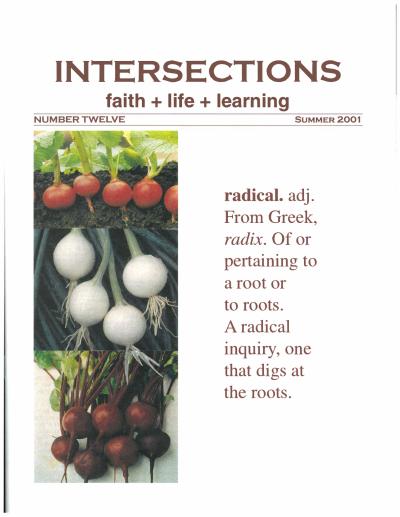
Selbyg reports that the Lutheran Brotherhood Foundation and the Lilly Endowment have funded the Lutheran Academy of Scholars, which since 1999 has gathered ten to twelve Lutheran scholars at Harvard for two-week summer seminars under Ronald Thiemann (themes: “Finding Our Voice—Christian Faith and Critical Vision” in 1999–2000 and “The Lutheran Public Intellectual: Faith, Reason and the Arts” in 2001), and announces that the academy will move to Berkeley in 2002 under Ted Peters to take up the intersection of faith and science.
-
 Editorial
From the Publisher
Mark Wilhelm
No. 30 · Fall 2009
Wilhelm reports on the difficult financial season facing the ELCA churchwide organization — a ten-percent budget reduction announced in November and significant cuts to unrestricted grants for colleges and universities — while affirming that the ELCA’s commitment to the mission of its schools remains strong, including its commitment to engaging the “other,” the theme of this issue.
-
 Article
Reflections on Our Shared Commitments
Mark S. Hanson
No. 25 · Spring 2007
Originally delivered to the Lutheran Educational Conference of North America in March 2007, Hanson’s address describes the ELCA as “an ecology of interdependent ecosystems” and locates the church’s relationship to its twenty-eight colleges and universities in a shared mission rather than in older anxieties about church-relatedness. Drawing on Wittenberg’s Lutheran Identity Study, Augustana’s “Five Faith Commitments,” Pamela Jolicoeur’s Concordia address, W. Robert Connor on “big questions,” Joseph Sittler on grace, Walter Brueggemann on fear, Jonathan Strandjord on being “other-wise,” and Cynthia Moe-Lobeda’s Public Church for the Life of the World, he names four marks of shared mission: communities of free inquiry, encouragement of religious expression in a diverse society, education for the common good, and the formation of leaders for church and religious communities worldwide.
-
 Reflection
Colleges Lead Way: Curiosity, Faith, Discernment, Mission are Key
Mark S. Hanson
No. 28 · Fall 2008
Reprinted from The Lutheran (November 2007), Hanson names four marks of the colleges of this church—nurturing unquenchable curiosity, nourishing faith formation and exploration, modeling public moral deliberation, and preparing students for engagement in the world—and gives thanks for the colleges’ vocation to call us to stand outside ourselves and reach out in mission for the sake of the world.
-
 Editorial
From the Publisher: Staying Connected
Mark Wilhelm
No. 38 · Fall 2013
Wilhelm frames Intersections as a tool for maintaining relationships among leaders in ELCA higher education, welcomes the journal’s new editorial advisory board, and points readers toward the 2014 Vocation of a Lutheran College conference at Augsburg and a special interfaith understanding conference at Augustana with Eboo Patel and Presiding Bishop Elizabeth Eaton.