“You Shall Know the Truth, and the Truth Will Set You Free”: A Scientist’s Response
Intersections No. 2 · Winter 1997
Prof. Walter Bowman presented a helpful paper at the 1996 Summer Conference for faculty at Lutheran colleges in response to the question “What is the Lutheran tradition?”. He proposed five major themes that inform Lutheran (and other Christian) colleges: the Lutheran tradition is Biblical, catholic, evangelical, sacramental, and world-affirming.
. . . I suggest that there is a way for students to look for the Truth that sets them free that is as valuable as the five traditions listed by Bowman: that is the scientific method.
I am neither equipped nor inclined to critique Prof. Bowman’s proposals. As a scientist, however, it seems to me that Bowman overlooks a tradition, albeit a newer one, important at contemporary church related liberal arts colleges. That is a tool for knowing the Truth that was not available to Martin Luther, but is certainly available to twentieth (and twenty-first) century students. That tool is, of course, the scientific method. I would therefore add a sixth tradition critical for Lutheran (and other Christian) colleges.
I do not mean science, although strong arguments can and have been made that citizens are poorly equipped to live in a modern society without a good understanding of science. Rather, I suggest that there is a way for students to look for the Truth that sets them free that is as valuable as the five traditions listed by Bowman: that is the scientific method. This method can be summarized by four steps in a continuous cycle.
Observations → Laws → Theories → Predictions → Observations
The scientific method begins with observations, made either in a laboratory where some conditions can be controlled, or in nature. When an observation is made repeatedly, or related observations are made by many observers, the collected observations are called laws. Theories are proposed to explain those laws. Theories try to answer the question “Why?” at a fundamental level. Theories lead inexorably to predictions, and predictions lead to further observations, and the cycle continues.
Some scientists have seen this cycle as the “engine of science”. Others see an ever-expanding spiral representing our knowledge of the universe. Others see an ever-narrowing spiral focussing in on the Truth. Whatever the metaphor, the scientific method has been remarkably successful in understanding and in mastering our universe. It has been so successful that many “non-scientific” fields have adopted it; thus we have, for example, political science.
“Science” comes from the Latin “scientia”, knowing. The scientific method is thus a method for learning the Truth. Everyone can participate in the scientific endeavor, if not as an active scientist, as a citizen knowledgeable of the power of the scientific method, who insists on rational answers. Application of the scientific method offers perhaps our best hope for solving many of the next century’s problems, including human problems such as poverty, famine, pestilence and war.
Scientists are expected to speak and act ethically, but too often we don’t expect scholars in other fields to know the scientific method.
Because science is sometimes thought of as being difficult, there is a temptation to excuse our students from understanding science. We don’t do our liberal arts students a service when we do this, just as we don’t do our science students justice if we teach them science at the expense of ethics. My thesis is that we need to do both. For example, environmentalists are sneered at when they ignore the effects of the Second Law of Thermodynamics. Scientists are expected to speak and act ethically, but too often we don’t expect scholars in other fields to be aware of the scientific method.
One of the pleasures of teaching at a Lutheran college is the opportunity for “truth seekers” to work together, sharing methods and insights. Not only is this conversation possible, it is (or should be) welcome, even expected. One of the traditions of a Lutheran college should be to treasure, cherish, and zealously protect this conversation. Colleges which stifle the religious tradition do so at the peril of losing their meaning. Colleges which stifle the scientific tradition do so at the peril of losing their significance.
A modest scientist would not claim that the scientific method is the only way to know the Truth, or even necessarily the best way to know the Truth. For two hundred years, however, it has been an integral part of the human endeavor, and it deserves to be included in the Lutheran college tradition. The scientific tradition is not unique to Lutheran colleges, but neither are the five traditions enumerated by Bowman. And there may be others, but my assignment was to give a scientists’ response to Bowman. I would conclude that the Lutheran tradition is Biblical, catholic, evangelical, sacramental, scientific, and world-affirming.
-
 Editorial
From the Publisher
James M. Unglaube
Unglaube reports on the second annual Vocation of a Lutheran College conference of August 1996, where Walter Bouman of Trinity Lutheran Seminary addressed “What is Lutheran; What is the Lutheran Tradition” (biblical, catholic, evangelical, sacramental, world-affirming—the world “received, enjoyed, served as God’s Gift”). He previews presentations by Wendy McCredie of Texas Lutheran and Baird Tipson of Wittenberg on how the Lutheran tradition is embodied in its colleges, and Bob Vogel’s challenge in “Coherence—And Now what?” that the tradition comes to life in how faculty give expression to their beliefs and values in the classroom and with colleagues.
-
Editorial
From the Editor
Tom Christenson
Christenson opens with an invitation for reader submissions to balance the conference-paper format of the first two issues, then asks how college and universities can turn students positively toward learning. Drawing on Aristotle’s claim that study is loved for its own sake (which students greet with disbelieving laughter) and Neil Postman’s The End of Education, he argues that students lack narratives within which learning makes sense and proposes four Lutheran mega-narratives—stewardship of creation, the freedom of the Christian, the sacramental presence of the transcendent in the concrete and ordinary, and vocation—that could inspire learning at the 28 ELCA colleges and universities.
-
Article
Lutheran Tradition: Five Continuing Themes
Walter R. Bouman
Bouman of Trinity Lutheran Seminary identifies five themes central to the Lutheran theological tradition (understood through Alasdair MacIntyre’s account of tradition as “an historically extended, socially embodied argument”): biblical (a non-oppressive authority for the Bible rooted in the gospel rather than in scholastic inerrancy, against the backdrop of Luther’s 1517 challenge to Tetzel and the post-Enlightenment marginalization of theology); catholic (continuity with the Book of Concord and the three ancient creeds, with Luther’s “Christology from below” recovering a Jewish rather than Hellenistic understanding of God, revived by Tillich, Pannenberg, Forde, and Jenson); evangelical (justification by faith as the answer to mortality’s radical question); sacramental (Word, Eucharist, and Baptism as Christ’s presence from the future of God’s consummated Reign); and world-affirming (creation as gift, vocation as God’s work in every calling, and stewardship of the ecological crisis).
-
Response
“My Wife, We Have Not Come to the End of All Our Trials, but a Measureless Labor Yet”: The Lutheran Argument in Colleges
Steven Paulson
Paulson of Concordia College responds to Bouman by invoking Penelope’s unreasonable patience for Odysseus and asking whether Bouman’s five “principles” deliver the “continuities of conflict” that MacIntyre’s account of a living tradition demands. He argues that the proper Lutheran “continuity of conflict” is the praxis of proclamation—Christ crucified as “a stumbling block to Jews and folly to Gentiles”—which is given outside the institution’s walls and which colleges and universities, as socially embodied arguments, “can’t like” because it places truth beyond their control. The Lutheran problem, he concludes, is not the Enlightenment or Post-Modernism but the “old Adam,” the Odysseus still unsure of his identity.
-
Response
Disputatio Pro Quo? The Search for Lutheran Education
Jon-David Hague, Kimberly Hague
Kimberly and Jon-David Hague—both Luther College graduates completing graduate studies at Berkeley and Boston University respectively—respond to Bouman by offering Luther’s curriculum reform at Wittenberg University in the spring of 1518, only months after the 95 theses, as a model of the Lutheran voice in higher education. Inspired by humanistic principles, Luther introduced lectures on classical authors and the first instruction in Greek and Hebrew, giving students the tools to encounter scripture directly rather than receive dictated doctrine. The spirit of that reform—providing students with every possible tool while acknowledging that an instructor’s perspective is neither ultimate authority nor final word—remains useful for the search for Lutheran academia today.
-
Response
Feeling at Home: Dimensions of Faculty Life
Jane Hokanson Hawks
Hawks of Midland Lutheran College responds to Bouman by reflecting on her path from a Lutheran childhood through the BSN at St. Olaf and thirteen years at four non-church-related institutions to her present home at Midland, where teaching at a Lutheran institution finally feels “right.” Bouman’s framing of the five themes as the Lutheran argument about what it means to be human helped her ad-hoc committee articulate the spiritual role in Midland’s new faculty mentoring program (recently funded by the Lilly Foundation), and grounds her work as a nurse educator confronting the daily humanness of grief, joy, ethical dilemmas, and care across cultural and religious difference.
-
Response
On the Outside Looking Out: A Personal and Social Psychological Response
Chuck Huff
Huff of St. Olaf—a self-described “Metho-Bap-terian” from the South educated at Bob Jones University—offers a personal response to Bouman’s themes (welcoming the rejection of biblical inerrancy, the distinction between gospel and scripture in the homosexuality debate, the gospel-in-the-creeds reading that releases him from Hellenistic conundrums, and the recasting of justification by faith as meaning rather than insurance policy) and a social-psychological response in which a planned study of campus social networks at St. Olaf was discontinued when preliminary interviews revealed that everyone—storied Lutherans, secular faculty, feminists, fundamentalists—felt like outsiders. Continuing the tradition requires constructing a conversation that is thoughtful, fair, inclusive, charitable, focussed, and still true to the tradition.
-
Poem
Two Poems: The Advent Carol / The Madonna of Dohany Street
Brian Forry Wallace
Two poems by Brian Forry Wallace of Capital University: “The Advent Carol,” a litany of the babies who were not adored—the Jewish baby shot with a Luger, the Black child hanged from a tree, the female messiah tossed into a river, the Tutsi infant cut by machetes, the Japanese newborn incinerated by atom bombs, the Chinese baby crushed by Japanese bombs, the aborted Mary’s child—ending with the baby “whom we do not understand, cannot feed, whom we kill”; and “The Madonna of Dohany Street,” on a Holocaust photograph in a Budapest museum of a dead mother and her dead Christ-child daughter in the former ghetto, in which annunciation, nativity, adoration, and crucifixion are seen together in a single instant.
-
Institutional Focus
Embodying the Tradition: The Case of Wittenberg University
Baird Tipson
Tipson, President of Wittenberg University, locates Wittenberg in the “American” strain of Ohio Lutheranism founded in 1845 under Ezra Keller (a Pennsylvania College and Gettysburg Seminary graduate and disciple of Samuel Simon Schmucker), with English-language preaching, financial support from the pan-Protestant New England Society, Presbyterians on the Board, and an Episcopalian teaching Latin. He names two ongoing challenges—remaining authentically Lutheran while welcoming a pluralistic student body (just under a quarter are Lutheran in a primary service area that is 5% Lutheran), and making the tradition clear and compelling to non-Lutheran or lukewarm Lutheran students—and presents the five things every Wittenberg graduate should be able to do (respond to the human condition; recognize, define, and solve problems; develop a sense of vocation; assume servant-leadership; take moral responsibility) as authentic expressions of the Gospel and of the university’s ELCA relationship.
-
 Article
Work Works
Julius Crump
No. 56 · Fall 2022
Crump argues that in an era of class-stratified careerism and the “ruins of neoliberalism,” commencement-speech rhetoric about heroic vocation will not resuscitate vocation — instead, professors embodying vulnerability, extemporaneity, and contemporaneity in the classroom can show students that consistent work, embodied as service to others, is itself worthy.
-
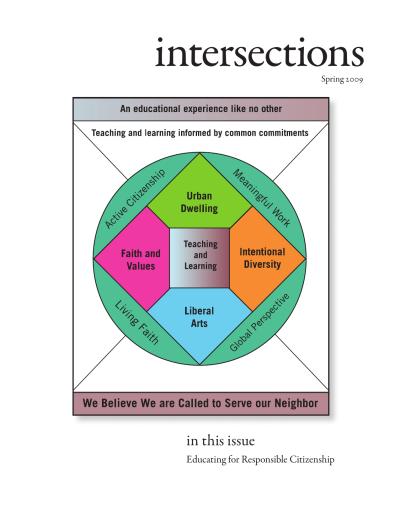 Editorial
From the Editor
Robert D. Haak
No. 29 · Spring 2009
Haak frames the issue’s essays around the question of Lutheran colleges and the role of citizen, noting H. Richard Niebuhr’s typology in Christ and Culture and Luther’s own complex understanding of Christian and state, and offers a fitting farewell to Arne Selbyg with Mike Blair’s tribute song “A Fine Norwegian.”
-
 Article
Leadership in Lutheran Key at a Time of Pandemics
Deanna Thompson
No. 52 · Fall 2020
Thompson draws on Luther’s theology of the cross and Shelly Rambo’s theology of trauma to sketch a Lutheran model of leadership for a season of pandemics — one that is attentive to pain, responsive to need, and intentionally nourished by food, friends, and deep conversation.
-
 Book Review
Old and New Ideas of the Liberal Arts: A Review of Claiming Our Callings
David Crowe, Katie Hanson
No. 41 · Spring 2015
Crowe and Hanson review Claiming Our Callings: Toward a New Understanding of Vocation in the Liberal Arts (Oxford 2014), a collection of thirteen essays by St. Olaf faculty edited by Kaethe Schwehn and L. DeAne Lagerquist. They commend the book’s thoughtful, sincere engagement with consumerism, sustainability, Buddhist meditation, and Lutheran-Bonhoefferian theology — and recommend it for any liberal arts campus pulled between idealistic mission and career-minded pressure.
-
 Article
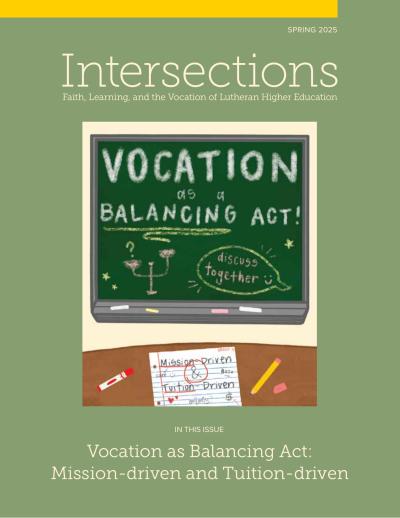
Vocation at Full Stretch: Reflections on Follow Your Bliss and Other Lies about Calling and its Use among College Students
Jason A. Mahn
No. 61 · Spring 2025
43 min audio
Mahn engages Bonnie Miller-McLemore’s Follow Your Bliss and Other Lies about Calling as required reading in a sophomore religion course, showing how her categories of missed, blocked, conflicted, fractured, unexpected, and relinquished callings empower young adults to perceive embodied, unplanned, and often painful dimensions of life as essential parts of vocation — and help close the gap between mission-driven and tuition-driven realities.
-
Article
Women in Leadership: Obstacles, Opportunities, and Entry Points
Susan Hasseler
No. 41 · Spring 2015
Drawing on two focus-group conversations with female faculty and academic administrators at Augustana College (Sioux Falls), Hasseler traces four obstacle/opportunity themes for women in academic leadership — valuing the intellectual work of leadership, religious and cultural interpretations of gender roles, caregiving realities, and embracing a strong voice — and proposes deliberate next steps for cultivating inclusive excellence on ELCA campuses.