Lutherans are “a decent, humble people,” says Garrison Keillor, the Lutheran church’s best known apologete. And they may have much to be humble about. In the USA, Lutherans are in the middle of the middle class, with lower average incomes than Presbyterians, Episcopalians, and members of the United Church of Christ, higher average incomes than Baptists, Pentecostals, and members of holiness churches. Only 12% of Lutherans are college graduates (compared with 34% for Episcopalians), but they have a high respect for college education.1 My assignment is to describe the Lutheran theological tradition for college faculty members at colleges related to the Evangelical Lutheran Church in America.
I propose to carry out my assignment by addressing what I believe to be the most important theological commitments of the Lutheran tradition. It is impossible to tell the complex story of the Lutheran theological tradition in the course of one lecture.2 What might help to make the task manageable is Alasdair MacIntyre’s description of a tradition.
When an institution - a university, say, or farm, or hospital - is the bearer of a tradition of practice or practices, its common life will be partly, but in centrally important way, constituted by a continuous argument as to what a university is and ought to be or what good farming is or what good medicine is. Traditions, when vital, embody continuities of conflict. . . . A living tradition then is an historically extended, socially embodied argument, and an argument, precisely in part about the goods which constitute that tradition.3
I want to identify five themes4 which I believe are central to the Lutheran theological tradition. These themes embody the “continuity of conflict” which MacIntyre says constitutes a tradition. I cannot trace each of them throughout Lutheran history. But I can indicate their roots in the 16th century and something of the case that can be made for them today.
These are themes about which Lutherans argue, for if Lutheranism is a living tradition, it is “an historically extended, socially embodied argument.” But more than that, these themes identify the Lutheran voice in that argument which is the larger Christian tradition. Extending this point even farther, these themes are the way Lutherans are involved in the argument about what it means to be human. The colleges and universities related to the ELCA are special places where all these arguments are - or ought to be - vigorously taking place.
I. The Lutheran Tradition is Biblical
Martin Luther (1463-1546) was a monumental figure in Western history, larger than life in his own life-time. He is of great importance to the Lutheran tradition, but he is not the founder of a religious institution in the sense in which, for example, Mary Baker Eddy is the founder of the Church of Christ, Scientist. He died excommunicated,5 before there was a “Lutheran Church.” If there is a “founding date” for the Lutheran Church it would be the Religious Peace of Augsburg of 1555.6 The text of this agreement for the nearly 250 political entities which made up the German “Holy Roman Empire” also indicates that the Augsburg Confession, not the theology of Martin Luther, is normative for the Lutheran Church.
A living tradition then is an historically extended, socially embodied argument, and an argument, precisely in part about the goods which constitute that tradition.
Nevertheless it is instructive to look briefly at the origins of the reform movement which eventually became the Lutheran Church. In 1515-16, the financial needs of the papacy, the imminent election of a new emperor, and the political ambitions of the Elector of Brandenburg combined in a rather sordid scheme.7 Albrecht of Brandenburg, newly appointed Archbishop of Mainz, used the sale of indulgences to finance his purchase of a papal dispensation so that, contrary to canon law, he could occupy three bishoprics. His primary salesman was an unscrupulous Dominican monk, Johann Tetzel.
Tetzel was not allowed to peddle his wares in Electoral Saxony, but he came close enough to Wittenberg, where Luther was professor of Bible at the recently founded university, so that parishioners from St. Mary’s, Wittenberg, where Luther was also one of the preachers and confessors, returned with indulgence documents which, they thought, gave them forgiveness for future as well as past sins. Luther denounced this outrageous distortion of the church’s traditional teaching on indulgence in an eloquent sermon early in 1517. Seven months later, on October 31, he posted 95 Latin theses for debate in the academic community on the true teaching about repentance, confession, and forgiveness.
The 95 Theses are not a declaration of independence. Luther proposed debate on them “out of love and zeal for the truth and the desire to bring it to light.”8 Luther was a complex person, and we know more about his thoughts than we do about any other pre-modern historical figure.9 But his concern for “the truth” about Christian teaching, worship, and life is a constant throughout his long and stormy career.
It was this concern for “the truth” which led him to challenge many developments in medieval doctrine and piety, especially if these developments seemed to be in conflict with what Luther believed to be the apostolic gospel. It was not long before Luther, in a 1519 debate with Johann Eck, one of his most severe critics, found himself asserting the primacy of the Bible over against the teaching authority of popes and councils.
Luther did not claim, as did some of his reforming contemporaries, that only what is Biblical can be regarded as Christian. He had a healthy regard and appreciation for many developments in Christian history, for the creeds and dogmatic formulations of the ancient church, for music, hymnody, and liturgy, for the memory and example of the saints, for the sacramental power of the Eucharist, Baptism, Confession, and Ordination, for the visual arts and iconography of the church.
But he did claim that these developments could not be uncritically accepted on the basis of the teaching authority of the popes and the councils. Only those developments which were not opposed to the gospel could be accepted. By the middle of the next decade serious reforms were introduced in the churches of various German principalities and cities, reforms which soon spread to other parts of Europe, largely because of Wittenberg University.
Mass was celebrated in the vernacular language. The chalice was restored to the laity at communion. The prayers which made the Mass an offering to God instead of a gift from God were eliminated. Priests were allowed to marry. Monasteries and convents as places of cultivating superior virtues designed to placate God’s wrath were dissolved and the monks and nuns were released from their vows. Legends about many saints and relics were subjected to critical scrutiny, and the piety which sought saving help from them was rejected. The practice of confession and penance was reformed. All of this was done in the name of the authority of the Bible versus the teaching authority of certain institutions in the church.
By the end of the century and the beginning of what came to be known as the “Age of Orthodoxy” (I prefer the term “Scholasticism” to “Orthodoxy”), the authority of the Bible came to be regarded as foundational and essential to the intellectual defense of Protestantism. It was supported by the (non-Biblical) doctrine of the Bible’s direct inspiration by God the Holy Spirit. Its divine origin was contrasted with all other sources of knowledge and information, which were said to be of human origin. Because the Bible was regarded to be of divine origin, its literal statements were held to be infallible, inerrant, on all matters about which it spoke. “No error, even in unimportant matters, no defect of memory, not to say untruth, can have any place in all the Holy Scriptures.”10
The idea that Holy Scripture was inspired and inerrant was common ground for Lutherans, Roman Catholics, Calvinists, and Anabaptists. They argued over interpretation. All regarded the theological interpreters of Holy Scripture as having primacy on university faculties. Theology was “Queen of the Sciences,” remembering that scientia is simply the Latin term for knowledge. But the claim that the Bible was inerrant in matters of history, geography, the natural sciences, languages, and indeed any area of learning was a claim waiting to be challenged. Making the claim led to the dissolution of the age of scholasticism and its replacement by the Enlightenment at the beginning of the 18th century.
Can the Lutheran tradition still carry on an argument about authority, especially the authority of the Bible?
But “replacement” is too mild a term. The scholastic doctrine of the Bible was used by the theologians to mount fierce opposition to any new discoveries and learnings which seemed to disagree with Biblical information. The consequence was that almost all of the new disciplines in the natural sciences, the social sciences, and the humanities came into existence not in conversation with theology but in the militant determination to be liberated from the hegemony and obscurantism of theology. The universities founded after the Enlightenment often no longer had theological faculties. The Lutheran and Christian argument was no longer part of the human argument. Church related colleges and universities in the USA came to be suspect in their learning if there was too much conversation with theology or in their theology if there was too much conversation with learning.
Theology was discredited in terms of having anything to do with truth. This situation was exacerbated by the terrible religious wars of the 17th century. The “denomination” was born when in a society like the United States persons stopped murdering each other in the name of religion. Denominations came to recognize the more or less Christian character of each other. Religion became a matter of choice, preference, taste, rather than a matter of truth. Deconstructionism was the coup d’grace. Claims were to be evaluated in terms of perspective, not in terms of truth.
Can the Lutheran tradition still carry on an argument about authority, especially the authority of the Bible? The very question evokes for academics visions of religious inquisitors, of censorship rather than academic freedom, of monologue rather than conversation.
But the Lutheran tradition has within it resources for acknowledging a non-oppressive authority for the Bible. The Lutheran tradition asks the question about the authority of the Bible in terms of the Christian gospel. The relationship between Bible and gospel can be formulated as follows: Only the gospel gives the Bible its authentic authority, and only the Bible gives the church normative access to the gospel. The church’s gospel is that Jesus of Nazareth is the Christ, the Messiah. He is disclosed to be such by his resurrection from the dead. Our access to this event in history comes through the documents which make up the prophetic and apostolic Scriptures, the Bible. These documents are the norm or standard by which the truthfulness, the authenticity, of the church’s proclamation of the gospel is judged. The church’s truthful or authentic proclamation of the gospel in turn gives authority to the church’s Bible.
The argument about the authority of the Bible is currently evident in the debate on matters of sexuality, especially the question as to the church’s position on the sexual expression of homosexuality. Many, perhaps most, Lutherans think that the authority of the Bible is being undermined or rejected if the ELCA ordains sexually active homosexuals or blesses the committed relationships of homosexuals. Other Lutherans argue that the ELCA must eliminate or change its condemnation of homosexual sexual expression because of the gospel. There is no resolution of this debate on the horizon. So the argument appropriately is the larger Christian tradition.
II. The Lutheran Tradition is Catholic
The term “catholic” is here intended to refer to two things: (1) the Lutheran tradition’s commitment to the continuity of the faith; and (2) the Lutheran tradition’s commitment to the creeds of the ancient church as the content of the faith. The Lutheran tradition recognizes that we have received the faith from our Christian ancestors, that we confess the faith with and to our contemporaries, and that we have the responsibility to transmit the faith to our children. Just this continuity cannot be taken for granted in Protestant and pluralist America. No one who knows the history of Protestantism in America can doubt the fact that it has often been actively hostile to the catholicity of the church. The challenge to the Lutheran tradition in a context where it is a minority is whether and how it preserves its commitment to catholic continuity.
The Book of Concord of 1580 contains the content of the catholic faith: the confessional documents to which the clergy, congregations, synods, and the ELCA are pledged by constitution and ordination. These are the Augsburg Confession of 1530, the Apology (or defense) of the Augsburg Confession of 1531, the Smalcald Articles and the Treatise on the Power and Primacy of the Pope of 1537, Martin Luther’s Large and Small Catechisms of 1529, and the Formula of Concord of 1577. The conclusion of the doctrinal section of the Augsburg Confession states:
This is about the sum of our teaching. As can be seen, there is nothing here that departs from the Scriptures or the catholic church or the church of Rome, in so far as the ancient church is known to us from its writers. Since this is so, those who insist that our teachers are to be regarded as heretics judge too harshly.11
In point of fact, the opponents of the reform movement contested only a few of the doctrinal articles of the Augsburg Confession, and the Lutheran-Roman Catholic dialogues of the past 30 years are demonstrating that even these few differences can eventually be reconciled.
Preceding these documents which grew out of the reform movement of the 16th century are the three ancient creeds, the Apostles’ Creed, the Nicene Creed, and the Athanasian Creed. There has been no great argument about the creeds in the Lutheran tradition. There are, however, some very important Lutheran “twists” to the essential content of these creeds, that is, to the confession that Jesus is God and that God is the Holy Trinity, Father, Son, and Holy Spirit. These Lutheran “twists” surfaced in the creative theological ferment of the 16th century, and they have resurfaced in the last fifty years of this century.
The medieval Christianity out of which the Lutheran reform movement emerged inherited an approach to the doctrine of God which can be traced back to Plato and Aristotle in Greek philosophy/theology and which received powerful expression in the writings of St. Anselm of Canterbury (1033-1109) and St. Thomas Aquinas (1225-1274). This approach held that God is a being distinguishable from the universe, and that God’s existence can be rationally demonstrated or proven.
Two proofs or arguments were advanced, the ontological (Plato/Anselm) and the cosmological (Aristotle/Aquinas). The ontological argument held that if God is the greatest thing that one can think, God must necessarily exist, for anything that exists is greater than anything that does not exist. The cosmological argument held that a creaturely phenomenon like effect and cause, when traced back to its ultimate source, must result in acknowledging the existence of a First Cause, that is, God.
The critical philosophy of Immanuel Kant (1724-1804) ushered in modern secularity by demonstrating that these arguments cannot prove or demonstrate the existence of God. The existence of God cannot be regarded as knowledge, scientia, but is simply opinion. Secularity does not mean the end of religion or the end of belief in God’s existence. It simply means that religion and the belief in the existence of God become options. Some persons are religious, some are not. Some believe in God’s existence, others do not. What is more, the notion of true or false gods is irrelevant. Since the existence of God or gods is a matter of opinion, one opinion is as valid as another, as long as no one is threatened by the opinion. Edward Gibbon’s description of the late antique world fits the modern world: The people thought all gods equally true; the philosophers thought them equally false; and the politicians thought them equally useful.
Martin Luther provided the Lutheran tradition with an “end run” around the critique of Immanuel Kant by reformulating the question of God, and by doing so in ancient Jewish rather than ancient Greek terms. Luther does this in his commentary on the First Commandment, “You shall have no other gods,” in the Large Catechism. There he writes:
What is it to have a god? What is God? Answer: a god is that to which we look for all good and in which we find refuge in every time of need. To have a god is nothing else than to trust and believe him with our whole heart. . . That to which your heart clings and entrusts itself is, I say, really your God.
Luther here defines “god” as whatever drives us, animates us, functions as the center or focus of our existence. Since every human has such a focus, all are “religious.” The question now arises as to whether our center or focus is authentic or inauthentic, that is, whether our “god” is true or false!
Lutheran scholasticism did not exploit this move of Luther, and because it returned to the medieval theological strategies of Anselm and Aquinas it fell victim to Kant’s critique. In the 20th century, however, Paul Tillich reintroduced the insight of Luther in his path-breaking book, The Dynamics of Faith. A “god” is an ultimate concern. “Faith” means having an ultimate concern. To regard something as ultimate which is not, in fact, ultimate (such as one’s nation or race or family) is to have a false ultimate. Having a false ultimate is both idolatrous and destructive.
The gospel starts with Jesus and thinks of God in terms of Jesus. Luther called this Christology “from below.”
Note once again the character of these insights of Luther, and ultimately Judaism, as revived by Tillich. The very meaning of the term “god” has to do, first of all, with whoever or whatever one regards as ultimate, final. When the validity of these insights are acknowledged it is possible to raise appropriately the question as to whether someone or something which is being regarded as ultimate is authentically or inauthentically ultimate, that is, whether one has a true or false “god.” False “gods” have been evident in the destructive dynamics of uncritical patriotism, nationalism, racism, and sexism. These insights have influenced the thinking of culture critics as diverse as Theodore Roszak, The Making of a Counter Culture; Neil Postman, Technopoly, and Ernest Becker, The Denial of Death. Great plays like Arthur Miller’s Death of a Salesman and Lillian Hellman’s The Little Foxes, and movies like The Pawnbroker disclose the destructive power of false “gods.”12
These insights do not prove or demonstrate that there is a true “god.” But they do help us to understand what Christian tradition means when it claims that Jesus is to be confessed as “God.” Luther’s insight into the meaning of “god” has had a profound effect on the way in which 20th century Lutheran theologians have understood the ancient church’s confession that Jesus of Nazareth is an incarnate person of the Holy Trinity, “God from God, Light from Light, true God from true God,” as formulated by the Nicene Creed. The ancient church had formulated its confession in terms of the Hellenistic meaning of “God.” “God” in Hellenistic terms meant a being totally outside of the physical universe whose primary characteristics were infinity and immortality.13 How then to think of Jesus, who was both finite and mortal?
In order to make Christianity intelligible to the Greco-Roman culture, theologians and apologetes thought they needed to use the Hellenistic term “Logos” (Word) as the primary title of Jesus instead of the Jewish “Christ” (Messiah). They concluded that the Logos was the Second Person of the Holy Trinity, infinite and immortal. Attention shifted from Jesus’ resurrection to the incarnation of the Logos. Logic compelled them to confess that the infinite Logos became a finite human being, that Jesus is in some sense God. But to confess that Jesus is God was to affirm ontological nonsense: the finite is infinite; the mortal is immortal. In making such a confession the ancient dogma lost its connection with the gospel and became instead an item of Christian ideology.
Martin Luther insisted that the creeds and dogmas of the ancient church have to do always and only with the gospel. But the gospel does not apply prior understandings of God to Jesus. The gospel starts with Jesus and thinks of God in terms of Jesus. Luther called this Christology “from below,” that is, thinking about Jesus as the Christ historically rather than philosophically. Contemporary theologians Werner Elert, Wolfhart Pannenberg, Jurgen Moltmann, Eberhard Jüngel, Gerhard Forde, and Robert Jenson have retrieved the ancient dogma about the divinity of Jesus in a way which is both Jewish and apostolic.14
We pay attention to Jesus at all because of his resurrection from the dead. The resurrection is intelligible only in terms of a Jewish understanding of God as moving history toward a final destiny: the full realization of the Messianic Age. In the resurrection of Jesus the outcome of history is disclosed. Jesus is revealed as Messiah, as final “judge.” He, not death, will have the last word. This is the gospel, the good news, proclaimed by Jesus’ disciples, by Christianity. Hence the earliest witnesses already give Jesus the highest titles, including the title “God” (e.g., Romans 9:5; Phil. 2:6).
But “God” does not mean a being outside of the universe, infinite and immortal. “God” means whoever has the last word, whoever is final, authentically ultimate, whoever can make unconditional promises, that is, promises not conditioned by death. The resurrection reveals the identity of that “whoever:” Jesus of Nazareth, the Christ, the Messiah! This is the meaning and power of the confession that Jesus is God.
If Jesus is revealed to be God in the resurrection, then the history of Jesus can also be said to be the history of God. Christian theology therefore should not make a priori statements about God, for example, that God is immortal, cannot die. Rather Christian theology should look at what happened in the history of Jesus and make statements about God on the basis of that history. Luther delighted in making such statements. God suckles at Mary’s breasts. God dirties his diapers. And ultimately, God dies on the cross. An early 17th century Lutheran Good Friday hymn says: “O sorrow dread! God himself is dead! On the cross he has died.”15
Because Jesus determines what Christian theology can say about God, the suffering and death of Jesus on the cross supplies the basis and content for the Christian doctrine of the Holy Trinity. Greek theology developed the doctrine of the Holy Trinity on a speculative basis, namely the relationship of the Logos to the Father in eternity prior to and apart from the incarnation. Augustine, in the West, made the doctrine of the Trinity irrelevant to Christian life because he taught that the distinction of the persons is appropriate only to describe the inner life of the Trinity itself. The activity of God in relation to the world is “indivisible,” without distinctions.16
If Christian theology begins with the cross, however, then the doctrine of the Trinity is the way the church must confess God on the basis of the cross. In the cross suffering and death are taken into the being of God, and there they are overcome so that they do not have the last word. The cross and resurrection of Jesus are the basis for the church’s proclamation of God as suffering and victorious love. The Trinity means that we are not abandoned in and to our suffering and death, that nothing can ever separate us from God’s love (Romans 8:28-39).
When justification by faith becomes one in a list of doctrines to be believed, it has lost its power.
This also affects our understanding of the language used in the Trinitarian confession. The meaning of “Father” does not derive from our experience or expression of fatherhood. It derives from the cross. “Father” means the self-offered vulnerability and participation of the Creator of Life in the suffering and death of the creature. The “Father” of Jesus, the Eternal Son, is about self-offering and vulnerability, not about patriarchy and oppression.
III. The Lutheran Tradition is Evangelical
The evangelical dimension of Lutheranism has its focus in the confession that justification is by faith. Martin Luther’s personal struggles as a monk involved the question of how he could be certain of God’s grace. The medieval arrangements of confession and penance, monastic discipline and pious works simply were of no help to his troubled conscience. Sometime, probably in 1513, while giving his first lectures on the Psalms in his new professorship at the University of Wittenberg, Luther made the astonishing discovery that God’s grace is total and unconditional in Christ, that grace alone, and not works, is to be trusted in life and in death.
This all often seems irrelevant to modern persons. Paul Tillich observed (in The Courage to Be) that modern persons are concerned about the meaning of life, not the graciousness of God. When justification by faith becomes one in a list of doctrines to be believed, it has lost its power. It is evident that justification by faith has been seriously misunderstood when it is viewed as easy rather than rigorous discipleship (Yoder), as cheap rather than costly grace (Bonhoeffer).
Robert Jenson and Gerhard Forde have placed justification by faith into a context that is both true to its origins in the life of Luther and capable of perjuring power.17 18 Luther’s encounter with mortality both raised the ultimate question and drove him into the monastic life.19 Mortality confronts us with the most radical question: What justifies my existence? Whatever we are able to do in this life to answer or evade that question, our lives have consequences which we are often not able to control in this life, and which we have no ability to control once we are dead. Only one who is beyond death is able to justify the existence of those who have death before them.
All justification of existence is by faith. The only appropriate question is, by faith in what? The Christian proclamation is that Jesus, the crucified one, lives. Death no longer has dominion over him (Rom. 6:9). He alone can make the unconditional promise that death does not have the last word, that your life and every life is justified. Life is to be lived in trust of that promise. Justification by faith in Jesus means that, if death does not have the last word, then there is more to do with my life than to preserve and protect it. I am free to offer my life.
IV. The Lutheran Tradition is Sacramental
The sacramentality of the Lutheran tradition means that when the Word of God is proclaimed, when the Holy Eucharist is celebrated, when Holy Baptism is administered, God is doing something in and through the human action of saying words, eating bread and drinking wine, washing someone with water. At this point the Lutheran tradition is unmistakably catholic, that is, it is offensive to every tradition which is non- or anti-sacramental.
When Samuel S. Schmucker (1799-1873), president and professor of Gettysburg Theological Seminary, proposed in 1855 an American version of the Augsburg Confession intended to make Lutheranism more acceptable to Protestant America, he sought to revise or eliminate precisely the sacramental articles of the confession. His proposal was rejected.20 But the sacramental dimension of the Lutheran tradition continues to be threatened by the American revivalist tradition and its contemporary expression in the Church Growth Movement.21
How are we to understand that God is doing something in the Word, the Eucharist, and Baptism? Only a brief response is possible. When the gospel is proclaimed, that Jesus the crucified one is risen, that Jesus is the Messiah, that the messianic age has come, a new reality occurs. Those who receive the proclamation in faith are set free from the illusion of the denial of death, free from the desperation of despair. God creates an authentic vision for the future.
On the basis of his promise and the church’s prayer Jesus, the Christ, comes to be present as the crucified and risen one in, with, and under the bread and wine of the Eucharist. He does not come from the past, evoked as a memory. He does not come from outside the physical world, wherever that might be, if at all. He comes from the future. He has not ascended to a different place in space, but to a different place in time. He has ascended to the final future of the consummated Reign of God. We are still at that point in time where the Reign of God has already begun but is not yet consummated. Hence Jesus is present as the power of the future. It is Jesus, embodied in history who comes as the self-offering one (his crucified body and shed blood) so that the community, shaped by the power of his offering, has the power to offer itself.
We are to regard the world as good, as gift. It is gift and good in its finitude.
Holy Baptism into the Triune Name is initiation into the Triune life of God. The power of death is displaced by the Lordship of Jesus. We are set by the Triune God into the struggle between the power of death and Reign of God, a struggle which takes place within ourselves and as well as within the world. In Baptism we are grasped by the God who will not give up on us and who will not let us go.
V. The Lutheran Tradition is World-Affirming
The sacramental dimension of the Lutheran tradition leads directly to the Christian affirmation of the world. The Christian doctrine of creation is the way we are free to look upon the world, to regard the world, if indeed the gospel is true. We are to regard the world as good, as gift. It is gift and good in its finitude. God alone is God. The world is not infinite, ultimate. Therefore it cannot be the source of ultimate terror nor the object of ultimate value. It is to be received, enjoyed, served as God’s gift.
If the creation of the world is a vision of the world, that vision involves not only how the world is to be received but also how the world is to be treated. Humanity is called to stewardship of creation, a calling never more urgently necessary than in the face of the growing ecological challenge which confronts humanity. Christian prayer, according to Martin Luther’s explanations in his Small Catechism, means asking how we hallow God’s Name, serve God’s Reign, do God’s will, etc. This is expressed in the offertory prayer of the Lutheran Book of Worship.
Blessed are you, O Lord our God, maker of all things. Through your goodness you have blessed us with these gifts. With them we offer ourselves to your service and dedicate our lives to the care and redemption of all that you have made, for the sake of him who gave himself for us.
Herb Brokering said this in a similar, but inimitable way.
Once there was a church where the people took the offering back home with them. First it was collected and brought to the altar. After they asked God to bless it, they took it and put it back into their pockets. They mixed it up with all their other money, so that they couldn’t tell which was blessed and which was not. Then they left. All week they spent as though each piece was blessed and was to be used lovingly.
There are many themes in the Lutheran tradition which give expression to its world affirmation. The place given to marriage by the Lutheran reform movement meant that celibacy was not to be regarded as holier, more pleasing to God. The concept of vocation meant that being parent or spouse, farmer or merchant, teacher or laborer was doing God’s work as surely as if one became a clergy person.22 With this vision and these themes comes an accountability before God to engage in authentic stewardship, authentic affirmation of the world.23 Lutherans have not always trained themselves or wanted to be accountable. Often it is difficult to discern what responsible and accountable stewardship involves.
Just these factors makes Lutheran world affirmation an argument. Those who teach and learn are called to participate in this argument. If the church-related college or university is not only an instance of the church teaching, but also an instance of the church learning, then you are called to be learning for us so that we can be learning with you what is the will and work of God in the world today.
Endnotes
- Wade Clark Roof and William McKinney, American Mainline Religion (New Brunswick: Rutgers University Press, 1987), pages 110-113.
- The best introduction is Eric W. Gritsch, Fortress Introduction to Lutheranism (Minneapolis: Fortress Press, 1994).
- Alasdair MacIntyre, After Virtue (Notre Dame: University of Notre Dame Press, 1981), pages 206-207.
- In Carl Braaten, Principles of Lutheran Theology (Philadelphia: Fortress Press, 1983), there are seven themes. My selection does not coincide with these; but I deal with most of the thematic material which Braaten identifies.
- This is a matter of very little significance for present relationships between Lutherans and Roman Catholics. I mention it here only to indicate his ecclesial status at his death.
- Henry Bettenson, Documents of the Christian Church (London: Oxford University Press, 1963), pages 301-302. The text states in part: “Let neither his Imperial Majesty nor the Electors, Princes, etc., do any violence or harm to any estate of the Empire on account of the Augsburg Confession ... Likewise the Estates espousing the Augsburg Confession shall let all the Estates and Princes who cling to the old religion live in absolute peace and in the enjoyment of all the estates, rights privileges.”
- Barbara Tuchman, The March of Folly (New York: Alfred A. Knopf, 1984), pages 52-126, describes the Renaissance popes, and especially the pontificate of Leo X from 1513-1521.
- Luther’s Works, American Edition, Vol. 31, page 25.
- From among the many books about Martin Luther, three seem especially helpful. Eric Gritsch, Martin - God’s Court Jester (Philadelphia: Fortress Press, 1983), is an excellent combination of biography and theology. Peter Manns, Martin Luther (New York: Crossroad, 1983), is a sympathetic biography written by a great German Roman Catholic scholar. Gerhard Forde, Where God Meets Man (Minneapolis: Augsburg Publishing House, 1972) is an excellent introduction to Luther’s theology for nonspecialists.
- Abraham Calovius (1612-1686), Systema Locorum Theologicorum, Vol. I (1655), page 551. Quoted in Heinrich Schmid, Doctrinal Theology of the Evangelical Lutheran Church (Minneapolis: Augsburg Publishing House, 1961), page 49.
- The Book of Concord, edited by Theodore G. Tappert (Philadelphia: Muhlenberg Press, 1959), page 47, par. 1. Future citations from The Book of Concord will be identified in the text by page and paragraph number.
- Ernest Becker, in Angel in Armor (New York: Free Press, 1969), pages 73-98, has a brilliant analysis of The Pawnbroker, in which he does not make explicit reference to Tillich or Luther but whose influence he acknowledges elsewhere.
- Robert Jenson, “The Triune God,” Christian Dogmatics, Vol. I, edited by Carl Braaten and Robert Jenson (Philadelphia: Fortress Press, 1984), pages 115-118, gives an excellent account of why and how hellenism’s tragic view of life and history resulted in the attempt to protect “god” from the ravages of time and matter.
- See especially Wolfhart Pannenberg, Jesus - God and Man, Gerhard Forde, Where God Meets Man, Eberhard Jungel, God - The Mystery of the World, Jurgen Moltmann, The Way of Jesus Christ, and Robert Jenson, Story and Promise.
- The German text reads: “O grosse Not! Gott selbst ist tot, Am Kreuz ist er gestorben.” The English translation somewhat weakens the dramatic German text: “O sorrow dread! God’s Son is dead!” Then it continues with a theological reason for the death and has no translation at all for the third line. W. G. Polack, The Handbook to the Lutheran Hymnal (St. Louis: Concordia Publishing House, 1942), page 131.
- Catherine LaCugna, God For Us: The Trinity and the Christian Life (San Francisco: Harper, 1991). Ted Peters, God as Trinity (Louisville: Westminster/John Knox, 1993), pages 122-128, has an excellent summary of LaCugna’s book. See also Walter R. Bouman, “The Trinity in the Experience of the Christian Life,” Trinity Seminary Review, Vol. 15, No. 2 (Fall 1993), pages 57-68.
- Eric Gritsch and Robert Jenson, Lutheranism: The Theological Movement and Its Confessional Writings (Philadelphia: Fortress Press, 1974), pages 36-44.
- Gerhard Forde, Justification by Faith: A Matter of Death and Life (Philadelphia: Fortress Press, 1982).
- Gritsch, Martin - God’s Court Jester, page 6.
- Gritsch, Fortress Introduction to Lutheranism, pages 58-62.
- Walter R. Bouman, Like Wheat Arising Green: How the Church Grows and Thrives, Vol. 8 (Valparaiso: The Liturgical Institute, 1991).
- Gustaf Wingren, Luther on Vocation (Philadelphia: Muhlenberg Press, 1957). Cf., Robert Benne, Ordinary Saints (Minneapolis: Fortress Press, 1988), and Carter Lindberg, Beyond Charity (Minneapolis: Fortress Press, 1988), and Carter Lindberg, Beyond Charity (Minneapolis: Fortress Press, 1993). Adaptation of the Lutheran understanding of vocation to a current issue is evident in Marc Kolden, “Christian Vocation in Light of Feminist Critiques,” Lutheran Quarterly, Vol. X, No. 1 (Spring, 1996), pages 71-85.
- Douglas John Hall, The Stewardship of Life in the Kingdom of Death (New York: Friendship Press, 1985).
-
 Editorial
From the Publisher
James M. Unglaube
Unglaube reports on the second annual Vocation of a Lutheran College conference of August 1996, where Walter Bouman of Trinity Lutheran Seminary addressed “What is Lutheran; What is the Lutheran Tradition” (biblical, catholic, evangelical, sacramental, world-affirming—the world “received, enjoyed, served as God’s Gift”). He previews presentations by Wendy McCredie of Texas Lutheran and Baird Tipson of Wittenberg on how the Lutheran tradition is embodied in its colleges, and Bob Vogel’s challenge in “Coherence—And Now what?” that the tradition comes to life in how faculty give expression to their beliefs and values in the classroom and with colleagues.
-
Editorial
From the Editor
Tom Christenson
Christenson opens with an invitation for reader submissions to balance the conference-paper format of the first two issues, then asks how college and universities can turn students positively toward learning. Drawing on Aristotle’s claim that study is loved for its own sake (which students greet with disbelieving laughter) and Neil Postman’s The End of Education, he argues that students lack narratives within which learning makes sense and proposes four Lutheran mega-narratives—stewardship of creation, the freedom of the Christian, the sacramental presence of the transcendent in the concrete and ordinary, and vocation—that could inspire learning at the 28 ELCA colleges and universities.
-
Response
“My Wife, We Have Not Come to the End of All Our Trials, but a Measureless Labor Yet”: The Lutheran Argument in Colleges
Steven Paulson
Paulson of Concordia College responds to Bouman by invoking Penelope’s unreasonable patience for Odysseus and asking whether Bouman’s five “principles” deliver the “continuities of conflict” that MacIntyre’s account of a living tradition demands. He argues that the proper Lutheran “continuity of conflict” is the praxis of proclamation—Christ crucified as “a stumbling block to Jews and folly to Gentiles”—which is given outside the institution’s walls and which colleges and universities, as socially embodied arguments, “can’t like” because it places truth beyond their control. The Lutheran problem, he concludes, is not the Enlightenment or Post-Modernism but the “old Adam,” the Odysseus still unsure of his identity.
-
Response
Disputatio Pro Quo? The Search for Lutheran Education
Jon-David Hague, Kimberly Hague
Kimberly and Jon-David Hague—both Luther College graduates completing graduate studies at Berkeley and Boston University respectively—respond to Bouman by offering Luther’s curriculum reform at Wittenberg University in the spring of 1518, only months after the 95 theses, as a model of the Lutheran voice in higher education. Inspired by humanistic principles, Luther introduced lectures on classical authors and the first instruction in Greek and Hebrew, giving students the tools to encounter scripture directly rather than receive dictated doctrine. The spirit of that reform—providing students with every possible tool while acknowledging that an instructor’s perspective is neither ultimate authority nor final word—remains useful for the search for Lutheran academia today.
-
Response
Feeling at Home: Dimensions of Faculty Life
Jane Hokanson Hawks
Hawks of Midland Lutheran College responds to Bouman by reflecting on her path from a Lutheran childhood through the BSN at St. Olaf and thirteen years at four non-church-related institutions to her present home at Midland, where teaching at a Lutheran institution finally feels “right.” Bouman’s framing of the five themes as the Lutheran argument about what it means to be human helped her ad-hoc committee articulate the spiritual role in Midland’s new faculty mentoring program (recently funded by the Lilly Foundation), and grounds her work as a nurse educator confronting the daily humanness of grief, joy, ethical dilemmas, and care across cultural and religious difference.
-
Response
“You Shall Know the Truth, and the Truth Will Set You Free”: A Scientist’s Response
Ben Huddle
Huddle of Roanoke College proposes adding a sixth theme to Bouman’s five—the scientific method—as a tool for knowing the Truth not available to Luther but central to twentieth- and twenty-first-century learning. Diagramming the continuous cycle of observations, laws, theories, and predictions, he argues that scientists must be ethical and that scholars in other fields must understand the scientific method (lest environmentalists ignore the Second Law of Thermodynamics). A Lutheran college, he concludes, should treasure both the religious and the scientific tradition: stifling either loses meaning or significance, and the Lutheran tradition is therefore biblical, catholic, evangelical, sacramental, scientific, and world-affirming.
-
Response
On the Outside Looking Out: A Personal and Social Psychological Response
Chuck Huff
Huff of St. Olaf—a self-described “Metho-Bap-terian” from the South educated at Bob Jones University—offers a personal response to Bouman’s themes (welcoming the rejection of biblical inerrancy, the distinction between gospel and scripture in the homosexuality debate, the gospel-in-the-creeds reading that releases him from Hellenistic conundrums, and the recasting of justification by faith as meaning rather than insurance policy) and a social-psychological response in which a planned study of campus social networks at St. Olaf was discontinued when preliminary interviews revealed that everyone—storied Lutherans, secular faculty, feminists, fundamentalists—felt like outsiders. Continuing the tradition requires constructing a conversation that is thoughtful, fair, inclusive, charitable, focussed, and still true to the tradition.
-
Poem
Two Poems: The Advent Carol / The Madonna of Dohany Street
Brian Forry Wallace
Two poems by Brian Forry Wallace of Capital University: “The Advent Carol,” a litany of the babies who were not adored—the Jewish baby shot with a Luger, the Black child hanged from a tree, the female messiah tossed into a river, the Tutsi infant cut by machetes, the Japanese newborn incinerated by atom bombs, the Chinese baby crushed by Japanese bombs, the aborted Mary’s child—ending with the baby “whom we do not understand, cannot feed, whom we kill”; and “The Madonna of Dohany Street,” on a Holocaust photograph in a Budapest museum of a dead mother and her dead Christ-child daughter in the former ghetto, in which annunciation, nativity, adoration, and crucifixion are seen together in a single instant.
-
Institutional Focus
Embodying the Tradition: The Case of Wittenberg University
Baird Tipson
Tipson, President of Wittenberg University, locates Wittenberg in the “American” strain of Ohio Lutheranism founded in 1845 under Ezra Keller (a Pennsylvania College and Gettysburg Seminary graduate and disciple of Samuel Simon Schmucker), with English-language preaching, financial support from the pan-Protestant New England Society, Presbyterians on the Board, and an Episcopalian teaching Latin. He names two ongoing challenges—remaining authentically Lutheran while welcoming a pluralistic student body (just under a quarter are Lutheran in a primary service area that is 5% Lutheran), and making the tradition clear and compelling to non-Lutheran or lukewarm Lutheran students—and presents the five things every Wittenberg graduate should be able to do (respond to the human condition; recognize, define, and solve problems; develop a sense of vocation; assume servant-leadership; take moral responsibility) as authentic expressions of the Gospel and of the university’s ELCA relationship.
-
 Article
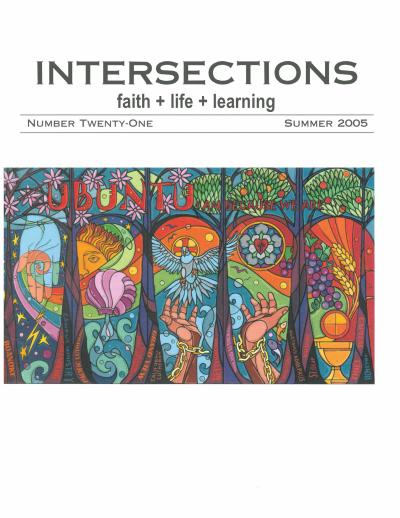
Money, Sex and Power: An Exploration of Some Controversial Issues in the Public Witness of the Church
Pamela K. Brubaker
No. 21 · Summer 2005
Brubaker explores two controversial issues in the church’s public witness—homosexuality and economic life—and the challenges they present for both church and college. Drawing on Beverly Harrison, Elizabeth Bounds, Ron Thiemann, Linell Cady, Marcia Bunge, Richard Hughes, Darrell Jodock, Ernest Simmons, Karen Bloomquist, Garth Kasimu Baker-Fletcher, and Larry Rasmussen, and on episodes at California Lutheran University around “Harmony Week” and Bishop Paul Egertson’s participation in Anita Hill’s ordination, she argues that colleges related to the ELCA are called to educate for “critical citizenship” by hosting rigorous, bold, and unfettered debate—including debate over the neo-liberal globalism that she names a form of economic fundamentalism.
-
 Article
Higher Education in the Age of Trump
Daniel B. Braaten
No. 45 · Spring 2017
Braaten surveys what the Trump administration has and has not done on higher education — from the selection of Betsy DeVos and a rumored Falwell-led task force to the travel ban and expanded deportation priorities — and argues that Lutheran colleges, guided by the ELCA’s social message on immigration, have a special obligation to consider what they will do to protect their most vulnerable students.
-
 Editorial
From the Editor
Tom Christenson
No. 3 · Summer 1997
Christenson explains that this issue breaks from the first two issues’ single-focus pattern to feature three principal papers on the environment, the education of desire, and hiring and personnel policies, plus two poems and a piece of reflective bemusement. He then commends George Marsden’s The Outrageous Idea of Christian Scholarship (Oxford, 1997) and challenges Lutheran scholars to articulate how the particulars of their faith inform their scholarship—in conversation with Calvinist work like Nicholas Wolterstorff’s Reason Within the Bounds of Religion and Art in Action—rather than remaining silently complicit in the view that faith has no place in the academy.
-
 Article
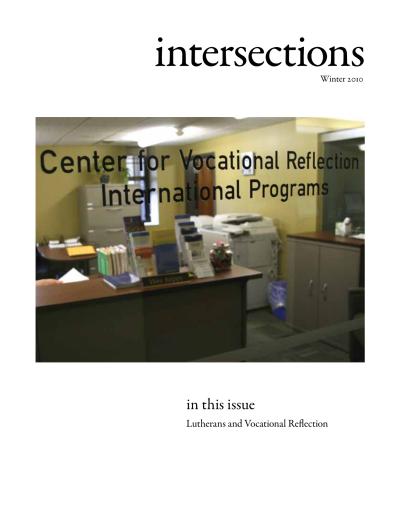
Called for Life — Affirming Vocational Discernment
Richard L. Torgerson
No. 31 · Winter 2010
Torgerson introduces the “Called for Life” project, a three-year, $278,437 Lilly Endowment-funded collaboration among Luther, Augsburg, and Augustana that—in partnership with Luther Seminary’s Centered Life initiative and Wilder Research—rigorously assessed the effectiveness of campus vocation programs, examining whether students’ exposure to and understanding of calling had increased, and what program elements were most effective in shaping discernment.
-
 Article
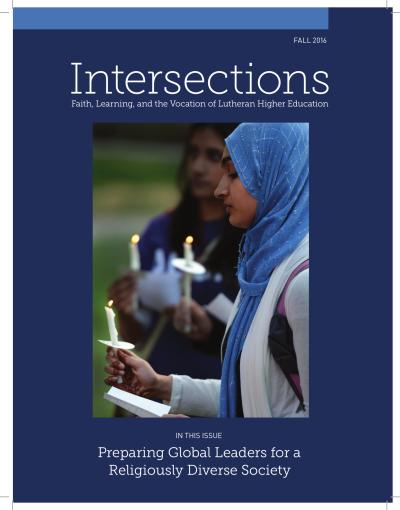
Risky Speech–Gifted Friendships
Sonja Hagander
No. 44 · Fall 2016
Augsburg College Pastor Sonja Hagander reflects on pastoral care across faith traditions — from a campus chapel service after the 2008 murder of Muslim student Achmednur Ali, to her decade-long friendship with Jewish colleague Barbara Lehmann — and reads the Gospel of John as a roadmap for interfaith friendships marked by love, free speech, public space, and a willingness to risk being changed.
-
Article
Resistance in the Age of Trump: An Interview with Ivonne Wallace Fuentes
Jason A. Mahn, M. Ivonne Wallace Fuentes
No. 45 · Spring 2017
In conversation with Jason Mahn, Roanoke College historian Ivonne Wallace Fuentes describes how she launched a local chapter of Indivisible after the 2016 election, how the skills of teaching and historical research carry over into grassroots advocacy, and how her sense of vocation (vocare) has become intertwined with the work of advocacy (advocare).