Arne Selbyg
Director for ELCA Colleges and Universities
Evangelical Lutheran Church in America
-
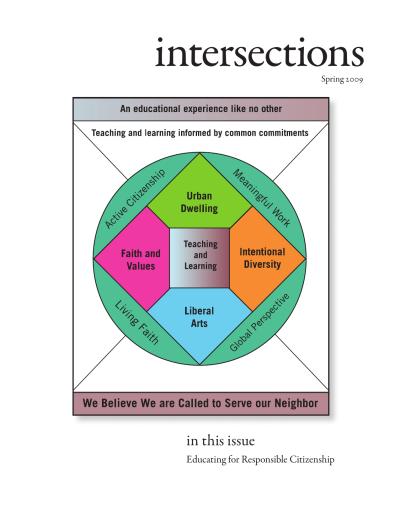 Article
From Alien to Citizen
Arne Selbyg
No. 29 · Spring 2009
Selbyg reflects on three experiences of being educated for citizenship—growing up in Norway under the legacy of Lutheran pastors and public school teachers who resisted the Nazi occupation, arriving in America as a resident alien, and becoming a naturalized American citizen—and proposes the jazz ensemble as a better metaphor for American society than the melting pot, one in which different citizens learn skills, study other instruments, and dialog with one another in service to the common music.
-
 Editorial
From the Publisher
Arne Selbyg
No. 27 · Spring 2008
Selbyg, retiring this summer as Director for ELCA Colleges and Universities, reflects on his decade serving as spokesperson between the church and its twenty-eight colleges and universities, and argues that the link between the colleges and the church has grown stronger over the last ten years — sustained by supportive church leaders like Presiding Bishop Mark Hanson, the annual Vocation of a Lutheran College conference, and a Lutheran theology of higher education whose principles (questioning authority, returning to the sources, including the excluded, serving the neighbor) remain a strong basis for operating colleges and universities in the twenty-first century.
-
 Editorial
From the Publisher
Arne Selbyg
No. 26 · Fall 2007
Selbyg notes that, while a stated purpose of Intersections over its twelve years and twenty-six issues has been the intersection of faith, learning, and teaching, surprisingly few articles have addressed how Lutheran faculty teach and why — and credits the editor for assembling essays from authors whose teaching has benefited from the ELCA Wittenberg Center, on the eve of the City of Wittenberg’s “Luther Decade” leading up to the 2017 Reformation anniversary.
-
 Editorial
From the Publisher
Arne Selbyg
No. 25 · Spring 2007
Selbyg notes that most papers in this issue grew out of a pan-Lutheran conference organized by the Association of Lutheran College Faculties in fall 2006 rather than the annual Vocation of a Lutheran College conference, and argues that the ELCA’s ecumenical posture—truthful but open to learning from others—is a good foundation for institutions of higher education whose faculty likewise profess while remaining subject to change based on new research and insights.
-
 Editorial
From the Publisher
Arne Selbyg
No. 24 · Fall 2006
Selbyg situates this issue in the ongoing ELCA conversation about education that began with the 2005 conference and is feeding into the second draft of the ELCA Social Statement on Education, previews the 2007 conference (“The Vocation of a Lutheran College — Engaging the World”) at Augustana College, Rock Island, and lifts up Luther’s insistence that the church and its members contribute to their wider communities rather than retreat into self-centered enclaves.
-
 Editorial
From the Publisher
Arne Selbyg
No. 23 · Summer 2006
Selbyg features articles based on presentations at the 2005 Vocation of a Lutheran College conference focused on the upcoming ELCA Social Statement on Education, and urges members of the ELCA higher-education community to download the first draft (“Our Calling in Education”) from the ELCA website and submit feedback to the Task Force on Education before the October 15 deadline. He worries that the sexuality social statement on a 2009 timeline will draw more attention than the education statement, but reminds readers that, for Martin Luther and for those who work in Lutheran higher education, education is as important as sex.
-
 Editorial
From the Publisher
Arne Selbyg
No. 22 · Spring 2006
Selbyg notes that both the ELCA and Intersections have undergone major changes this year—the Division for Higher Education and Schools is gone, replaced by the Educational Partnerships and Institutions group within the Vocation and Education unit, and the journal has a new editor (Robert Haak), a new home at Augustana College, a new printer, and a new design. He commends the issue’s focus on human sexuality and points readers to the first draft of Our Calling in Education.
-
 Editorial
From the Publisher
Arne Selbyg
No. 21 · Summer 2005
Selbyg notes that ELCA colleges and universities have remained more loyal to the church than the institutions of many other denominations and announces that with this issue Tom Christenson’s nine-year service as editor of Intersections comes to an end, with Bob Haak of Augustana College in Rock Island assuming the editorship and institutional support shifting from Capital to Augustana.
-
 Editorial
From the Publisher
Arne Selbyg
No. 20 · Fall 2004
Selbyg reports that during 2004 a task force appointed by the ELCA Division for Church in Society has been laying the groundwork for a Social Statement on Education, with a draft to be debated in congregations and educational forums in 2006 and considered for adoption at the 2007 Churchwide Assembly. He urges Lutheran educators to obtain and study the new Task Force study document from the Division for Church in Society and submit their reactions so that the drafters know what those with ties to Lutheran educational institutions think is important.
-
 Editorial
From the Publisher
Arne Selbyg
No. 19 · Summer 2004
Selbyg notes that while the primary source of articles for Intersections is the annual Vocation of a Lutheran College Conference, this issue draws on participants in the Lutheran Academy of Scholars in Higher Education, whose Lutheran Brotherhood and Lilly Endowment grants have been exhausted but which has been continued through DHES, the colleges, and especially St. Olaf’s release of DeAne Lagerquist to direct it. He draws attention to editor Tom Christenson’s new book The Gift and Task of Lutheran Higher Education (Augsburg Fortress).
-
 Editorial
From the Publisher
Arne Selbyg
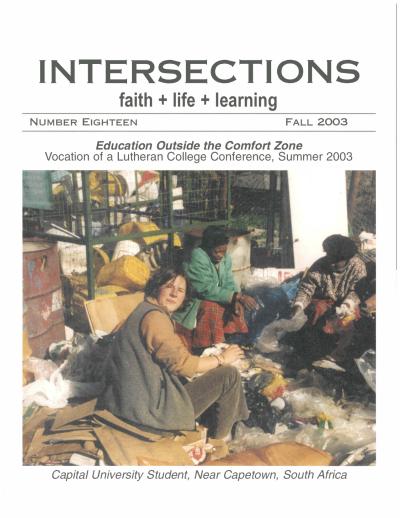
No. 18 · Fall 2003
Selbyg reports that the ELCA Church Council’s new strategic directions include the charge to “assist this church to bring forth and support faithful, wise, and courageous leaders whose vocations serve God’s mission in a pluralistic world,” and assures readers that Intersections, the Vocation of a Lutheran College conferences, and related programs will remain among the tools by which the churchwide organization reaches its strategic goals.
-
 Editorial
From the Publisher
Arne Selbyg
No. 17 · Summer 2003
Selbyg explains that the four essays in this issue grew out of the first Lutheran Academy of Scholars in Higher Education—a two-week seminar funded by the Lutheran Brotherhood Foundation and the Lilly Endowment, led for its first three years by Dr. Ronald Thiemann of Harvard Divinity School—whose official theme “Finding Our Voice—Christian Faith and Critical Vision” became informally “What’s Faith Got To Do With It?”
-
 Editorial
From the Publisher
Arne Selbyg
No. 16 · Winter 2003
Selbyg reports that “vocation” is surely among the top three words in Intersections’s history and congratulates nine ELCA institutions—Augsburg, Augustana (Rock Island), Concordia (Moorhead), Gustavus Adolphus, Luther, Pacific Lutheran, St. Olaf, Valparaiso, and Wartburg—on receiving roughly two-million-dollar Lilly Endowment grants for the “Programs for the Theological Exploration of Vocation,” while reminding readers that for Lutherans the priesthood of all believers means callings to be accountants, nurses, police officers, and home makers count as fully as callings into ministry.
-
 Editorial
From the Publisher
Arne Selbyg
No. 14 · Summer 2002
Writing on behalf of the publisher, Sue Edison-Swift names vocation as one of the precious gifts Lutheran theology offers education, reflects on her first ELCA Vocation of a Lutheran College conference, and asks readers to gift future issues of Intersections with feedback—notes on what they read and skipped, and how they ended up with a copy.
-
 Editorial
From the Publisher
Arne Selbyg
No. 15 · Winter 2002
Selbyg announces that the 2001 ELCA Churchwide Assembly has commissioned a new social statement on education, placing it alongside the economy, the environment, abortion, sexuality, health, and peace, and invites Intersections readers to submit input on which topics within the field of education the statement should address.
-
 Editorial
From the Publisher
Arne Selbyg
No. 13 · Winter 2002
Selbyg reports that Executive Director Leonard Schulze has challenged the ELCA Division for Higher Education and Schools to develop a comprehensive communications plan reaching high school students, college students, parents, pastors, and journalists, and invites Intersections readers to review the redesigned elcacolleges.org website, the “FREE STUFF” brochures, the journal’s advertisements in The Lutheran and related publications, Ernie Simmons’ new Augsburg-Fortress book Lutheran Higher Education: An Introduction, and the ELCA video magazine Mosaic—and to send in their own ideas.
-
 Editorial
From the Publisher
Arne Selbyg
No. 12 · Summer 2001
Selbyg reports that the Lutheran Brotherhood Foundation and the Lilly Endowment have funded the Lutheran Academy of Scholars, which since 1999 has gathered ten to twelve Lutheran scholars at Harvard for two-week summer seminars under Ronald Thiemann (themes: “Finding Our Voice—Christian Faith and Critical Vision” in 1999–2000 and “The Lutheran Public Intellectual: Faith, Reason and the Arts” in 2001), and announces that the academy will move to Berkeley in 2002 under Ted Peters to take up the intersection of faith and science.
-
 Editorial
From the Publisher
Arne Selbyg
No. 11 · Spring 2001
Selbyg admits that promoting Lutheran colleges and universities can feel Sisyphean—clueless faculty or staff, fundraising treadmills, students and parents treated poorly by admissions, pastors with no sense of the colleges’ mission—but reports that alumni satisfaction surveys, ELCA-college faculty seminars, an engaging bishop, Ernie Simmons’s Lutheran Higher Education: An Introduction, and renewed reader interest in Intersections all show the stone is not at the bottom of the hill.
-
 Editorial
From the Publisher
Arne Selbyg
No. 10 · Fall 2000
Selbyg explains that, while Intersections usually publishes papers from the annual Vocation of a Lutheran College conferences, this issue gathers presentations from a St. Olaf 125th-anniversary conference—a companion to the volume Called to Serve edited by Pamela Schwandt—because the theology and educational perspectives behind them apply to any Lutheran college and clarify what makes ELCA church-related colleges excellent institutions for students of any faith.
-
 Editorial
From the Publisher
Arne Selbyg
No. 9 · Summer 2000
Selbyg reports on the “Reclaiming Lutheran Students” research by the Lutheran Education Conference of North America (partly funded by the Aid Association for Lutherans), which found that alumni of Lutheran colleges report higher satisfaction with the overall quality of their education than alumni of flagship public universities, with more than eighty percent affirming that their college helped them develop moral principles and benefit from spiritual development, while also noting that parents of Lutheran high school students remain largely unaware of both the magnitude of financial aid offered and the quality of the education provided.
-
 Editorial
From the Publisher
Arne Selbyg
No. 8 · Winter 2000
Selbyg reflects on the origins of Intersections—begun out of concern that the philosophy and theology behind Lutheran higher education could be lost to retirements and other preoccupations—and credits Paul Dovre of Concordia and Robert Sorensen of the ELCA Division for Higher Education and Schools as key figures behind the resumption of the debate. He points to three recent books (Ernest Simmons’s Lutheran Higher Education, Paul Contino and David Morgan’s The Lutheran Reader, and Pamela Schwandt’s Called to Serve) and to the new Lutheran Academy for Scholars in Higher Education, and previews the next “Vocation of a Lutheran College” conference at Dana College in August on what differentiates Lutheran colleges within American higher education.
-
 Editorial
From the Publisher
Arne Selbyg
No. 7 · Summer 1999
Selbyg celebrates the popularity of the previous issue—the first to draw on papers from the annual “Vocation of a Lutheran College” conference—and announces a new Lutheran Brotherhood Foundation grant that will fund the inaugural Lutheran Academy of Scholars in Higher Education, a two-week seminar at Harvard led by Ronald Thiemann on “Finding Our Voice: Christian Faith and Critical Vision.”
-
 Editorial
From the Publisher
Arne Selbyg
No. 6 · Winter 1999
Selbyg reports on the work of the Division of Higher Education and Schools to focus what makes Lutheran colleges and universities distinctive, recaps the 1998 Vocation of a Lutheran College conference at Wittenberg, previews the 1999 Susquehanna conference on “Identity and Fragmentation: Can the Lutheran Center hold?” (inspired by Yeats’s vision of the Second Coming), commends Ernest Simmons’s Lutheran Higher Education: An Introduction for Faculty (Augsburg Fortress, 1998), and announces a new NEH/NSF-style initiative called “The Lutheran Academy of Scholars in Higher Education.”
-
Lutherans Engage the World
No. 27 · Spring 2008
The Spring 2008 issue, on Lutheran higher education’s engagement with the world, marks Arne Selbyg’s retirement after a decade as Director for ELCA Colleges and Universities. Mary S. Carlsen offers a recipe for engaging the local community drawn from social work. R. Guy Erwin advances three theses on the vocation of Lutheran colleges in a globalist context. Peter Marty challenges the “one calling” assumption with a poly-dimensional account of vocation. Mark C. Mattes traces Grand View’s Grundtvigian heritage. Richard W. Priggie’s closing sermon calls for a “deep ecumenism” loving the whole cosmos.
-
Luther and Melanchthon
No. 26 · Fall 2007
The Fall 2007 “Luther and Melanchthon” issue draws on the ELCA Wittenberg Center on the eve of the “Luther Decade.” Ernest Simmons argues Lutheran higher education is well suited to cultivate “public intellectuals”; Sabine U. O’Hara reflects on education as Bildung; Kathryn Kleinhans, Cynthia Bane, Penni Pier, and Fred Waldstein share fruits of Wartburg’s 2006 seminar in Wittenberg, Eisenach, and Neuendettelsau; Kathy Book imagines No Child Left Behind in conversation with Melanchthon; Matthew J. Marohl reviews Imaging the Journey and The Grand View College Reader.
-
Shared Commitment and Diversity
No. 25 · Spring 2007
The Spring 2007 “Shared Commitment and Diversity” issue opens with Presiding Bishop Mark S. Hanson’s LECNA address on the shared mission of the twenty-eight ELCA colleges. Guest editor Madeleine Forell Marshall introduces four papers from the 2006 ALCF meeting: Randall Balmer proposes Christian liberal arts colleges as “halfway houses” for engaging pluralism; Storm Bailey argues Lutheran identity undergirds academic freedom; José Marichal diagnoses the “decoupling” of campus diversity and civic engagement; Pamela K. Brubaker tells two Lutheran communion stories from Bolivia and Brazil.
-
Liberal Learning and Professional Preparation
No. 24 · Fall 2006
The Fall 2006 issue of Intersections, “Liberal Learning and Professional Preparation,” gathers papers from the 2006 Vocation of a Lutheran College conference at Midland. Stanley N. Olson asks whether Lutheran colleges draw contentment from being on Lutheran soil rather than from the work of vocation. Kathryn L. Johnson revisits Luther’s “Freedom of a Christian” as a paradigm for the freedom of a Lutheran college. Gail Summer and Lake Lambert argue the real divide is within, not between, liberal arts and professional preparation. Steven C. Bahls closes with a call for “philosopher-servants.”
-
Lutherans and "Our Calling in Education"
No. 23 · Summer 2006
The Summer 2006 issue of Intersections draws on the 2005 Vocation of a Lutheran College Conference at Capital University, contributing to the ELCA’s forthcoming social statement “Our Calling in Education.” Marcia J. Bunge, Paul J. Dovre, Samuel Torvend, and Cheryl Budlong each respond to the Task Force’s draft: Bunge urges focus on children and youth across public schools, Lutheran schools, and faith formation; Dovre traces the statement’s social context and Lutheran resources; Torvend insists it speak to the post-Lutheran “none zone”; Budlong asks educators to reexamine their ‘mental models’ of education itself.
-
Lutherans and Human Sexuality
No. 22 · Spring 2006
The Spring 2006 “Lutherans and Human Sexuality” issue arrives after the 2005 ELCA Churchwide Assembly’s contested votes on same-sex couples and rostered ministry, and marks Robert D. Haak’s first issue as editor. D. M. Yeager defends the church as a community of moral deliberation; Adina Nack surveys research on sexuality across the lifespan; Ritva Williams tests a Lutheran “critical traditionalist hermeneutic” against Gagnon on Romans 1; Jacqueline Bussie argues the theology of the cross supports rejecting state bans on gay marriage; Robert Benne questions whether Lutheran colleges can model fair moral discourse.
-
Endings and Beginnings: Some Reflections on the ELCA and Higher Education in the Last Decade
No. 21 · Summer 2005
The Summer 2005 issue is transitional—Tom Christenson’s final issue as founding editor before handing off to Bob Haak, and a turning point as the ELCA Division for Higher Education and Schools folds into a larger unit. W. Robert Sorensen and Leonard G. Schulze reflect on DHES. From the 2004 Vocation of a Lutheran College Conference at Carthage, Loren J. Anderson explores public witness in the Pacific Northwest’s “None Zone”; Harvard Stevens Jr. preaches on Proverbs; Pamela K. Brubaker examines money, sex, and power; Christenson closes on education as Christian calling.
-
Number Twenty
No. 20 · Fall 2004
The Fall 2004 issue gathers voices—“young and old, angry and encouraging, prophetic and hopeful”—around the Lutheran tradition of faithful criticism. Carl Skrade’s “Mars, Mammon—and Other Options” probes American militarism under the second Bush administration and proposes just-war principles and Matthew 5:43–48 as the Christian alternative. Steven C. Bahls argues law schools must teach students to distinguish vocation from career. Eric Childers profiles six students at Concordia, Lenoir-Rhyne, and Muhlenberg. Tom Christenson closes with a review of Wolterstorff’s Educating for Shalom.
-
Academic Vocation: What the Lutheran University has to Offer
No. 19 · Summer 2004
The Summer 2004 issue of Intersections features work from the Lutheran Academy of Scholars in Higher Education. Wendy McCredie grounds an academic vocation for the Lutheran university in the dialogical tension between bonds of faith and openness to the neighbor. Mark C. Mattes draws on Ricoeur’s hermeneutics to defend dual citizenship in Athens and Jerusalem. Thomas W. Martin reflects on the dark side of the Reformation myth. Ned Wisnefske argues that fear of “the Ought” underwrites contradictory faculty objections to moral formation. Tim Knopp closes with the poem “Unpossible.”
-
Education Outside the Comfort Zone
No. 18 · Fall 2003
The Fall 2003 “Education Outside the Comfort Zone” issue gathers papers from the 2003 Vocation of a Lutheran College Conference on global outreach. Christopher M. Thomforde offers six theses on global education grounded in Psalm 24; Kathryn Wolford of Lutheran World Relief reads economic globalization through mercy and justice; Janet E. Rasmussen describes Pacific Lutheran’s “Global Education Continuum” and its partnerships in Trinidad, China, and Namibia; Bishop Munib A. Younan offers a Palestinian Christian theology of incarnation, grace, and the cross as a foundation for just peace and interfaith dialogue.
-
What's Faith Got To Do With It?
No. 17 · Summer 2003
The Summer 2003 issue gathers papers from the first Lutheran Academy of Scholars in Higher Education, a Harvard Divinity seminar under Ronald Thiemann themed “What’s Faith Got to Do with It?” Pamela Brubaker describes teaching Christian ethics as moral discourse in a religiously diverse classroom; Jim Huffman traces his journey from Christian exclusivism to pluralism; Diane Scholl reads Winthrop and The Scarlet Letter against Ezekiel’s dry bones; Bruce Reichenbach applies the exclusivist/inclusivist/pluralist taxonomy to Lutheran higher education. Caitlin McHugh offers a poem, and Baird Tipson continues his conversation with Robert Benne.
-
Number 16, Winter 2003
No. 16 · Winter 2003
The Winter 2003 issue celebrates the new Lilly Endowment vocational-exploration grants awarded to nine ELCA colleges, drawing on the eighth Vocation of a Lutheran College Conference. Curtis Thompson frames Lutheran identity as a dialectical “knot in the stomach” held by the theology of the cross. Carol Gilbertson honors “the Word” through chapel talks and poems. Bruce Allen Heggen argues the theology of the cross teaches hope even in the secular university. Susan O’Shaughnessy Poppe reads the Samaritan Woman alongside The Vagina Monologues; Sig Royspern offers fourteen oracular questions; Robert Benne defends Lutheran intellectual engagement.
-
Vocation: Faith + Life + Learning
No. 14 · Summer 2002
A single-topic Summer 2002 issue on vocation drawn from the 2001 conference. Darrell Jodock reads Putnam’s Bowling Alone alongside Luther’s ethic and the new Gustavus Center for Vocational Reflection. Marcia Bunge maps eight “doorways” through Valparaiso’s Lilly grant. Richard Rouse tracks “Paths Unknown.” John P. Trump’s play “Holy Odors” argues digging up old bones can be as holy a call as ministry. Karla Bohmbach traces her vocation as a feminist biblical scholar; Don Braxton reviews Alister McGrath’s Glimpsing the Divine.
-
Marks of an ELCA College
No. 15 · Winter 2002
The Winter 2002 “Marks of an ELCA College” issue gathers bishops, presidents, philosophers, poets, and students on what it means for a college to be Lutheran. Bishop Stanley Olson’s lead essay names eight “marks of an ELCA college” and surveys all twenty-eight ELCA mission statements against them. Gregg Muilenberg argues non-Lutheran faculty feel welcome only when invited into the faith-and-reason struggle. Mary Theresa Hall and Cora Lazor read Thiel’s mission alongside Bacon and Newman, Don Braxton defends “honesty of mind,” and Baird Tipson reviews Dovre’s The Future of Religious Colleges.
-
Opening Lines
No. 13 · Winter 2002
The Winter 2002 issue, themed around Lutheran humor and identity, draws from the 2001 Vocation of a Lutheran College Conference at Valparaiso. Ernest L. Simmons names community, mentoring, and faith-values integration as the three areas where the Lutheran “two-handed” theology equips ELCA colleges to respond to the Millennial Generation. Darrell Jodock’s Bernhardson chair lecture develops humor, community, and freedom. Brian Wallace and Corin Wesner contribute travel reflections from post-apartheid South Africa. The issue closes with reviews of Hughes’s How Christian Faith Can Sustain the Life of the Mind and Benne’s Quality With Soul.
-
Number 12
No. 12 · Summer 2001
The Summer 2001 issue of Intersections gathers papers from the sixth Vocation of a Lutheran College Conference at Dana College. Leonard Schulze defines teaching as paradoxical “servant leadership” and closes with ten Wittenberg-style theses. L. DeAne Lagerquist places the twenty-eight ELCA colleges in American higher education and proposes five characteristic practices engendering gratitude, wisdom, freedom, and humility. Ruth Henricks calls colleges and social ministry to front-line leadership at a church threshold. A. Joseph Everson borrows “a river runs through it” to image California Lutheran’s six commitments.
-
Number 11
No. 11 · Spring 2001
The Spring 2001 issue of Intersections gathers four pieces on Christian higher education, academic freedom, and journalism as Christian vocation. Richard Hughes argues Christian particularity is itself the foundation for diversity and academic freedom; Nicholas Wolterstorff offers eight considerations on academic freedom in religiously based institutions; Storm Bailey argues religious commitment serves academic goals; and Catherine McMullen, surveying 1998 in American journalism, argues journalism is a Lutheran vocation—“a Christian cobbler makes good shoes, not poor shoes with little crosses on them.”
-
Number 10
No. 10 · Fall 2000
This Fall 2000 special issue gathers papers from the St. Olaf 125th Anniversary Conference, “Called to Serve: Faith, Understanding, Action.” Paul J. Dovre meditates through T.F. Gullixson’s pioneer woman who “turned her face to the west wind.” Robert Benne names four inadequate theologies of Christian higher education and three marks of an adequate one. David J. O’Brien surveys Catholic justice and peace education since Vatican II; Shirley Hershey Showalter traces the Mennonite tradition and Goshen’s Study-Service Term. Student Matt Peterson closes with a homily on vocation as becoming, not doing.
-
Number 9
No. 9 · Summer 2000
The Summer 2000 issue of Intersections opens with a two-kingdoms discussion: Richard VonDohlen argues the doctrine as recently invoked walls theology off from the disciplines, and David Ratke responds with a defense grounded in Luther’s writings on temporal authority. Capital student Rachel Hammond gives a chapel talk on five months in Guayaquil during the sucre’s collapse. Chuck Huff’s Mellby Lecture argues virtue is cultivated through community and small choices rather than fairy-tale heroism. John Reumann reflects on a half century of “serving two masters” between academy and church.
-
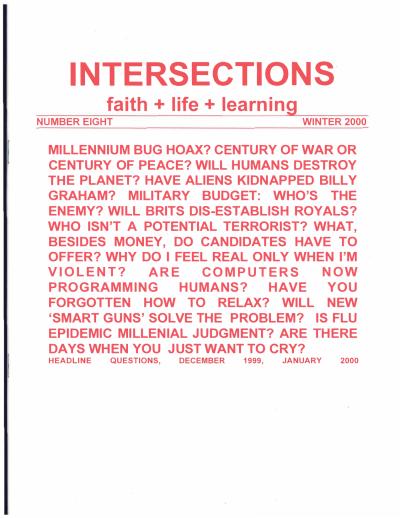
Number 8
No. 8 · Winter 2000
The Winter 2000 issue takes up the 1999 Vocation of a Lutheran College Conference question: “Integrity and Fragmentation: Can the Lutheran Center Hold?” Robert Benne proposes an “intentional, robust pluralism” for colleges that have lost a center; Philip Nordquist traces Lutheran higher education “from pietism to paradox”; Florence Amamoto, a Buddhist “inside outsider” at Gustavus, argues diversity and integrity belong together. Sig Royspern offers “Things That Renew Hope,” Kathy Fritz turns to 1 Corinthians 12 amid crisis at Newberry, and Daisybelle Thomas-Quinney offers “a view from the other side” from Thiel.
-
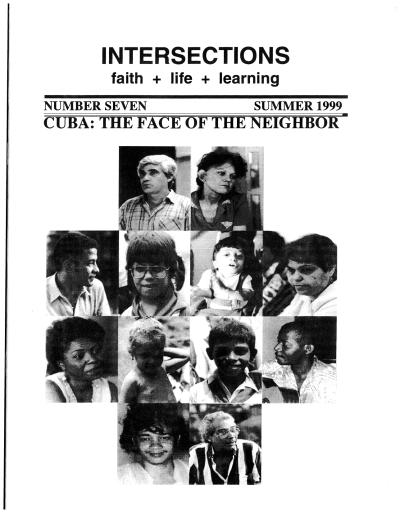
Number 7
No. 7 · Summer 1999
The Summer 1999 “Cuba: The Face of the Neighbor” issue continues papers from the 1998 Vocation of a Lutheran College Conference. Cheryl L. Ney argues for “sustainable science practice” rooted in empathy; Robert Scholz responds to Christenson’s “Freedom of a Christian” as a musician, critiquing taped accompaniments and TV evangelism; Jennifer Sacher Wiley offers Unitarian Universalist reflections on a more inclusive “little Christ.” Four Capital faculty recount a 1998 Cuba trip, Erik Haaland meditates on a Band Chapel service, and the journal’s first letter to the editor closes the issue.
-
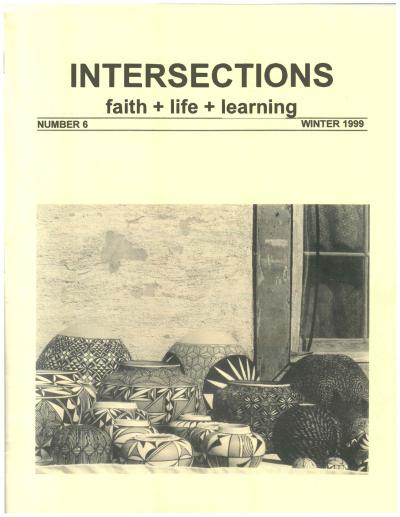
Number 6
No. 6 · Winter 1999
The Winter 1999 issue of Intersections gathers papers from the 1998 Vocation of a Lutheran College Conference at Wittenberg. Tom Christenson’s keynote frames the Lutheran educational task by gift, freedom, and vocation, proposing four “liberating arts.” Ryan La Hurd reads Luther’s two kingdoms onto the institution, distinguishing the “imagined” from the “real” college of budgets. Pamela M. Jolicoeur searches for “the words” in California’s religious marketplace; David Wee meditates on being “wise about others”; Kevin Griffith closes with two poems.