This article is based on three opportunities I have had to be educated for citizenship. One was while growing up in Norway, one was when I arrived in America as a resident alien, and one was when I became an American citizen.
Growing up Norwegian
I was born in Norway while that country was occupied by German soldiers during the Second World War, and while it was administered by Norwegian Nazis under German supervision. My father’s brother participated in the Norwegian resistance movement. Soon after I was born, the Nazis discovered this. My uncle fled to Sweden, and since the authorities could not catch him they put my father in a prison camp. For more than two years my mother raised two small children by herself.
After the war, the Norwegians were very concerned about why some Norwegians had cooperated with the Germans, while many others had resisted the Nazis. They wanted to make sure that my generation, and future generations, would be brought up as responsible citizens, prepared to resist any future attacks and occupations. Two of the groups they saw as crucial in this effort were the Lutheran pastors and the public school teachers. At one point during the occupation, the Nazi authorities ordered the pastors to preach that the Nazi ideology was a proper Christian view, and to accept supervision by new bishops put in place by the new regime instead of the old bishops from before the war. The vast majority of the pastors refused to follow this order, so they were removed from the pulpits, and many of them were sent to prison camps in northern Norway.
In the same way, the new authorities told the public school teachers to change the curriculum and their teaching, to stop praising the royal family and the old government, and to teach Nazi ideology. Again, the vast majority of the teachers refused to do this, so they were sent to prison camps. Several pastors and teachers died in the prison camps, but these public servants set an example for others, that by united action the Nazis could be resisted, that people could follow their convictions. Many would suffer from that, but most would survive with a clear conscience and the respect of their neighbors.
I think all the children who grew up in Norway after World War II heard about these heroes of resistance. We did not hear about the policemen who helped the Germans round up Norwegian Jews, the bus drivers and train engineers who helped move the Jews to the ports so they could be loaded on ships bound for Germany, or the many others who cooperated with the Nazis, made money trading with them, or did nothing to interfere with them. Clearly, the view was that one way to educate children for responsible citizenship was to show us examples of good citizenship, people in whose footsteps we were supposed to follow. We heard that there had been some collaborators and Norwegian Nazis, but the emphasis was on heroic Norwegians. Some times these Norwegians were compared favorably to the Danes or Swedes or others who supposedly had not resisted the Nazis as much or as heroically as the Norwegians had.
We also learned about the glorious history of Norway, how the Norwegian Vikings had discovered America and had conquered the European world; and about the great Sagas, with detailed history writing, advanced legal philosophy, and engaging literature written in the first centuries after the Viking Age. And we learned about the successful struggle for freedom from Danish and Swedish rule in the nineteenth century. We did not learn that many of the Vikings were murderers and robbers (in these days we would call them terrorists), and that the most famous Saga writers were Icelanders, several generations removed from their Norwegian origins.
And we did not learn much about the many centuries when Norway was just a province of Denmark. We learned to be proud of our country, and proud of our heritage, and to look down our noses or feel sorry for others who could not claim this ancestry. You can call it patriotism, or you could call it arrogance and conceit.
All of this is, of course, a generalization and simplification, and is based mainly on what the media, the politicians, the teachers and pastors taught us in grade school. The presentation of Norway became more complex as we moved up in the grades, with more attention given to Norwegian weaknesses. But I believe any Norwegian of my generation would recognize the main emphases of the civic education he or she received.
Part of this national pride was also tied to the strong democratic system in Norway, including high participation in all elections. One reason for this was that Norway has an election system with proportional representation from multi-member districts. Therefore it is relatively easy to start new parties, and for weak parties to survive. Your political party does not need to win the majority of the vote in a district to get somebody elected; you just have to have enough votes to get some representatives from that district. Most Norwegian parties gather less than ten percent of the national vote, but they can still be influential. One of the political parties in Norway, the Reds, consistently gathers one percent or less of the vote, but it still survives. So Norwegians do not consider their ballots wasted if their party does not win. They find it worthwhile to fight for just one additional percentage of the vote. And the vast majority of them use their right to vote.
When I was growing up it was also important that during the war there were no elections, so the citizens saw the vote as an important way to demonstrate that we had won the war. The undemocratic groups that had tried to take over had been beaten. For the same reason there was widespread use of the Norwegian flag, and great emphasis on singing the national anthem, and other patriotic and native songs. The royal family was very popular since the king had been one of the leaders of the resistance to the Nazis.
Widespread use of the outdoors for recreational activities was also presented as an important part of Norwegian citizenship. The popular saying was that Norwegians were born with skis on their feet—a saying obviously concocted by men, not by women. Norway does have spectacular nature, and much of that nature is public property. But there are also laws that give everyone access to private property for non-destructive use. You are entitled to go cross-country skiing in privately owned forests and mountainous areas in the wintertime, and to take hikes, go berry picking or mushroom picking in the summer and fall, and to land your boat on a private shoreline, as long as it is not close to inhabited houses or cultivated land. These activities are seen as particularly Norwegian, even by citizens who would much rather spend their time on a couch or in an urban park.
There was no separation of church and state. The Norwegian constitution said that Norway was a Lutheran country. The laws said that one of the purposes of the public school system was to help all children get a Christian and moral upbringing, and we had religion courses as part of the almost compulsory curriculum every year of grade school and junior high school. The pastors in the (Lutheran) Church of Norway are civil servants assigned to their congregations by the Ministry of Church Affairs. The bishops are appointed to their positions by the national government. Methodists, Catholics and children whose parents belonged to church bodies other than the Church of Norway could be excused from the religion courses at school, but I never saw anyone stay out of religion courses. Not only were the parents of about ninety-five percent of the children Lutheran, so there were not many children to excuse, but any religious minorities would stand apart from their classmates as different or weird if they were excused.
And the parents knew very well that the religion courses were mostly extremely boring, taught by teachers who never went to church themselves, and just went through the motions of teaching the assigned curriculum. We learned many hymns, and memorized prayers, creeds and many aspects of religion, but the courses were more likely to turn the kids away from the church than proselytizing them to become active Lutherans.
In fact, the Lutherans learned from the incorporation of the church into the state that they did not need to go to church on Sundays. The church would be there for them when they needed it for a funeral, baptism or wedding, no matter how little personal support they gave it. The members of religious minorities learned the opposite, that their congregation would only survive if they were active and gave it their personal support.
Moving to America
When I moved to the United States there were some clear parallels, and some clear differences. Strangely enough, the Americans I met were just as proud of their country as Norwegians were of theirs, and most of them were not focused on the problems of American society that we had learned about in Norway. I learned that Americans thought their democracy was the strongest in the world. They thought it was much better to have a president than a king who inherited the throne, thought a strong two party system was superior to a multiparty system, and thought there should be a separation between church and state.
But maybe the biggest difference was that in Norway we learned that when there were problems to be solved we should try to solve them by collective action. We demanded that the government do something, or called on the trade unions or the cooperative movement, the farm organizations or other voluntary organizations to step in. In America there were also numerous voluntary organizations, but they seemed more like social clubs. Most people did not trust the government or the organizations they joined to solve social problems. They had been taught not only that change was possible through individual action, but that they were much more likely to successfully accomplish change through their individual efforts.
Another major difference in the political system was that in America, candidates for election bragged about how successful they had been as businessmen. This was seen as a sign that they knew how to set priorities and manage resources. The parties looked for candidates who were rich, and could raise large amounts of money. From Norway, I was used to the electorate looking with skepticism on any rich candidate for office. The voters were worried that rich people running for office were trying to buy more influence than the one-person one-vote system called for, and wondered who they had cheated or exploited to get so rich. And in Norway the main responsibility for financing elections was on the political parties, not on the candidates personally. This was tied to the fact that many Norwegians were members of political parties, partly because a labor union could decide to collectively enroll all its members as members of a political party. The election system also meant that the electorate voted for parties, not for individual candidates.
How was I educated about American democracy and citizenship? Actually, nobody thought it was necessary to educate me. The superiority of America was taken for granted. Everybody knew that this was the best country in which to live, so just by living here I was expected to pick up the value of American citizenship. When I was hired for my first full-time teaching job, at the University of North Dakota, I had to sign a declaration that I supported the American constitution and the constitution of the state of North Dakota. I pointed out that I had never read any of those documents and certainly did not know whether I agreed with them. I was told to sign anyway, it was state law. I pointed out that there would be a vote in the upcoming election on a proposed amendment to the North Dakota constitution, and asked whether state law prevented state workers from supporting the proposed amendment. No, it only meant that they would not try to change the constitution by illegal means. So I signed the document with that footnote, that I would support the two constitutions in the sense of not using illegal means to change them. But nobody thought I needed to read the documents; that I needed to know what I supported; that it was important to formally teach me what it means to be an American citizen.
In the same way, when my children started school they had to pledge allegiance to the flag of the United States of America and to the republic for which it stands. My children had dual citizenship, Norwegian and American. I was not sure whether Norwegian law would allow them to remain Norwegian citizens if they pledged allegiance to a republic. But by now I had mellowed, I did not argue with the teachers or principal. I did not want to embarrass my kids, especially in front of their friends, so I did not raise the issue. I had learned that not all fights are worth fighting, or maybe I had learned to be a hypocrite.
Of course, I had learned that in Norway too. At church for example, for confirmation, we had a public examination of our preparedness for church citizenship in front of our bishop and the congregation. And so our pastor drilled us about the order in which we would march in and stand in front of the congregation, because the bishop would ask a predetermined set of questions in a certain order, and if we were standing in the wrong spot we would get somebody else’s question, not the one for which we had memorized the answer. But if we followed the marching instructions it would look like we all knew everything, because all of us would get our answers right. We would look good and the pastor would look good.
“In America the debate was more often about ideals.”
So I learned to memorize an answer. My children learned to memorize the pledge of allegiance. We all learned that you demonstrate your citizenship by memorizing certain formulaic sentences, and by learning about the glorious history of our country, about our heroes from the past. Americans did not celebrate their national independence day or sing along to their national anthem the way Norwegians did, but they stood at attention for the anthem and attended parties with fireworks on Independence Day.
When I first came to America, some people protested the actions, or in-actions, of the government by burning the national flag. But most of my neighbors would not dream of doing that. They were responsible citizens who honored their country. They criticized government policies and tried to change them with the legal means allowed by the constitution. In Norway it seemed that the political debates were about pragmatics. What are the consequences of government policies for me and my family, and for other groups? In America the debate was more often about ideals. What can we do to better measure up to the ideals that are set forth in the constitution? So the education Americans had received was not so much about reading the constitution and memorizing its words. It was more about the ideals expressed through those words. In a way Americans emphasized that a democracy was a government of the people by the people, while the Norwegians were more concerned with whether the government actions were for the people.
Becoming a Citizen
Years later, after I had moved to Augustana College in Rock Island, Illinois as its academic dean, I did decide to become an American citizen. I still liked Norway and was proud of its heritage and political and social system. But it was clear that I would be spending more time in this country with my wife and children than with my mother and brothers in Norway. It was getting irritating that I could not vote in elections, not even for school board or park district trustees. Since I lived in Iowa, I had to go to Nebraska to take a citizenship test. The test was more about memorization of years and numbers than about ideals and principles. How many members are there of the US Supreme Court? How many amendments have been made to the US Constitution? In which decade was the Civil War? I don’t remember any questions about the ideals behind the American government or much about the obligations of being a citizen.
The most memorable remark when I became an American citizen was made by the judge in Davenport, Iowa, after swearing us in. He said, “You have just renounced all allegiance to foreign potentates and rulers. That does not mean that you have renounced your native culture. Feel free to celebrate and enjoy what you have always enjoyed.” It felt good to know that I could still cheer for the Norwegian women’s soccer team when they played for the Olympic championship, even against the US team.
But more importantly, it showed that judge understood that the USA is not a melting pot. There is still a difference between the descendants of the Irish and the Italians who came to the USA many years ago. The members of the many racial and ethnic groups that have become citizens of the United States have not lost all cultural differences, even though they have adopted some traits from other groups, and have contributed to the cultures of other groups. Their differences have not melted away.
The melting pot is a poor metaphor for America. I think a better one is a jazz ensemble. When you become a citizen of the United States, you are invited to jam with other musicians in a combo. We are different from each other, and we play different instruments, but we can make beautiful music together. It is a very creative and improvising process. We do not play a preset score, under the baton of a conductor who can make us combine for exactly the sound that he has in mind. Citizens of Norway, when I grew up, were more like the members of a bluegrass band, only traditional instruments allowed (it is no longer like that). Our perception of the old Soviet Union was more like the drum circle at an Indian powwow, forceful rhythmic collective action where individual creativity is hard to discern. In a jazz ensemble you have individual performers, and they take turns being featured in solos. But they are members of an ensemble, so they have to respect the playing of others, and still try to make the whole group shine.
How do you educate people to play jazz? They have to play an instrument well, so they must receive music lessons. You don’t contribute much if it is your first time at the piano or the first time you pick up the guitar or the trumpet. To be a contributing citizen, you must learn to do something well. You study your own culture, be it Western European Civilization or the African American Heritage. And you don’t just read about the instrument and its history or listen to others play jazz, you must practice on the instrument. You must learn skills. So you go out of the classroom and practice-teach, or intern in a business or voluntary organization, or engage in service-learning. And you learn communication skills, oral and written, and skills of critical thinking and analysis. After many years of lessons and practice, many people can make their instruments sound great. It gives them and others much pleasure during a solo recital.
“You must learn skills.”
But we are members of an ensemble, so it is not enough to play one instrument well. We also need to know something about the other instruments in the ensemble. I need to know something about the limitations and timbre of your instrument to know how we can blend with each other. Jazz musicians use their instruments to converse with each other. They both listen and play. And the best jazz musicians are versatile. They know how to play several different wind instruments, or different keyboards, or a variety of drums, so they can contribute many different sounds to the ensemble.
So we need general education. In order to learn what others can do, we need to study and become knowledgeable about the different cultures in America and the interrelationships between them. To learn the necessary interpersonal and intercultural skills, we need the experience of living and working next to people of different backgrounds. So our campuses must be diverse.
Good jazz musicians not only have the skills of the masters of a craft, they are artists who use their music to express their feelings and life experience. The musicians dialog with each other. As James Baldwin has pointed out, they also bear witness to themselves and others about their life, their suffering, their hopes and their worries. In the same way American culture is an expression of our experience as a nation. It has its warts and problems, but it is also the basis on which we generate our future.
“We need the experience of living and working next to people of different backgrounds. So our campuses must be diverse.”
So our students need to clarify for themselves why they are playing; what is the meaning of life; what is God trying to accomplish through them? That is very difficult. The faculty and administration need to help them do that. And maybe as we help them, we can figure out more about what is the meaning of our own lives, what is our vocation.
During a jazz performance, the different instruments are featured in turn. Everyone has times when they are featured, when they play back-up, and times when they rest. In the same way in American culture, every group of citizens need the chance to show off its accomplishments, as well as times when the joint action of different groups is the most important. Right now we are in the middle of an extended jam session, and some of the players who have been playing backup for a long time are saying that it is their turn to solo. They insist that the rest of us listen to the exploitation they have suffered, and to the visions they can provide for the future of America. New players are arriving with new and exotic instruments: hand drums, koto, and bamboo flutes. They want their chance to contribute to the ensemble.
This is jazz, so creativity and improvisation are essential, and the band leader does not direct a symphony orchestra performing a pre-composed piece. But somebody has to determine when to play “Mood Indigo” and when to play “St. Louis Blues.” So even the citizens of America have to accept that they will not always get their way, that there are times when our leaders make decisions that we think are stupid. I left the blue grass band to join this jazz ensemble, and I have now spent a career helping prepare people to play in it. As a citizen I have the right to vote, so I do help select our band leader. Some of the band leaders have disappointed me. Some times I think our band is moving in the wrong direction. But I still enjoy the opportunity to make music with the rest of you.
There are other aspects of citizenship that are not illustrated well with the jazz metaphor. Citizenship gives you certain formal rights, like the right to vote if you are above a certain age and the right to carry an American passport. I no longer have the right to vote in Norwegian elections, or to carry a Norwegian passport. You do not have a legal right to play in a jazz band. If your music does not fit in well, you will not be invited back, but you can try out with another group.
We extend the concept of citizenship beyond the legal and formal when we talk about being a citizen of our church, or a citizen of the world. These extensions beyond the formal are among the most important educational lessons. Polls made clear that Barack Obama was the favored candidate for the American presidency in Norway, Germany, and many other countries in the world. Even though they had no vote in the election, it was of huge importance for the citizens of those countries who we Americans selected to serve as president of the United States. Many foreigners have died, many have been ruined, and many have prospered because of American political decisions. We need to learn that what we do greatly influences people in other countries. And that we owe it to them not to be selfish, but to take their welfare into consideration when we act, or fail to act.
In the same way, their activities have great effect on us. The climate of the whole world is changing because we Americans do not conserve energy, but waste it; and because people in India and China believe they are entitled to drive cars around just like Americans do. The whole world is suffering because we Americans are poor citizens of the world. The world would benefit if we cut back our driving, and switched to more fuel efficient cars. We ourselves would benefit from this. This is an important part of our responsibility—to educate for citizenship (but I do not find a jazz metaphor for it).
Why is this part of “The Vocation of a Lutheran College”? In the ELCA unit on Vocation and Education, we talk about the concept of vocation. We talk about the many vocations each of us have. We have a vocation tied to the work we do. We have a family vocation. We have a community vocation. We have a citizen-of-the-world vocation. In all of our relations we are supposed to act to the best of our abilities, not in selfishness but in service to others, and to respond to God’s generosity to us by being agents of God’s love. Teaching that, and teaching how best to do that, to students, faculty, and staff, is a central part of the mission of all the colleges and universities that are related to the Evangelical Lutheran Church in America. It gives me great pleasure to now retire, convinced that these colleges and universities take that mission seriously.
-
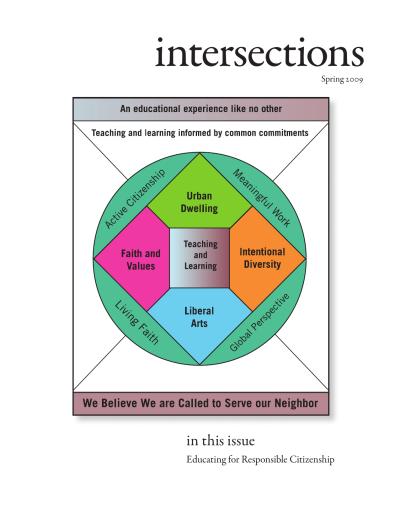 Editorial
From the Publisher
Mark Wilhelm
Wilhelm introduces essays from the 2008 Vocation of a Lutheran College Conference held at Luther College under the theme “Educating for Responsible Citizenship,” previewing contributions from Paul Pribbenow on dual citizenship at Augsburg, Wanda Deifelt on Luther College’s engagement with civic vocation, Jose Marichal on the promise and peril of digital citizenship, and Arne Selbyg on his three experiences of being educated for citizenship.
-
Editorial
From the Editor
Robert D. Haak
Haak frames the issue’s essays around the question of Lutheran colleges and the role of citizen, noting H. Richard Niebuhr’s typology in Christ and Culture and Luther’s own complex understanding of Christian and state, and offers a fitting farewell to Arne Selbyg with Mike Blair’s tribute song “A Fine Norwegian.”
-
Article
Dual Citizenship: Reflections on Educating Citizens at Augsburg College
Paul C. Pribbenow
Pribbenow argues that the vocation of Augsburg College is to educate “dual citizens”—those able to live within the messiness of common work rather than resolve every tension once and for all. Drawing on John Courtney Murray on democracy as “the intersection of conspiracies,” Bill Moyers, Jean Bethke Elshtain, Stephen Carter, and the Augsburg vision statement “We believe we are called to serve our neighbor,” he names four common commitments and five principles of civic education that ground Augsburg’s incarnational mission in its city neighborhood.
-
Article
Students in the Cloud: Creating Digital Citizens
Jose Marichal
Marichal weighs the utopian and dystopian views of the “networked information economy,” drawing on Yochai Benkler, Manuel Castells, Henry Jenkins, Cass Sunstein, Robert Putnam, Nicholas Carr, and Andrew Keen to chart the promise and peril of life “in the cloud,” and proposes Aristotle’s intellectual virtue of phronesis—developed through Hubert Dreyfus’s five stages of skill acquisition—as the goal of digital citizenship for college faculty and their students.
-
Article
Seeking the Common Good: Lutheran Contributions to Global Citizenship
Wanda Deifelt
Deifelt draws on Luther’s account of neighborly love in “The Freedom of a Christian” and on his Two Kingdoms theology to argue that a Lutheran ethics of care fosters a sense of responsibility, accountability, and compassion that broadens citizenship beyond rights and virtues. Engaging William Galston’s typology of civic virtues, Sylvia Walby on women’s citizenship, Serene Jones on communitarianism, and Manuel Castells on globalization, she proposes that Lutheran theology equips the church to educate for transformative participation in world affairs.
-
 Editorial
From the Publisher
Arne Selbyg
No. 27 · Spring 2008
Selbyg, retiring this summer as Director for ELCA Colleges and Universities, reflects on his decade serving as spokesperson between the church and its twenty-eight colleges and universities, and argues that the link between the colleges and the church has grown stronger over the last ten years — sustained by supportive church leaders like Presiding Bishop Mark Hanson, the annual Vocation of a Lutheran College conference, and a Lutheran theology of higher education whose principles (questioning authority, returning to the sources, including the excluded, serving the neighbor) remain a strong basis for operating colleges and universities in the twenty-first century.
-
 Editorial
From the Publisher
Arne Selbyg
No. 26 · Fall 2007
Selbyg notes that, while a stated purpose of Intersections over its twelve years and twenty-six issues has been the intersection of faith, learning, and teaching, surprisingly few articles have addressed how Lutheran faculty teach and why — and credits the editor for assembling essays from authors whose teaching has benefited from the ELCA Wittenberg Center, on the eve of the City of Wittenberg’s “Luther Decade” leading up to the 2017 Reformation anniversary.
-
 Editorial
From the Publisher
Arne Selbyg
No. 25 · Spring 2007
Selbyg notes that most papers in this issue grew out of a pan-Lutheran conference organized by the Association of Lutheran College Faculties in fall 2006 rather than the annual Vocation of a Lutheran College conference, and argues that the ELCA’s ecumenical posture—truthful but open to learning from others—is a good foundation for institutions of higher education whose faculty likewise profess while remaining subject to change based on new research and insights.
-
 Editorial
From the Publisher
Arne Selbyg
No. 24 · Fall 2006
Selbyg situates this issue in the ongoing ELCA conversation about education that began with the 2005 conference and is feeding into the second draft of the ELCA Social Statement on Education, previews the 2007 conference (“The Vocation of a Lutheran College — Engaging the World”) at Augustana College, Rock Island, and lifts up Luther’s insistence that the church and its members contribute to their wider communities rather than retreat into self-centered enclaves.
-
 Editorial
From the Publisher
Arne Selbyg
No. 23 · Summer 2006
Selbyg features articles based on presentations at the 2005 Vocation of a Lutheran College conference focused on the upcoming ELCA Social Statement on Education, and urges members of the ELCA higher-education community to download the first draft (“Our Calling in Education”) from the ELCA website and submit feedback to the Task Force on Education before the October 15 deadline. He worries that the sexuality social statement on a 2009 timeline will draw more attention than the education statement, but reminds readers that, for Martin Luther and for those who work in Lutheran higher education, education is as important as sex.
-
 Editorial
From the Publisher
Arne Selbyg
No. 22 · Spring 2006
Selbyg notes that both the ELCA and Intersections have undergone major changes this year—the Division for Higher Education and Schools is gone, replaced by the Educational Partnerships and Institutions group within the Vocation and Education unit, and the journal has a new editor (Robert Haak), a new home at Augustana College, a new printer, and a new design. He commends the issue’s focus on human sexuality and points readers to the first draft of Our Calling in Education.
-
 Editorial
The Vocation of a Lutheran College: Some Transitional Thoughts
James M. Unglaube
No. 4 · Winter 1998
Unglaube offers final reflections on thirty years in Lutheran higher education as he leaves the ELCA Division for Higher Education and Schools to join Carthage College, his alma mater. He recalls colleague Richard Solberg’s influence, the closing of Upsala College in 1995, the Higher Education and Namibia program shared with Naomi Linnell, the growth of endowments from $70 million to $1 billion in 25 years, and the Vocation of a Lutheran College project he credits Paul Dovre with inspiring. He likens the twenty-eight ELCA colleges to flowers on a rose bush—same Lutheran tradition, each blossom different—requiring constant nurture if the partnership between church and college is to thrive.
-
 Book Review
Types, Methods, and Sagas in Lutheran Higher Education: Learning from Childers
Lake Lambert
No. 39 · Spring 2014
Lambert situates Eric Childers’ College Identity Sagas within the older tradition of the 1977 Association of Lutheran College Faculties volume The Church-Related College in an Age of Pluralism, working through Burton Clark’s “saga” and Robert Benne’s typology of church-related colleges. He commends Childers’ socio-scientific approach while questioning whether a typology can do justice to institutions that resist easy classification.
-
Editorial
From the Publisher
Arne Selbyg
No. 27 · Spring 2008
Selbyg, retiring this summer as Director for ELCA Colleges and Universities, reflects on his decade serving as spokesperson between the church and its twenty-eight colleges and universities, and argues that the link between the colleges and the church has grown stronger over the last ten years — sustained by supportive church leaders like Presiding Bishop Mark Hanson, the annual Vocation of a Lutheran College conference, and a Lutheran theology of higher education whose principles (questioning authority, returning to the sources, including the excluded, serving the neighbor) remain a strong basis for operating colleges and universities in the twenty-first century.
-
 Article
Vocation and Civil Discourse: Discerning and Defining
Lynn Hunnicutt
No. 48 · Fall 2018
Hunnicutt draws on Rabbi Amy Eilberg’s reading of Moses’ calling to identify four features of vocational discernment — attention, wonder, communal consciousness, and humility — and argues that these same qualities are also key aspects of civil discourse, so that forming students for vocational discernment is simultaneously forming them for civility.
-
 Book Review
Alister McGrath: Glimpsing the Divine: The Search for Meaning in the Universe
Don Braxton
No. 14 · Summer 2002
Braxton reviews Alister McGrath’s Glimpsing the Divine (Eerdmans, 2002), commending its twelve articulate, lavishly photographed meditations as a fine introduction to Western spirituality but criticizing its conservative neo-Barthian confessionalism, its Eurocentric treatment of non-Western traditions as “taillights” to Christianity’s “headlights,” its one-sided host-guest engagement with the natural sciences, and its metaphysical dualism. In a section added for ministerial readers, he contrasts McGrath’s self-contained confessionalism with H. Richard Niebuhr’s call to respond to all things as if to God’s actions upon us, and argues that in an era of rival fundamentalisms exclusivity must become a thing of the past.
-
 Editorial
From the Editor
Jason A. Mahn
No. 38 · Fall 2013
Mahn reads Michael Sandel’s What Money Can’t Buy alongside Larry Rasmussen and Martha Nussbaum to ask how Lutheran schools can articulate the “value added” of vocation without commodifying it, and previews the 2013 Vocation of a Lutheran College conference papers, Patricia Lull’s sermon, and Ann Hill Duin and Eric Childers’ Project DAVID essay that make up the issue.