Lutherans Engage the World
The Spring 2008 issue, on Lutheran higher education’s engagement with the world, marks Arne Selbyg’s retirement after a decade as Director for ELCA Colleges and Universities. Mary S. Carlsen offers a recipe for engaging the local community drawn from social work. R. Guy Erwin advances three theses on the vocation of Lutheran colleges in a globalist context. Peter Marty challenges the “one calling” assumption with a poly-dimensional account of vocation. Mark C. Mattes traces Grand View’s Grundtvigian heritage. Richard W. Priggie’s closing sermon calls for a “deep ecumenism” loving the whole cosmos.
Editors
Articles in this Issue
-
 Editorial
From the Publisher
Arne Selbyg
Selbyg, retiring this summer as Director for ELCA Colleges and Universities, reflects on his decade serving as spokesperson between the church and its twenty-eight colleges and universities, and argues that the link between the colleges and the church has grown stronger over the last ten years — sustained by supportive church leaders like Presiding Bishop Mark Hanson, the annual Vocation of a Lutheran College conference, and a Lutheran theology of higher education whose principles (questioning authority, returning to the sources, including the excluded, serving the neighbor) remain a strong basis for operating colleges and universities in the twenty-first century.
-
Editorial
From the Editor
Robert D. Haak
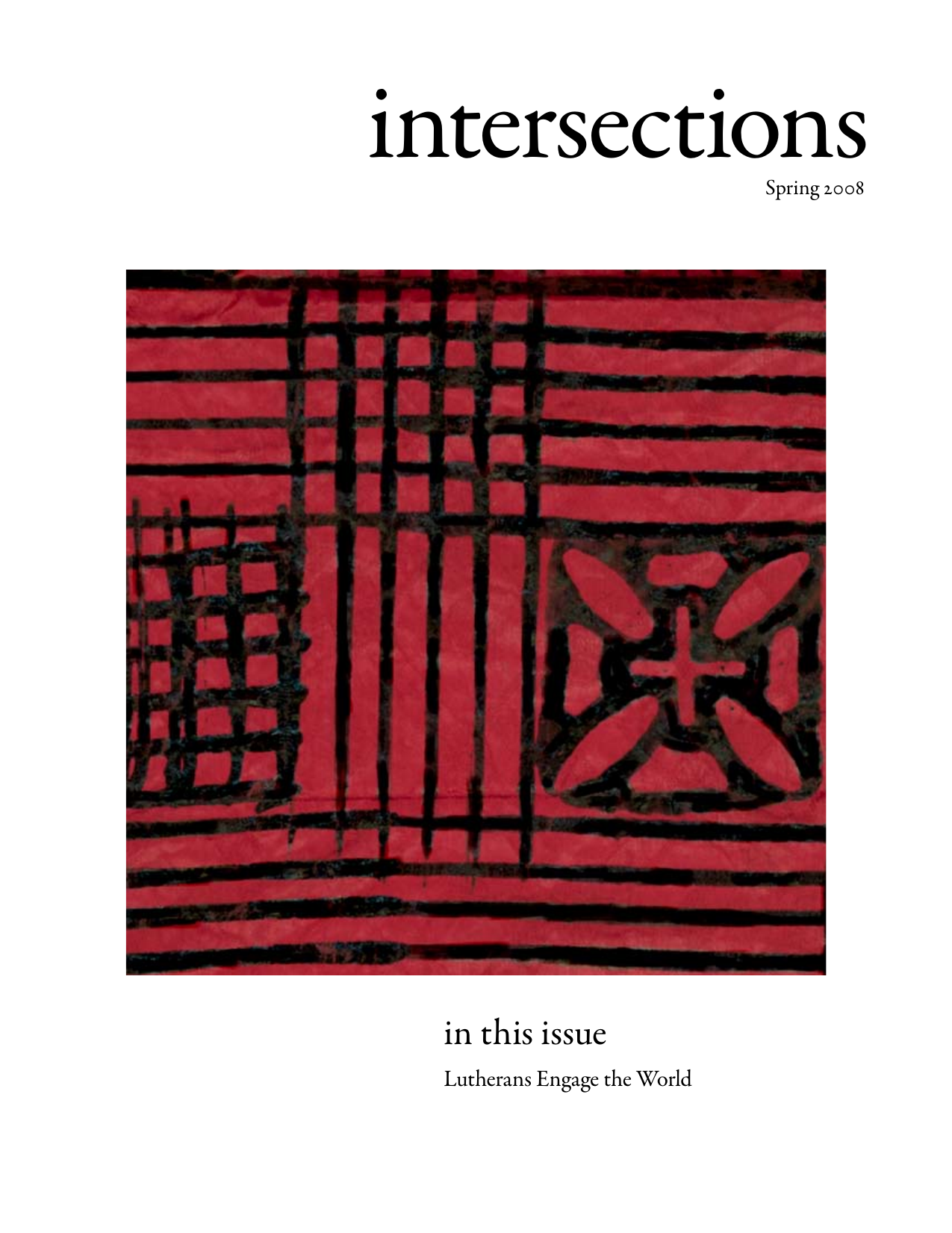
Haak frames the issue around the question of why Lutherans engage the world rather than retreat from it, locating the answer in the doctrines of creation and incarnation, and introduces essays by Erwin on globalism, Carlsen on local community engagement, Marty on multiple callings, and Mattes on the Grundtvigian heritage at Grand View. He also bids farewell to publisher Arne Selbyg, noting the fittingness of the Adinkra (“farewell”) cloth on the cover of this final issue under Selbyg’s leadership.
-
Article
Engaging the Local Community: Why Bother?
Mary S. Carlsen
Carlsen traces the often adversarial history of town-gown relations from the medieval universities through the Battle of St. Scholastica Day to the “ivory tower” pattern of American higher education, then argues that Lutheran colleges should engage their local communities for practical, educational, ecological, moral, and theological reasons. Drawing on her work in social work education at St. Olaf and on Ira Harkavy, Ernest Boyer, and the ELCA’s “Our Calling in Education,” she offers a recipe for engagement that is Passionate, Ethical (Needed, Welcomed, Mutual, Long-term, Attentive to diversity, Strengths-based, Respectful), and Reflective.
-
Article
Lutheran Higher Education in Global Context: Called to Serve the World
R. Guy Erwin
Erwin advances three theses on the global vocation of Lutheran higher education: that the vocation of a Lutheran college is to live out its mission in a service-oriented way; that Luther’s definition of vocation as love of neighbor must today have global dimensions; and that a Lutheran college best fulfills its vocation when it fosters a global perspective in its community, curriculum, and ethos. Drawing on Gustav Wingren and Luther’s catechisms, sermons on schooling, and three-realms ethics, he surveys the mission statements and websites of all twenty-eight ELCA colleges and universities for evidence of globalist commitment.
-
Article
Who Said You Have Only One Calling?
Peter Marty
Marty argues that our normal practice of thinking singularly about vocation must be enlarged: God has not limited any of us to one expression or gift, and Martin Luther never spoke of individuals as having only one calling. Drawing on Max DePree’s parable of the millwright-poet, William May on the etymology of “career,” Evelyn Underhill on the verb “to Be,” James VanOosting, Scot McKnight’s “Jesus Creed,” and a Golden Gate Bridge patrolman who has saved hundreds of lives, he identifies four features common to every story of vocation in scripture: special purpose, special gifts, a caller from outside, and the requirement of sacrifice and generosity.
-
Article
Reclaiming Grundtvig at Grand View College
Mark C. Mattes
Mattes traces the Grundtvigian heritage of Grand View College — the only North American institution founded by Grundtvigian Danes — from its origins in the 1880s split between Pietist Inner Mission and Grundtvigian Danish Lutherans through its golden years of folk dancing, gymnastics, and the weekly lecture, to the demographic and curricular changes of the 1950s through 1990s. He describes recent tangible initiatives, including the Grand View College Reader, Imaging the Journey, and the 2007 Strategic Planning Commission’s “Faith Foundations” statement, that seek to recover the “Human first, then Christian” mantra of Grand View’s ancestors for a generation of students whose “ship” has had not only its planks but its very model replaced.
-
Reflection
John 3:16-17
Richard Priggie
Preached at the Vocation of the Lutheran College conference in August 2007, Priggie’s sermon on John 3:16-17 reads the Greek word “cosmos” as evidence that “God was into globalism long before we were” and calls Lutheran colleges to embrace Matthew Fox’s “deep ecumenism” — an embrace of and care for all created things. Drawing on J.B. Philipps’s Your God Is Too Small and the movie Pleasantville, he invites his hearers to come to Rock Island in order to leave Rock Island, to be Christian in order to be more than Christian, and to find the places where the roads don’t go in a circle but just keep going.