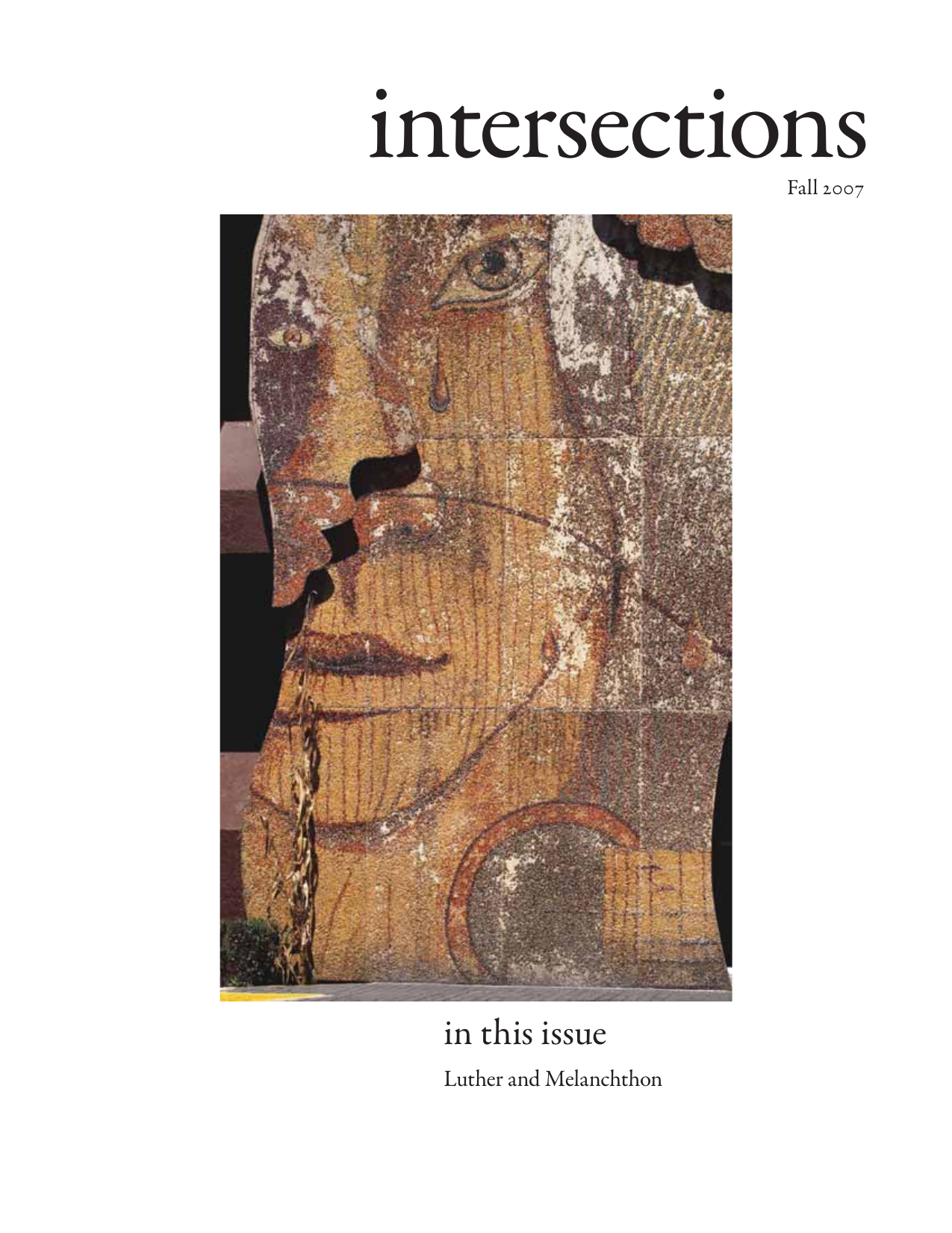
Luther and Melanchthon
The Fall 2007 “Luther and Melanchthon” issue draws on the ELCA Wittenberg Center on the eve of the “Luther Decade.” Ernest Simmons argues Lutheran higher education is well suited to cultivate “public intellectuals”; Sabine U. O’Hara reflects on education as Bildung; Kathryn Kleinhans, Cynthia Bane, Penni Pier, and Fred Waldstein share fruits of Wartburg’s 2006 seminar in Wittenberg, Eisenach, and Neuendettelsau; Kathy Book imagines No Child Left Behind in conversation with Melanchthon; Matthew J. Marohl reviews Imaging the Journey and The Grand View College Reader.
Editors
Articles in this Issue
-
 Editorial
From the Publisher
Arne Selbyg
Selbyg notes that, while a stated purpose of Intersections over its twelve years and twenty-six issues has been the intersection of faith, learning, and teaching, surprisingly few articles have addressed how Lutheran faculty teach and why — and credits the editor for assembling essays from authors whose teaching has benefited from the ELCA Wittenberg Center, on the eve of the City of Wittenberg’s “Luther Decade” leading up to the 2017 Reformation anniversary.
-
Editorial
From the Editor
Robert D. Haak
Haak introduces the issue with the question of whether “our Lutheranism” should have any discernible effect on how we operate as Lutheran colleges, and proposes a working list of “Lutheran” values that characterize our institutions — complexity, real evil, suffering as part of human experience, the centrality of discourse, transcendent values, attention to place, institutional self-criticism, and unity over division — inviting campuses to extend the conversation begun by Simmons, O’Hara, and the Wartburg colleagues.
-
Article
Lutheran Higher Education and the Public Intellectual
Ernest L. Simmons
Simmons argues that college faculty and administrators are, like it or not, public intellectuals, and that Lutheran higher education’s dialectical understanding of Christ and culture is well suited to support four functions of the public intellectual: articulating constructive critique of received social explanation (especially the “collage identity” described by Renate Schacht); presenting a transcendent theological perspective through the theology of the cross that takes seriously God’s hiddeness, the presence of ambiguity, and the reality of suffering; pursuing the common good amid the demise of the “commons” through H. Richard Niebuhr’s “Christ and Culture in Paradox”; and educating for citizenship through Christian vocation by connecting the practical and existential dimensions of the question “Why are you here?”
-
Article
The Vocation of a Lutheran College—Living the Legacy of the Reformation in the Twenty-first Century
Sabine U. O'Hara
O’Hara reflects on Luther’s understanding of education as Bildung — “becoming in the image of God” — through four key aspects: education must be relevant, education demands engagement with the community, education requires attention to place, and education demands engagement with the world. Drawing on her German upbringing, her work as president of Roanoke College, and on Darrell Jodock and Dietrich Bonhoeffer, she argues that Luther’s vision of a well-educated citizenry as the priesthood of all believers calls Lutheran colleges to messy, interdisciplinary, communal scholarship in service to the neighbor.
-
Article
Lutheran Heritage Across the Curriculum: Reflections from a Faculty/Staff Development Seminar
Cynthia Bane, Fred Waldstein, Kathryn A. Kleinhans, Penni Pier
Four Wartburg College colleagues share fruits of the 2006 Lilly-funded “Discovering and Claiming Our Callings” faculty/staff development seminar in Wittenberg, Eisenach, and Neuendettelsau. Kleinhans frames the curriculum and books used; Bane (psychology) finds Lutheran convictions about the value of humans, the affirmation of creation, and the universality of sin congruent with her discipline; Pier (communication arts) reads Luther as a model of dialectical rhetoric that gives educators permission to challenge students with uncomfortable ideas; and Waldstein (political science) reflects on the paradox of humility and self-confidence in Luther and on the Luther-Melanchthon collaboration as a model for the seminar group’s own work.
-
Article
No Child Left Behind Meets Philip Melanchthon: A Reflective Conversation
Kathy Book
Inspired by Tim Lull’s My Conversations with Martin Luther, Book imagines an interview with Philip Melanchthon in the cobblestone courtyard of the University of Wittenberg, in which the Praeceptor Germaniae reflects on his pedagogy (Socratic questioning, brevity and example, declamations, repetition, and interdisciplinary connections), his graded curriculum from primer to university, and his collaboration with Luther on the responsibility of community, parents, and government for the education of all children — and finds his vision strikingly resonant with the No Child Left Behind legislation of 2006.
-
Book Review
Reviews
Matthew J. Marohl
Marohl reviews two 2006 Lutheran University Press volumes from Grand View College (Des Moines, IA). Mark C. Mattes and Ronald R. Darge’s Imaging the Journey … of Contemplation, Meditation, Reflection, and Adventure pairs Mattes’s Lutheran meditations on seven themes (from a spirituality of communication to Alpha and Omega) with Darge’s photographs and Ronald Taylor’s short prayers, with Mattes’s writing on vocation singled out as the volume’s finest. The Grand View College Reader, edited by Mattes, Evan A. Thomas, Kathryn Pohlman Duffy, and Ronald Taylor, surveys the college’s Foundations, Creativity, and Vocation through chapters by Thorvald Hanson, Kenneth Sundet Jones, Kevin Gannon, Ammertte C. Deibert, Steven Snyder, and President Kent Henning, tracing Grand View’s Grundtvigian and Danish Lutheran roots.