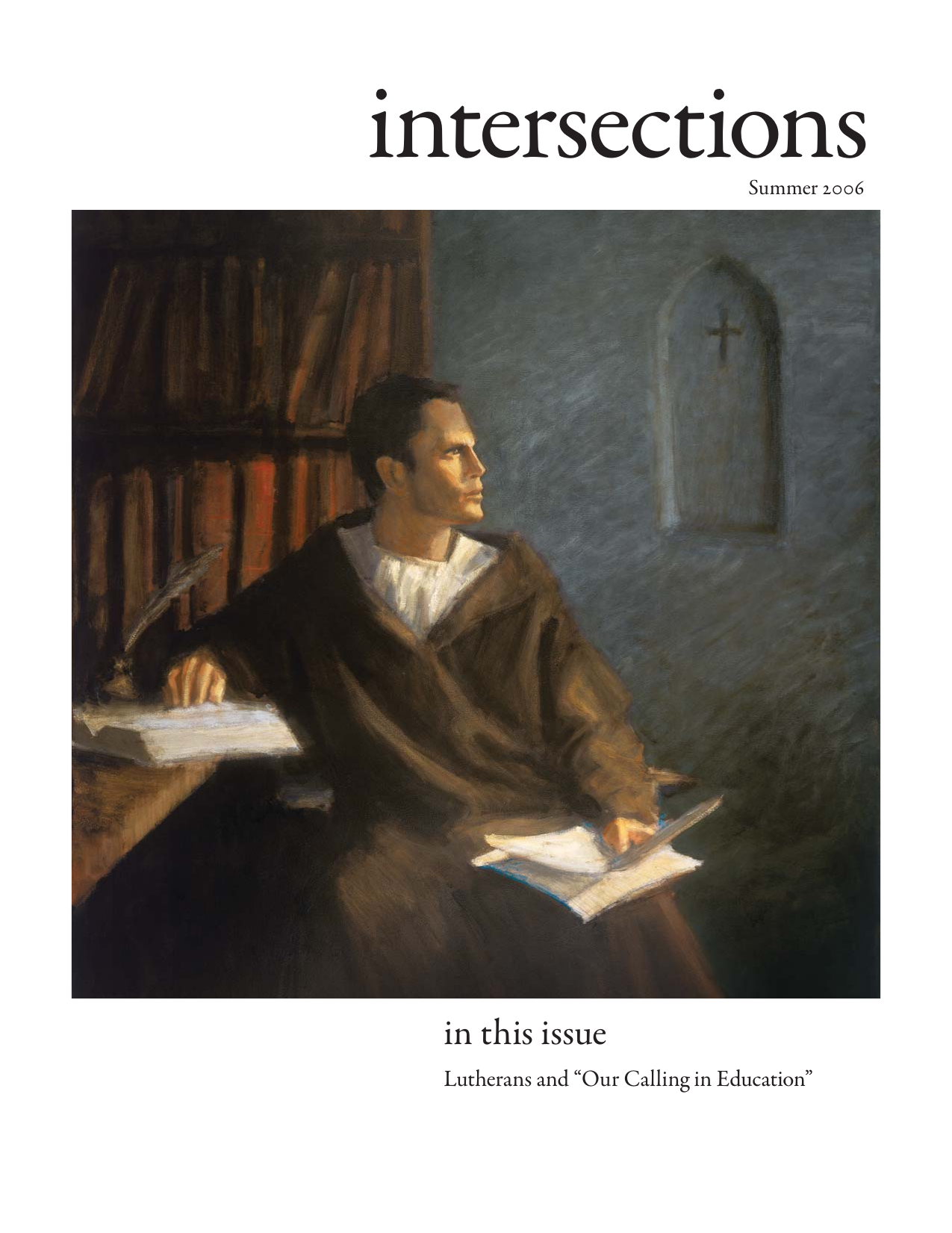
Lutherans and "Our Calling in Education"
The Summer 2006 issue of Intersections draws on the 2005 Vocation of a Lutheran College Conference at Capital University, contributing to the ELCA’s forthcoming social statement “Our Calling in Education.” Marcia J. Bunge, Paul J. Dovre, Samuel Torvend, and Cheryl Budlong each respond to the Task Force’s draft: Bunge urges focus on children and youth across public schools, Lutheran schools, and faith formation; Dovre traces the statement’s social context and Lutheran resources; Torvend insists it speak to the post-Lutheran “none zone”; Budlong asks educators to reexamine their ‘mental models’ of education itself.
Editors
Articles in this Issue
-
 Editorial
From the Publisher
Arne Selbyg
Selbyg features articles based on presentations at the 2005 Vocation of a Lutheran College conference focused on the upcoming ELCA Social Statement on Education, and urges members of the ELCA higher-education community to download the first draft (“Our Calling in Education”) from the ELCA website and submit feedback to the Task Force on Education before the October 15 deadline. He worries that the sexuality social statement on a 2009 timeline will draw more attention than the education statement, but reminds readers that, for Martin Luther and for those who work in Lutheran higher education, education is as important as sex.
-
Editorial
From the Editor
Robert D. Haak
Haak previews the issue’s four essays by Marcia Bunge, Paul Dovre, Samuel Torvend, and Cheryl Budlong — each engaging the ELCA Task Force on Education’s study document and first draft of the social statement on Lutheran education — and invites readers to bring their distinctive voices as professional educators at Lutheran institutions into the conversation before the October 15 deadline. He also invites submissions to Intersections and directs readers to LauraOMelia@augustana.edu to be added to the direct mailing list.
-
Article
"Our Calling in Education": Working Together to Generate a Strong Social Statement on Public Schools, Lutheran Schools and Colleges, and the Faith Formation of Children and Young People
Marcia Bunge
Bunge, Professor of Theology and Humanities at Christ College, Valparaiso University, makes two claims about the ELCA’s forthcoming social statement on education: first, that it should be built on a robust Lutheran understanding of vocation, addressing four common misconceptions (vocation as occupation, as self-fulfillment, as ordained ministry, and as “vo-tech”) and recovering the breadth of Luther’s teaching; and second, that the statement should narrow its focus to three urgent areas affecting children and young people — public schools, Lutheran schools and colleges, and faith formation — rather than addressing the full lifespan of education in equal depth.
-
Article
The Lutheran Calling in Education: Context and Prospect
Paul J. Dovre
Dovre, President Emeritus of Concordia College and co-chair of the ELCA Task Force on Education, undertakes three tasks: focusing on the current social context (young people’s spiritual lives, the state of mainline denominations, the family map, schools, communities, and higher education); reflecting on why Lutherans care about education (creation in God’s image, vocation, Luther’s legacy, the priesthood of all believers, civic righteousness, and hope); and considering the prospects and possibilities for addressing the calling (biblical, confessional, theological, and pedagogical legacies; the renewal of apostolic ministry, the Christian-college renaissance, K–12 reform, and the congregational education explosion).
-
Article
Lutheran Education in the None Zone
Samuel Torvend
Torvend, Associate Professor of Religion at Pacific Lutheran University, argues that any ELCA social statement on education must speak not only to those raised within the cultural and theological traditions of ELCA Lutheranism but also to the diverse communities of the “none zone” — the Pacific Northwest and other regions where religious affiliation is increasingly unaffiliated. The statement must therefore equip Lutheran colleges, congregations, and schools for engagement with religious pluralism and cultural diversity rather than presuming a Lutheran cultural baseline.
-
Article
"Our Calling in Education": An Educator's Perspective
Cheryl Budlong
Budlong, Professor of Education at Wartburg College, asks educators to reexamine their ‘mental models’ of what education itself means in light of the rapidly expanding literature on how young people learn. Drawing on Malcolm Gladwell, Eric Jensen, Ruby Payne, Judith Harris, Robert Slavin, and the AACTE’s Leading a Profession retrospective on the AACTE agenda 1980–2005, she calls on Lutheran educators to articulate vocation intentionally in their classrooms and to ground curricular and pedagogical reform in Wartburg’s focus on Discovering our Calling.