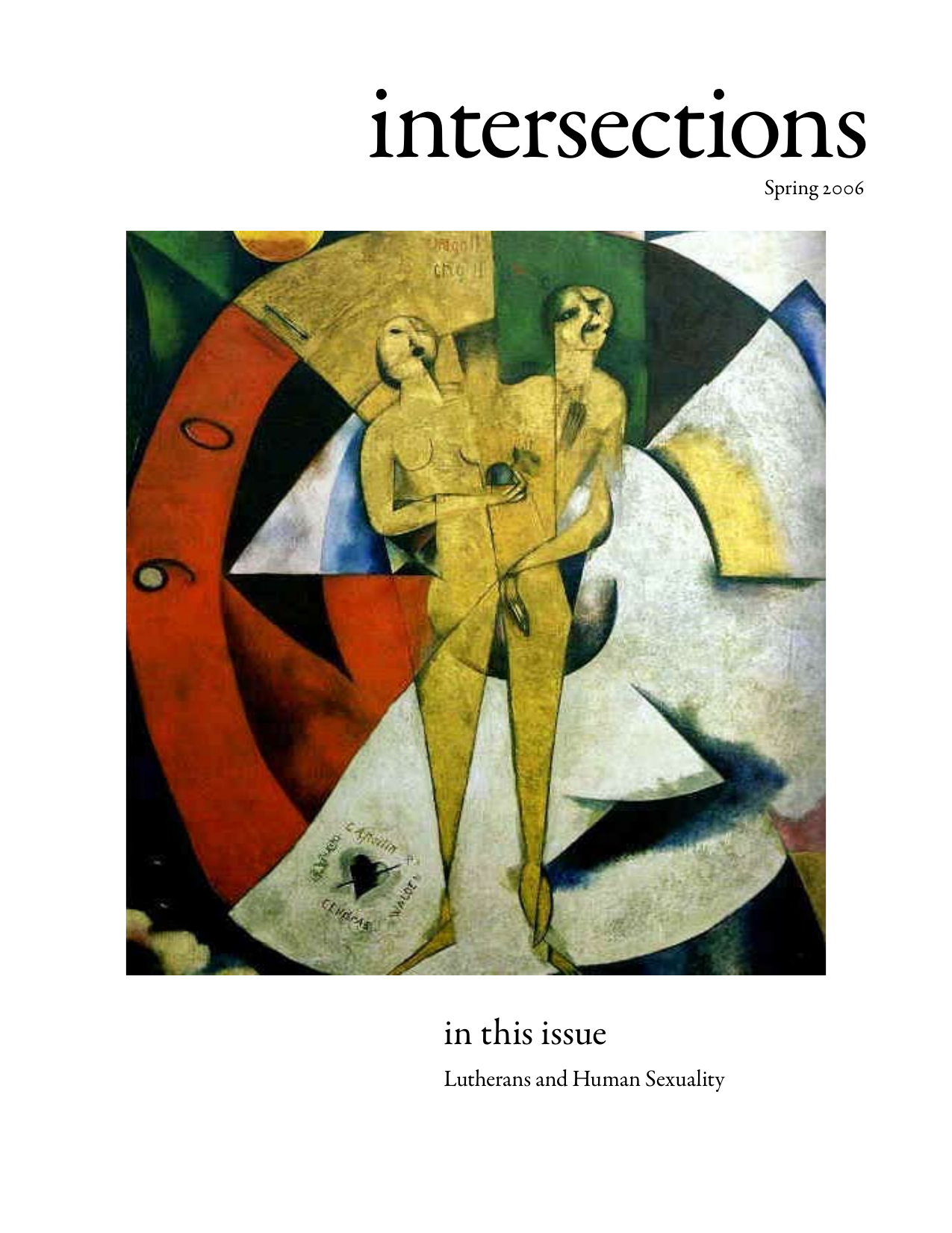
Lutherans and Human Sexuality
The Spring 2006 “Lutherans and Human Sexuality” issue arrives after the 2005 ELCA Churchwide Assembly’s contested votes on same-sex couples and rostered ministry, and marks Robert D. Haak’s first issue as editor. D. M. Yeager defends the church as a community of moral deliberation; Adina Nack surveys research on sexuality across the lifespan; Ritva Williams tests a Lutheran “critical traditionalist hermeneutic” against Gagnon on Romans 1; Jacqueline Bussie argues the theology of the cross supports rejecting state bans on gay marriage; Robert Benne questions whether Lutheran colleges can model fair moral discourse.
Editors
Articles in this Issue
-
 Editorial
From the Publisher
Arne Selbyg
Selbyg notes that both the ELCA and Intersections have undergone major changes this year—the Division for Higher Education and Schools is gone, replaced by the Educational Partnerships and Institutions group within the Vocation and Education unit, and the journal has a new editor (Robert Haak), a new home at Augustana College, a new printer, and a new design. He commends the issue’s focus on human sexuality and points readers to the first draft of Our Calling in Education.
-
Editorial
From the Editor
Robert D. Haak
Haak introduces himself as the new editor inheriting the journal from Tom Christenson and frames the issue around the question of what ELCA colleges might contribute to conversations about human sexuality. He summarizes the contributions of Yeager, Benne, Williams, Bussie, and Nack, and shares previously uncollected National Study of Youth and Religion data on the sexual attitudes and behaviors of Lutheran teens—including that 25% of regularly-attending ELCA teens report the church has done nothing to help them with their sexuality.
-
Article
A Church, the Human Condition, and the Fissured Face of Peace
D. M. Yeager
Yeager, a member of the ELCA Task Force for Studies on Sexuality, reflects on lessons for the church’s educational mission in the wake of the 2005 Churchwide Assembly. Drawing on Macquarrie’s The Concept of Peace, Polanyi on the personal coefficient of knowledge, Hannah Arendt’s The Human Condition, and responses to the task force report from Roy Harrisville III and Larry Rasmussen, she proposes “the fissured face of peace”—peace as the absence of hostility rather than disagreement—and maps how Arendt’s five conditions of human existence (life, earth, natality, mortality, worldliness, plurality) might shape Lutheran colleges’ curricula in history, epistemology, and the sociology of knowledge so that graduates can disagree without hostility and embrace the slow work of reformation.
-
Article
Sexuality over the Lifespan—Social Trends Pose Moral Dilemmas for Communities of Faith
Adina Nack
Nack, a sociologist who presented to the ELCA Task Force for Studies on Sexuality, surveys empirical research on three life-stages flagged by the Task Force as particularly contested—premarital sexuality among adolescents and young adults, sexuality after divorce and within single parenting, and sexuality in late adulthood. Drawing on the Alan Guttmacher Institute, the Office of the Surgeon General, AARP, National Council on the Aging, and the World Health Organization’s 2002 definition of sexual health, she closes each section with questions about the church’s role in education, blessing of committed nonmarital relationships, and dismantling stereotypes about aging and sexuality.
-
Article
Ethical Deliberation and the Biblical Text—A Lutheran Contribution to Reading the Bible
Ritva Williams
Williams articulates a Lutheran “critical traditionalist hermeneutic”—a phrase borrowed from her Hebrew Bible professor Robert Polzin—that honors Scripture as queen while keeping Christ as its king, and tests it by critiquing Robert Gagnon’s use of Romans 1:18-32 in The Bible and Homosexual Practice. Drawing on Lazareth, Lotz, Philip Esler’s Conflict and Identity in Romans, Stanley Stowers’ Rereading Romans, and Ben Witherington III, she proposes an alternative reading in which Paul recites a Hellenistic-Jewish ethnic caricature in 1:18-32 only to overturn it in 2:1-16, making the passage a critique of self-righteous stereotyping rather than the foundation of a moral doctrine on same-sex intercourse.
-
Article
Scarred Epistemologies: What a Theology of the Cross Has to Say about the Gay Marriage Ban
Jacqueline Bussie
Responding to Robert Benne’s claim (citing Gilbert Meilander and Wolfhart Pannenberg) that one cannot defend gay marriage on biblical or confessional grounds, Bussie reads three theses of Luther’s Heidelberg Disputation alongside Moltmann’s Crucified God and Martin Luther King Jr.’s Letter from Birmingham Jail to argue that the theologia crucis—with its insistence on calling the thing what it is, its acknowledgment of scarred epistemologies and simul justus et peccator, and its refusal to domesticate God—exposes the Ohio Defense of Marriage Act as scapegoating, selective literalism, and an unjust law that the Christian conscience must reject.
-
Article
What Could the Lutheran Colleges and Universities Contribute to the ELCA Discussion of Sexuality—But What Would They Actually Contribute?
Robert Benne
Benne hopes that Lutheran colleges might model fair moral discourse on sexuality by gathering a balanced mix of what James Davison Hunter calls “orthodox” and “progressive” voices from religion and social-science faculties, with the Great Tradition treated as the default position. He doubts this is what would actually happen: citing Klein, Stern, and Western’s research showing a ten-to-one liberal-to-conservative ratio in social-science and humanities associations, he suspects Lutheran faculties skew further left than other private colleges and would simply reinforce the ELCA’s already-progressive seminary and churchwide leadership.