Sometimes it is tough to be a promoter of Lutheran colleges and universities. You run into some jerks in faculty or staff positions that don’t seem to have a clue about what they are doing and why, or you hear that a dedicated institution just finished beating the bushes vigorously for contributions in order to pay their bills and balance their books, and succeeded, but now they have to start all over again to find another short term solution. Or you hear from students and parents who have been treated poorly by the admissions office at an ELCA school, or meet Lutheran pastors who have no sense of the missions of the church colleges and how those missions are linked to the overall ministry of the gospel. You may cry out “How long, oh Lord, how long” will I have to push this stone up the mountainside, and like Sisyphus see it roll down, and know that you have to push it all the way up again, and again, and again.
But then you hear the results of the surveys that show how satisfied with their college education the alumni of the Lutheran colleges and universities are, and how much more often their college education integrated academic and ethical issues, and how they are more active in their churches and service activities than graduates of other institutions. And you attend a seminar with a dozen faculty members from ELCA colleges with deep insights into the holistic educational process, and deep commitment to the students of their institutions. Or you hear an engaging presentation by a bishop of the church that captures the spirit of Lutheran higher education to a tee.
And then you hear from someone who has read the book that the Division for Higher Education and Schools has published, Lutheran Higher Education — An Introduction, written by professor Ernie Simmons, and has used it in the development of a mission statement for their institution, and now want several copies to distribute to other faculty members. And you get calls from people who have read an issue of Intersections, and want to get on the subscriber list, and talk about how inspirational a certain article was, and how the journal should be distributed more widely. And the editor of Intersections agrees to keep on putting it together, and the university where he works agrees to continue to subsidize it, and you hear that there is now enough good material submitted so the journal can be published more often.
So you know that the stone is not at the bottom of the hill, and that the colleges and universities of the church have made a huge difference in thousands of lives, and that some of the programs you work on are successful and do make a big difference, and that they can continue to be offered.
And you feel deeply blessed, and know that the colleges and universities of the ELCA will continue to serve God through the services they offer their students, and that the students will be inspired to serve the Lord and their society in their work and lives and vocations. Sometimes it is great to be a promoter of Lutheran colleges and universities.
Arne Selbyg
Director for Colleges and Universities
-
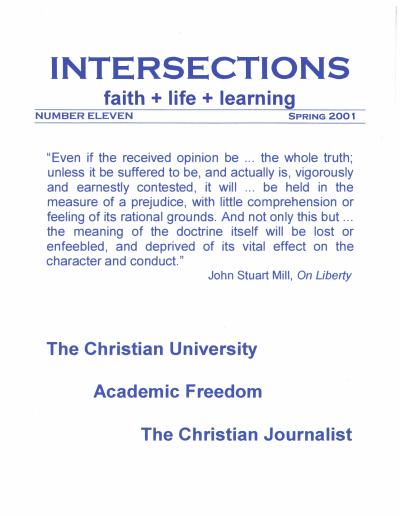 Editorial
From the Editor
Tom Christenson
Christenson explains that this issue “borrows everything from other sources”—Richard Hughes’s talk at Pepperdine president Andrew K. Benton’s inauguration, Nicholas Wolterstorff’s and Storm Bailey’s essays from the AAUP’s Academe, and Catherine McMullen’s Concordia talk—and defends the blatant borrowing as appropriate to faculty work, hoping new faculty will find in these pieces a corrective to common misconceptions about faith-related education and academic freedom.
-
Article
The Idea of a Christian University
Richard Hughes
Hughes’s lecture at the inauguration of Andrew K. Benton as the seventh president of Pepperdine argues that a Pepperdine-wide “strategy of community-wide conversation,” carried by the new Pepperdine University Center for Faith and Learning, can sustain the school as a Christian university by leaning into the paradox of Christian particularity rather than around it. Drawing on the incarnation, the Matthew 5 and Luke 14 teachings of Jesus, the Quaker and Cane Ridge (Joseph Thomas) abolition traditions, Galatians 2 and Romans 8, and Luther’s simul Justus et peccator as the gospel that frees the scholar to be wrong, to doubt, and to confess “Lord I believe; help thou mine unbelief,” he mines the Churches of Christ heritage—Alexander Campbell, Barton W. Stone, and John Rogers of Carlisle, Kentucky—as a unity-and-freedom tradition that grounds both diversity and academic freedom.
-
Article
Ivory Tower or Holy Mountain? Faith and Academic Freedom
Nicholas Wolterstorff
Wolterstorff defines infringement of academic freedom as impairing a faculty member’s standing on account of the ideological content of her position, argues that academic freedom (like free speech) is “duly qualified” rather than absolute, and offers eight considerations bearing on religiously based institutions: Weber’s differentiation of Wissenschaft, religious pluralism within a liberal polity, the vitality of American civil society, a decentralized educational system, the “holistic” character of much American religion, the post-Kuhnian collapse of classical foundationalism and of the “generically human” academy, the fact that ideas matter, and the personhood violated by infringement (the desecration of an image of God). He concludes that the private sector offers wider academic freedom than the public, that religious qualifications are not inherently inappropriate (any more than St. John’s Great Books commitment), but that religiously based colleges too often apply them unjustly—arbitrarily, secretly, without recourse—and that the AAUP’s best service is model codes of procedure.
-
Article
Uneasy Partners? Religion and Academics
Storm Bailey
Bailey, a philosopher at Luther College, takes up the reflex of describing church-related colleges as “pretty good in spite of the religion” and argues instead that religious commitment serves academic goals on three fronts: service as central academic purpose (Richard Hughes on Mennonite colleges in Models of Christian Higher Education), educational community (Plato’s dialogues, Parker Palmer, and Mark Schwehn’s Exiles from Eden), and integration of knowledge across disciplines against Nelson and Watt’s “entrepreneurial disciplinarity.” He then defends academic freedom on Christian grounds by drawing on Mill’s On Liberty argument from fallibilism, the centrality of epistemic weakness in the Christian tradition, and Wolterstorff’s claim that to infringe academic freedom is to desecrate an image of God—making personal and institutional religious commitment a foundation, not a foe, of the liberal academic ideal.
-
Article
Can a Christian Be a Journalist?
Catherine McMullen
McMullen recounts how Ernie Mancini’s alumni-program invitation forced her to articulate what a print-journalism major at Concordia might be, then surveys the annus horribilus of 1998—Chiquita and the Cincinnati Enquirer, CNN/Time’s retracted Tailwind story, Patricia Smith and Mike Barnicle fired at the Boston Globe, Stephen Glass at The New Republic, and Matt Drudge and the White House scandal—before contrasting Concordia’s liberal-arts approach with Pat Robertson’s Regent University, whose “Christian journalism” produces one-sided vampire-cult stories and graduates who conclude journalism is no place for a Christian. Drawing on Richard Baker’s The Christian as a Journalist, Tom Christenson on the “law of niceness,” Ernie Simmons, Harmon Smith and Louis Hodges on Christian ethics, Robert Benne’s Lutheran four orders and his “Christian cobbler makes good shoes, not poor shoes with little crosses on them,” Mel Mencher, Robert Bugeja, Walter Cronkite, Pete Hamill, Jeremy Iggers, David Remnick, the Northwestern Death Row exoneration of Dennis Williams, Verneal Jimerson, and William Rainge, and Pulitzer citations for Katherine Boo, Eric Newhouse, George Dohrman, and Mark Schoofs, she argues that journalism is a Lutheran vocation and that Christian cobblers—and Christian journalists—make good shoes.
-
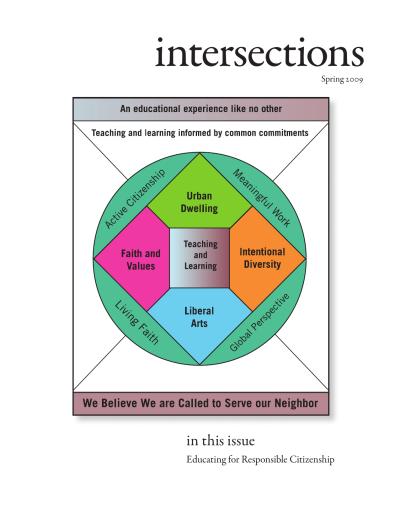 Article
From Alien to Citizen
Arne Selbyg
No. 29 · Spring 2009
Selbyg reflects on three experiences of being educated for citizenship—growing up in Norway under the legacy of Lutheran pastors and public school teachers who resisted the Nazi occupation, arriving in America as a resident alien, and becoming a naturalized American citizen—and proposes the jazz ensemble as a better metaphor for American society than the melting pot, one in which different citizens learn skills, study other instruments, and dialog with one another in service to the common music.
-
 Editorial
From the Publisher
Arne Selbyg
No. 27 · Spring 2008
Selbyg, retiring this summer as Director for ELCA Colleges and Universities, reflects on his decade serving as spokesperson between the church and its twenty-eight colleges and universities, and argues that the link between the colleges and the church has grown stronger over the last ten years — sustained by supportive church leaders like Presiding Bishop Mark Hanson, the annual Vocation of a Lutheran College conference, and a Lutheran theology of higher education whose principles (questioning authority, returning to the sources, including the excluded, serving the neighbor) remain a strong basis for operating colleges and universities in the twenty-first century.
-
 Editorial
From the Publisher
Arne Selbyg
No. 26 · Fall 2007
Selbyg notes that, while a stated purpose of Intersections over its twelve years and twenty-six issues has been the intersection of faith, learning, and teaching, surprisingly few articles have addressed how Lutheran faculty teach and why — and credits the editor for assembling essays from authors whose teaching has benefited from the ELCA Wittenberg Center, on the eve of the City of Wittenberg’s “Luther Decade” leading up to the 2017 Reformation anniversary.
-
 Editorial
From the Publisher
Arne Selbyg
No. 25 · Spring 2007
Selbyg notes that most papers in this issue grew out of a pan-Lutheran conference organized by the Association of Lutheran College Faculties in fall 2006 rather than the annual Vocation of a Lutheran College conference, and argues that the ELCA’s ecumenical posture—truthful but open to learning from others—is a good foundation for institutions of higher education whose faculty likewise profess while remaining subject to change based on new research and insights.
-
 Editorial
From the Publisher
Arne Selbyg
No. 24 · Fall 2006
Selbyg situates this issue in the ongoing ELCA conversation about education that began with the 2005 conference and is feeding into the second draft of the ELCA Social Statement on Education, previews the 2007 conference (“The Vocation of a Lutheran College — Engaging the World”) at Augustana College, Rock Island, and lifts up Luther’s insistence that the church and its members contribute to their wider communities rather than retreat into self-centered enclaves.
-
 Editorial
From the Publisher
Arne Selbyg
No. 23 · Summer 2006
Selbyg features articles based on presentations at the 2005 Vocation of a Lutheran College conference focused on the upcoming ELCA Social Statement on Education, and urges members of the ELCA higher-education community to download the first draft (“Our Calling in Education”) from the ELCA website and submit feedback to the Task Force on Education before the October 15 deadline. He worries that the sexuality social statement on a 2009 timeline will draw more attention than the education statement, but reminds readers that, for Martin Luther and for those who work in Lutheran higher education, education is as important as sex.
-
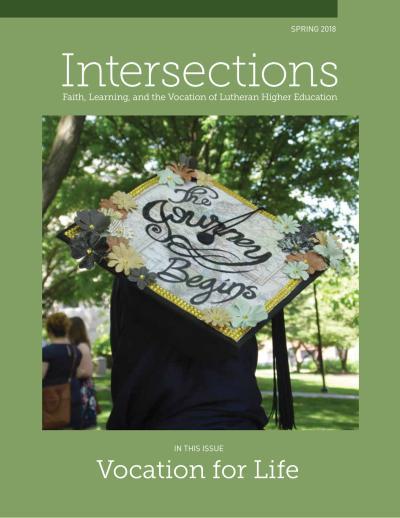 Article
Vocation for Emerging Adulthood: Within and Beyond College
Adam Copeland
No. 47 · Spring 2018
Copeland uses scenes from Master of None, David Brooks’ columns, Meg Jay’s The Defining Decade, and the stories of two ELCA college graduates to argue that emerging adulthood has fundamentally changed — and that Lutheran colleges should call out cultural lies about work, reframe vocation as meaning-making, and help graduates take small, wise steps into their twenties.
-
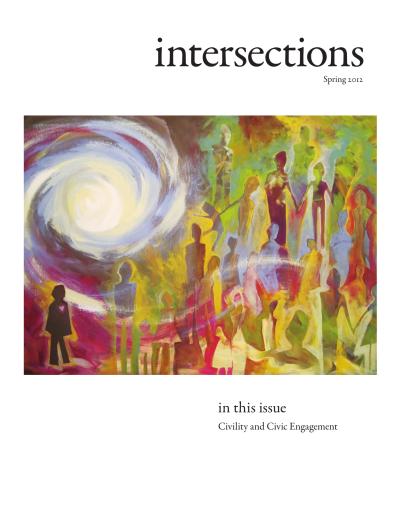 Article
Why Lutheran Colleges Need to Engage Civil Society
Ann M. Svennungsen
No. 35 · Spring 2012
Svennungsen makes the case that Lutheran colleges must engage the larger civil sphere, drawing on her work with The Presidents’ Pledge Against Global Poverty, Darrell Jodock’s seven fundamental experiences for vocational discernment, David Brooks on civility and modesty, and Michael Sandel’s argument that the affluent are seceding from public life. She urges Lutheran educators to invest in the infrastructure of civic renewal so that service-learning and civic engagement remain central to the Lutheran college curriculum.
-
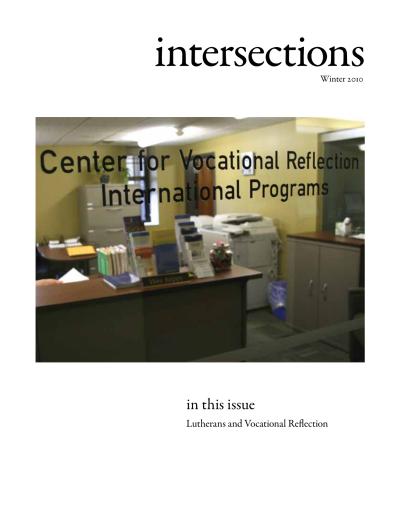 Editorial
From the Publisher
Mark Wilhelm
No. 31 · Winter 2010
Wilhelm traces his decades-long enthusiasm for the Lutheran doctrine of vocation from his St. Olaf days reading Luther’s Open Letter to the German Nobility, notes Parker Palmer’s lecture-circuit ministry and Mark C. Taylor’s reflections on calling, and argues that ELCA colleges should claim vocation as the defining mark of Lutheran higher education—yet warns that vocation risks becoming “the program du jour” rather than a permanent hallmark.
-
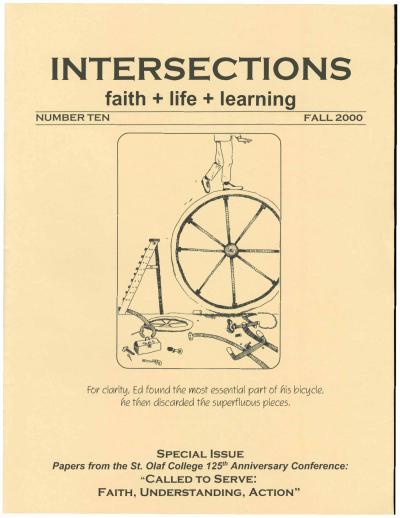 Article
Toward an Adequate Theology of Christian Higher Education
Robert Benne
No. 10 · Fall 2000
Drawing on his forthcoming Eerdmans volume Quality With Soul—Thriving Ventures in Christian Higher Education, which studies St. Olaf, Valparaiso, Notre Dame, Baylor, Wheaton, and Calvin, Benne argues that these schools have kept their souls because a critical mass of boards, administrators, faculty, and students treat the Christian account as comprehensive, unsurpassable, and central. He critiques four inadequate theologies of Christian higher education—pietism, liberal theology (Whitehead, Henry Nelson Weiman, the “values” turn, and accommodation to diversity and multiculturalism), “First Article” approaches (including Merrill Cunninggim’s Methodist version and a Lutheran two-kingdoms quietism), and reactionary/triumphalist theology—and contrasts the Catholic (Notre Dame), Reformed (Calvin, Wheaton, Baylor), and Lutheran (St. Olaf, Valpo) ways of relating faith and learning, calling Lutherans to recover “Christ and culture in paradox” as serious extended conversation rather than as a lazy excuse.
-
 Article
The Ought
Ned Wisnefske
No. 19 · Summer 2004
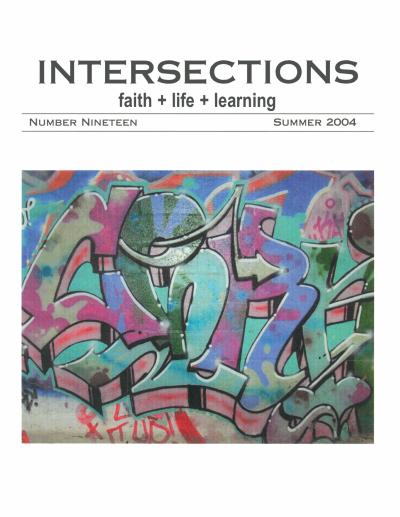
Wisnefske observes that students and faculty raise contradictory objections to moral education—that students are already morally formed, and that teachers must not form them—and argues that both share the same fear of “the Ought.” He proposes that the Ought is best encountered not in front of us but behind us, nudging us, as we exercise impartiality, sympathy, and free will and discover that the persons participating in moral inquiry deserve respect; the Ought can then reform our past formations and transform our wants, so that it is never too late, or a mistake, to be shaped by it.
-
Article
Cultivating Transformative Responsible Dialogue: Community of Moral Deliberation and Lutheran Higher Education
Per Anderson
No. 35 · Spring 2012
Anderson proposes that ELCA colleges and universities embrace a project of “transformative responsible dialogue” that advances the ELCA’s commitment to be a “community of moral deliberation” and answers the LIFT Report’s call for a culture of faithful discernment. Drawing on Michael Meyer’s “liberal civility,” Martha Nussbaum, Hans Jonas’s responsibility ethic, Patrick Keifert’s ecclesiology of strangers, and Kathryn Tanner on culture, he argues that liberal education at our schools can form students whose dialogue knits together civility, responsibility, and Christian openness to the other.