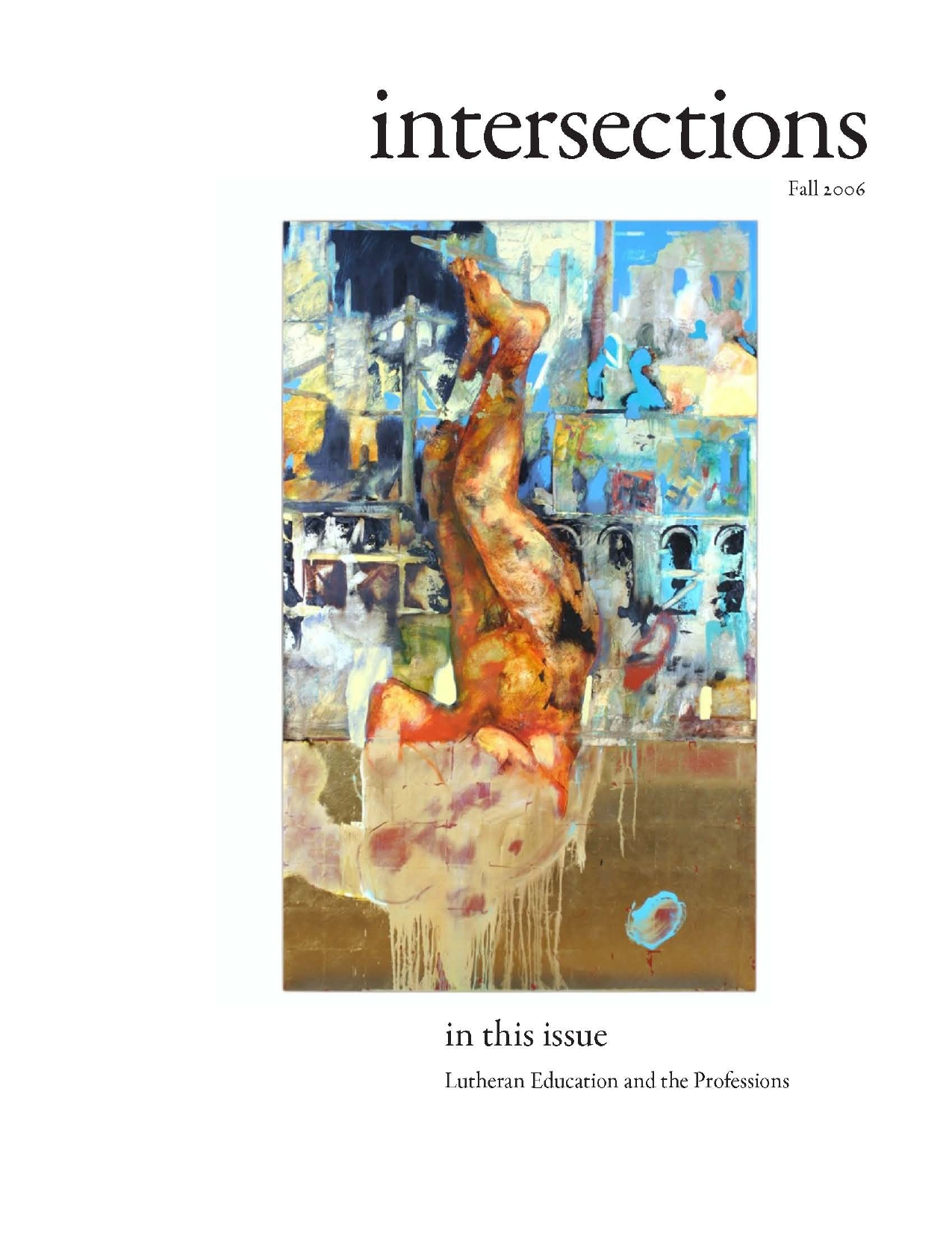
Liberal Learning and Professional Preparation
The Fall 2006 issue of Intersections, “Liberal Learning and Professional Preparation,” gathers papers from the 2006 Vocation of a Lutheran College conference at Midland. Stanley N. Olson asks whether Lutheran colleges draw contentment from being on Lutheran soil rather than from the work of vocation. Kathryn L. Johnson revisits Luther’s “Freedom of a Christian” as a paradigm for the freedom of a Lutheran college. Gail Summer and Lake Lambert argue the real divide is within, not between, liberal arts and professional preparation. Steven C. Bahls closes with a call for “philosopher-servants.”
Editors
Articles in this Issue
-
 Editorial
From the Publisher
Arne Selbyg
Selbyg situates this issue in the ongoing ELCA conversation about education that began with the 2005 conference and is feeding into the second draft of the ELCA Social Statement on Education, previews the 2007 conference (“The Vocation of a Lutheran College — Engaging the World”) at Augustana College, Rock Island, and lifts up Luther’s insistence that the church and its members contribute to their wider communities rather than retreat into self-centered enclaves.
-
Editorial
From the Editor
Robert D. Haak
Haak introduces the issue’s essays by Stanley N. Olson, Kathryn L. Johnson, Gail Summer, Lake Lambert, and Steven C. Bahls; argues that on Lutheran campuses, professional programs in business, education, and nursing are not “second-class citizens” but integral to the institution’s vocation; cites Olson’s mantra (“Because of Christ, the world; because of the world, vocation; because of vocation, education”); and thanks Matt Marohl for assisting with the editing.
-
Article
Vocation and the Vocation of a Lutheran College (Cows, Colleges and Contentment)
Stanley Olson
Drawing on a childhood image of contented cows on Lutheran-owned farmland in Northfield, Olson—Executive Director of the ELCA Vocation and Education unit—asks whether Lutheran colleges are content because they draw nourishment from the Lutheran tradition, or merely because they happen to be standing on Lutheran soil. He proposes the mantra “Because of Christ, the world; because of the world, vocation; because of vocation, education,” and traces what each clause demands of the colleges and universities of the ELCA.
-
Article
Freedom of a Christian-College: Looking through the Lens of Vocation
Kathryn L. Johnson
Johnson, Paul Tudor Jones Professor of Church History at Louisville Presbyterian Theological Seminary, re-reads Luther’s 1520 treatise The Freedom of a Christian as a paradigm for the “freedom of a Christian college” amid the pressures of professional preparation. She traces Luther’s paradoxical claim that a Christian is “a perfectly free lord of all, subject to none” and at the same time “a perfectly dutiful servant of all, subject to all,” and argues that the same dialectic frees a Lutheran college to engage the professions without being captured by them.
-
Article
Professional Education/Liberal Arts Education: Not a Case of Either-Or but Both-And
Gail Summer
Summer, Dean of Academic Programs at Lenoir-Rhyne College, traces the historical interweaving of liberal arts and professional education in American higher education (using the rise of engineering as a case study) and argues that the standard “either-or” framing of liberal arts versus professional preparation misreads both. At Lutheran colleges, the “both-and” relationship is shaped by a Lutheran understanding of vocation in which professional programs are integral to, not in tension with, the liberal arts.
-
Article
The Divide Within (Not Between) Liberal Arts and Professional Education
Lake Lambert
Lambert, then Board of Regents Chair in Ethics at Wartburg College and Project Director for the “Discovering and Claiming our Callings Initiative,” argues that the real divide in higher education runs not between the liberal arts and the professions but within each — between teaching that forms students for callings and teaching that merely transmits content or credential. He calls Lutheran colleges to recover, across both liberal arts and professional disciplines, a shared commitment to vocational formation grounded in the Lutheran tradition.
-
Article
Liberal Arts and Professional Education: A Call for Philosopher-Servants
Steven C. Bahls
Bahls, President of Augustana College (Rock Island), calls for a renewed commitment at Lutheran colleges to form “philosopher-servants” — graduates whose grounding in the liberal arts and the liberating gospel equips them for thoughtful service in business, education, nursing, and the other professions. Their impact, he argues, is “a good thing and a fact that we can be proud of as those who labor in Lutheran higher education.”